Cost to Develop an App Like ChatGPT: 2027 Price Guide


Create engaging, high-performance mobile applications tailored to your business needs. We craft future-ready apps that offer smooth user experiences on all devices.
Build robust and scalable websites and CMS platforms that help you manage content effortlessly. Our development ensures a seamless digital presence.
Launch secure, feature-rich online stores with intuitive shopping experiences. We build tailored eCommerce platforms designed for growth.
Design captivating games with immersive gameplay and stunning graphics. From concept to launch, we build engaging experiences that players love.
Enhance your customer relationships with customized Salesforce implementations. Drive growth and efficiency with smarter CRM solutions.
Harness artificial intelligence and machine learning to automate workflows and gain actionable insights. Our AI transforms data into smart decisions.
Accelerate your software delivery lifecycle with continuous integration, delivery, and infrastructure automation to boost efficiency.

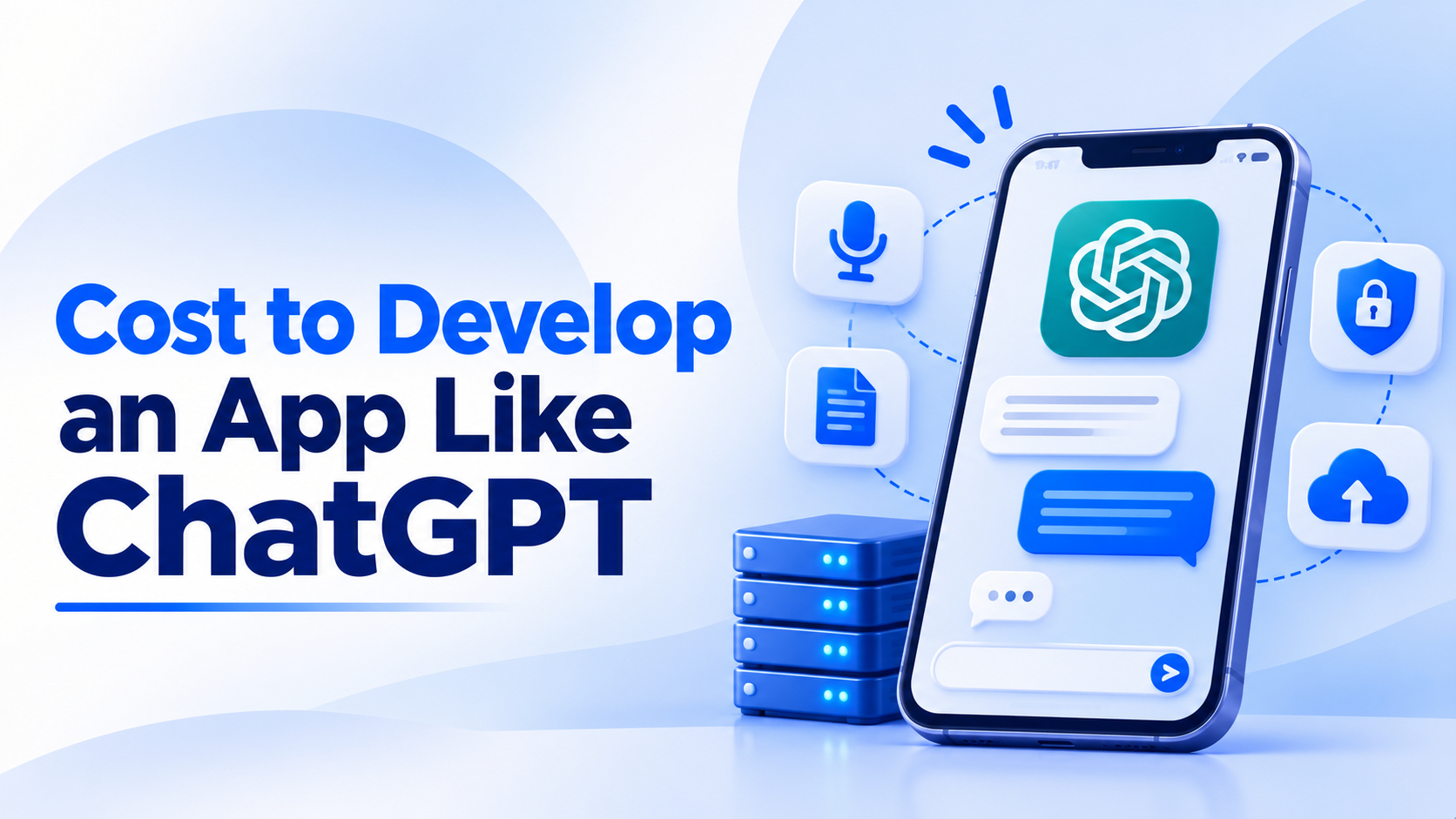
Quotes for a ChatGPT-style product swing from $40,000 to several million dollars. Both numbers can be correct, and that is exactly the problem.
The cost to develop an app like ChatGPT depends on one decision: are you building on top of a foundation model, or building one? An assistant powered by OpenAI, Anthropic, or Google APIs ships for $40,000 to $90,000. Add fine-tuning, retrieval, and compliance layers and you land between $90,000 and $250,000.
Training a model from scratch moves into seven figures and rarely makes sense outside research labs. Most funded startups sit in the middle tier, where spend goes into data pipelines, evaluation, and keeping answers accurate under real user load.
These ranges follow wider AI app development cost patterns, where model complexity sets the price far more than feature count.
Three layers sit under every conversational AI product, and they do not cost the same. The model layer carries the most risk and the most money. The application layer is where users form their opinion, and the infrastructure layer is what quietly bills you forever.
This is where your budget concentrates. If you use a hosted model through an API, you pay per token instead of paying for training. If you need domain accuracy, LLM fine tuning services add $20,000 to $60,000 on top, driven mostly by data preparation rather than compute.
Evaluation is the line item founders forget. You need a test set, scoring criteria, and regression checks before every release. Without that, generative AI development services turn into guesswork, and quality drifts with each model update.
Streaming responses, conversation threads, memory, file uploads, and prompt history look simple from outside. They are a serious engineering job. Token streaming alone demands careful state handling on both client and server.
Budget $15,000 to $40,000 here for a production-grade build. Teams investing in proper conversational AI development spend more on this layer than they expect, because retries, rate limits, and partial failures all need visible handling in the UI.
Vector databases, caching, queueing, observability, and logging all carry monthly costs that scale with usage. A product serving 10,000 daily conversations needs very different plumbing than an internal pilot with 50 users.
Expect $10,000 to $35,000 for initial setup. Choices around cloud computing decide how gracefully you handle traffic spikes, and a weak setup here surfaces as latency the moment you get press coverage.
Three build paths dominate this category, and each one answers a different business question. The right pick depends on whether you are testing demand, defending a niche, or owning the model itself. Here is how the cost to develop an app like ChatGPT splits across them.
| Build type | What you get | Typical cost | Timeline |
| API-based assistant | Hosted model, custom UI, basic memory | $40,000 to $90,000 | 10 to 14 weeks |
| Fine-tuned and RAG product | Domain knowledge, retrieval, guardrails | $90,000 to $250,000 | 4 to 7 months |
| Custom trained model | Owned weights, full control | $2 million and up | 12 months plus |
You call an existing model and build everything else around it. This is the fastest route to a live product and the lowest-risk way to validate demand. Most consumer AI apps launched in the last two years started here.
The tradeoff is dependency. Pricing, rate limits, and model behavior sit outside your control. If a provider deprecates a model version, you re-test everything. Teams comparing this against AI chatbot development cost for narrower use cases often find the gap smaller than expected.
Here you ground the model in your own content using retrieval, then tune tone and formatting for your domain. This is the sweet spot for legal, medical, financial, and support products where generic answers fail.
Costs rise because data work is real work. Chunking strategy, embedding choice, and reranking all affect answer quality. Proper RAG application development services include evaluation harnesses, not just a vector store and hope.
Training a foundation model yourself requires GPU clusters, a research team, and a dataset nobody else has. For almost every company reading this, it is the wrong call.
The narrow exception is a small specialist model trained on proprietary data where latency and unit economics matter at scale. That still needs mature machine learning development services and a clear answer to why an open-weight model cannot do the job.
Knowing the total helps less than knowing where it goes. Each stage below carries a predictable share of budget, and skipping any one of them shows up later as rework. Use these percentages to sanity-check any proposal you receive.
This stage defines use cases, success criteria, and the evaluation set your model gets measured against. One to two weeks of structured work prevents months of drift later. Teams define what a good answer looks like before a single prompt gets written.
Budget 8% to 12% of total cost here. Founders validating a narrow use case often pair this with MVP development so the first release tests one workflow properly instead of five workflows badly. Skipping discovery is the single most reliable way to overspend.
Collecting, cleaning, labeling, and structuring your knowledge base happens here, alongside embedding generation and retrieval tuning. For domain-specific products, this stage frequently takes longer than the application build itself.
Expect 20% to 30% of your budget. Teams with messy documentation pay more, because unstructured PDFs and inconsistent formatting slow everything down. Strong data science services matter more than raw model choice at this point, since retrieval quality caps how good your answers can get.
Frontend, backend, authentication, billing, conversation storage, and admin tooling get built in this stage. Streaming, error states, and response regeneration all need deliberate design rather than default behavior.
This absorbs 35% to 45% of total spend. Thoughtful UI/UX design earns its keep here, because trust in an AI product is built through clear sourcing, editable prompts, and honest failure messages. Rushed interfaces produce high install numbers and poor week-two retention.
AI products need two kinds of testing: standard QA plus model evaluation against your scoring set. Red-teaming for prompt injection and unsafe outputs belongs here too, not after launch.
Allocate 10% to 15%. Mature DevOps practice matters because model versions, prompts, and retrieval indexes all need versioning and rollback. Shipping without reproducible deployments means you cannot explain why last week’s answers were better than today’s.
Inference is the big one. Every conversation costs money, and heavy users cost far more than average users. A product with 5,000 daily active users can spend $3,000 to $15,000 monthly on model calls alone, depending on context length and model tier.
Then comes everything else. Vector database hosting, monitoring, and content moderation run $1,000 to $5,000 monthly at moderate scale.
Ongoing mobile app maintenance and support typically adds 15% to 20% of build cost annually, and AI products sit at the higher end because models get deprecated on vendor timelines, not yours.
Narrow the scope before you negotiate the price. One workflow executed well beats a general assistant that does everything acceptably, and it cuts both model spend and engineering hours. Most successful products in this space launched doing a single job.
Control token usage deliberately. Prompt caching, shorter context windows, and routing simple queries to cheaper models can cut inference bills by half.
On the delivery side, outsourcing software development to India remains the most common way founders stretch budget, with senior engineering rates running well below US equivalents.
Companies that hire AI developers on a dedicated model also avoid paying agency margin on long-running work.
Teams come to EngineerBabu when a conversational AI product has to survive its own traffic, not just demo well.
The approach is architecture first:
Work runs on a CMMI Level 5 process with senior engineers staying on the project, and the team was selected into the Google AI Accelerator. Services span AI development, full-stack engineering, cloud, and DevOps. Founders needing continuity after launch can hire dedicated development team capacity instead of restarting with a new vendor every quarter.
The cost to develop an app like ChatGPT is a function of ambition, not screen count. An API-backed assistant at $60,000 and a fine-tuned domain product at $200,000 can look identical in a screenshot and behave nothing alike under load.
Decide your model strategy first, then price the build around it. That order protects your budget better than any line-item negotiation.
Planning a conversational AI build? Talk to the EngineerBabu team about scoping your model strategy and budget.
An API-based assistant ships in 10 to 14 weeks. Fine-tuned products with retrieval and compliance layers usually need 4 to 7 months from discovery through launch.
Yes. Most commercial AI assistants run on hosted foundation models through APIs, adding retrieval and prompt engineering instead of training weights from scratch.
Expect $3,000 to $15,000 monthly at around 5,000 daily active users. Context length, model tier, and caching strategy drive most of that variation.
Sometimes. You trade per-token fees for GPU hosting and MLOps work, which usually pays off only above consistently high and predictable request volumes.
Only if the app answers from your own documents. Pure conversational assistants without grounded knowledge can launch without any retrieval infrastructure.
Most products use credit or message-based tiers, because flat unlimited pricing exposes you to heavy users whose inference costs exceed their subscription.