Insurance POSP App Development: Features, Cost, Compliance


Create engaging, high-performance mobile applications tailored to your business needs. We craft future-ready apps that offer smooth user experiences on all devices.
Build robust and scalable websites and CMS platforms that help you manage content effortlessly. Our development ensures a seamless digital presence.
Launch secure, feature-rich online stores with intuitive shopping experiences. We build tailored eCommerce platforms designed for growth.
Design captivating games with immersive gameplay and stunning graphics. From concept to launch, we build engaging experiences that players love.
Enhance your customer relationships with customized Salesforce implementations. Drive growth and efficiency with smarter CRM solutions.
Harness artificial intelligence and machine learning to automate workflows and gain actionable insights. Our AI transforms data into smart decisions.
Accelerate your software delivery lifecycle with continuous integration, delivery, and infrastructure automation to boost efficiency.

TL;DR
The point of sales person model turned insurance distribution in India into a mobile-first business. IRDAI’s latest annual report counts 27,18,487 POSPs operating across the country alongside 31.23 lakh individual agents, a network that reaches towns no branch network covers.
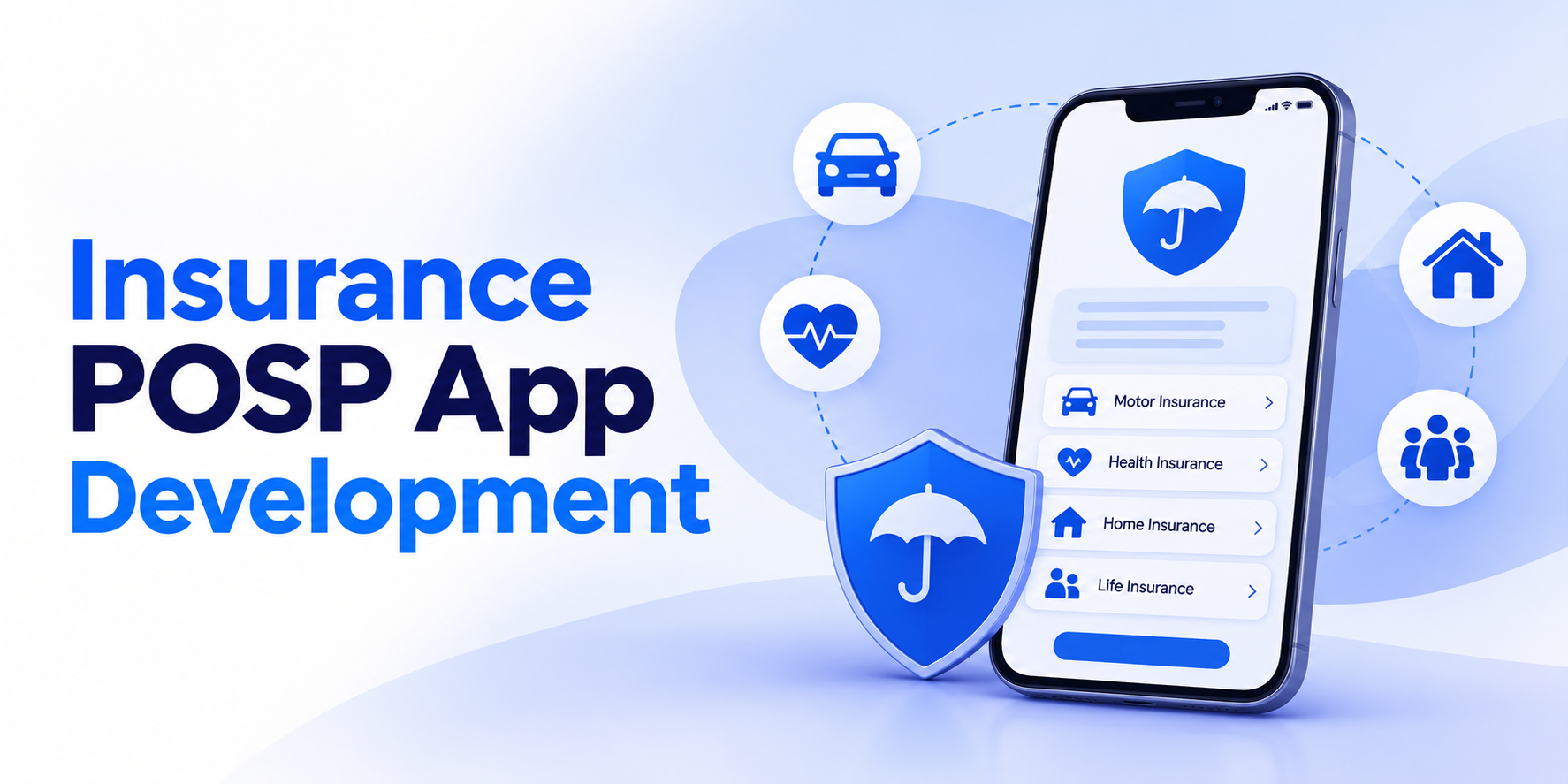
That scale only works through software. A POSP is not a full-time employee and rarely has a desktop. Insurance POSP app development exists to put onboarding, training, quoting, issuance, and earnings into one app that works on a mid-range Android phone with patchy data.
At minimum, four things. Onboard and certify a new POSP under IRDAI norms. Let that person compare quotes across insurers for permitted products. Issue a policy and collect payment. Calculate and pay commission accurately.
Everything else is enhancement. Teams that add leaderboards and chat before getting payouts right usually see churn they cannot explain.
POSPs need a minimum tenth-standard qualification and must complete the prescribed training hours before certification. Your app has to deliver that training, run the assessment, and store the completion record. Nothing about this can be skippable in the UI.
POSPs can only sell specified, pre-underwritten products where terms are standardized. Motor, personal accident, travel, and certain term and health plans typically qualify. The app must enforce this at the catalog level so a POSP cannot quote something outside scope.
Every POSP sits under one sponsoring insurer or intermediary. The system needs clean mapping, because duplicate or overlapping registrations create regulatory problems and commission disputes at the same time.
Training records, certification, sales logs, and payout history must be retrievable on demand. Build the audit trail as a first-class feature, not as a report you generate later under pressure.
Onboarding is where most apps lose people. The flow starts with mobile verification, then PAN and Aadhaar capture, bank account details, and educational proof.
Automate the verification steps instead of queuing documents for manual review, because a three-day wait kills activation.
Patterns from eKYC, eSign and bank verification flows apply almost directly here. Once verified, the POSP moves into training, completes the assessment, signs the agreement digitally, and receives a certificate. A well-built flow completes in under 48 hours, and the best ones finish same-day.
This is the daily loop, so it has to be fast. The POSP enters customer and risk details once, and the app returns comparable quotes from every mapped insurer. Keep the comparison honest, showing IDV, add-ons, and exclusions side by side rather than just premium.
After selection, the app collects documents, runs payment, and returns the policy PDF to both POSP and customer. Target under six minutes for a motor policy.
Routing logic matters here, and the thinking behind multi-lender routing in lending translates well to multi-insurer quoting.
Payout logic is the retention engine. Commission varies by insurer, product, and sometimes by campaign, and it changes mid-cycle. Build a rules-driven engine rather than hardcoded percentages.
Show the POSP an earnings ledger with each policy, the applicable rate, status, and expected credit date. Handle clawbacks on cancelled or refunded policies cleanly, because surprise deductions generate more support tickets than anything else.
Weekly or fortnightly settlement works better than monthly for this audience. Reconciliation against insurer statements should run automatically.
Build cross-platform unless you have a specific reason not to. React Native or Flutter covers the device range efficiently and keeps iteration fast, which matters because insurer integrations change often.
On the backend, treat each insurer connection as an isolated adapter behind a common interface. Insurers change APIs without much notice, and one broken integration should never take down quoting for the others. Queue policy issuance rather than handling it synchronously, so a slow insurer does not time out the user’s session.
Store documents in object storage with signed URLs and keep PII encrypted at field level. Compliance teams will ask about this, and retrofitting it is expensive. Field-level discipline from field force automation software development projects transfers directly.
A single-insurer POSP app with onboarding, quoting, issuance, and basic payouts runs roughly ₹18 to ₹35 lakh over four to six months.
A multi-insurer platform with a rules-based commission engine, training module, and admin console lands between ₹40 and ₹80 lakh across six to ten months. Add more for a web admin portal, analytics, and insurer-side reporting.
Integration count drives cost more than screen count. Each insurer typically adds three to five weeks, including their certification cycle. The pricing logic in insurance mobile app development projects follows the same pattern.
EngineerBabu builds distribution platforms for Indian financial services, covering agent onboarding, multi-partner integrations, commission engines, and compliance logging. The team has delivered comparable systems in lending, where DSA networks, payout accuracy, and regulatory audit trails carry identical requirements.
Work runs through a CMMI Level 5 process with senior engineers staying on the project, and spans everything from the POSP mobile app to the insurer-facing admin console. Broader insurance software development capability covers the rest of the stack as your network grows.
Scoping an insurance POSP app development project? Talk to the EngineerBabu team about your insurer mix and onboarding volume.
A successful insurance POSP app is more than a digital sales platform. It needs a compliant onboarding process, reliable insurer integrations, a seamless quote-to-policy journey, and a commission engine that agents can trust.
Getting these fundamentals right from the beginning makes it easier to onboard more POSPs, expand insurer partnerships, and scale distribution without operational bottlenecks.
With the right technology partner, you can build an insurance POSP platform that meets India’s regulatory requirements while delivering a better experience for agents and customers alike.
Yes, if the sponsoring intermediary holds the relevant insurer tie-ups. The POSP remains mapped to one sponsor, while the sponsor’s platform routes quotes across several insurers.
You need to be a registered insurer or intermediary, or build the app for one. The platform itself is not licensed, but the entity recruiting POSPs must be.
Same-day is achievable when KYC verification is automated and training is self-paced. Manual document review typically stretches it to three or four days, which hurts activation rates badly.
Partially. Lead capture, saved quotes, and training content can work offline. Policy issuance and payment always require connectivity, since they depend on live insurer and gateway responses.
A POSP sells only standardized, pre-underwritten products after shorter prescribed training. A licensed agent completes fuller certification and can sell a wider product range, including underwritten policies.