How to Build an App Like Instawork: Marketplace, Trust & Cost (USA)


Create engaging, high-performance mobile applications tailored to your business needs. We craft future-ready apps that offer smooth user experiences on all devices.
Build robust and scalable websites and CMS platforms that help you manage content effortlessly. Our development ensures a seamless digital presence.
Launch secure, feature-rich online stores with intuitive shopping experiences. We build tailored eCommerce platforms designed for growth.
Design captivating games with immersive gameplay and stunning graphics. From concept to launch, we build engaging experiences that players love.
Enhance your customer relationships with customized Salesforce implementations. Drive growth and efficiency with smarter CRM solutions.
Harness artificial intelligence and machine learning to automate workflows and gain actionable insights. Our AI transforms data into smart decisions.
Accelerate your software delivery lifecycle with continuous integration, delivery, and infrastructure automation to boost efficiency.

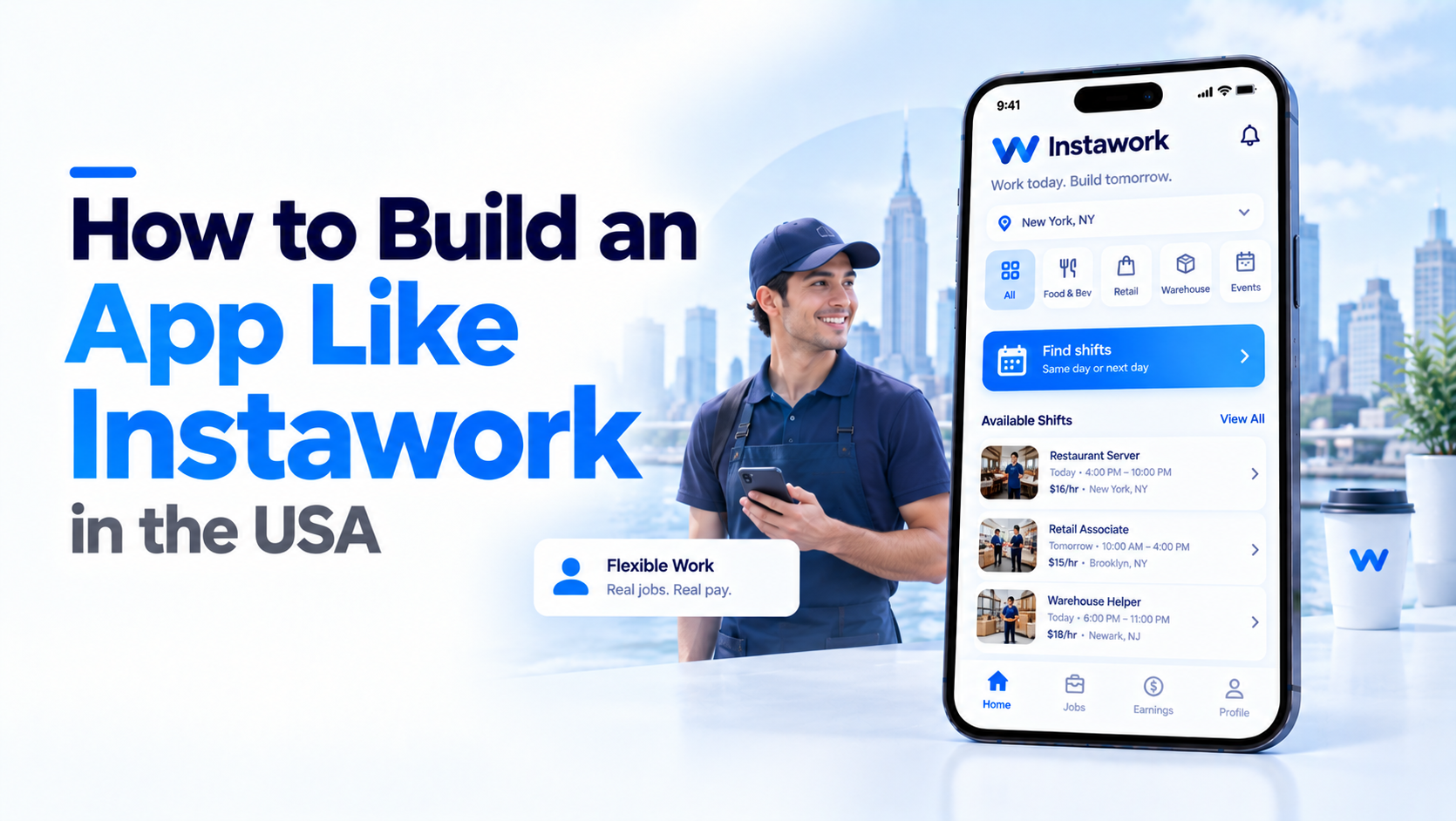
A restaurant manager in Chicago loses a line cook at 4 p.m. on a Friday. Dinner service starts at 5. No recruiter is going to fix that.
An app that puts a verified, qualified cook in that kitchen within the hour is solving a different problem than hiring software. That gap is why founders want to build an app like Instawork.
The model looks simple from the outside. Businesses post shifts, workers claim them, the platform takes a cut. Underneath, it is a logistics problem wrapped in a trust problem wrapped in a payments problem. Here is what actually goes into building one.
US staffing revenue grew 3.3% year over year in the second quarter of 2026, the first year-to-year growth the American Staffing Association has recorded since late 2022.
Flat overall growth is not bad news here. Demand is shifting from long contracts toward short, flexible commitments, which is exactly the slice a shift marketplace serves. Hospitality, warehousing, events, and retail all need coverage by the hour, not the quarter.
Traditional agencies price that work at 40% to 60% markups with phone-based dispatch. That spread is what makes it worth building an app like Instawork rather than another staffing agency.
Three groups use the product, and they want contradictory things.
Every feature decision should name which of these three it serves. Teams that build an app like Instawork without ops tooling end up running a marketplace through Slack and spreadsheets.
Pick a metro and a single vertical, usually hospitality or warehousing. Both have high turnover, hourly pay, and urgent coverage gaps.
Recruit worker supply manually before launch. A hundred verified, active workers in one city beats five thousand signups spread across twelve states. The first version of a marketplace runs on operator effort, not automation. Founders who try to build an app like Instawork nationally from day one end up with empty shifts in every market.
Build only what moves one shift from posted to paid. Business posts, worker claims, worker clocks in, hours get approved, worker gets paid, business gets invoiced.
Skip ratings, skip recommendations, skip analytics. Run that loop for sixty to ninety days with real customers and fix what breaks. The lessons here mirror what any team learns when they build an online service marketplace: liquidity beats feature depth every time.
Now add the pieces that reduce human intervention. Automated identity and document verification, credential expiry alerts, reliability scores, and no-show penalties.
Add backfill logic that re-offers a dropped shift to ranked alternates within minutes. This is the step that lets one ops person cover hundreds of shifts instead of dozens. Dispatch and tracking patterns here overlap heavily with how teams build an app like Uber for real-time assignment.
Add a second city only when your first one fills shifts without manual rescue. Then expand verticals inside your existing worker base, since a warehouse worker often accepts event and retail shifts too.
Regulated verticals come last. Healthcare shifts need licensure checks and facility credentialing, which is why per diem nurse scheduling software development is a separate build rather than a toggle on your existing app.
A shift marketplace fails in a specific way. A business posts a Friday night shift, nobody claims it, and that business never posts again.
Protect against that with three mechanics. Keep a reliable core of workers you contact directly for high-risk shifts. Cap how many shifts you accept in a region based on actual supply. Track fill rate and time-to-fill as your primary health metrics, above GMV.
Most founders measuring revenue early miss the signal. Fill rate tells you whether the product works.
Worker classification decides your architecture. W-2 models require payroll tax handling, workers’ compensation, and state wage compliance. 1099 models shift that burden but limit how much you can direct the work, which affects scheduling and performance controls.
Many US shift platforms run W-2 for exactly this reason. Build for that assumption unless counsel tells you otherwise.
Also plan for I-9 verification, state overtime and break rules, and predictive scheduling ordinances in cities like Seattle, San Francisco, and New York. Those laws dictate advance-notice windows and penalty pay, which means they are product logic, not legal footnotes.
| Build stage | Scope | Timeline | Indicative cost |
| MVP | Shift loop, worker and business apps, basic verification, payouts | 4 to 5 months | $45,000 to $75,000 |
| V1 | Matching engine, reliability scoring, backfill, ops console | 3 to 4 months | $40,000 to $70,000 |
| Scale | Multi-city, multi-vertical, advanced compliance, analytics | 5 to 7 months | $60,000 to $110,000 |
Three things push the number up: background check integrations, payroll and same-day payout infrastructure, and regulated verticals. A single codebase across iOS and Android keeps costs down early, so the native vs cross platform development decision matters more here than in most apps. For US-specific benchmarks, the mobile app development cost in USA breakdown gives a reliable range.
To build an app like Instawork, you need marketplace engineering, payment infrastructure, and compliance workflows handled together. Those three usually sit with three different vendors, which is where timelines slip.
EngineerBabu builds all three in one team, with CMMI Level 5 delivery and senior engineers staying through launch. Founders validating the model first often start with a scoped build through an MVP app development company in the USA approach before committing to multi-city infrastructure.
A single-city MVP with the full shift loop typically costs $45,000 to $75,000. A market-ready platform with matching, reliability scoring, and compliance workflows generally runs $100,000 to $180,000 depending on verticals and payout speed.
Four to five months for an MVP, and nine to twelve months for a multi-vertical platform. Background check and payment integrations usually set the real timeline, not app development.
Most US shift platforms use W-2 because it allows direct control over scheduling, training, and performance standards. The choice affects payroll architecture, so decide with counsel before development begins.
Fill rate, followed by time-to-fill and rebooking rate. Revenue follows those numbers. A high GMV with a 70% fill rate signals a business that churns clients quietly.
Manual recruiting through local job groups, community organizations, and referral bonuses. Guarantee shift availability for early workers, even if you subsidize some of it. Supply density is worth the early cost.
Technically yes, practically no. Each metro needs its own supply base, local wage rules, and operational coverage. Sequential launches with proven fill rates scale far better than simultaneous ones.