How to Build an App Like Pocket FM: Coin Economy, Features, and Cost


Create engaging, high-performance mobile applications tailored to your business needs. We craft future-ready apps that offer smooth user experiences on all devices.
Build robust and scalable websites and CMS platforms that help you manage content effortlessly. Our development ensures a seamless digital presence.
Launch secure, feature-rich online stores with intuitive shopping experiences. We build tailored eCommerce platforms designed for growth.
Design captivating games with immersive gameplay and stunning graphics. From concept to launch, we build engaging experiences that players love.
Enhance your customer relationships with customized Salesforce implementations. Drive growth and efficiency with smarter CRM solutions.
Harness artificial intelligence and machine learning to automate workflows and gain actionable insights. Our AI transforms data into smart decisions.
Accelerate your software delivery lifecycle with continuous integration, delivery, and infrastructure automation to boost efficiency.
Hire app developers ready to turn your ideas into sleek, high-performing mobile apps for any platform.
Bring in frontend pros who craft smooth, beautiful, and user-friendly interfaces that your visitors will love.
Get backend developers who build fast, secure, and reliable systems to keep everything running behind the scenes.
Hire eCommerce developers who build secure, scalable online stores designed to offer seamless shopping and grow your sales.
Get dedicated developers committed to your projects, delivering consistent quality and speed as an extension of your team.
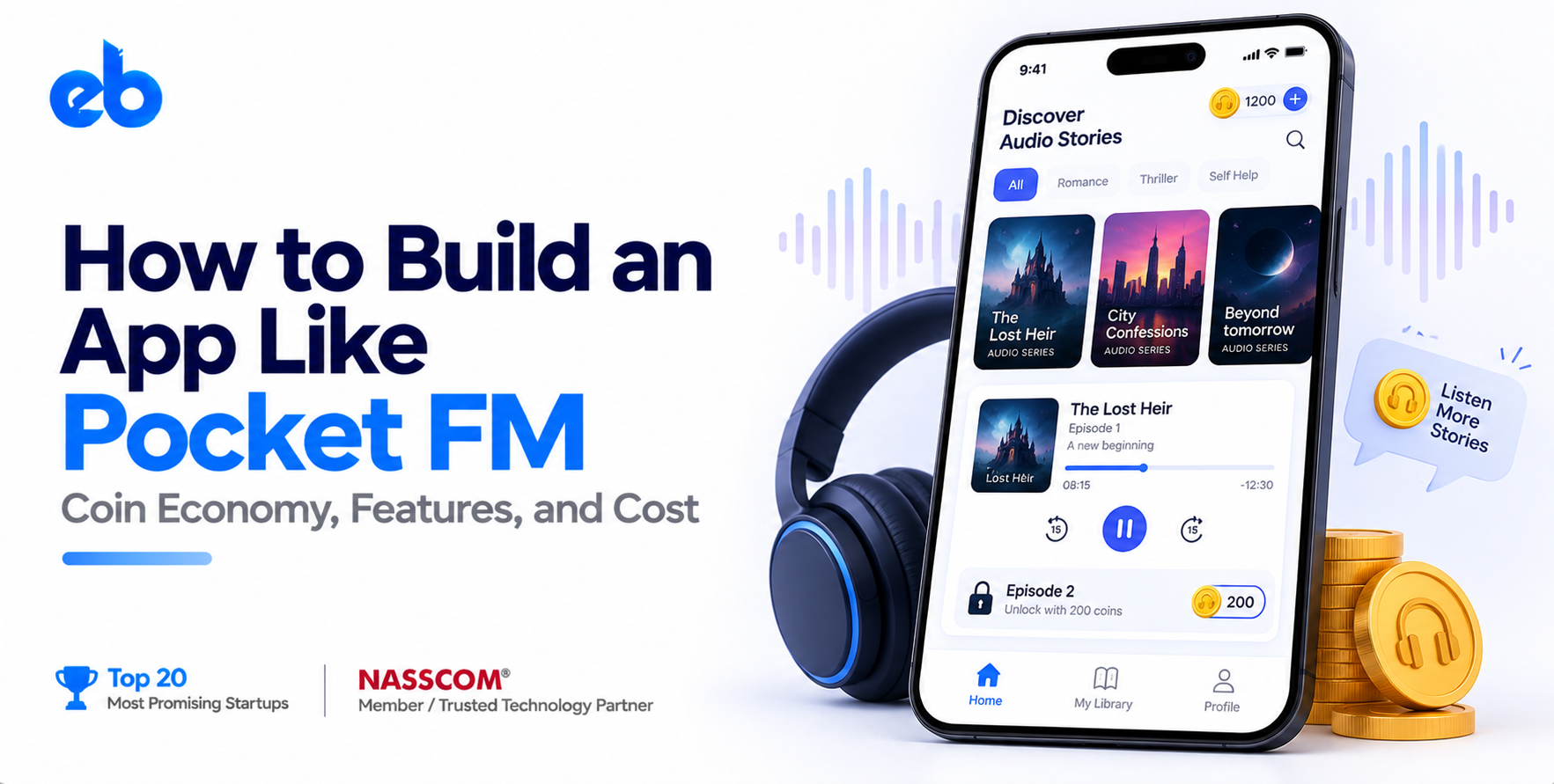
The Cliffhanger Is Not a Writing Choice. It Is the Pricing Model. Every episode ends mid-scene for a reason. That moment is where a listener decides to spend money or walk away.
Forbes estimates Pocket FM pulled in roughly $400 million in topline revenue over the past year, with more than 2.5 million paying customers averaging around 150 minutes a day, in its report on the platform. Its biggest series runs past 4,000 episodes.
That changes what it means to build an app like Pocket FM. You are not shipping an audio player with a subscription bolted on. You are shipping a virtual economy that happens to play audio.
Three mechanics carry the entire model.
Subscriptions reward broad catalogs. Microtransactions reward one obsessive series that a listener cannot put down. That difference drives every architectural decision ahead.
Treat coins like a Stripe plan and you will be rebuilding within six months.
Build a double-entry ledger where every coin issuance, spend, bonus, refund, and expiry is an immutable record. Balances get derived, never edited. This matters the first time a user disputes a charge or a promotion misfires across 40,000 accounts.
Then plan for pricing variation. Episode prices differ by series, position in the series, market, and user segment. Early episodes cost less. Later episodes, where intent is proven, cost more.
Bonus coins need separate accounting from purchased coins, since tax treatment and refund obligations differ. Coin systems also attract abuse through promo farming and refund exploits, so the fraud controls in a web application security checklist apply directly to your wallet endpoints.
Store billing adds the last wrinkle. Apple and Google take a cut of every coin pack, which must sit in your unit economics before you set prices.
Pocket FM did not curate its way to scale. It opened the gates to hundreds of thousands of first-time writers and let performance data pick winners.
That means your creator side is a product, not an admin panel. Writers need submission tools, episode scheduling, performance dashboards, and transparent revenue share. Narration needs either a voice-actor pipeline or AI voice generation at scale.
AI changed the math here. Script assistance and synthetic narration cut cost per episode enough that a platform can afford thousands of experiments. Teams evaluating generative AI development for voice and script tooling usually find it reshapes the content budget more than the engineering budget.
The structure resembles a two-sided marketplace more than a media library. Supply quality rises only after volume creates competition.
Moderation deserves real investment. Open creator platforms attract copied manuscripts, and one infringement claim can threaten an entire catalog.
| Layer | Practical choice |
| Mobile | Kotlin and Swift for playback depth, Flutter where speed matters more |
| Backend | Go or Node.js for APIs, dedicated service for the coin ledger |
| Streaming | HLS with adaptive bitrate, CDN with edge caching per region |
| Database | PostgreSQL for ledger and catalog, Redis for quotas and sessions |
| Events | Kafka or Kinesis for playback and unlock events |
| Analytics | ClickHouse or BigQuery for episode-level funnel analysis |
| Payments | Store billing for coins, Stripe or Razorpay for web top-ups |
Background audio and notification behavior differ enough across platforms that native code often wins. Where the budget is tight, the tradeoffs in cross-platform app development savings are worth modeling before committing to two codebases.
Also Read: How to Build an App Like Audible
Decide your free quota, coin pack prices, and per-episode costs first. These numbers determine whether the business works at all.
Model a listener who consumes 40 episodes. What do they spend, what does the store take, and what goes to the creator? Run that math before design starts.
Then set your unlock curve. Free early episodes build investment, while later episodes carry higher prices. Getting this wrong means either weak conversion or listeners who quit at episode five.
Start with the ledger. Every transaction gets recorded as an entry, with balances calculated from history rather than stored as a number.
Next comes the entitlement check that answers whether this account can play this episode right now. Free quota, purchased unlocks, rewarded ad credits, and promotions all feed one answer.
Keep this service independent of the player. Web, Android, and iOS must produce identical results, because inconsistent unlock states generate support tickets faster than any other bug.
Listeners stay in the app for over two hours daily, so playback stability outranks visual polish.
Transcode each episode to several bitrates, serve through a CDN near your audience, and switch quality without stopping audio. Store playback position as events so progress survives crashes and device switches.
Test memory and battery behavior across multi-hour sessions. Android audio handling varies widely by manufacturer, which is where well-chosen Android libraries prevent a long tail of device-specific playback bugs.
Build the ingestion path early, since your catalog must grow weekly without engineering help.
Creators need script upload, AI or human narration selection, automated quality checks, and scheduled publishing. Add a review queue that flags plagiarism, explicit content, and metadata problems before release.
Payouts need equal attention. Track unlocks per episode, calculate revenue share, and handle multi-country payments with tax documentation. Writers leave platforms over payment delays faster than over low rates.
Standard app analytics will not run this business. You need per-episode drop-off curves, unlock conversion by position, and coin balance behavior over time.
Track where listeners abandon a series, which cliffhangers convert, and how price changes affect completion. Then feed those signals back to creators so future episodes improve.
Recommendation quality compounds this. Surfacing the next series before a listener finishes the current one is where AI-powered app experiences protect retention and repeat spending.
Ship with 15 to 20 complete series rather than 200 partial ones. Listeners who hit an unfinished series usually do not return.
Pick one genre with proven demand, such as romance, thriller, or fantasy. Launch in one market with one currency and one coin pack structure.
Watch three numbers for six weeks: day-seven retention, first-purchase conversion, and coins spent per paying user. Expand only when those hold steady, since scaling weak economics simply loses money faster.
Subscription apps measure churn monthly. Coin apps measure it per episode.
Acquisition cost also shapes design. If paid marketing drives installs, your first-session experience must convert quickly, or spending outruns revenue.
Related: How to Build an App Like Kuku FM
| Scope | What you get | Estimated cost |
| MVP | One market, coin wallet, free quota, basic player, manual content upload | $30,000 to $55,000 |
| Growth build | Creator portal, dynamic pricing, rewarded ads, recommendations, web app | $65,000 to $110,000 |
| Full platform | AI narration pipeline, multi-market pricing, payout engine, analytics warehouse | $120,000 to $190,000+ |
Content and marketing sit outside these figures and usually dominate the budget. Episode production and user acquisition routinely exceed build cost within the first year.
Scope discipline matters more than rate negotiation here, though the levers in reducing app development costs help once requirements are locked. For a broader picture of what shapes the number, this breakdown of app development cost covers the variables in detail.
An MVP takes 14 to 18 weeks. The wallet and entitlement service consume more of that than the player does.
A full platform with creator tooling and AI narration runs seven to nine months. Content production should start during development, so launch day has depth rather than a promising empty shelf.
Traffic spikes from a hit series expose weak foundations quickly, so building scalable custom apps from the start avoids emergency rewrites during your best week.
Teams that build an app like Pocket FM need three capabilities in one team: ledger-grade transaction engineering, streaming infrastructure, and a creator platform with payouts attached.
EngineerBabu covers that combination, with CMMI Level 5 process and senior engineers who stay involved past kickoff. For founders testing the economics first, MVP development gets a single-market version live before the full platform investment.
The technical patterns to build an app like Pocket FM are established. Wallets, streaming, and entitlement checks all have known solutions.
What is not established is your economy. Free quota, coin pricing, and paywall placement decide whether listeners convert or uninstall. Model those numbers before writing code, then let real behavior correct them.
Ready to scope your build?
Talk to the EngineerBabu team about your audio series platform.
An MVP runs $30,000 to $55,000. A full platform with creator tooling, AI narration, and multi-market pricing typically reaches $120,000 to $190,000, excluding content and marketing.
Roughly 14 to 18 weeks for an MVP and seven to nine months for a full platform. The coin ledger and entitlement service drive most of that timeline.
Coins separate price from real currency, which makes each unlock feel small. They also let listeners pay only for series they love rather than an entire catalog.
Start with 15 to 20 complete series in one genre. Commission scripts directly, then open a creator program once listener data shows which formats perform.
For high-volume catalog production, largely yes. Flagship series still benefit from human performance, since narrator quality measurably affects completion rates.
Price rises with position in the series. Early episodes stay cheap or free to build investment, while later episodes carry higher prices once listener intent is proven.