App Development Cost by Industry: A 2026 Comparison Table


Create engaging, high-performance mobile applications tailored to your business needs. We craft future-ready apps that offer smooth user experiences on all devices.
Build robust and scalable websites and CMS platforms that help you manage content effortlessly. Our development ensures a seamless digital presence.
Launch secure, feature-rich online stores with intuitive shopping experiences. We build tailored eCommerce platforms designed for growth.
Design captivating games with immersive gameplay and stunning graphics. From concept to launch, we build engaging experiences that players love.
Enhance your customer relationships with customized Salesforce implementations. Drive growth and efficiency with smarter CRM solutions.
Harness artificial intelligence and machine learning to automate workflows and gain actionable insights. Our AI transforms data into smart decisions.
Accelerate your software delivery lifecycle with continuous integration, delivery, and infrastructure automation to boost efficiency.
Hire app developers ready to turn your ideas into sleek, high-performing mobile apps for any platform.
Bring in frontend pros who craft smooth, beautiful, and user-friendly interfaces that your visitors will love.
Get backend developers who build fast, secure, and reliable systems to keep everything running behind the scenes.
Hire eCommerce developers who build secure, scalable online stores designed to offer seamless shopping and grow your sales.
Get dedicated developers committed to your projects, delivering consistent quality and speed as an extension of your team.
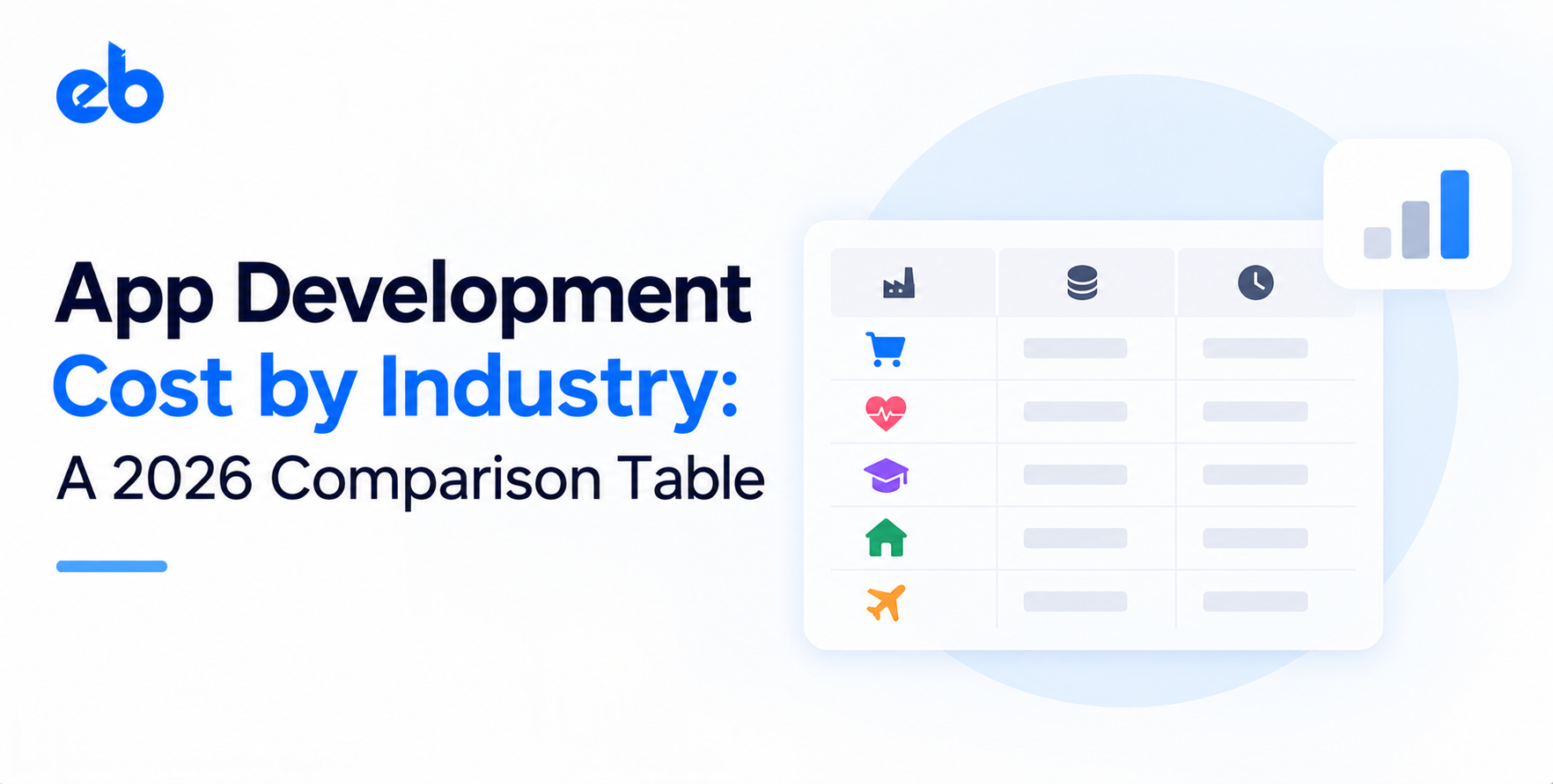
App development cost by industry in 2026 ranges from $55,000 to $300,000 or more for a production build. Lightly regulated sectors such as retail, edtech, travel, and proptech land between $55,000 and $200,000.
Regulated sectors such as fintech and healthcare run $80,000 to $300,000 or more. MVPs across every sector fall between $25,000 and $80,000.
Feature count is not what separates those numbers. Three variables do: how much compliance work the sector requires, how many third-party systems the app must integrate with, and how expensive a single failure is for the user.
A retail loyalty app and a consumer lending app can share an identical wireframe and still be $60,000 apart.
This guide breaks down app development cost by industry across 10 sectors. You get an MVP range, a production range, a realistic timeline, and the specific cost driver for each one, plus the phase-by-phase budget split that holds true no matter which industry you are in.
These figures assume a blended team of $30 to $60 per hour, which is typical for an offshore or hybrid model. A US-based agency at $150 to $250 per hour will roughly double them.
| Industry | MVP range | Production build | Timeline | Biggest cost driver |
| Fintech and lending | $45,000 – $80,000 | $90,000 – $300,000+ | 6 – 12 months | KYC, credit bureau calls, audit trails |
| Healthcare and telehealth | $40,000 – $75,000 | $80,000 – $250,000 | 6 – 11 months | HIPAA controls, EHR and FHIR work |
| SaaS and B2B platforms | $35,000 – $70,000 | $80,000 – $250,000 | 6 – 12 months | Multi-tenancy, roles, billing logic |
| On-demand and logistics | $35,000 – $65,000 | $75,000 – $220,000 | 5 – 10 months | Live tracking plus three separate apps |
| Social and media | $30,000 – $55,000 | $70,000 – $250,000 | 5 – 10 months | Feed infrastructure, storage, moderation |
| eCommerce and retail | $30,000 – $60,000 | $70,000 – $200,000 | 4 – 9 months | Catalog scale, payments, ERP sync |
| EdTech and eLearning | $30,000 – $55,000 | $60,000 – $180,000 | 4 – 9 months | Video delivery, authoring tools |
| Travel and hospitality | $30,000 – $60,000 | $65,000 – $180,000 | 5 – 9 months | Booking engines, cancellation rules |
| Manufacturing and inventory | $30,000 – $55,000 | $60,000 – $160,000 | 5 – 9 months | Barcode or IoT input, offline sync |
| Real estate and proptech | $25,000 – $50,000 | $55,000 – $150,000 | 4 – 8 months | Listing feeds, heavy media handling |
Read the MVP column first. Most teams should be pricing that number rather than the production one.
One more thing about app development cost by industry: the ranges overlap. A simple fintech app can cost less than an ambitious retail one.
Three things separate a $60,000 build from a $220,000 one, and none of them are visible in a wireframe. Understand these and app development cost by industry stops looking arbitrary.
GoodFirms research drawn from 267 app development companies found that compliance, security, and data protection requirements in regulated sectors raise budgets by 30% to 50% (GoodFirms, 2026).
That premium buys encryption at rest and in transit, immutable audit logs, role-based access control, consent capture, and a pre-launch security review. It is the single largest reason app development cost by industry splits the way it does. A fintech app carries all of it. A furniture catalog app carries almost none.
Retail apps talk to Stripe and a shipping API. Lending apps talk to credit bureaus, KYC vendors, bank aggregators, and ACH rails. Each one brings its own sandbox, error codes, and approval queue. Careful API Development work on those connections often runs 20% to 30% of a regulated build.
A crashed loyalty app loses a coupon redemption. A crashed remote monitoring app loses a vital sign reading. That difference shows up as more QA hours, staging environments, and monitoring, and it is a real part of app development cost by industry.
Here is what drives the number inside each sector, and where the budget usually goes sideways.
Fintech carries the heaviest compliance load of any sector. Underwriting logic, disbursement, collections, and dispute handling each need their own workflows and audit trail.
Expect $12,000 to $30,000 for KYC and bureau integrations alone, before a single underwriting rule gets written. Nothing else in app development cost by industry starts that high. Anything touching card data adds PCI DSS scope.
Teams that hire a specialist fintech app development company usually spend less overall, because the regulatory rework is where budgets die.
For Healthcare app development, HIPAA is the baseline, not the finish line. A US telehealth build needs signed BAAs, PHI segregation, and audit logging on every record view.
Interoperability is the real budget swing. A standalone symptom tracker is cheap. The same app with Epic or Cerner integration through FHIR adds $25,000 to $60,000 and months of sandbox approvals. Video consults and e-prescribing each bring their own vendor contracts.
Nothing here is regulated, yet the architecture is unforgiving. Multi-tenancy, permissions, usage metering, and subscription billing must be right on day one. Retrofitting any of them means rewriting the data layer.
Admin tooling is the line founders forget. Internal dashboards, impersonation, and support views routinely add 15%.
You are not building one app. You are building a customer app, a provider app, and a dispatch console, plus the routing engine underneath.
Live location tracking sounds simple and is not. Battery-efficient background updates, offline queuing, and geofencing take real engineering time. Surge pricing or automated matching pushes you into ML Development territory, which adds 20% to 40% on top.
Retail app development is the most predictable to budget, which is why quotes cluster tightly. Catalog, cart, checkout, and order tracking are well-trodden ground.
Costs climb with scale rather than complexity. A 200-product store is straightforward. A 200,000-SKU catalog with variant pricing, real-time inventory, and ERP sync is a different project. Recommendation engines built through AI Development add $15,000 to $50,000 depending on data maturity.
Course delivery is cheap. Video is not. Adaptive streaming, DRM, and CDN bandwidth are ongoing operational costs, not one-time build items.
Instructor-side tooling is the hidden half of the budget. Authoring, grading, cohort management, and analytics often cost as much as the student app. It is worth reviewing how established edtech app development companies scope that admin layer before you sign anything.
The phase split barely moves between sectors, even when totals differ wildly. However far apart your app development cost by industry ranges sit, this distribution should hold. Use it to sanity-check any quote.
| Phase | Share of budget | What it covers |
| Discovery and planning | 8 – 12% | Scope, flows, architecture decisions |
| UI/UX design | 12 – 18% | Wireframes, prototypes, design system |
| Frontend development | 22 – 30% | Screens, state, device handling |
| Backend and integrations | 28 – 35% | APIs, database, third-party services |
| QA and security testing | 10 – 15% | Functional, regression, penetration testing |
| Deployment and launch | 5 – 8% | Store submission, monitoring, CI/CD |
If a vendor quotes you 5% for QA on a healthcare app, that is not a discount. That is a deferred invoice.
Start from the table above and pick your sector’s MVP range. Industry averages that blend fintech with real estate are useless for planning, because the compliance load is what separates them. Write down the range, then list every regulation that applies to you: HIPAA, PCI DSS, GDPR, RBI guidelines, SOC 2.
Each one you can honestly cross out moves you toward the lower bound. Each one that stays adds engineering hours you cannot negotiate away later, and it is why app development cost by industry beats any blended benchmark.
List every external system your app must talk to on day one. Payment gateway, identity verification, credit bureau, EHR, ERP, mapping, messaging, analytics. Budget 40 to 120 engineering hours per integration, plus vendor onboarding time you do not control. Two integrations is a normal build.
Eight is a systems project wearing an app costume. This single count explains more quote variance than feature lists do, so get it on paper before you ask anyone for pricing.
Take your feature list and mark each item as needed for the first paying user or not. Most lists shrink by 40% under that test. Ship the smaller version, then let real usage decide what comes next.
A disciplined MVP Development approach cuts total spend meaningfully, mostly by preventing features nobody opens. Keep the roadmap items visible in your architecture decisions, though, so version two does not require a rebuild.
Add 15% to 25% of your build cost as annual maintenance, then add infrastructure separately. Cloud, CDN, and vendor API fees scale with users, not with your budget.
A healthcare app also carries recurring audits, and a fintech app carries per-transaction bureau and payment costs. Put both in the model now. Founders who plan app development cost by industry across 24 months, rather than 4 months, negotiate far better contracts.
These rarely appear in a quote, and they skew app development cost by industry after launch rather than during the build.
Cut design polish on internal tools. Cut nice-to-have features. Cut native builds when one cross-platform codebase will do, which saves 20% to 40% on frontend work. None of those three changes your regulatory floor, which is the part of app development cost by industry you cannot trim.
Do not cut QA, security, or architecture. Those three are the only line items that get more expensive the longer you postpone them.
Choosing the right partner matters as much as the number. Vendor rates vary widely, and comparing shortlists of mobile app development companies against your own industry, not their portfolio highlights, is the fastest way to spot a mismatch.
Ask for a stage-by-stage breakdown, and ask who specifically writes your code.
App development cost by industry is not a mystery once you know what you are actually paying for. You are paying for regulatory weight, integration count, and how much a failure costs your users.
A retail app and a lending app can share a wireframe and still be separated by $100,000. Budget from your industry row, price your integrations honestly, and treat the first year after launch as part of the project.
If you want a number built around your feature set rather than a market average, EngineerBabu’s mobile app development team scopes projects by stage across fintech, healthtech, and retail.
EngineerBabu is a technology development company building products across fintech, healthtech, and AI, from MVPs to scaled, production-ready platforms.
It holds a CMMI Level 5 rating, has worked with 4 unicorn clients, and has supported 200+ VC-funded products. The company is backed by Vijay Shekhar Sharma.
Founded by Mayank Pratap (Co-founder) · mayank@engineerbabu.com
Fintech, at $90,000 to $300,000 or more for a production build. Underwriting logic, KYC and bureau integrations, PCI DSS scope, and audit requirements all stack on top of standard app work. Healthcare sits close behind once EHR interoperability enters the picture.
Because features are only part of the bill. Compliance controls, the number of third-party systems you must integrate, and your tolerance for downtime change the engineering effort behind identical screens. Regulated sectors typically carry a 30% to 50% premium on the same functionality.
Real estate and proptech sit at the bottom of app development cost by industry, usually $55,000 to $150,000 for a full build. Listing search, saved favorites, and inquiry flows are well-established patterns with light regulatory exposure. Media handling for photos and virtual tours is the main variable.
Treat them as planning brackets, not quotes. They assume blended offshore or hybrid rates. Your actual number moves with integration count, compliance scope, platform choice, and team location, so ask any vendor for a phase-by-phase estimate against your real feature list.
Yes, in most cases. An MVP typically costs 40% to 60% less than a full launch and reveals which features users actually open. The saving comes from not building the roadmap items that testing proves unnecessary.
Plan on 15% to 25% of your original build cost annually, plus infrastructure and vendor API fees that scale with usage. Regulated industries should add recurring audit and certification costs on top of that figure.