How to Build a D2C E-commerce Platform, Headless Commerce, Subscription Engine, AI Personalisation, and Brand-Owned Checkout 2026


Create engaging, high-performance mobile applications tailored to your business needs. We craft future-ready apps that offer smooth user experiences on all devices.
Build robust and scalable websites and CMS platforms that help you manage content effortlessly. Our development ensures a seamless digital presence.
Launch secure, feature-rich online stores with intuitive shopping experiences. We build tailored eCommerce platforms designed for growth.
Design captivating games with immersive gameplay and stunning graphics. From concept to launch, we build engaging experiences that players love.
Enhance your customer relationships with customized Salesforce implementations. Drive growth and efficiency with smarter CRM solutions.
Harness artificial intelligence and machine learning to automate workflows and gain actionable insights. Our AI transforms data into smart decisions.
Accelerate your software delivery lifecycle with continuous integration, delivery, and infrastructure automation to boost efficiency.
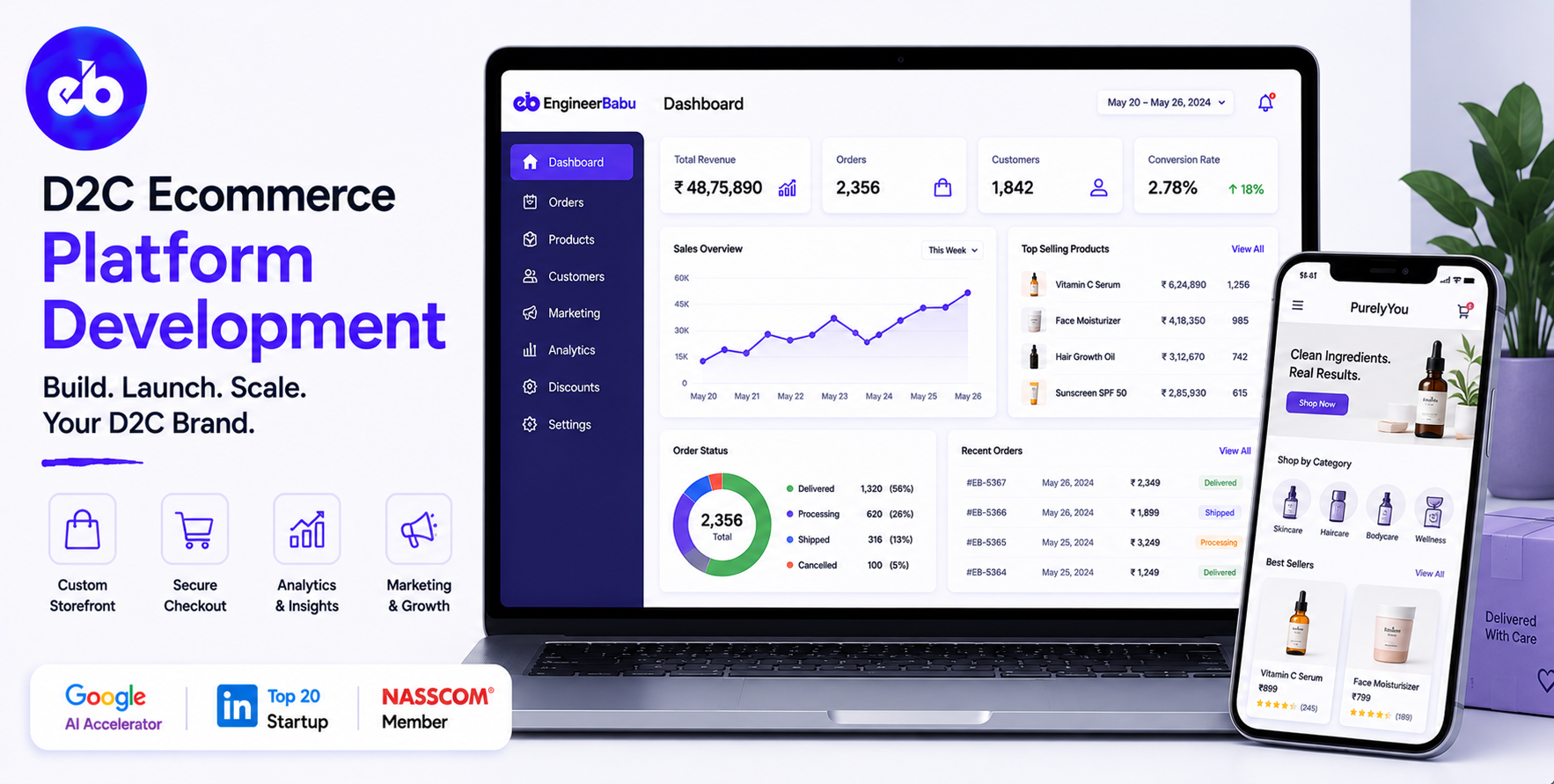
The economics of D2C have changed. In 2021, a D2C brand could acquire customers profitably on Facebook ads at $12 CAC and run its entire operation on Shopify. In 2026, Facebook CPMs are 13-14% higher, Apple’s App Tracking Transparency has degraded targeting, and Shopify’s 2.9% + 30¢ transaction fee on every sale compounds into a meaningful cost at scale.
The brands that are winning are the ones that own their technology stack, their checkout, their customer data, their subscription engine, their loyalty programme, rather than renting it from a platform that also takes a cut of every transaction.
Building a custom D2C e-commerce platform is not for every brand. A brand doing $500K annually should stay on Shopify. A brand at $5M to $50M, where platform fees, customisation limitations, and data ownership are real constraints on growth, is at exactly the right point to build.
This guide covers how to build a D2C e-commerce platform that gives a brand complete control, from the product catalogue through the checkout, the subscription engine, the post-purchase experience, and the analytics that tell the brand what its customers are actually doing.
EngineerBabu has built technology for 75+ YC-backed companies across D2C, fintech, and marketplace verticals. CMMI Level 5. Google AI Accelerator 2024 Top 20. Contact: mayank@engineerbabu.com
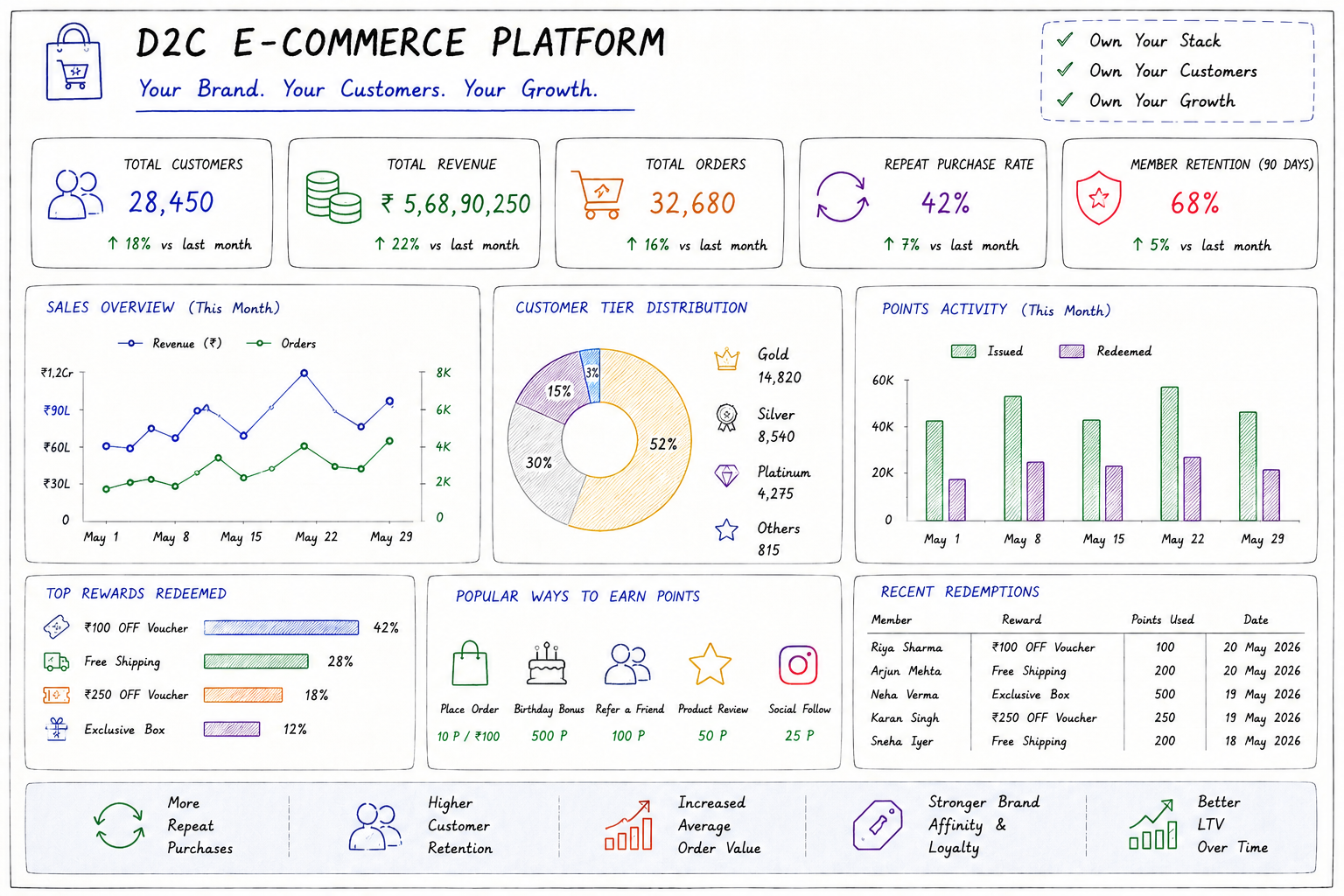
Before covering architecture, the specific limitations that drive brands to build their own platform must be clear. Building for the wrong reason wastes a significant investment.
The legitimate reasons to build:
| Limitation | What It Costs | Who It Affects |
| Transaction fees | 2.9% + 30¢ per transaction (Basic), 2.6% (Advanced), on every sale | Brands at $5M+ annually, this is $130K+ per year |
| Subscription complexity | Native subscriptions limited, Recharge costs $499+/month at scale | Subscription-first brands |
| Custom checkout | Shopify’s checkout customisation locked until Plus ($2,000/month) | Brands with complex checkout logic |
| Data ownership | Customer data stored on Shopify, limited raw export, API rate limits | Brands building first-party data strategy |
| B2B + B2C on one platform | Shopify handles this poorly, separate stores, complexity | Brands selling both channels |
| International complexity | Multi-currency, multi-language, country-specific pricing, expensive to manage | Global D2C brands |
| Headless flexibility | Shopify Hydrogen exists but is constrained, custom UI hard at speed | Brands with complex UI/UX requirements |
The wrong reasons to build:
Building because “we want something unique” without a specific technical constraint being hit is the most common cause of expensive D2C platform builds that fail to deliver ROI. If Shopify handles your use case, stay on Shopify.
The product data model:
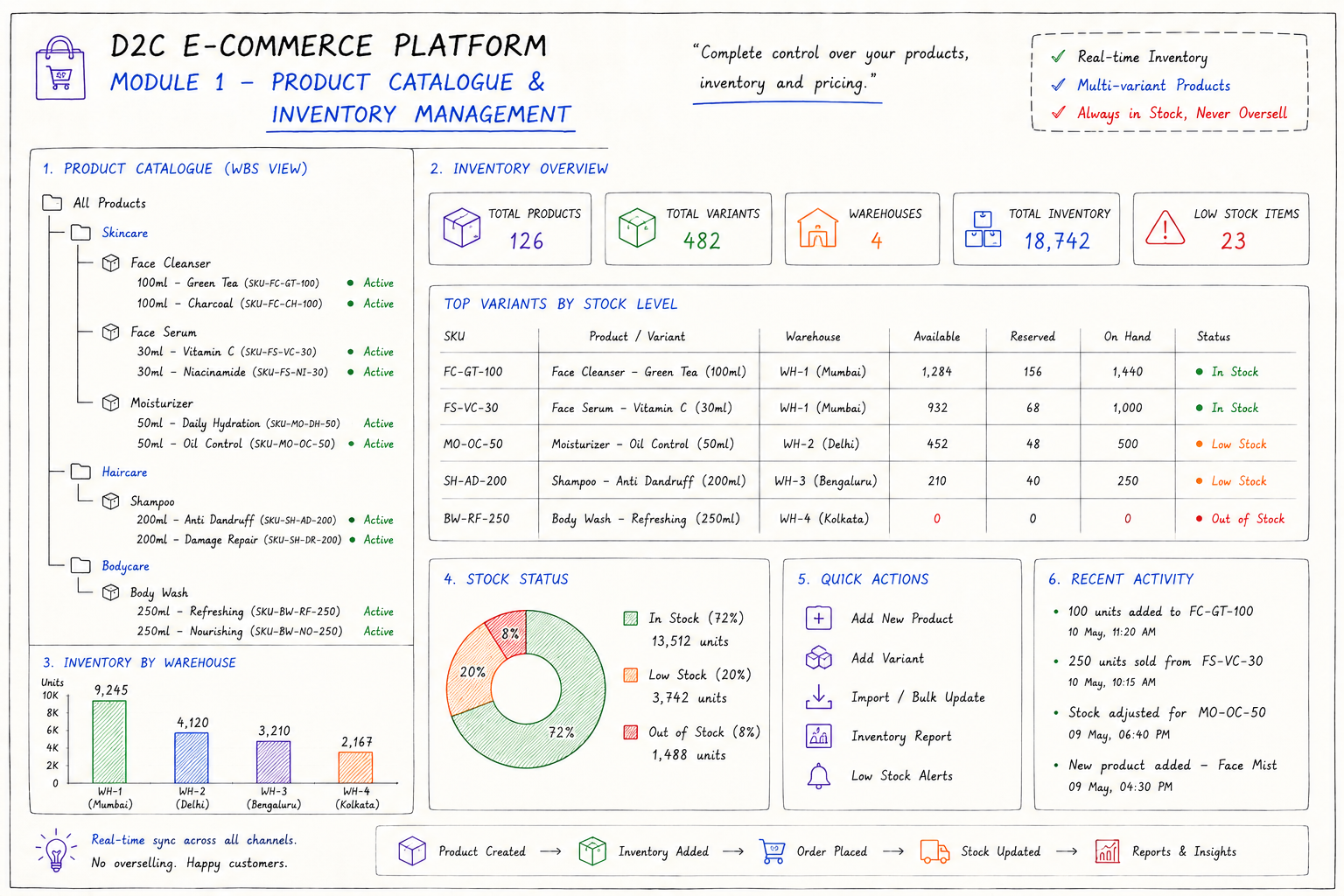
A D2C product catalogue is more complex than most developers expect because a single product has multiple representations, the storefront display, the variant selection logic, the inventory record, the pricing logic, and the subscription configuration, that must all be consistent in real time.
| Entity | Description |
| Product | Top-level product record, name, description, images, categories, tags |
| Variant | Specific purchasable version, SKU, size, colour, flavour, quantity |
| Inventory | Real-time stock level per variant per warehouse |
| Price | Base price, sale price, wholesale price, subscription price, per variant |
| Bundle | Pre-configured multi-product set with its own SKU and price |
| Subscription config | Which variants are available on subscription, at what interval, at what discount |
Real-time inventory management:
Every order placed decrements inventory in real time. Every return that passes inspection increments inventory.
The system must have inventory management that can handle race conditions, two customers purchasing the last unit simultaneously, by implementing optimistic locking or database-level transactions that prevent overselling.
Backorder management:
When a variant is out of stock, the platform can either block purchases (pure out-of-stock), allow backorders (purchase now, ships when available), or show a waitlist sign-up.
The choice depends on the brand’s model. The ERP must support all three and allow the brand to configure per variant.
The checkout is where most D2C revenue is lost. A 1% improvement in checkout conversion at $10M revenue is $100,000. The checkout must be fast, mobile-optimised, and handle every edge case, discount stacking, gift cards, subscriptions mixed with one-time purchases, split payment, and free gift with purchase, without error.
Checkout flow design:
| Step | User Action | System Action |
| Cart review | Customer sees items, quantities, subtotal | Cart validation, inventory check |
| Contact information | Email, phone, used for order confirmation and marketing | Customer lookup/creation |
| Shipping address | Address entry with autocomplete | Address validation, shipping zone lookup |
| Delivery method | Standard, express, same-day, with rates and ETAs | Real-time carrier rate query |
| Payment | Card, UPI, BNPL, gift card, store credit | Payment processor integration |
| Order review | Final order summary | Final inventory hold |
| Order confirmation | Order placed | Inventory decrement, confirmation email/SMS, order to WMS |
One-page checkout:
The highest-converting checkout design for mobile-first D2C brands is the one-page checkout, all steps visible on one screen with progressive disclosure. Address, delivery, and payment fields expand as the customer completes each step. No page reloads. No progress being lost if the customer navigates back.
Payment integrations:
| Market | Payment Methods | Integration |
| India | UPI, cards, wallets (Paytm, PhonePe), BNPL (Simpl, LazyPay), COD | Razorpay or PayU |
| US | Cards, Apple Pay, Google Pay, BNPL (Klarna, Afterpay), ACH | Stripe |
| Global | Cards + local methods | Stripe + Adyen |
Subscription is the highest-LTV model in D2C. A customer who subscribes at ₹999/month and stays for 18 months is worth ₹17,982. A one-time purchaser at ₹1,299 is worth ₹1,299. The subscription engine is the single highest-ROI module a D2C brand can build.
Subscription model types:
| Model | Description | Example |
| Subscribe and save | Fixed product, fixed interval, discount for subscribing | Protein supplement every 30 days, 15% off |
| Build a box | Customer curates a recurring box of their choice | Monthly beauty box, customer picks items |
| Replenishment | Automatic reorder when a product runs out | Coffee capsules, order when stock estimated to deplete |
| Membership | Monthly fee unlocks benefits across the store | Free shipping, early access, exclusive products |
| Prepaid subscription | Customer pays upfront for 3/6/12 months | 12-month skincare subscription, 20% off |
Subscription management features:
| Feature | Customer Capability |
| Pause subscription | Skip the next delivery without cancelling |
| Skip a delivery | One-time skip for this billing cycle |
| Swap product | Change which variant is included |
| Change frequency | Shift from monthly to bi-monthly |
| Change address | Update delivery address |
| Add one-time item | Add a one-time purchase to the next subscription order |
| Cancel | Cancel with a save flow, discount offer before final cancel |
The dunning engine for failed subscription payments:
When a subscription payment fails, the dunning engine retries on a smart schedule, typically Day 1, Day 3, Day 7, and communicates with the customer to update their payment method.
A failed subscription payment that is not recovered within 7 days becomes a churn event. The dunning engine determines whether that churn is preventable.
A D2C brand’s competitive advantage in 2026 is first-party customer data, the purchase history, browsing behaviour, subscription patterns, and preference signals that belong to the brand and not to a marketplace or platform. The AI personalisation layer converts this data into revenue. That’s where professional AI development services come into play.
Personalisation surfaces:
| Surface | What Is Personalised | Revenue Impact |
| Homepage | Hero products, featured categories | Increases time on site |
| Product page | Frequently bought together, complete the routine | Increases AOV |
| Cart | Add-on recommendations, bundle suggestion | Increases AOV |
| Post-purchase | “Customers who bought X also bought Y” | Drives repeat purchase |
| Email campaigns | Product recommendations per customer | Increases email CTR and conversion |
| Push notifications | Personalised reorder reminders | Increases retention |
| Search results | Personalised ranking within search | Surfaces relevant products first |
The recommendation engine:
The recommendation engine uses collaborative filtering (customers who bought X also bought Y), content-based filtering (products similar to what this customer has viewed), and contextual signals (time since last purchase, subscription status, loyalty tier) to generate ranked product recommendations for every customer at every surface.
The AI-powered search:
Product search on a D2C site is frequently the path to the second purchase. A customer who knows they want “SPF moisturiser” and types it into search should see the most relevant product, not an alphabetical list of everything with “moisturiser” in the title. The search engine uses semantic understanding to match customer intent, applies personalisation to rank results, and learns from click and purchase signals.
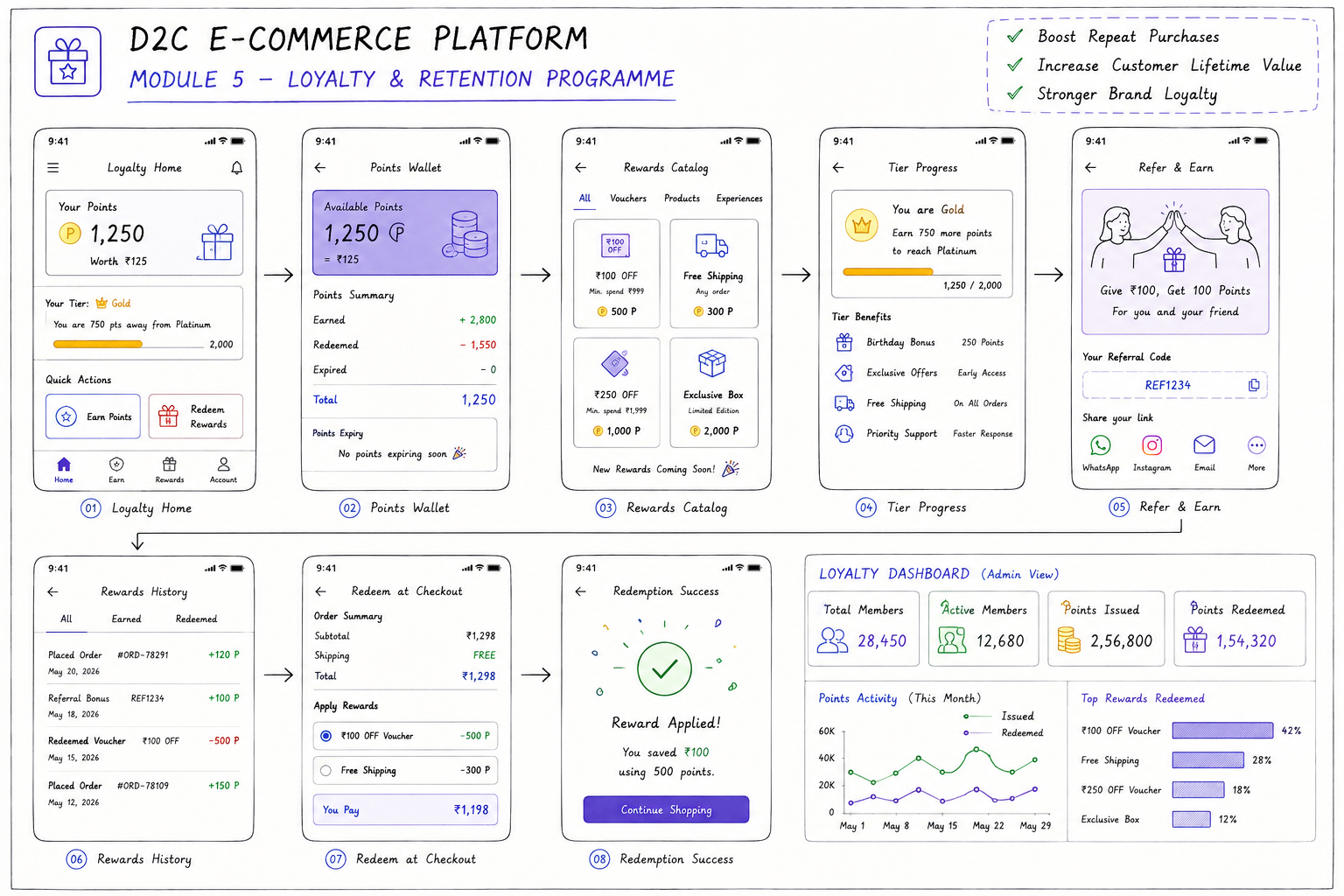
The highest-ROI investment a D2C brand makes is in customer retention. Increasing customer retention by 5% increases profits by 25 to 95% depending on the category. The loyalty programme is the primary retention mechanism for non-subscription customers.
Loyalty programme structure:
| Element | Configuration |
| Points earning | ₹1 spent = 1 point; referral = 500 points; review = 100 points; birthday = 250 points |
| Points redemption | 100 points = ₹10 off at checkout |
| Tiers | Silver (0–999 points/year), Gold (1,000–4,999), Platinum (5,000+) |
| Tier benefits | Gold: free shipping; Platinum: early access + free gift on each order |
| Points expiry | Points expire if no purchase in 12 months |
| Referral programme | Referrer gets ₹200 credit when referee makes first purchase |
Retention analytics:
| Metric | Calculation | Target |
| Repeat purchase rate | Customers who made 2+ purchases / total customers | > 30% |
| Average order frequency | Total orders / unique customers in period | Track and improve |
| Customer LTV | Average order value × average order frequency × customer lifespan | Maximise by segment |
| Cohort retention | % of each monthly cohort still active at 3/6/12 months | Identify churn point |
| Win-back rate | Lapsed customers who made a purchase after win-back campaign | > 10% |
The purchase is not the end of the customer journey. It is the beginning of the fulfilment journey, and a bad fulfilment experience is the fastest path to a refund request and a one-star review.
Post-purchase communication sequence:
| Trigger | Message | Channel |
| Order confirmed | Order details, expected delivery date | Email + WhatsApp |
| Order packed | “Your order is being packed” | |
| Shipped | Tracking number, carrier, tracking link | Email + SMS + WhatsApp |
| Out for delivery | “Your order is out for delivery today” | SMS + Push |
| Delivered | Confirmation with delivery photo if available | WhatsApp + Email |
| Review request (3 days post-delivery) | “How was your experience? Leave a review” | |
| Reorder nudge (product-specific timing) | “Running low? Time to restock” | Push + Email |
Returns and refunds:
A frictionless returns experience is a competitive advantage. The platform provides a self-service returns portal where the customer enters their order number, selects items to return, chooses a reason, and receives a return shipping label immediately. No need to email customer support and wait for a response.
| Module | Cost Range (USD) | Notes |
| Product catalogue + inventory management | $8K – $15K | Variants, bundles, real-time inventory |
| Brand-owned checkout (one-page) | $10K – $18K | Payment integrations, discount engine |
| Subscription commerce engine | $10K – $20K | All subscription models, dunning |
| AI personalisation + recommendation engine | $10K – $20K | Google AI Accelerator capability |
| Search (semantic + personalised) | $6K – $12K | |
| Loyalty and referral programme | $6K – $12K | |
| Post-purchase communication engine | $5K – $10K | |
| Customer portal (order history, subscriptions) | $5K – $10K | |
| WMS/3PL integration | $5K – $10K | |
| Analytics + customer intelligence | $6K – $12K | Cohort, LTV, retention |
| Admin panel (catalogue, orders, customers) | $6K – $12K | |
| AWS + VAPT + Year 1 ops | $5K – $10K | |
| Total | $82K – $161K | Full D2C platform |
Contact: mayank@engineerbabu.com
A D2C brand should consider building a custom platform when three or more of the following conditions are true: annual revenue exceeds $5M and transaction fees represent $130,000 or more annually; the brand’s subscription model is complex enough that third-party subscription apps like Recharge cost more than $500 per month and still require workarounds; the checkout requires customisation that Shopify Plus does not support at an acceptable cost; the brand’s data strategy depends on first-party customer data that cannot be fully accessed from Shopify’s API due to rate limits; or the brand operates both D2C and B2B channels that cannot be managed efficiently on one Shopify store. Below $5M revenue, the investment in a custom build rarely generates sufficient ROI to justify the development cost and the ongoing maintenance overhead.
Headless commerce separates the frontend customer experience (the “head”) from the backend commerce logic, inventory, orders, payments, subscriptions. In a headless architecture, the storefront is built as a custom React or Next.js application that calls the commerce backend through APIs. This gives complete creative control over the customer experience without being constrained by a platform’s template system. D2C brands choose headless when their customer experience requires interaction patterns, animations, or flows that a platform’s theme system cannot support, personalised landing pages that change based on where the customer came from, product configurators with complex visual logic, or progressive web apps that feel like native mobile apps. The tradeoff is development cost and ongoing frontend maintenance. Headless commerce is only the right choice when the creative and UX requirements are genuinely constrained by a platform’s templating system.
Involuntary churn, losing subscription customers because their payment failed rather than because they chose to cancel, accounts for 20 to 40% of total subscription churn in most D2C businesses. A dunning engine reduces it through two mechanisms. First, smart retry timing: rather than retrying a failed payment at a fixed interval, the engine retries at times when success probability is highest based on card type, issuing bank, and historical success patterns, for example, debit cards succeed more often on payday dates. Second, proactive communication: the moment a payment fails, the customer receives a personalised message, not a generic system alert, but a message explaining that their delivery is at risk and providing a one-tap link to update their payment method. The combination of smart retries and proactive communication typically recovers 60 to 80% of failed subscription payments that would otherwise result in involuntary churn.