How to Build a Cold Chain Monitoring Platform, IoT Temperature Tracking, Excursion Alerts, Compliance Reporting 2026


Create engaging, high-performance mobile applications tailored to your business needs. We craft future-ready apps that offer smooth user experiences on all devices.
Build robust and scalable websites and CMS platforms that help you manage content effortlessly. Our development ensures a seamless digital presence.
Launch secure, feature-rich online stores with intuitive shopping experiences. We build tailored eCommerce platforms designed for growth.
Design captivating games with immersive gameplay and stunning graphics. From concept to launch, we build engaging experiences that players love.
Enhance your customer relationships with customized Salesforce implementations. Drive growth and efficiency with smarter CRM solutions.
Harness artificial intelligence and machine learning to automate workflows and gain actionable insights. Our AI transforms data into smart decisions.
Accelerate your software delivery lifecycle with continuous integration, delivery, and infrastructure automation to boost efficiency.
Hire app developers ready to turn your ideas into sleek, high-performing mobile apps for any platform.
Bring in frontend pros who craft smooth, beautiful, and user-friendly interfaces that your visitors will love.
Get backend developers who build fast, secure, and reliable systems to keep everything running behind the scenes.
Hire eCommerce developers who build secure, scalable online stores designed to offer seamless shopping and grow your sales.
Get dedicated developers committed to your projects, delivering consistent quality and speed as an extension of your team.
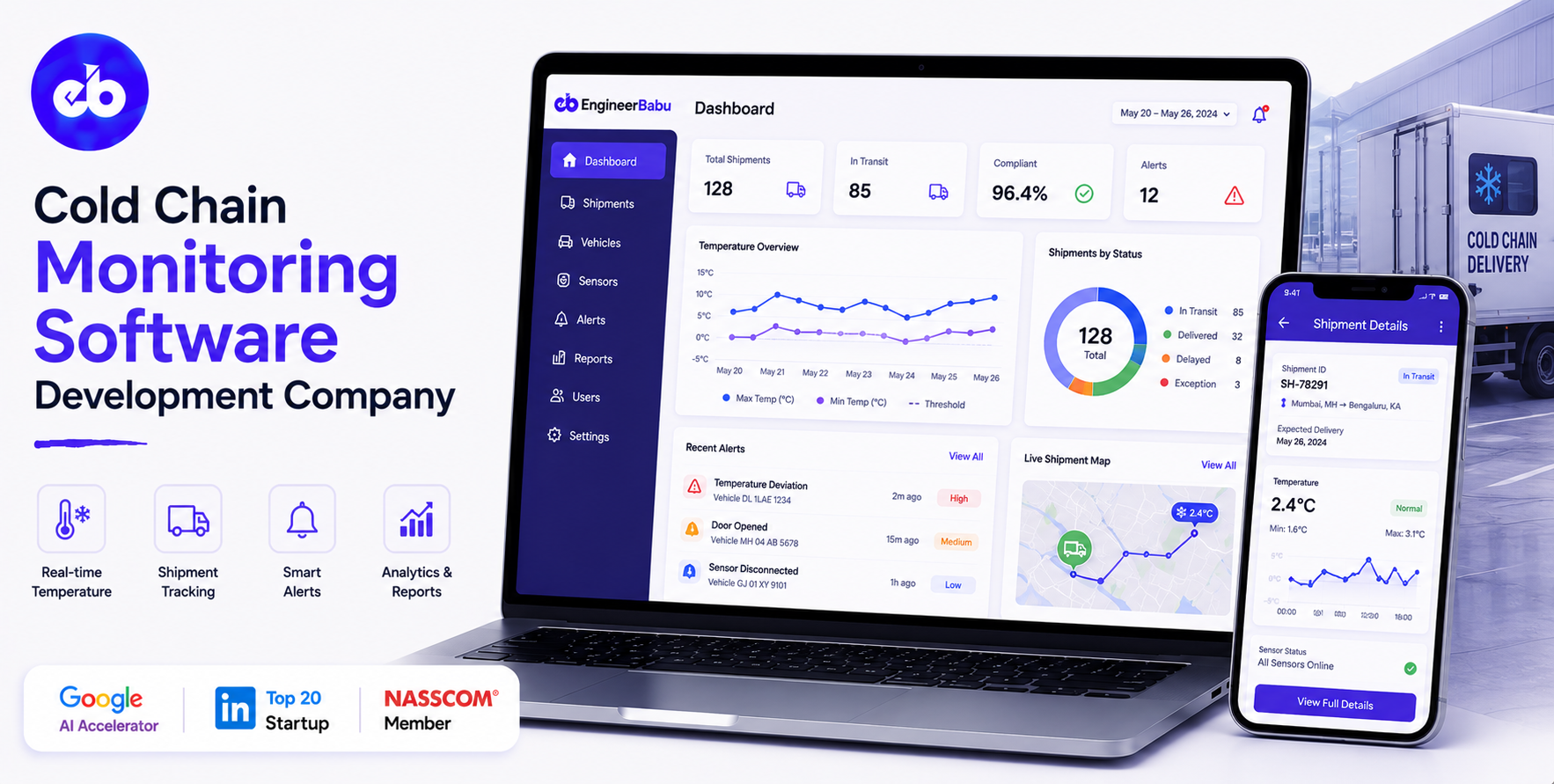
A single temperature excursion, a vaccine shipment that goes above 8°C for four hours during transit, can render an entire cold chain load worthless. In pharmaceuticals, that means discarding inventory worth thousands of dollars and potentially delaying patient access to critical medication.
In food and beverage, it means a recall, a regulatory investigation, and a brand reputation problem that takes years to recover from.
The global cold chain monitoring market is projected to reach $15.04 billion by 2030. Every pharmaceutical manufacturer, food distributor, biotech company, and vaccine logistics operator needs real-time visibility into temperature conditions across the full cold chain, from manufacturing facility through distribution centre through last-mile delivery to the end point of use.
This guide covers how to build a cold chain monitoring platform, IoT sensor integration, real-time alert architecture, regulatory compliance reporting, and the data intelligence that prevents excursions rather than just recording them.
EngineerBabu built Somnoware, the remote monitoring platform acquired by ResMed, and enterprise operations management for Adani Group. We understand production-grade IoT monitoring at scale. CMMI Level 5. Google AI Accelerator 2024 Top 20. Contact: mayank@engineerbabu.com
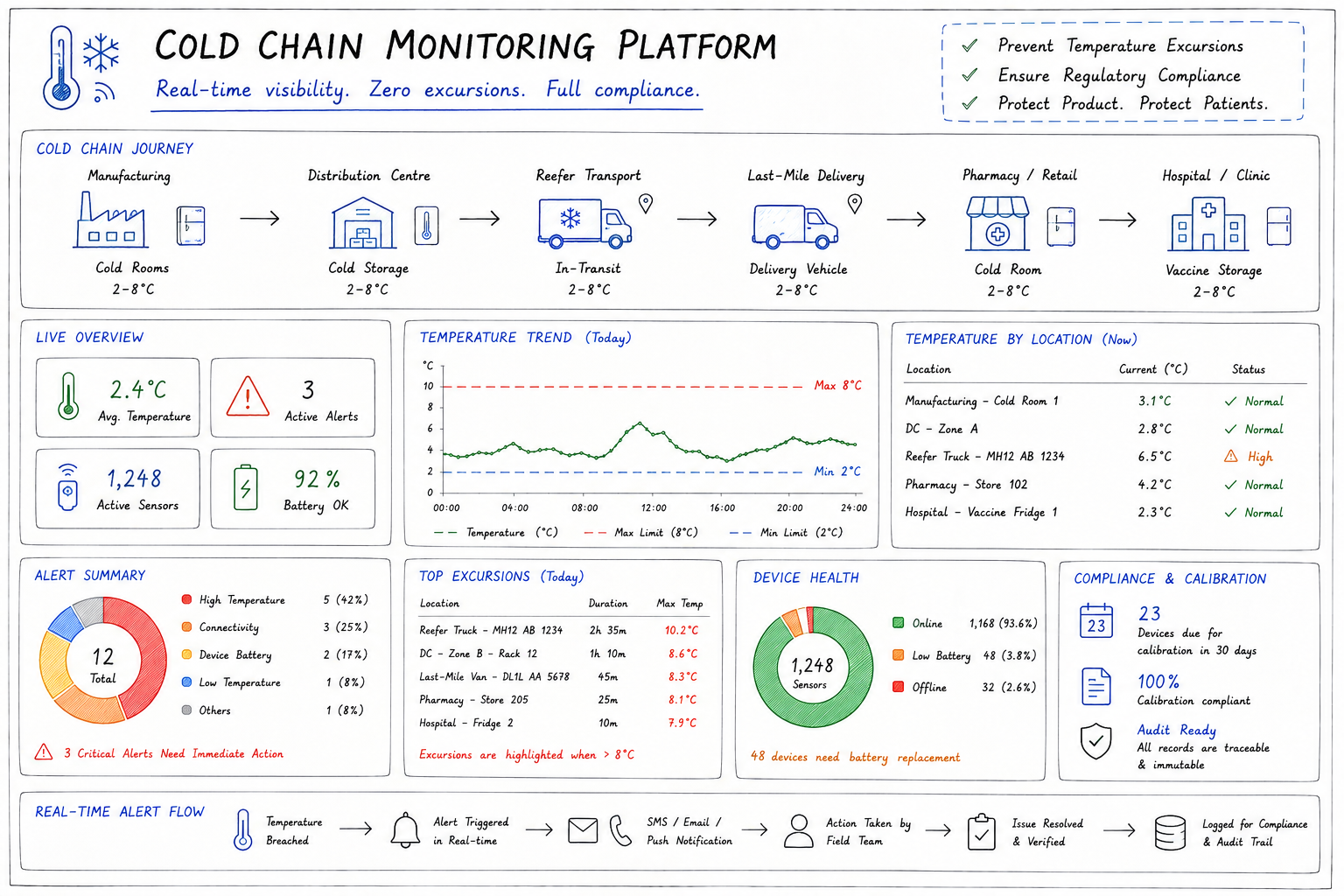
Cold chain monitoring is not a single-point temperature logger. It is end-to-end visibility across every node and every transit leg where temperature-sensitive product exists, and the intelligence layer that distinguishes a normal reading from an excursion that requires immediate action.
| Node | What Is Monitored | Criticality |
| Manufacturing cold room | Temperature, humidity, door open events | Very high, product origin |
| Distribution centre cold storage | Temperature per zone, per rack, per pallet | Very high, highest volume |
| Refrigerated vehicles (reefer trucks) | Cabin temperature, setpoint compliance, door events | High, transit leg |
| Last-mile delivery vehicles | Temperature during delivery routes | High, final leg |
| Pharmacies and retail cold rooms | Point of sale temperature compliance | High, end point |
| Hospital and clinic storage | Vaccine refrigerator temperature | Very high, patient safety |
| Temporary staging areas | Airport cold rooms, port cold storage | Medium, handoff points |
Each node has different sensor requirements, different alert thresholds, different regulatory standards, and different response protocols. The platform must handle all of them in one unified view.
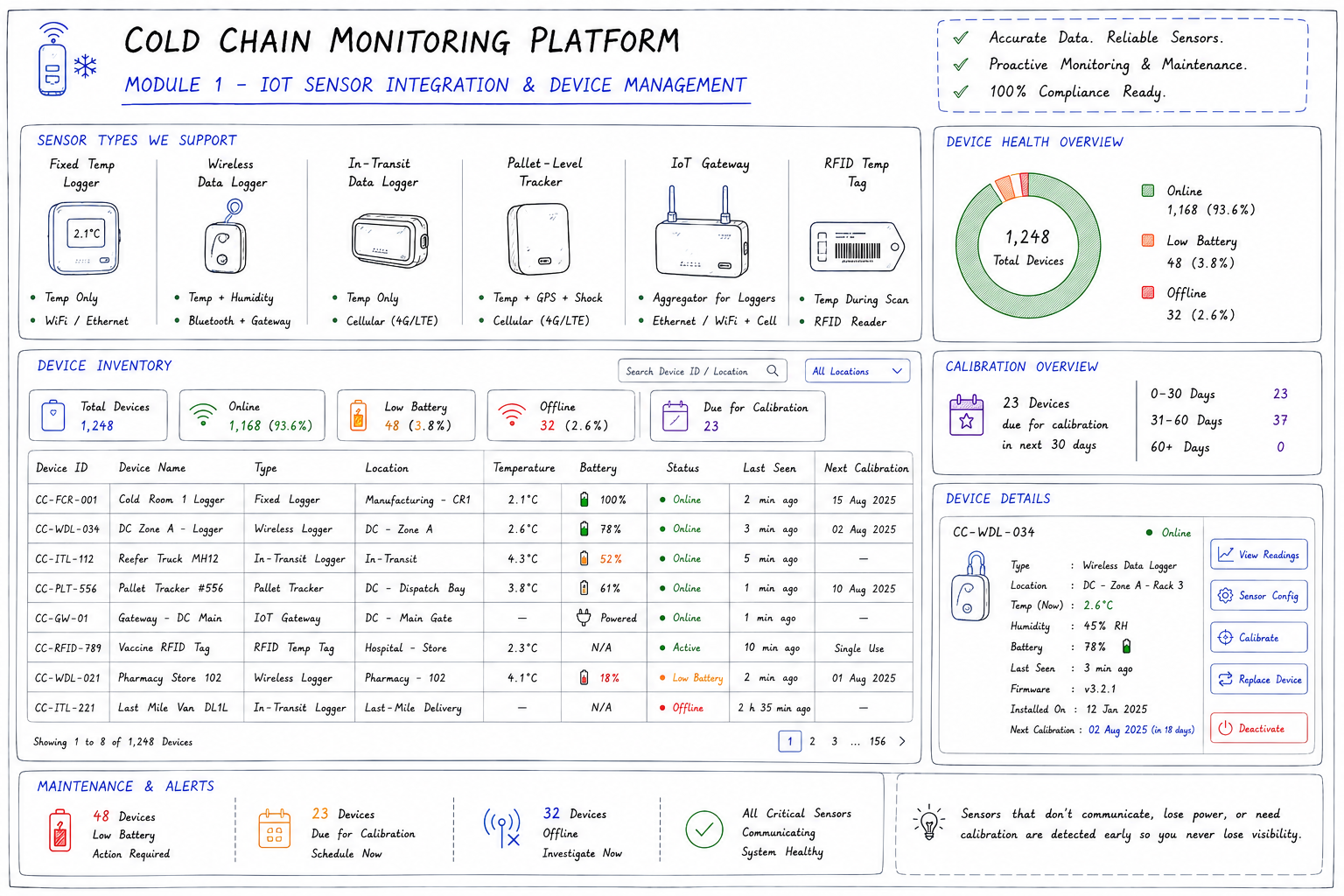
The cold chain monitoring platform is only as good as the sensors feeding it. The sensor selection, type, form factor, communication protocol, battery life, determines what can be monitored and at what granularity.
Sensor types and use cases:
| Sensor Type | Measurement | Form Factor | Communication | Battery Life |
| Fixed temperature logger | Temperature only | Wall-mounted or shelf unit | WiFi or Ethernet | Powered |
| Wireless data logger | Temperature + humidity | Clip-on or standalone | Bluetooth + gateway | 2–5 years |
| In-transit data logger | Temperature | Attached to shipment | Cellular (4G/LTE) | 1–3 weeks |
| Pallet-level tracker | Temperature + GPS + shock | Attached to pallet | Cellular | 2–4 weeks |
| IoT gateway | Aggregator for Bluetooth loggers | Fixed at facility | Ethernet/WiFi + cellular | Powered |
| RFID temperature tag | Temperature during scan | Label format | RFID reader required | Single-use |
The device management module:
Every sensor in the network is registered in the platform with its unique device ID, location assignment, calibration date, next calibration due date, battery level, last communication timestamp, and firmware version.
The platform monitors sensor health continuously. A sensor that has not communicated in more than a defined interval, 15 minutes for critical cold rooms, 4 hours for in-transit loggers, triggers a connectivity alert.
A sensor whose battery is below 20% triggers a replacement alert. A sensor due for calibration within 30 days appears in the maintenance queue.
Calibration management:
Regulatory compliance, FDA 21 CFR Part 11, WHO PQS, EU GDP, requires documented calibration of every temperature monitoring device. The platform tracks calibration records, calibration certificate uploads, calibration due dates, and generates calibration reminder alerts. Every temperature reading in the system is traceable to a calibrated, certified device.
Temperature data has unique characteristics that require purpose-built infrastructure. It is high-frequency, a sensor may record every 1 to 5 minutes. It is time-series by nature, every reading is meaningless without its timestamp.
And it must be stored with perfect integrity, in a regulatory audit, a temperature record that cannot be proven immutable is worthless.
The data pipeline:
Sensor reads temperature → communicates via Bluetooth to gateway or directly via cellular → data arrives at platform API → validated and timestamped → written to time-series database → evaluated against alert thresholds → alert triggered if threshold breached → dashboard updated in real time.
Time-series database:
| Technology | Why Used |
| InfluxDB | Purpose-built time-series, high write throughput, efficient time-range queries |
| TimescaleDB | PostgreSQL extension, familiar SQL interface, strong consistency |
| AWS Timestream | Fully managed, serverless, auto-scaling |
At a network of 500 sensors each recording every 5 minutes, the platform ingests 144,000 readings per day. At 10,000 sensors, that is 2.88 million readings per day. The time-series database must handle this volume with consistent write latency and fast historical query performance for compliance reporting.
Data immutability for regulatory compliance:
For pharmaceutical cold chain specifically, temperature records must be immutable, they cannot be edited after the fact.
The platform implements append-only storage with cryptographic hashing, each new reading includes a hash of the previous reading, creating a chain that detects any tampering. This is the technical implementation of the data integrity requirement under FDA 21 CFR Part 11.
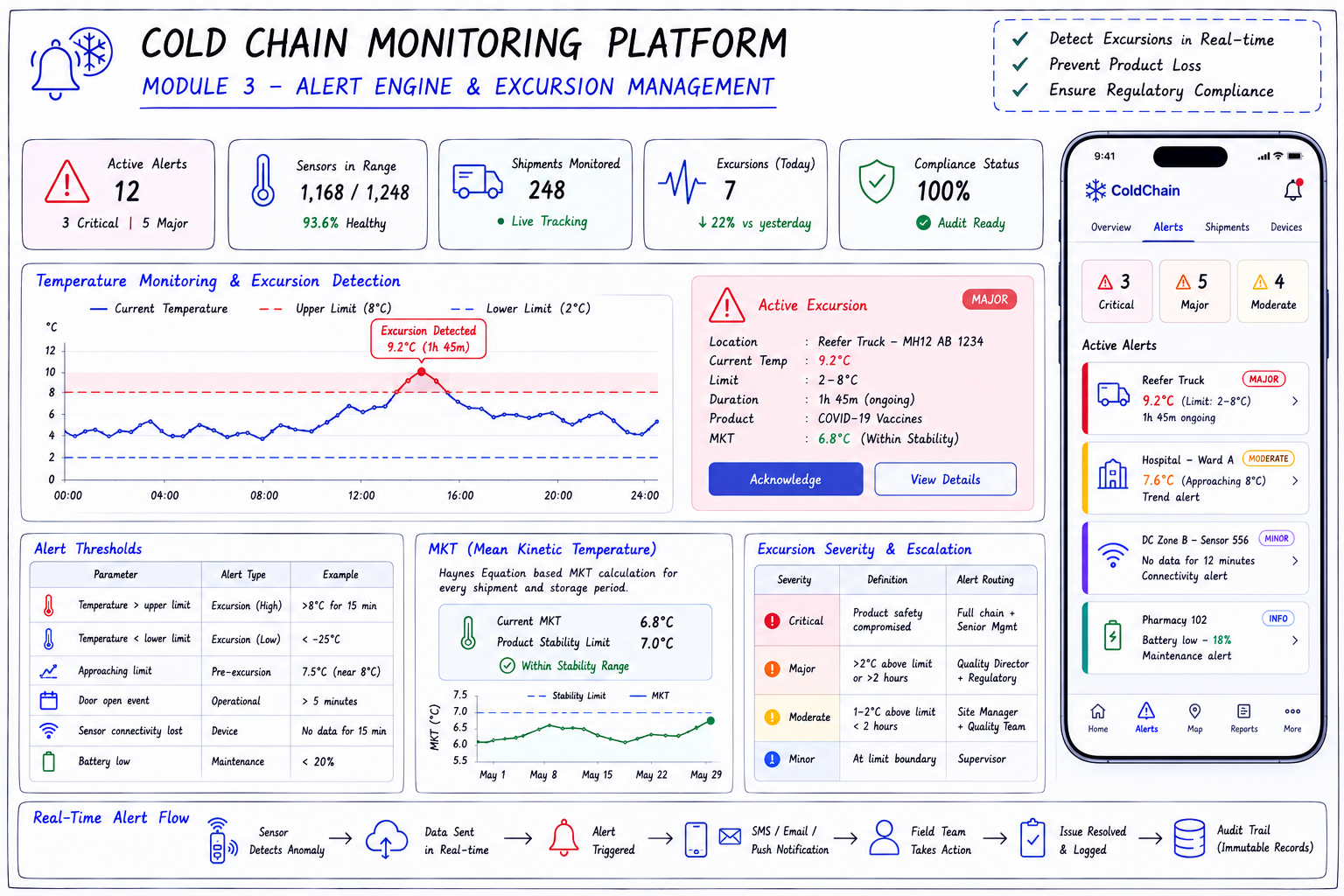
The alert engine is the most operationally critical component of a cold chain monitoring platform. An excursion that is detected in real time can often be corrected, an engineer can fix the refrigeration unit, the shipment can be moved to a backup cold room, the driver can be contacted to check the reefer unit.
An excursion that is only discovered at the next manual check, hours later, has already caused irreversible product damage.
The alert threshold model:
Each monitored location and each product type has its own alert configuration:
| Parameter | Alert Type | Example |
| Temperature > upper limit | Excursion, high | Vaccine storage >8°C for 15 minutes |
| Temperature < lower limit | Excursion, low | Frozen product < -25°C |
| Temperature approaching limit | Pre-excursion warning | Vaccine storage at 7.5°C, approaching 8°C limit |
| Rate of change | Trend alert | Temperature rising 0.5°C per hour, will breach in 30 minutes |
| Door open event | Operational alert | Cold room door open > 5 minutes |
| Sensor connectivity lost | Device alert | No data from sensor for 15 minutes |
| Battery low | Maintenance alert | Sensor battery below 20% |
The Mean Kinetic Temperature (MKT) calculation:
For pharmaceutical products, the relevant question is not just “did the temperature breach the limit?” but “what was the cumulative thermal stress on the product over the entire journey?”
MKT (Mean Kinetic Temperature) is the single derived temperature that, if maintained for the same time period, would have the same thermal effect as the actual varying temperature profile.
The platform calculates MKT automatically for every shipment and every storage period using the Haynes equation. The MKT is compared against the product’s stability limit, not the storage limit, to determine whether the product is still within its approved shelf life even after a temperature event.
Excursion escalation protocol:
| Excursion Severity | Definition | Alert Routing | Required Response |
| Minor | Temperature at limit boundary, MKT within stability | Supervisor notification | Log and monitor |
| Moderate | Temperature 1–2°C above limit, duration < 2 hours | Site manager + quality team | Quarantine product pending assessment |
| Major | Temperature > 2°C above limit or duration > 2 hours | Quality director + regulatory team | Full deviation report, product quarantine |
| Critical | Product safety compromised | Entire escalation chain + senior management | Immediate product recall consideration |
In-transit monitoring is where cold chain visibility is hardest to achieve and where excursions are most common. A refrigerated truck driver who opens the reefer unit frequently, a shipment left on a loading dock in summer heat, or a refrigeration unit that fails mid-route, all of these happen and all of them are preventable with real-time transit monitoring.
The transit monitoring model:
Each shipment in the cold chain is a trackable entity with:
| Attribute | Details |
| Shipment ID | Unique identifier linked to the order or delivery note |
| Product | What is being shipped, product, quantity, lot number |
| Temperature requirement | Ambient / Chilled (2–8°C) / Frozen (-18°C or below) / Ultra-cold (-70°C) |
| Origin and destination | Pickup and delivery locations |
| Expected transit time | Planned duration |
| Assigned logger | Which sensor is travelling with this shipment |
| Vehicle | Which vehicle/driver is carrying the shipment |
Real-time transit dashboard:
The dispatch team sees a map of all active shipments with each shipment’s current temperature reading, current GPS location, current driver, and alert status.
A shipment showing a yellow or red alert is immediately visible and actionable, the dispatcher can contact the driver, reroute the shipment, or activate a contingency protocol.
This is the module that pharmaceutical companies, biotech companies, and vaccine logistics operators care most about. Temperature records are not just operational data, they are regulatory evidence. FDA, EMA, WHO PQS, India CDSCO, and national pharmacopoeias all specify how temperature data must be recorded, stored, and reported.
The compliance reports generated:
| Report | Regulatory Standard | Content |
| Temperature log (per location, per period) | FDA 21 CFR 211.68, EU GDP | Complete time-stamped temperature record for every sensor |
| Excursion report | All GMP standards | Date, time, duration, maximum deviation, MKT impact, corrective action |
| Calibration certificate log | ISO 17025, FDA | Calibration dates, certificate numbers, next due dates |
| Mean Kinetic Temperature report | USP <1079>, ICH Q1A | MKT calculation per shipment or per storage period |
| Chain of custody report | WHO PQS | Every handoff point, responsible party, temperature at handoff |
| Validation summary | FDA 21 CFR Part 11, EU Annex 11 | System validation documentation |
| Deviation summary | All GMP standards | All deviations in a period with status and resolution |
The audit trail:
Every action in the platform, alert acknowledged, excursion investigated, report generated, calibration recorded, is logged with a timestamp, the user who performed it, and an immutable record of what was done. This audit trail is the primary evidence in an FDA inspection or EU GDP audit.
The most valuable capability a cold chain monitoring platform can offer is not detecting excursions, it is predicting and preventing them.
An AI platform that tells you the cold room will breach its temperature limit in 90 minutes, based on current temperature trajectory, ambient conditions, and equipment performance trends, gives you time to act before the excursion happens.
Predictive capabilities:
| Prediction | Data Used | Action Enabled |
| Equipment failure prediction | Temperature trend + rate of change + historical failure patterns | Pre-emptive maintenance before failure |
| Transit excursion risk | Route temperature forecast + vehicle performance history | Route change or vehicle substitution |
| Storage capacity planning | Seasonal demand + historical temperature impact of high load | Pre-season refrigeration servicing |
| Battery depletion prediction | Battery discharge rate × current level | Replacement before connectivity loss |
The ML model for equipment failure:
Refrigeration equipment that is about to fail shows characteristic patterns, temperature oscillation increases, recovery time after door openings lengthens, compressor run time increases. The platform trains an ML model on historical equipment data to recognise these patterns and predict failure with enough lead time for maintenance intervention.
| Module | Cost Range (USD) | Notes |
| IoT sensor integration layer (8 sensor types) | $10K – $20K | Protocol library, Bluetooth, cellular, WiFi |
| Device management + calibration tracking | $5K – $10K | |
| Real-time data pipeline + time-series DB | $8K – $15K | InfluxDB or AWS Timestream |
| Alert engine + excursion escalation | $8K – $15K | Multi-tier alert routing |
| MKT calculation engine | $5K – $10K | Haynes equation, per-shipment calculation |
| Transit tracking + GPS integration | $6K – $12K | Live shipment map |
| Regulatory compliance reports | $8K – $15K | FDA/EU GDP/WHO PQS formats |
| Immutable audit trail | $5K – $10K | Cryptographic hash chain |
| Predictive excursion ML model | $8K – $15K | Equipment failure prediction |
| Dashboard + mobile app | $8K – $15K | Real-time monitoring, alerts |
| AWS + HIPAA-equivalent + VAPT | $6K – $12K | |
| Total | $77K – $149K | Full cold chain platform |
EngineerBabu built Somnoware, the remote IoT monitoring platform acquired by ResMed. Production-grade medical IoT at scale. CMMI Level 5. Google AI Accelerator 2024. Contact: mayank@engineerbabu.com
Mean Kinetic Temperature (MKT) is a single derived temperature value, calculated using the Haynes equation, that represents the equivalent constant temperature that would produce the same cumulative thermal stress on a pharmaceutical product as the actual varying temperature profile observed during storage or transit. It matters because most pharmaceutical products have stability data that allows for short excursions above their storage temperature, a vaccine stored at 2–8°C may remain safe for patient use even after a 4-hour excursion to 12°C, depending on the product’s stability profile. MKT allows quality assurance teams to make evidence-based decisions about whether a product experiencing a temperature excursion should be quarantined or released, rather than defaulting to a blanket disposal that wastes valuable product. Regulatory guidelines including USP <1079> and ICH Q1A require MKT calculations to support these decisions.
A pharmaceutical cold chain monitoring platform serving the US market must comply with FDA 21 CFR Part 211.68 (electronic records in pharmaceutical manufacturing), FDA 21 CFR Part 11 (electronic records and signatures, requires immutable audit trail, access controls, and data integrity controls), and USP <1079> (Good Storage and Shipping Practices, specifies MKT requirements and temperature monitoring guidance). For EU distribution, EU GDP Guidelines (Good Distribution Practice) govern the technical requirements for temperature monitoring equipment, including calibration, data logging, and excursion management. WHO PQS standards apply for vaccine cold chains in international health programmes. A platform built for global pharmaceutical clients should support all three regulatory frameworks simultaneously, generating compliance reports in the format required by each.
A temperature data logger is a device that records temperature readings at defined intervals and stores them in onboard memory for manual download and review. It answers the question of what temperature was reached but requires physical retrieval and manual analysis to identify excursions. A cold chain monitoring platform is a connected system, sensors communicate in real time to a cloud platform that automatically detects excursions, sends immediate alerts to the right people, calculates MKT, generates regulatory compliance reports, and provides historical analytics across the entire cold chain network. The difference is real-time vs retrospective, automated vs manual, and point-level vs network-wide. A logistics company managing a single cold room can function with data loggers. A pharmaceutical distributor managing 200 vehicles and 50 cold rooms across multiple locations cannot.