How to Build a Corporate Learning Management System, Course Authoring, Compliance Training, Skills Tracking, and AI-Powered Learning 2026


Create engaging, high-performance mobile applications tailored to your business needs. We craft future-ready apps that offer smooth user experiences on all devices.
Build robust and scalable websites and CMS platforms that help you manage content effortlessly. Our development ensures a seamless digital presence.
Launch secure, feature-rich online stores with intuitive shopping experiences. We build tailored eCommerce platforms designed for growth.
Design captivating games with immersive gameplay and stunning graphics. From concept to launch, we build engaging experiences that players love.
Enhance your customer relationships with customized Salesforce implementations. Drive growth and efficiency with smarter CRM solutions.
Harness artificial intelligence and machine learning to automate workflows and gain actionable insights. Our AI transforms data into smart decisions.
Accelerate your software delivery lifecycle with continuous integration, delivery, and infrastructure automation to boost efficiency.
Hire app developers ready to turn your ideas into sleek, high-performing mobile apps for any platform.
Bring in frontend pros who craft smooth, beautiful, and user-friendly interfaces that your visitors will love.
Get backend developers who build fast, secure, and reliable systems to keep everything running behind the scenes.
Hire eCommerce developers who build secure, scalable online stores designed to offer seamless shopping and grow your sales.
Get dedicated developers committed to your projects, delivering consistent quality and speed as an extension of your team.
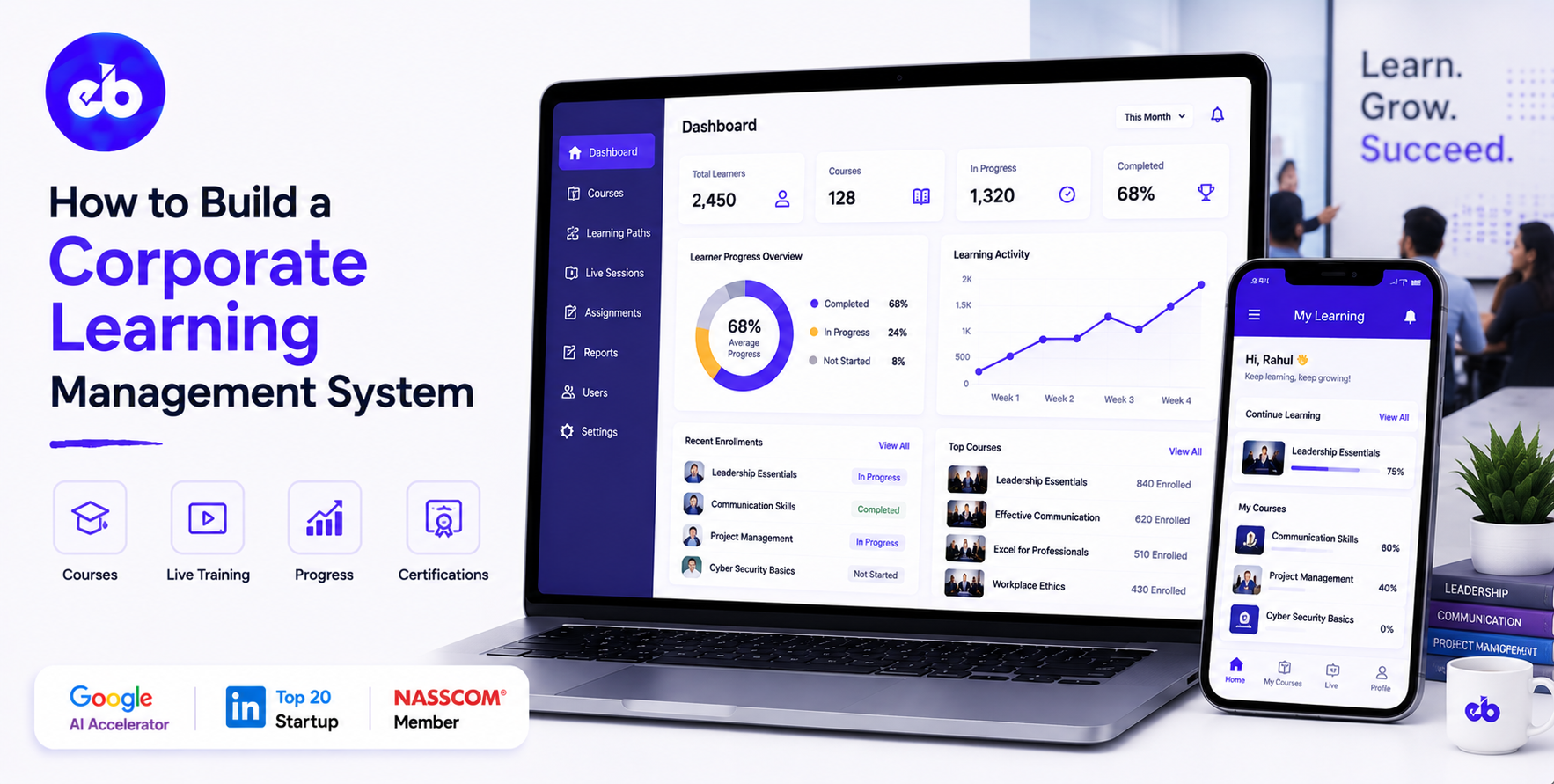
Corporate learning has a completion rate problem. The average enterprise LMS sees 20 to 30% course completion rates across voluntary programmes. Compliance training completion, where completion is mandatory and often tied to regulatory requirements, gets to 80 to 90% only because consequences are attached.
The training itself is rarely the problem. The platform experience, clunky navigation, irrelevant content, no mobile access, zero personalisation, is what kills engagement.
The global corporate LMS market is projected to reach $27.8 billion by 2030. The growth is driven by organisations that have realised they cannot hire their way to capability, they have to build it.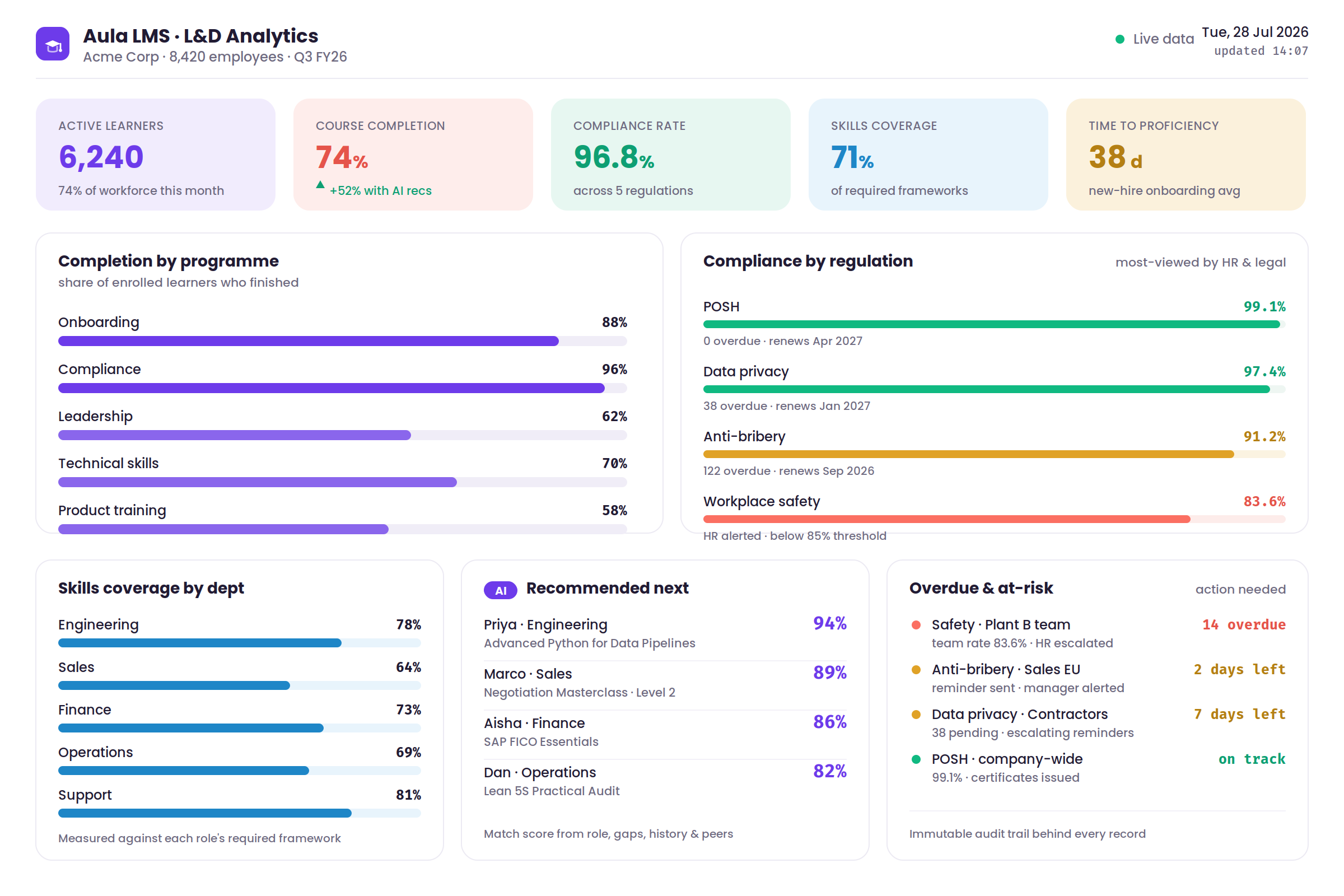
Every new hire needs onboarding. Every employee needs compliance certification. Every leader needs development. Every technical team needs skills currency.
A purpose-built corporate LMS that handles all of this in one system, with the AI personalisation that keeps learners returning, is one of the highest-ROI technology investments an enterprise can make.
This guide covers how to build one from scratch, course authoring, compliance tracking, skills management, AI-powered personalisation, and the management analytics that tell HR heads what the learning investment is actually producing.
EngineerBabu built enterprise platforms for Adani Group and technology solutions for 75+ YC-backed companies. CMMI Level 5. Google AI Accelerator 2024 Top 20. Contact: mayank@engineerbabu.com
A corporate LMS is not a video hosting platform with a quiz at the end. It is the infrastructure for every learning intervention a company makes, from new hire onboarding through annual compliance recertification, technical skill development, leadership programmes, and performance-linked learning pathways.
| Function | LMS Module |
| Content delivery | Course player supporting video, SCORM, xAPI, PDF, assessments |
| Course authoring | Built-in authoring tool for content creation |
| Learning pathways | Structured programmes combining multiple courses |
| Onboarding programmes | New hire learning journeys with milestone tracking |
| Compliance training | Mandatory courses with due dates, reminders, and certificates |
| Skills management | Skill frameworks, gap analysis, learning recommendations |
| AI personalisation | Content recommendations based on role, performance, and learning history |
| Assessments | Quizzes, assignments, practical evaluations, certifications |
| Live learning | Webinar and virtual classroom integration |
| Social learning | Discussion forums, peer review, collaborative content |
| Reporting and analytics | Completion rates, skill coverage, compliance status, ROI |
| HRMS integration | Employee data, role, department, manager hierarchy |
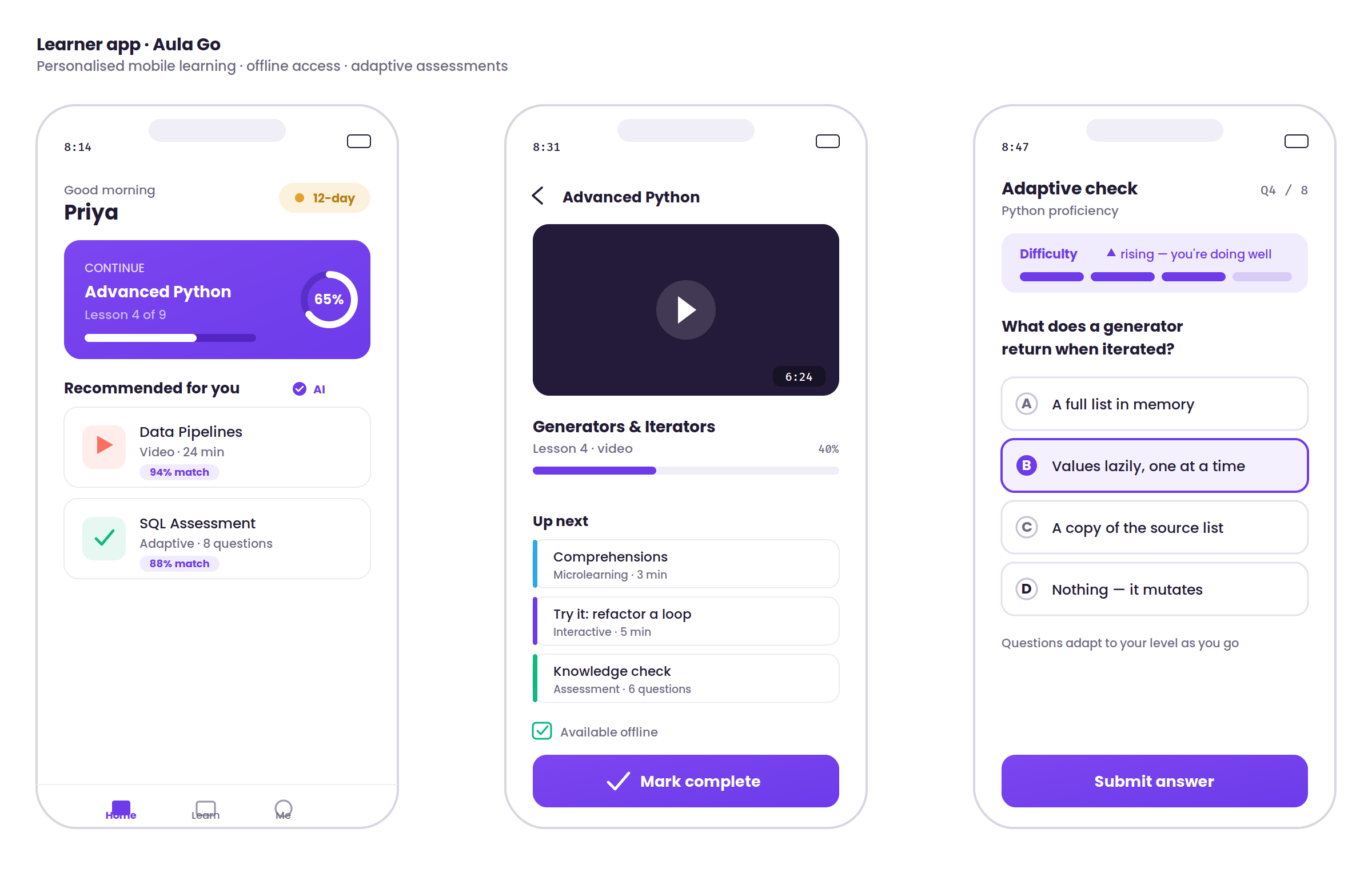
| Mobile App learning | iOS and Android apps with offline access |
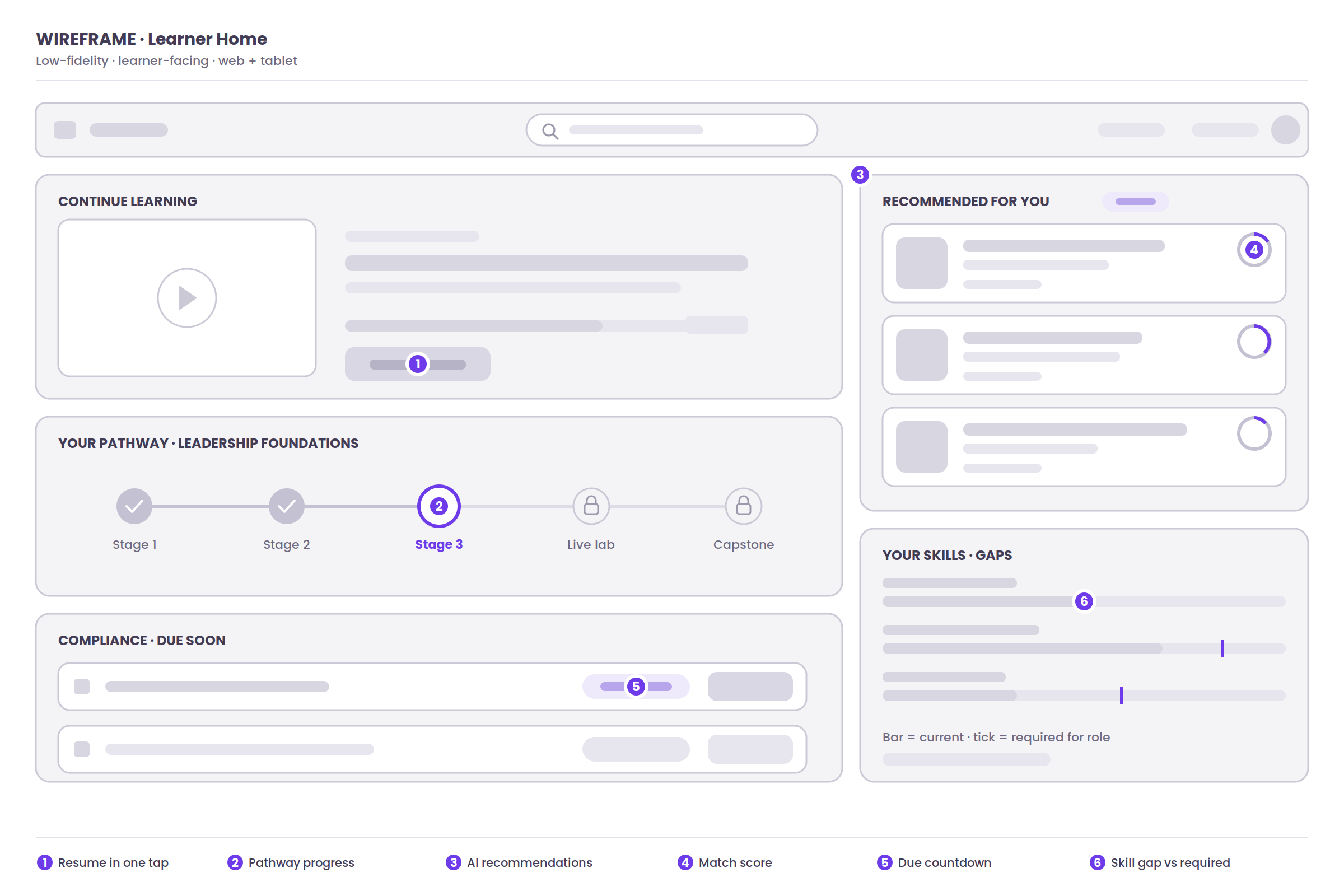
The quality of content on the LMS determines whether learners return. The authoring tool must be powerful enough to create engaging learning, not just upload a PowerPoint, but simple enough that subject matter experts who are not instructional designers can use it without training.
Content types the authoring tool must support:
| Content Type | Authoring Approach | Engagement Level |
| Video lessons | Upload or record in-browser | High, if under 8 minutes |
| Interactive slides | Drag-and-drop slide builder | Medium |
| SCORM packages | Import from Articulate or Adobe Captivate | Variable |
| xAPI (Tin Can) statements | Track learning from any external source | High flexibility |
| Assessments | Question bank, auto-scoring, attempt limits | Medium–High |
| Scenario-based learning | Branching scenarios with decision points | Very high |
| Microlearning | Short content cards, 2–5 minutes | High |
| PDF documents | Upload with page-tracking | Low–Medium |
| External content | YouTube embed, external website, LTI integration | Variable |
The content library:
Every piece of content in the LMS lives in a central library. This allows the same video or assessment to be used in multiple courses without duplication. When the content is updated, the update propagates to every course that references it.
This is critical for compliance content, when a regulation changes, the affected lesson is updated once and every course containing it is automatically current.
SCORM and xAPI compliance:
SCORM (Sharable Content Object Reference Model) is the dominant standard for packaged e-learning content. A SCORM-compliant LMS can import any SCORM 1.2 or 2004 package and track completion, score, and time spent.
xAPI (Experience API / Tin Can) is the modern successor, it tracks learning experiences outside the LMS, including mobile learning, simulations, and performance on the job.
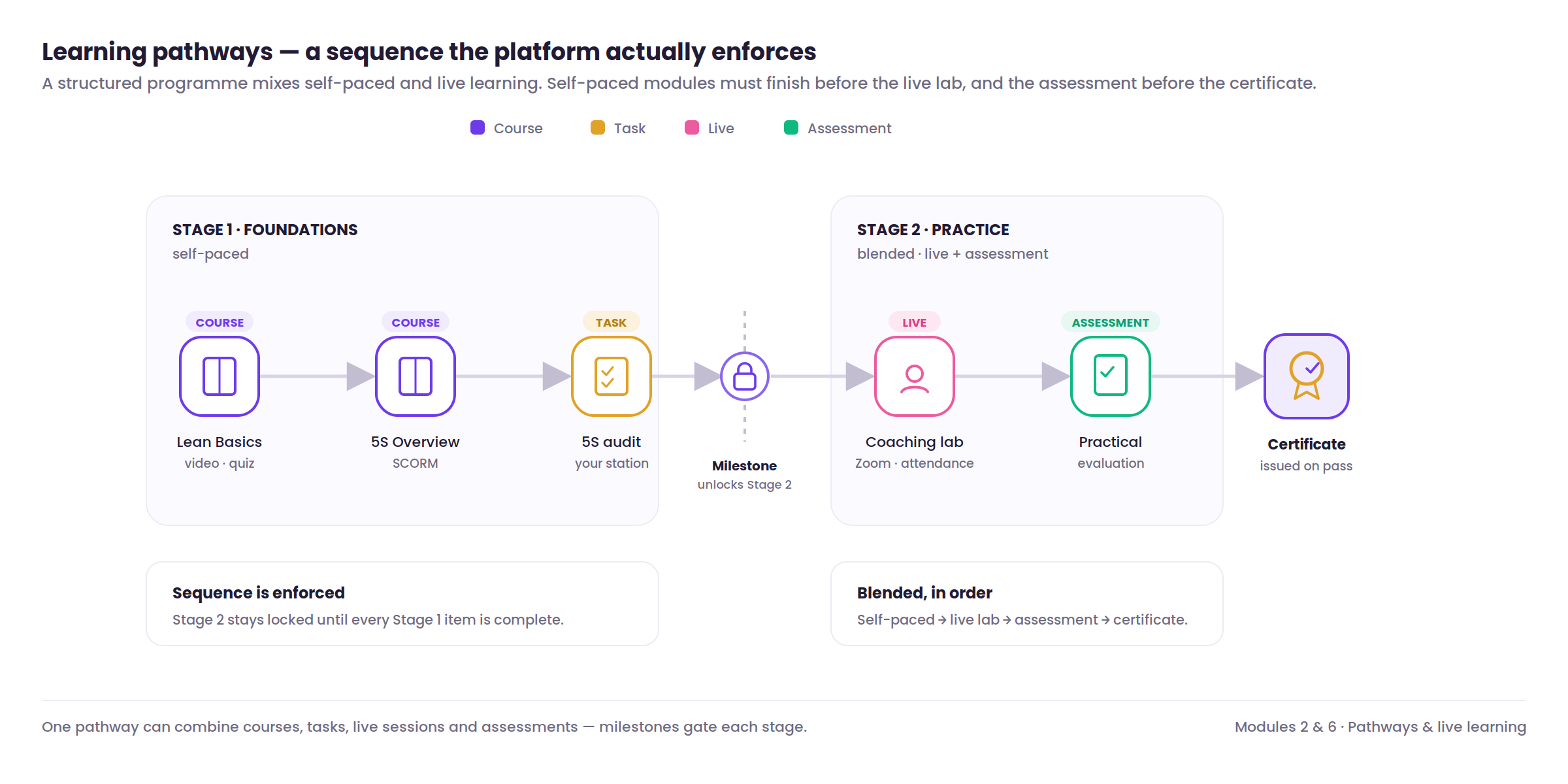
A single course rarely produces a behaviour change. A structured programme, a sequence of courses, assessments, live sessions, and practical tasks that build on each other, does.
Learning pathway structure:
| Element | Description | Example |
| Stage | A phase of the programme with defined outcomes | Stage 1: Foundations |
| Course | A structured learning experience | “Introduction to Lean Manufacturing” |
| Assessment | A knowledge check or practical evaluation | Post-course quiz |
| Live session | A scheduled webinar or classroom | Manager coaching session |
| Task | A real-world application activity | “Complete a 5S audit of your workstation” |
| Milestone | A checkpoint that triggers the next stage | “Complete Stage 1 to unlock Stage 2” |
Onboarding pathways:
New hire onboarding is the highest-stakes learning programme in most companies. A new hire who completes their onboarding programme fully is significantly more likely to reach productivity faster and stay longer than one who does not.
The LMS supports role-specific onboarding pathways, a software engineer’s onboarding is different from a sales representative’s, which is different from a finance analyst’s. Each pathway is pre-built with the right content, the right sequence, and the right milestones.
When a new employee is created in the HRMS and their role is assigned, the LMS automatically enrols them in the appropriate pathway. Their manager sees their progress in real time.
Compliance training is the non-negotiable layer of corporate learning. POSH training, anti-bribery policies, data privacy awareness, safety training, industry-specific certifications, every employee must complete certain training by certain dates, with verifiable proof of completion.
The compliance module manages:
| Feature | Details |
| Mandatory course assignment | Courses assigned automatically by role, location, or regulation |
| Due date management | Completion deadlines set at individual or batch level |
| Escalating reminders | Email + push notification at 30 days, 14 days, 7 days, 2 days before due date |
| Manager alerts | Manager notified when their direct report is overdue |
| HR escalation | HR notified when a team’s compliance rate falls below threshold |
| Certificate generation | PDF certificate issued on completion with employee name, date, score |
| Audit trail | Immutable record of who completed what, when, at what score |
| Renewal tracking | Annual or periodic recertification managed automatically |
| Exemption management | Employees who qualify for exemption (e.g., experienced hire) flagged |
| Regulatory reporting | Compliance status export for regulatory submission |
The compliance dashboard:
The compliance dashboard is the most-viewed screen for HR and legal teams. It shows: company-wide compliance percentage by regulation, department-wise completion rates, individuals overdue with days remaining, historical completion trend, and upcoming renewal dates by cohort.
Most corporate learning is reactive, an employee needs a skill, they find a course, they complete it.
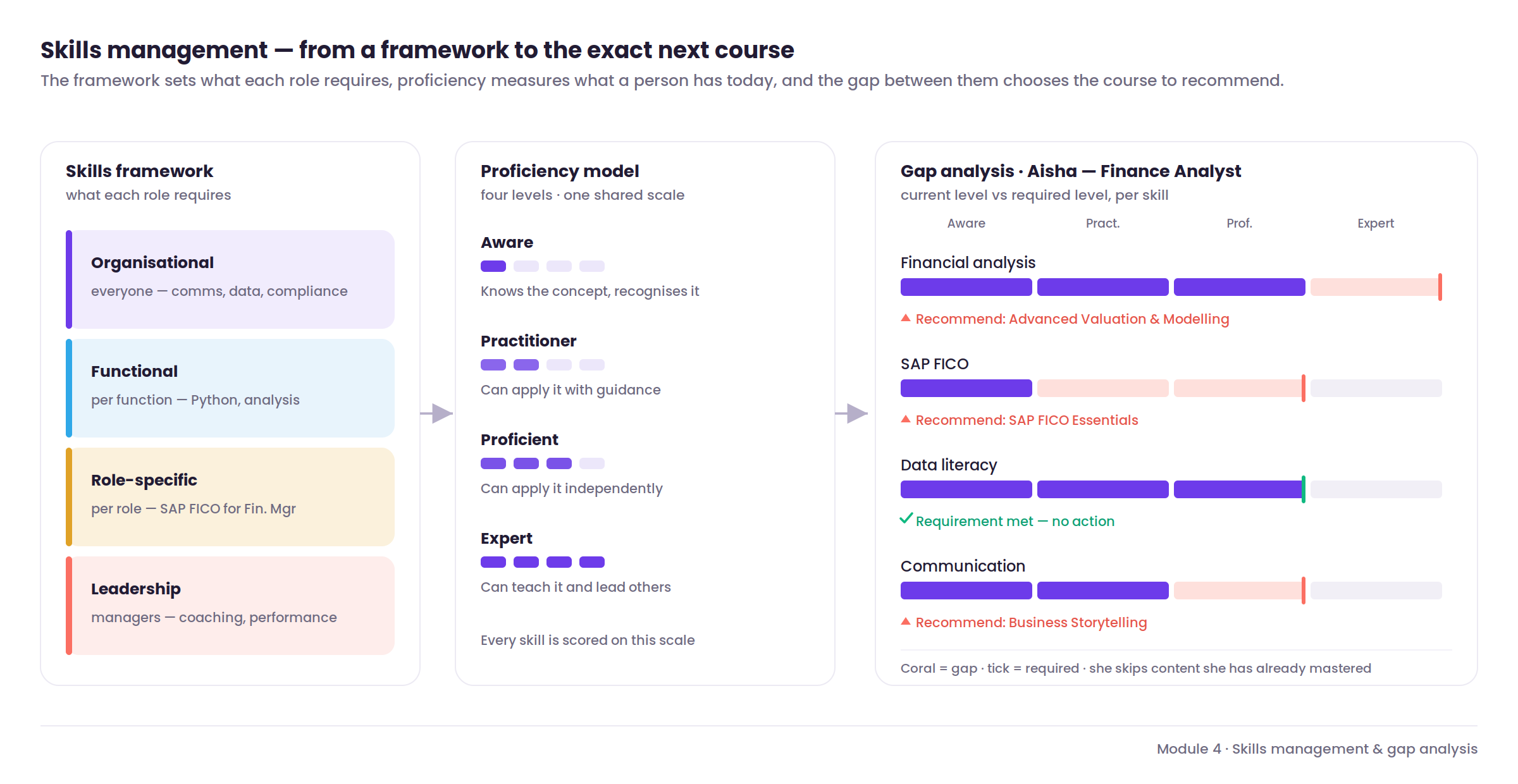
A skills management module makes learning proactive, the system knows which skills each role requires, measures which skills each employee currently has, and recommends the specific learning that closes the gap.
The skills framework:
| Level | Skills |
| Organisational skills | Skills required by everyone (communication, data literacy, compliance) |
| Functional skills | Skills required by a function (financial analysis for Finance, Python for Engineering) |
| Role-specific skills | Skills required for a specific role (SAP FICO for Finance Manager) |
| Leadership skills | Skills required for management roles (coaching, performance management) |
The skill proficiency model:
Each skill has four proficiency levels:
| Level | Description |
| Aware | Knows the concept, can recognise it |
| Practitioner | Can apply it with guidance |
| Proficient | Can apply it independently |
| Expert | Can teach it and lead others |
The gap analysis:
For each employee, for each required skill, the system shows the current proficiency level and the required proficiency level for their role. The gap, current vs required, drives learning recommendations.
An employee who is Aware in a skill that requires Proficiency gets the intermediate course, not the beginner course they have already passed.
This is where the LMS moves from content delivery to actual learning intelligence. A one-size-fits-all learning catalogue is the fastest way to destroy learner engagement.
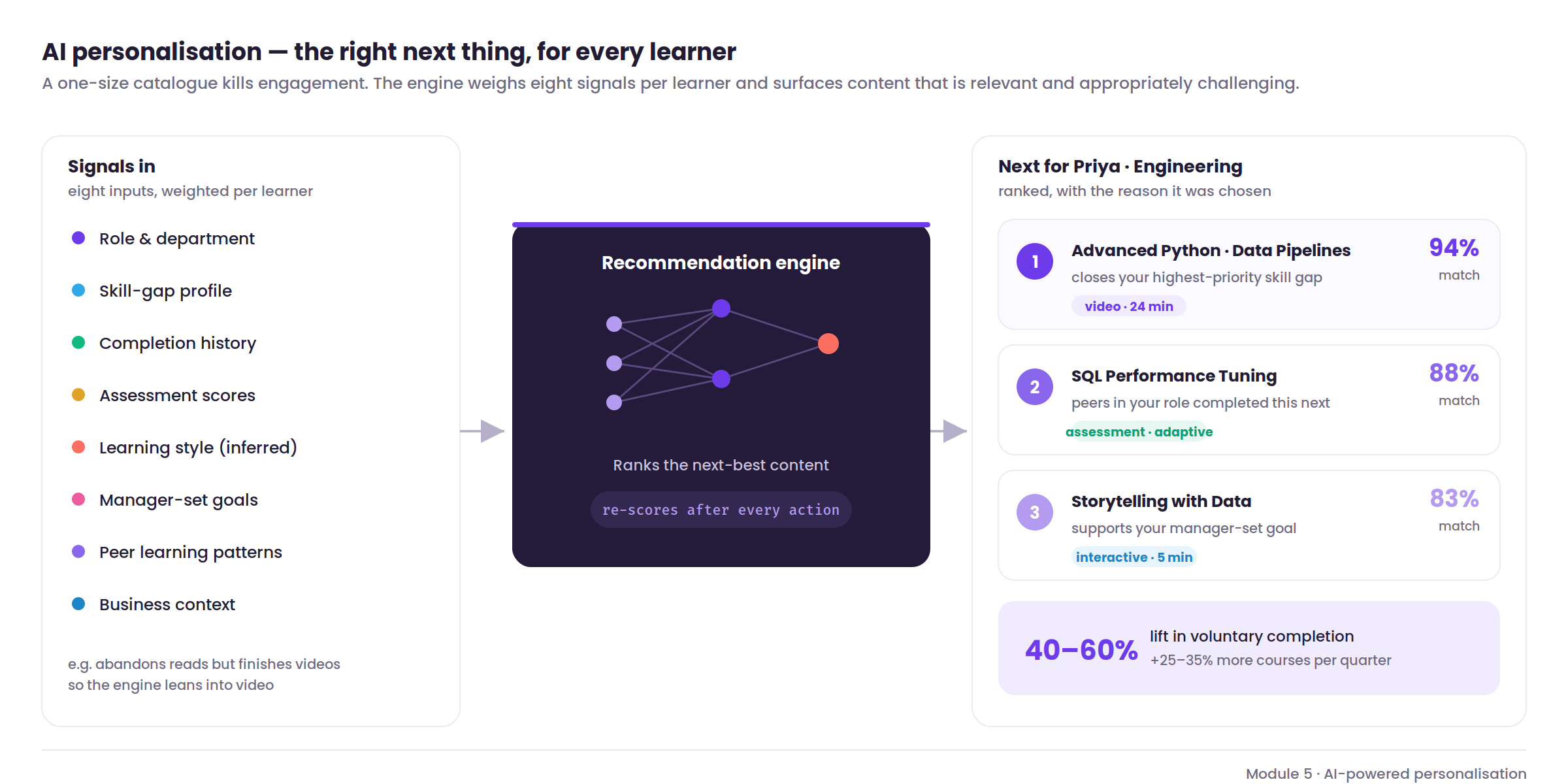
An AI-personalised experience that shows each learner exactly what they need next, based on their role, their skill gaps, their learning history, and their performance signals, is what drives the completion rates that actually move capability.
The AI recommendation engine:
| Signal | How It Informs Recommendations |
| Role and department | Prioritises role-specific and function-specific content |
| Skill gap profile | Recommends content that closes the highest-priority gaps |
| Completion history | Avoids re-recommending completed content, builds on prior learning |
| Assessment scores | Identifies knowledge gaps from assessment performance |
| Learning style (inferred) | If learner consistently completes videos but abandons reads, recommends video |
| Manager-assigned goals | Performance goals drive learning recommendations |
| Peer learning patterns | “People in your role who completed X also completed Y” |
| Business context | Company is launching a new product, recommend related product training |
Adaptive assessment:
In adaptive assessment, question difficulty adjusts based on the learner’s performance. A learner who answers three consecutive questions correctly gets harder questions. A learner who struggles gets easier ones.
The result is a more accurate measure of proficiency than a fixed question bank, and a less frustrating experience for the learner because they are not stuck on questions above their current level.
Not everything can be self-paced. Leadership development, complex skill workshops, peer discussion, and coaching need human interaction. The LMS integrates with live learning to manage the scheduling, attendance, and follow-up of live sessions.
Live learning types supported:
| Type | Integration | Tracking |
| Virtual instructor-led training (VILT) | Zoom, Teams, Webex integration | Attendance logged automatically |
| In-person classroom | Manual attendance mark or QR scan | Attendance logged by facilitator |
| Webinars | Zoom Webinar, GoToWebinar | Attendance logged via integration |
| Coaching sessions | Calendar integration | Session notes logged by coach |
| Assessment centres | Custom evaluation forms | Evaluator input → competency record |
Blended learning programmes:
A blended programme combines self-paced and live elements in a single pathway. The LMS tracks both, a learner must complete the self-paced modules before they can attend the live workshop, and must complete the post-workshop assessment to earn the programme certificate. The sequence is enforced by the platform.
The most important question every CHRO and CLO needs answered: “What is the training investment actually producing?” The LMS analytics layer must be able to answer this, not with vanity metrics like completion rates, but with business-linked outcomes.
Learning analytics views:
| Report | Business Question |
| Completion rates by programme | Are employees actually finishing what they start? |
| Skill coverage by department | How much of the required skill framework does each team actually have? |
| Compliance status | Are we covered legally? Who is at risk? |
| Time to proficiency | New hire onboarding, how fast are people reaching independence? |
| Assessment score trends | Is learning actually improving performance on assessments over time? |
| Content effectiveness | Which courses have the highest completion and highest post-course assessment scores? |
| Learning vs performance correlation | Do employees who complete more learning perform better on their performance reviews? |
| Engagement by content type | Do learners prefer video, interactive, or text-based content? |
| Mobile vs desktop usage | Where are learners accessing content? |
| Drop-off analysis | At what point in each course do learners stop? |
| Module | Cost Range (USD) | Notes |
| Course authoring tool + content library | $10K – $18K | Video, SCORM, xAPI, interactive slides |
| Learning pathway + programme management | $8K – $15K | Onboarding, blended learning |
| Compliance training + certificate generation | $8K – $15K | Due dates, reminders, audit trail |
| Skills framework + gap analysis | $8K – $15K | |
| AI recommendation engine | $10K – $20K | Google AI Accelerator capability |
| Adaptive assessment engine | $6K – $12K | |
| Live learning integration (Zoom/Teams) | $5K – $10K | |
| HRMS integration (SAP/Workday/Darwinbox) | $6K – $12K | Employee data sync |
| Mobile app (iOS + Android, offline) | $10K – $18K | |
| Analytics and learning ROI dashboard | $6K – $12K | |
| Admin and content management panel | $5K – $10K | |
| AWS + VAPT + Year 1 ops | $5K – $10K | |
| Total | $87K – $167K | Full corporate LMS |
EngineerBabu built enterprise platforms for Adani Group and technology solutions for 75+ YC-backed companies globally. CMMI Level 5. Google AI Accelerator 2024 Top 20. Contact: mayank@engineerbabu.com
SCORM (Sharable Content Object Reference Model) is the industry standard for packaged e-learning content. A SCORM package is a ZIP file containing an e-learning course, typically built with tools like Articulate Storyline or Adobe Captivate, that can be imported into any SCORM-compliant LMS and tracked for completion, score, and time spent. Most enterprise organisations have existing SCORM content libraries, courses purchased from vendors, courses built by instructional designers over the years, or content from previous LMS migrations. A corporate LMS that does not support SCORM 1.2 and SCORM 2004 cannot use this existing content, forcing expensive content rebuilds. Supporting SCORM is non-negotiable for any enterprise LMS deployment.
A corporate LMS is primarily an administrator-driven system, HR and L&D teams assign courses, set compliance deadlines, and track completion. The learner’s experience is largely determined by what administrators push to them. A Learning Experience Platform (LXP) is primarily learner-driven, it surfaces content recommendations based on the learner’s role, interests, and behaviour, and allows learners to discover and complete content they were not explicitly assigned. Modern corporate LMS platforms increasingly blend both models: a structured administrator-controlled layer for compliance and required learning, and an AI-powered personalisation layer that makes voluntary learning genuinely engaging. Building a platform that serves both functions, structure for compliance, personalisation for development, is what separates enterprise-grade LMS from both legacy compliance tools and pure consumer-style learning platforms.
AI personalisation improves completion rates by solving the relevance problem, the primary reason learners abandon voluntary training. When an LMS recommends courses based purely on job title, learners see content they have already completed, content that is too basic for their level, or content that does not connect to their current work priorities. AI personalisation analyses learning history, assessment performance, skill gap profile, manager-set goals, and peer learning patterns to recommend the next most relevant and appropriately challenging content for each learner. Research from enterprise LMS deployments consistently shows that AI-personalised recommendations increase voluntary course completion rates by 40 to 60% and increase the number of courses completed per learner per quarter by 25 to 35%.