How to Build a Digital Twin Platform - IoT Data Binding, Real-Time Simulation, Scenario Analysis 2026


Create engaging, high-performance mobile applications tailored to your business needs. We craft future-ready apps that offer smooth user experiences on all devices.
Build robust and scalable websites and CMS platforms that help you manage content effortlessly. Our development ensures a seamless digital presence.
Launch secure, feature-rich online stores with intuitive shopping experiences. We build tailored eCommerce platforms designed for growth.
Design captivating games with immersive gameplay and stunning graphics. From concept to launch, we build engaging experiences that players love.
Enhance your customer relationships with customized Salesforce implementations. Drive growth and efficiency with smarter CRM solutions.
Harness artificial intelligence and machine learning to automate workflows and gain actionable insights. Our AI transforms data into smart decisions.
Accelerate your software delivery lifecycle with continuous integration, delivery, and infrastructure automation to boost efficiency.
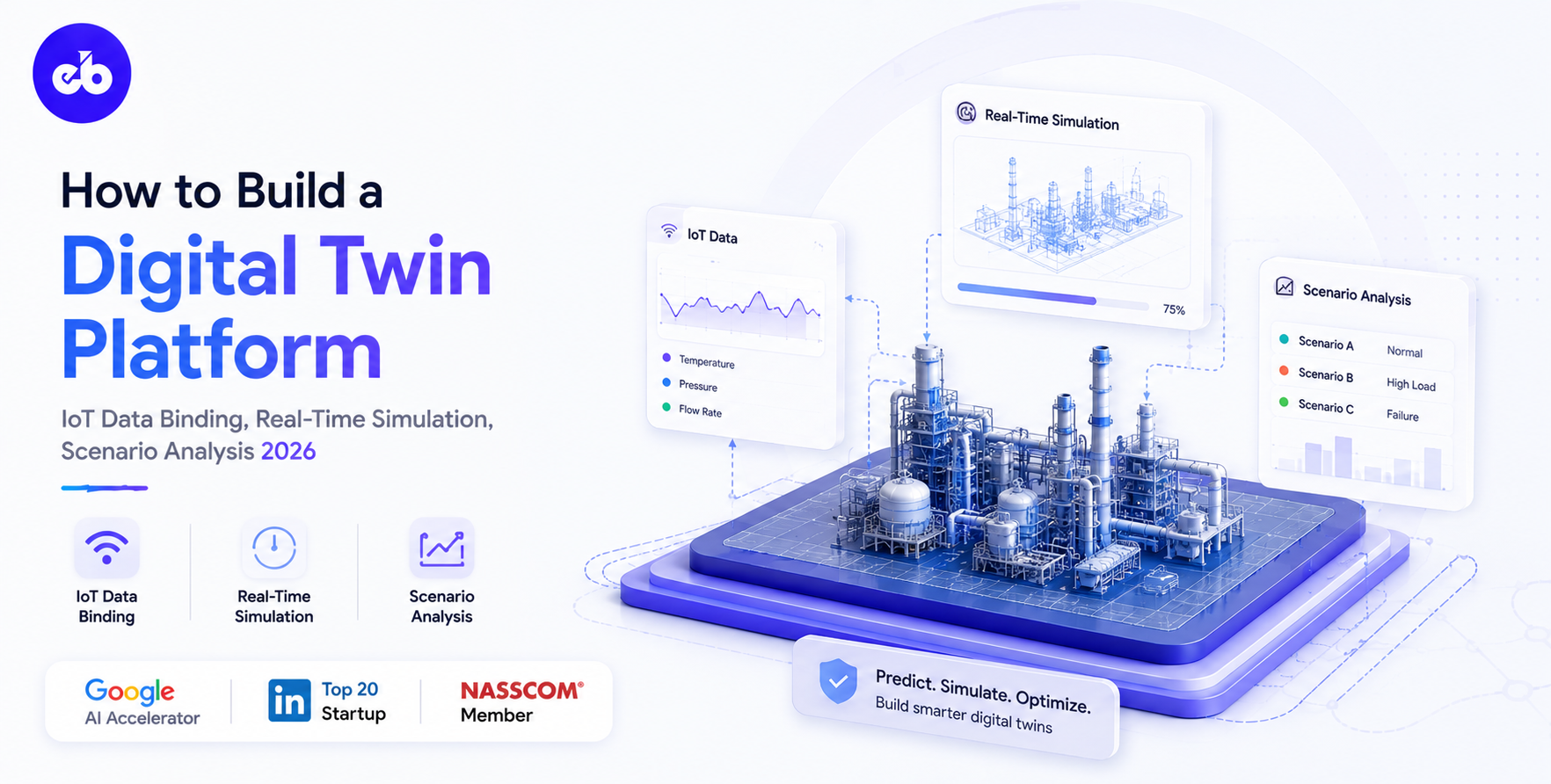
A digital twin is a real-time digital replica of a physical asset, process, or system, continuously updated from sensor data so its virtual state mirrors the physical reality. The value is not the 3D model. It is the simulation and prediction layer.
A digital twin of a gas turbine can simulate the effect of changing maintenance schedules on reliability without touching the physical turbine.
EngineerBabu built AI-powered operations management for Adani Group, large-scale industrial operations where digital twin capabilities directly impact uptime and efficiency. Contact: mayank@engineerbabu.com
A digital twin is a dynamic digital representation of a physical asset, process, or entire facility that stays synchronized with real-world conditions through continuous data from IoT sensors, industrial control systems, and enterprise applications.
Unlike static dashboards, digital twins combine real-time monitoring with simulation, predictive analytics, and optimization to help organizations understand current performance, anticipate failures, and evaluate operational changes before implementing them.
Industries such as manufacturing, energy, utilities, oil and gas, logistics, and smart buildings use digital twins to reduce downtime, optimize maintenance, improve energy efficiency, and increase asset lifespan. As more industrial assets become connected, digital twins are becoming a core component of Industry 4.0 initiatives.
According to MarketsandMarkets, the global digital twin market is projected to grow from $21 billion in 2025 to $149.32 billion by 2032, driven by rapid adoption of IoT, AI, and industrial automation technologies.
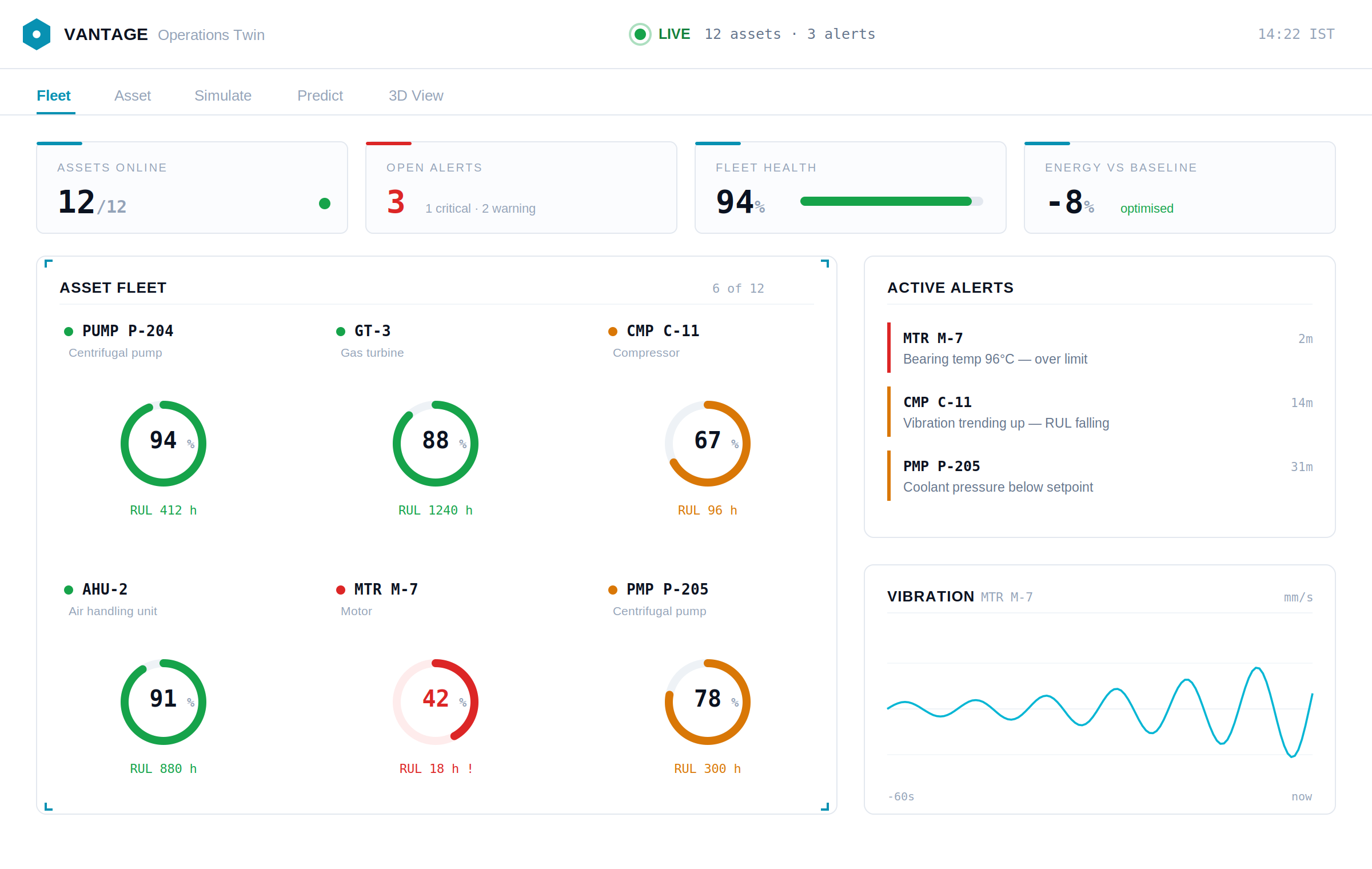
The digital twin ontology:
| Element | Description |
| Identity | Unique ID, name, type, location |
| Properties | Static attributes (motor rated power, design pressure) |
| State variables | Dynamic values updated from sensors |
| Relationships | How this twin relates to others (pump → cooling system → building) |
| Behaviours | Physics equations or data models governing response to inputs |
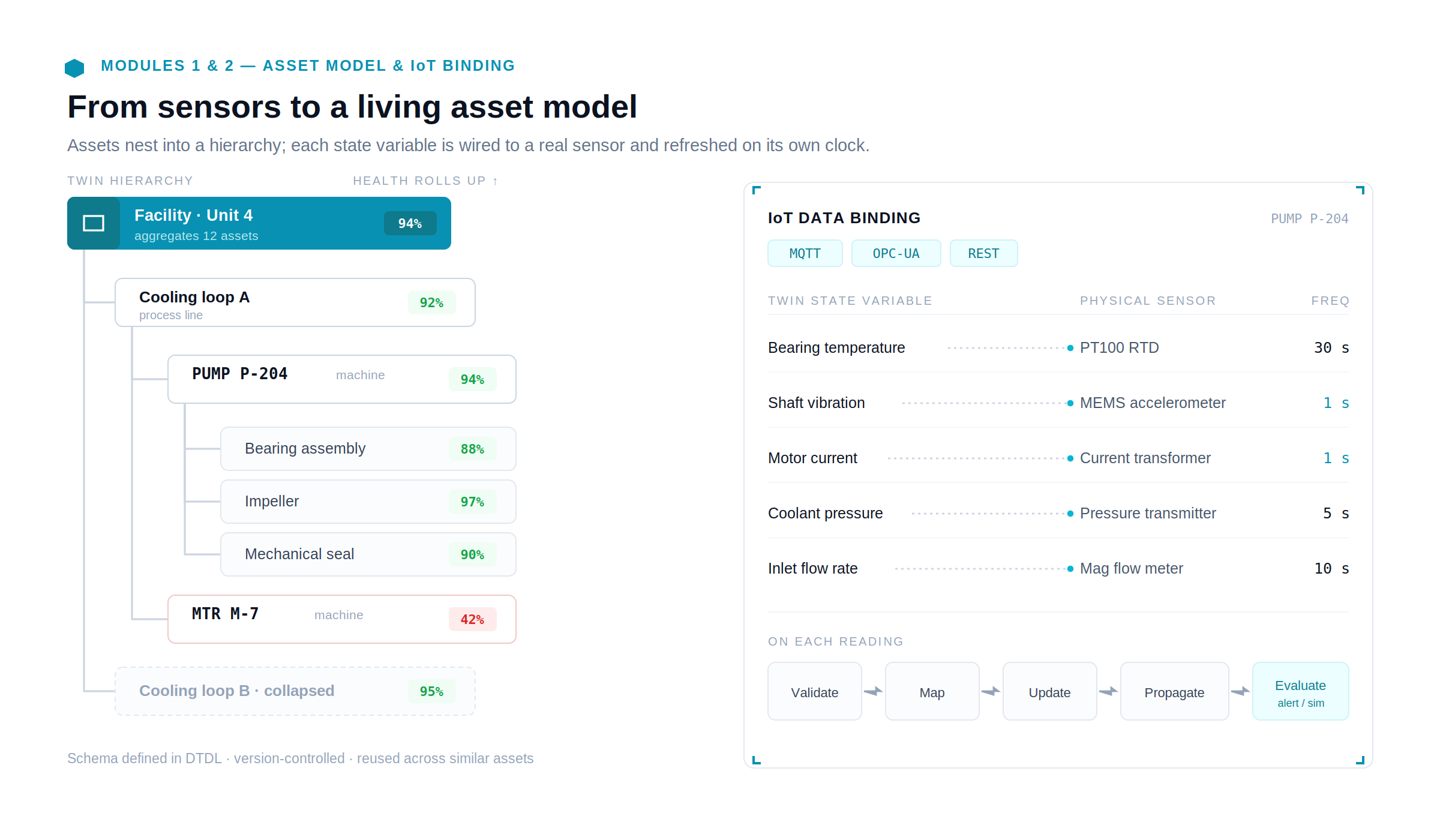
The twin hierarchy:
Digital twins are hierarchical. A facility twin contains process line twins, which contain machine twins, which contain component twins. This enables roll-up analytics, the facility dashboard reflects aggregated health of all assets below it.
Twin definition language:
The platform uses Microsoft DTDL (Digital Twins Definition Language) or OWL-based ontology for twin schemas. Schemas are version-controlled and reused across similar assets.
State variable to sensor mapping:
| Twin State Variable | Physical Sensor | Update Frequency |
| Bearing temperature | PT100 on bearing housing | Every 30 seconds |
| Shaft vibration | MEMS accelerometer | Every 1 second |
| Motor current | Current transformer | Every 1 second |
| Coolant pressure | Pressure transmitter | Every 5 seconds |
| Inlet flow rate | Electromagnetic flow meter | Every 10 seconds |
Real-time state synchronisation:
When a sensor reading arrives (via MQTT, OPC-UA, or API):
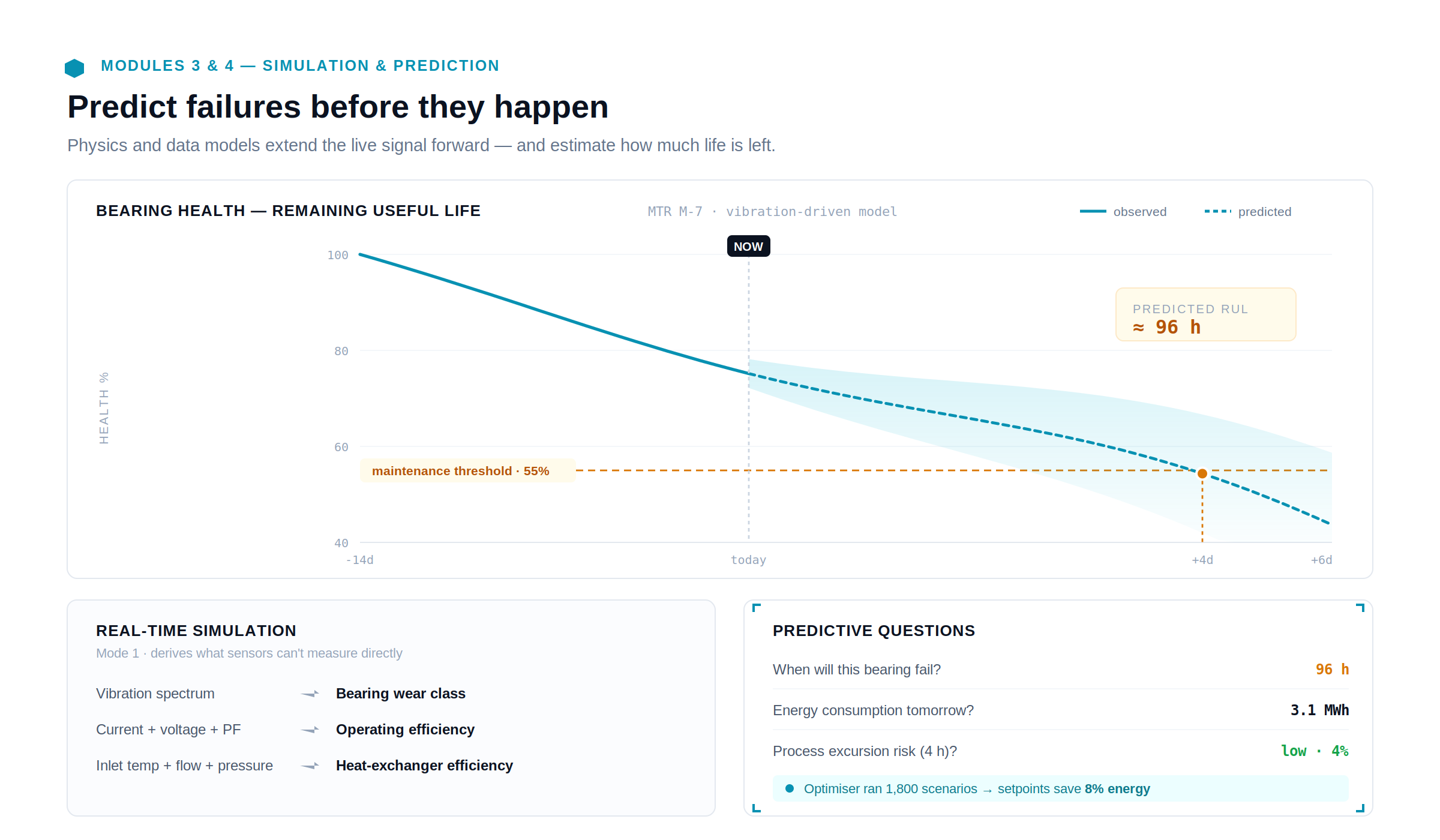
Two simulation modes:
Mode 1 – Real-time simulation (continuous):
Physics-based or data-driven models run continuously, computing derived properties:
| Measured Inputs | Simulated Output |
| Inlet temperature + flow + pressure | Heat exchanger efficiency |
| Motor current + voltage + power factor | Operating efficiency |
| Vibration spectrum at bearings | Bearing wear classification |
| Building occupancy + HVAC setpoints | Energy consumption forecast |
Mode 2 – What-if scenario analysis:
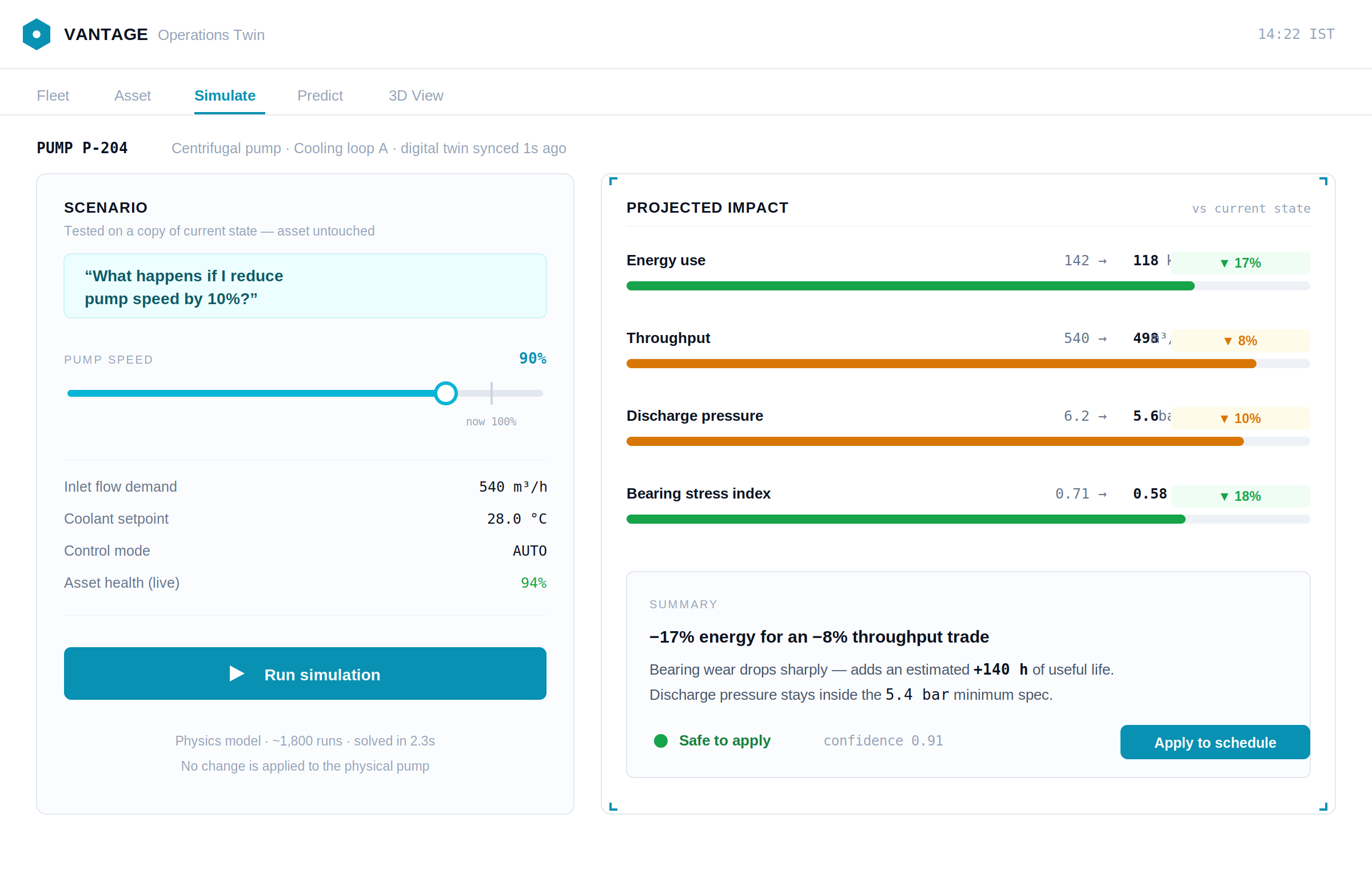
Operator creates a scenario: “What happens if I reduce pump speed by 10%?” Simulation runs against a copy of current state with proposed change, returns projected impact on energy, throughput, pressure, temperature, and equipment stress.
| Question | Prediction |
| When will this bearing fail? | RUL from vibration trend |
| What will energy consumption be tomorrow? | Time-series forecast |
| What is process excursion risk in next 4 hours? | Process safety model |
| What maintenance needed in next 30 days? | Aggregated RUL across child twins |
Optimisation engine:
What setpoint temperatures minimise energy consumption while maintaining comfort, given current asset health? The optimisation engine runs thousands of simulations and returns recommended setpoints.
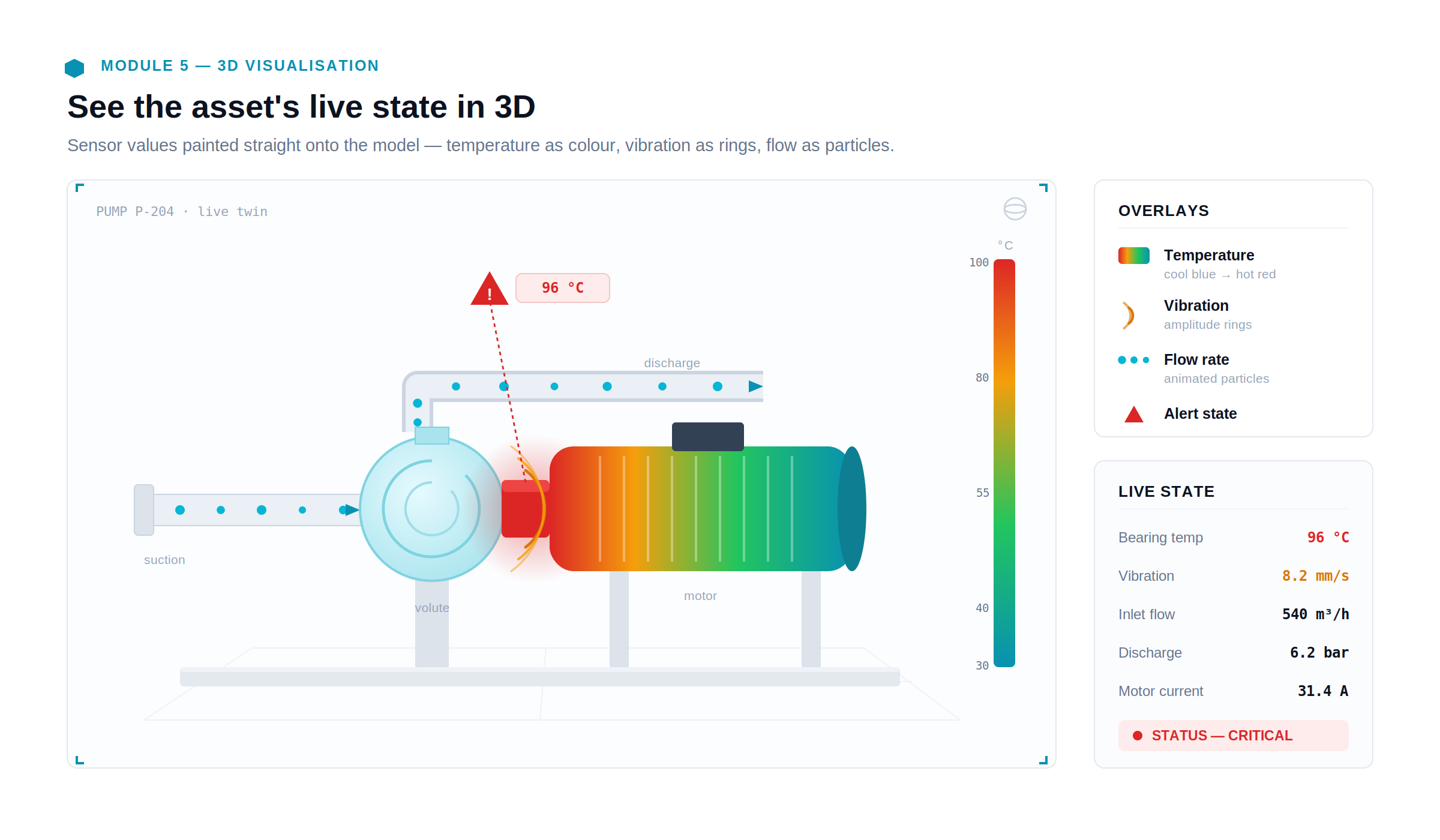
A web-based 3D viewer (Three.js or Babylon.js) renders the asset model with state overlaid:
| Module | Cost Range (USD) | Notes |
| Twin model management + DTDL | $8K – $15K | Schema versioning + hierarchy |
| IoT data binding layer | $8K – $15K | Multi-protocol |
| Real-time state synchronisation | $6K – $12K | |
| Time-series state history | $5K – $10K | InfluxDB or TimescaleDB |
| Physics simulation engine | $10K – $20K | Per domain |
| What-if scenario framework | $8K – $15K | |
| RUL/predictive analytics | $8K – $15K | |
| Optimisation engine | $8K – $15K | |
| 3D visualisation layer | $10K – $20K | Three.js + state overlay |
| AWS IoT + SOC 2 + VAPT | $6K – $12K | |
| Total | $77K – $149K | Full digital twin platform |
Contact: mayank@engineerbabu.com
AI-powered digital twins give organizations a real-time, predictive view of physical assets, enabling smarter maintenance, optimized operations, and faster decision-making through continuous data synchronization, simulation, and analytics.
EngineerBabu builds enterprise-grade AI platforms, IoT, and digital twin solutions tailored for industrial operations. To discuss your project, contact us at mayank@engineerbabu.com.
A traditional IoT dashboard displays current sensor readings and historical trends, it shows what is happening. A digital twin is a model-based representation continuously synchronised with sensor data. The key difference is the simulation and prediction layer: the digital twin runs physics models to compute derived properties not directly measured, simulates the effect of proposed operational changes before implementing them, and predicts future states based on current condition and degradation models. A dashboard shows temperature is rising. A digital twin explains why (process model), predicts what happens in 4 hours (prediction model), and recommends what operational adjustment prevents it (optimisation model).
The highest-value applications are rotating machinery (motors, pumps, compressors, turbines, predictive maintenance delivers measurable ROI), building systems (HVAC, electrical, water, energy optimisation), production lines (throughput optimisation, quality prediction), and infrastructure assets (bridges, pipelines, power networks, structural health monitoring). The common thread is assets where unplanned failure is expensive, operating efficiency is measurable, and sensor instrumentation is practical to install.
Digital twins continuously analyze sensor data alongside historical operating patterns to detect early signs of equipment degradation. By estimating the remaining useful life (RUL) of components, maintenance teams can schedule repairs before failures occur, reducing unplanned downtime and maintenance costs.
Yes. Digital twin platforms typically integrate with PLCs, SCADA systems, MES, ERP software, and IoT platforms using protocols such as MQTT, OPC-UA, Modbus, REST APIs, and industrial gateways. This allows organizations to leverage existing infrastructure without replacing operational systems.
No. While large industrial facilities often see the biggest ROI, mid-sized manufacturers, commercial buildings, utilities, and logistics companies also benefit from digital twins. Organizations can begin with a single critical asset or production line and expand the platform incrementally as business needs grow.