How to Build an AI Contract Intelligence Platform - Clause Extraction, Risk Scoring, Obligation Tracking 2026


Create engaging, high-performance mobile applications tailored to your business needs. We craft future-ready apps that offer smooth user experiences on all devices.
Build robust and scalable websites and CMS platforms that help you manage content effortlessly. Our development ensures a seamless digital presence.
Launch secure, feature-rich online stores with intuitive shopping experiences. We build tailored eCommerce platforms designed for growth.
Design captivating games with immersive gameplay and stunning graphics. From concept to launch, we build engaging experiences that players love.
Enhance your customer relationships with customized Salesforce implementations. Drive growth and efficiency with smarter CRM solutions.
Harness artificial intelligence and machine learning to automate workflows and gain actionable insights. Our AI transforms data into smart decisions.
Accelerate your software delivery lifecycle with continuous integration, delivery, and infrastructure automation to boost efficiency.
A mid-size enterprise manages 5,000 to 50,000 contracts simultaneously, vendor agreements, customer contracts, NDAs, employment agreements, leases.
Each contains obligations, deadlines, termination rights, renewal windows, liability caps, indemnification provisions, and payment terms.
When a contract auto-renews for three years because nobody noticed the 90-day notice window, that is not a legal problem. It is a technology problem. AI contract intelligence makes these obligations and risks visible at the speed of business.
An AI-powered Contract Intelligence Platform helps organizations automatically analyze, organize, and monitor contracts throughout their lifecycle.
Instead of manually reviewing lengthy legal documents, legal and procurement teams can use AI to extract critical clauses, identify risks, track contractual obligations, and search thousands of agreements in seconds.
By combining large language models (LLMs), document AI, semantic search, and workflow automation, contract intelligence platforms reduce manual effort, improve compliance, and help businesses make faster, data-driven decisions.
A modern contract intelligence platform typically includes:
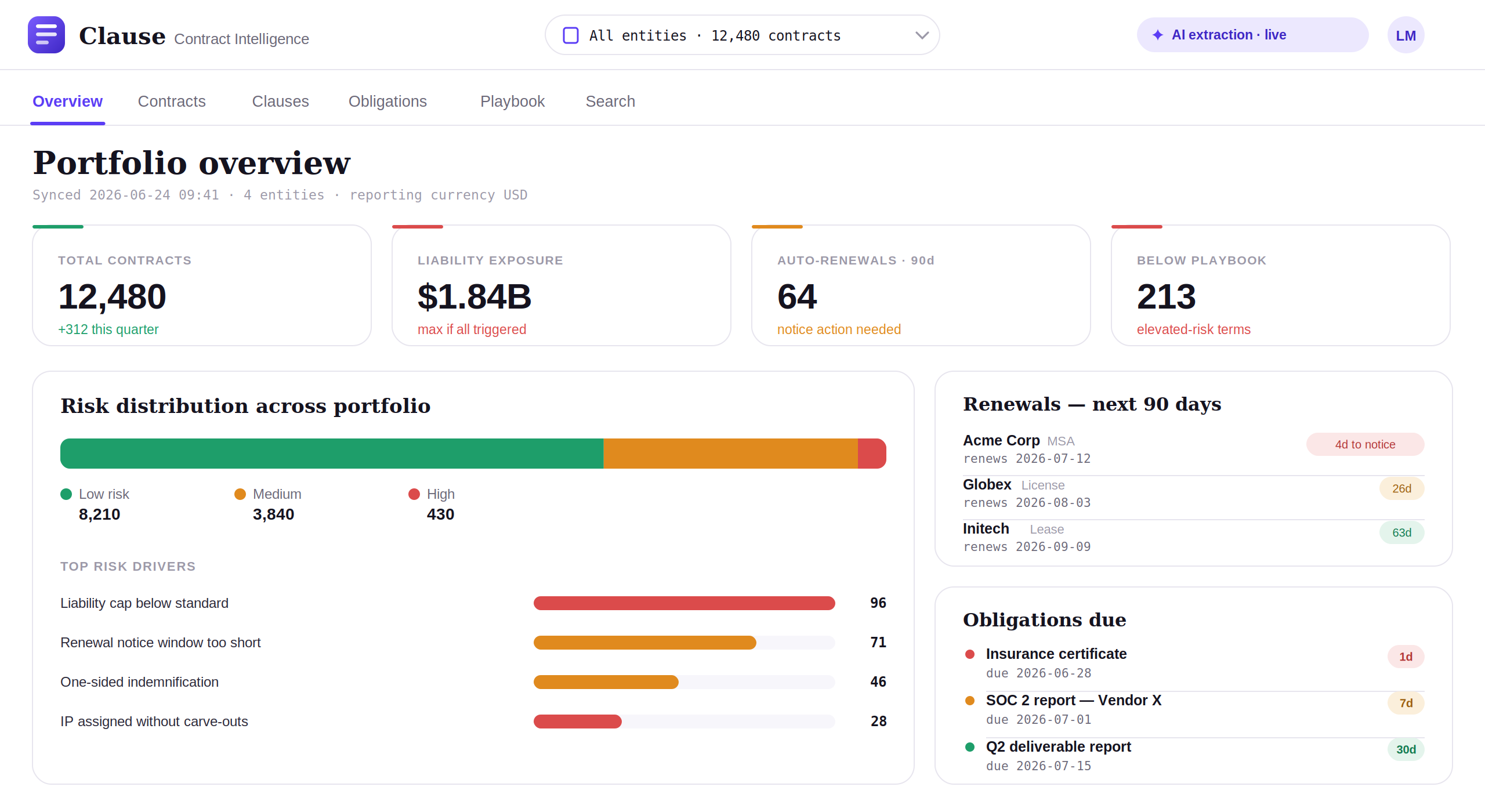
Ingestion sources:
Document classification:
A fine-tuned vision-language model classifies each document into a contract type:
Confidence routing:
| Confidence | Action |
| > 95% | Auto-classify, proceed to extraction |
| 85–95% | Auto-classify with spot-check flag |
| < 85% | Route to human classification queue |
The extraction prompt structure:
System: You are a legal contract analyst.
Extract the following clause from this document.
Return as structured JSON with confidence scores.
If not present, return {“found”: false}.
Clause type: Limitation of Liability
Fields to extract:
– cap_amount (string or number)
– cap_type (per_occurrence, aggregate, annual)
– consequential_damages_excluded (boolean)
– carve_outs (array of strings)
Common clause types extracted:
| Clause Type | Extracted Fields |
| Limitation of liability | Cap amount, cap type, exclusions |
| Indemnification | Indemnifying party, indemnified events, carve-outs |
| Termination | For-cause conditions, convenience notice period |
| Renewal | Auto-renewal flag, notice period to prevent |
| Payment terms | Due days, late penalty, invoicing requirements |
| Governing law | Jurisdiction, state/country |
| IP ownership | Who owns IP created under the contract |
| Confidentiality | Duration, exclusions, permitted disclosures |
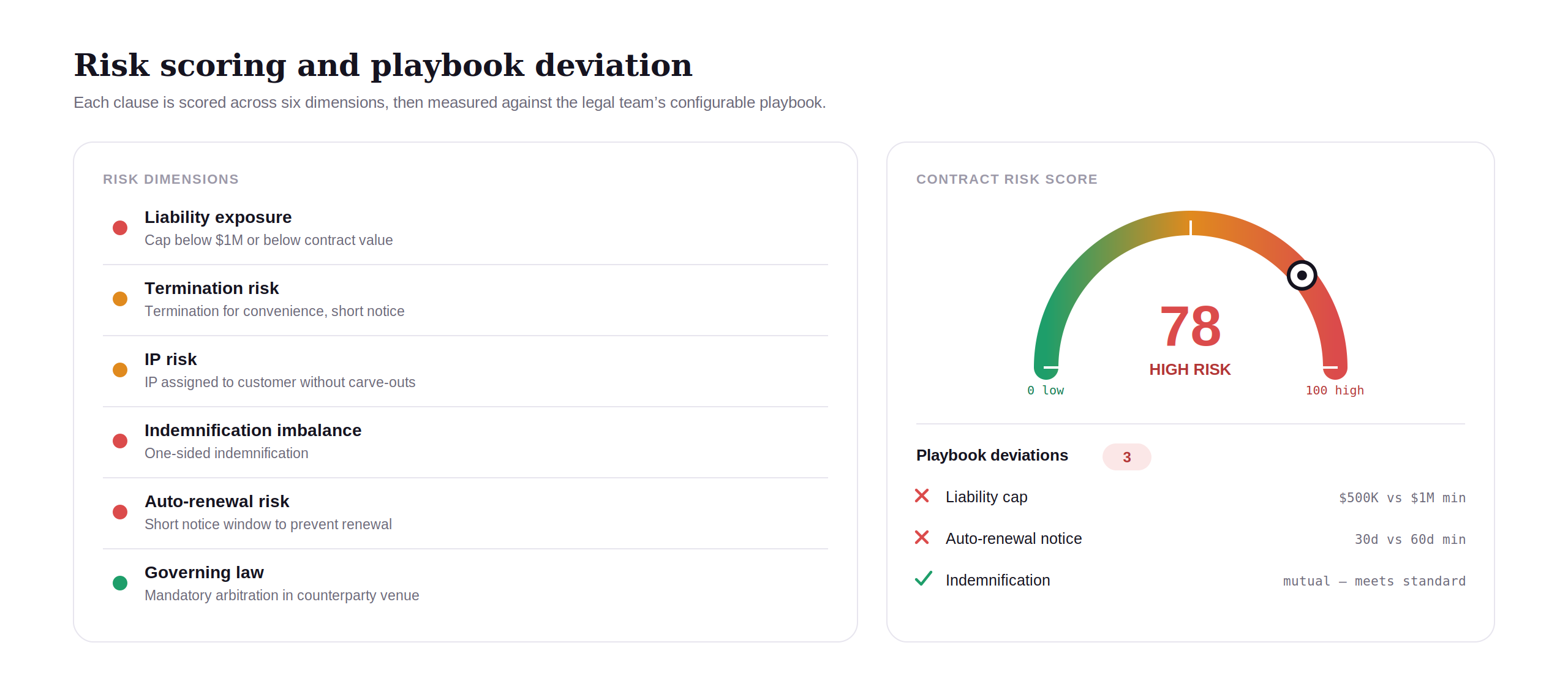
Risk scoring dimensions:
| Dimension | High-Risk Indicator |
| Liability exposure | Cap below $1M or below contract value |
| Termination risk | Termination for convenience with short notice |
| IP risk | IP assigned to customer without carve-outs |
| Indemnification imbalance | One-sided indemnification |
| Auto-renewal risk | Short notice period to prevent renewal |
| Governing law | Mandatory arbitration in counterparty’s home jurisdiction |
Playbook comparison:
The legal team defines the company’s standard contract playbook, approved positions on each clause type. The platform compares each extracted clause against the playbook:
| Clause | Contract Language | Playbook Standard | Risk Flag |
| Liability cap | $500,000 aggregate | $1,000,000 minimum | 🔴 Below standard |
| Auto-renewal notice | 30 days | 60 days minimum | 🔴 Insufficient |
| Indemnification | Mutual | Mutual required | ✅ Meets standard |
Obligation types extracted:
| Category | Examples |
| Payment | Invoice by the 1st, payment net-30 |
| Deliverable | Deliver initial report within 60 days of execution |
| Compliance | Provide SOC 2 report annually |
| Notice | 90-day notice before contract end to prevent auto-renewal |
| Insurance | Maintain $5M general liability throughout term |
The obligation calendar:
Every obligation with a deadline appears on an organisation-wide calendar. Alerts fire at 30 days, 7 days, and 1 day before. Responsible owner receives email and Slack notifications. Missed obligations escalate to their manager.
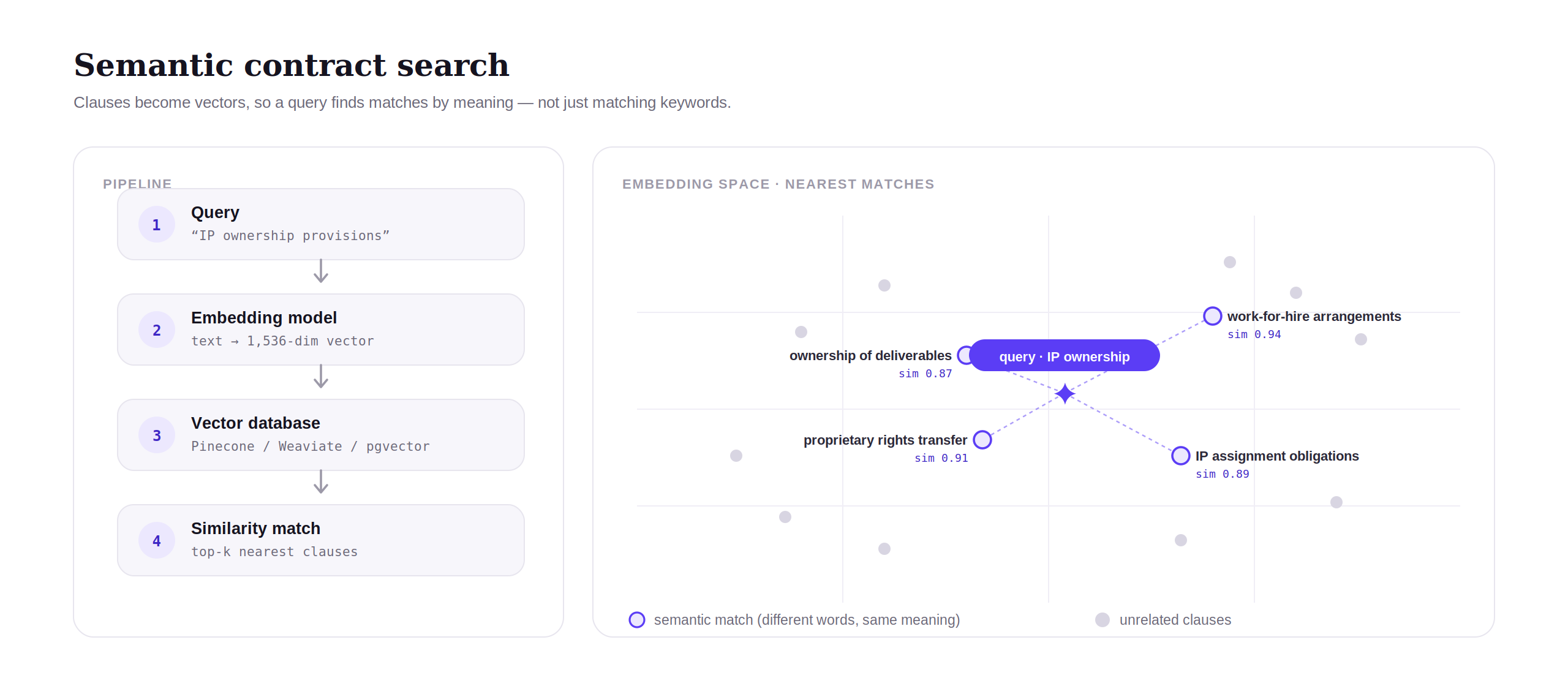
The search architecture:
Every extracted clause is embedded using a text embedding model. Embeddings stored in a vector database (Pinecone, Weaviate, or pgvector). Search queries embedded and matched against clause embeddings by similarity.
A search for “intellectual property ownership provisions” finds clauses about “work-for-hire arrangements,” “IP assignment obligations,” and “proprietary rights transfer”, even if those exact words are not in the query.
Portfolio analytics:
| View | Business Question |
| Total liability exposure | Maximum financial exposure if all contracts trigger |
| Auto-renewal risk | Contracts that could auto-renew in next 90 days |
| Below-playbook count | Contracts with non-standard elevated-risk terms |
| Jurisdiction distribution | Percentage governed by preferred jurisdiction |
| Module | Cost Range (USD) | Notes |
| Document ingestion pipeline | $5K – $10K | Multi-source |
| LLM clause extraction engine | $10K – $20K | 20+ clause types |
| Risk scoring + playbook comparison | $8K – $15K | Configurable playbook |
| Obligation extraction + calendar | $8K – $15K | Date parsing + alerts |
| Vector search infrastructure | $5K – $10K | Semantic search |
| Contract metadata extraction | $4K – $8K | Parties, dates, values |
| CLM/Drive/DocuSign integration | $6K – $12K | |
| Portfolio analytics dashboard | $6K – $12K | |
| Workflow integration (Slack, Teams, email) | $4K – $8K | |
| AWS + SOC 2 + VAPT | $5K – $10K | |
| Total | $61K – $120K | Full CLM platform |
Contact: mayank@engineerbabu.com
Read more: How to Build a Clinical Trial Management System
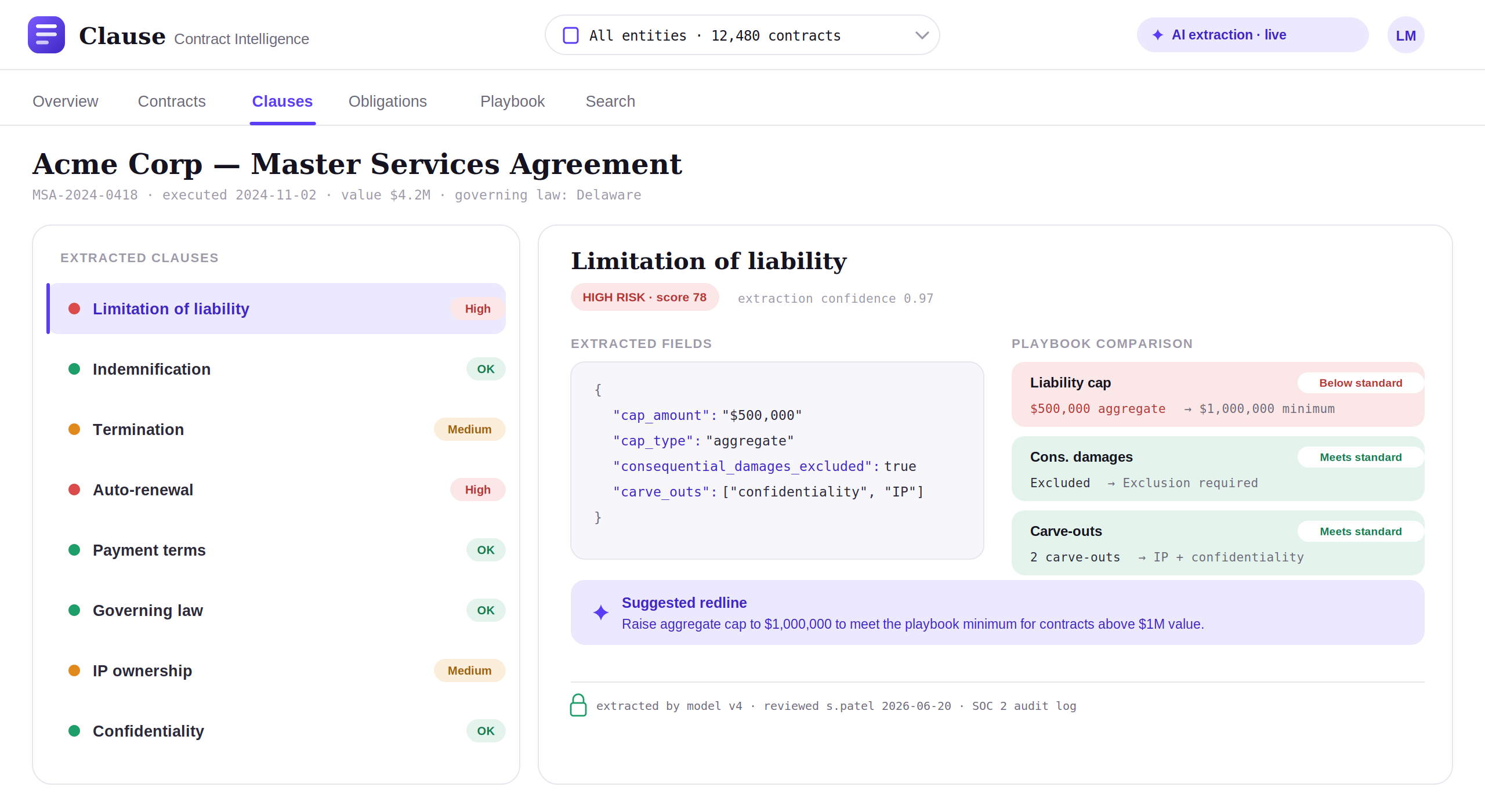
An AI-powered contract intelligence platform transforms contract management by making legal obligations, risks, and critical deadlines visible and actionable.
With automated clause extraction, risk analysis, semantic search, and obligation tracking, organizations can accelerate legal review while reducing compliance and financial risks.
If you’re planning to build a custom AI contract intelligence platform tailored to your business workflows, EngineerBabu can help. Contact us at mayank@engineerbabu.com to discuss your requirements and receive a tailored development estimate.
A contract playbook defines the legal team’s approved positions on every standard contract clause, the minimum acceptable liability cap, the required indemnification structure, the preferred governing law. Playbook comparison automatically evaluates each extracted clause against the approved position and flags deviations. Legal teams using playbook comparison report 60 to 70% reduction in first-pass review time, as reviewers focus attention on flagged deviations rather than reading every clause from scratch.
Semantic search uses text embedding models to represent contract clauses as numerical vectors where semantically similar text appears near each other. A search for “intellectual property ownership provisions” finds clauses about “work-for-hire arrangements” and “proprietary rights transfer” even if those exact words are not in the search query. Keyword search misses these conceptual variants. For legal research, where the same concept may be expressed in dozens of different ways across different contracts and jurisdictions, semantic search is the difference between finding the relevant clause and missing it entirely.
Yes. Modern contract intelligence platforms can process scanned PDFs, digitally generated PDFs, Microsoft Word documents, and contracts stored in cloud repositories such as SharePoint, Google Drive, and OneDrive. OCR technology enables extraction from scanned documents before AI analyzes the content.
Yes. Risk models and contract playbooks are fully configurable. Organizations can define acceptable liability caps, preferred governing jurisdictions, approved indemnification language, renewal notice periods, and other legal standards. The AI evaluates every contract against these internal policies.
Yes. Enterprise contract intelligence platforms are typically deployed with role-based access controls, encryption for data at rest and in transit, comprehensive audit logs, and security practices aligned with standards such as SOC 2. Additional deployment options, including private cloud or on-premises environments, can be implemented based on business and regulatory requirements.