How to Build a Clinical Trial Management System - Protocol Tracking, Site Management, eTMF, FDA 21 CFR Part 11 2026


Create engaging, high-performance mobile applications tailored to your business needs. We craft future-ready apps that offer smooth user experiences on all devices.
Build robust and scalable websites and CMS platforms that help you manage content effortlessly. Our development ensures a seamless digital presence.
Launch secure, feature-rich online stores with intuitive shopping experiences. We build tailored eCommerce platforms designed for growth.
Design captivating games with immersive gameplay and stunning graphics. From concept to launch, we build engaging experiences that players love.
Enhance your customer relationships with customized Salesforce implementations. Drive growth and efficiency with smarter CRM solutions.
Harness artificial intelligence and machine learning to automate workflows and gain actionable insights. Our AI transforms data into smart decisions.
Accelerate your software delivery lifecycle with continuous integration, delivery, and infrastructure automation to boost efficiency.
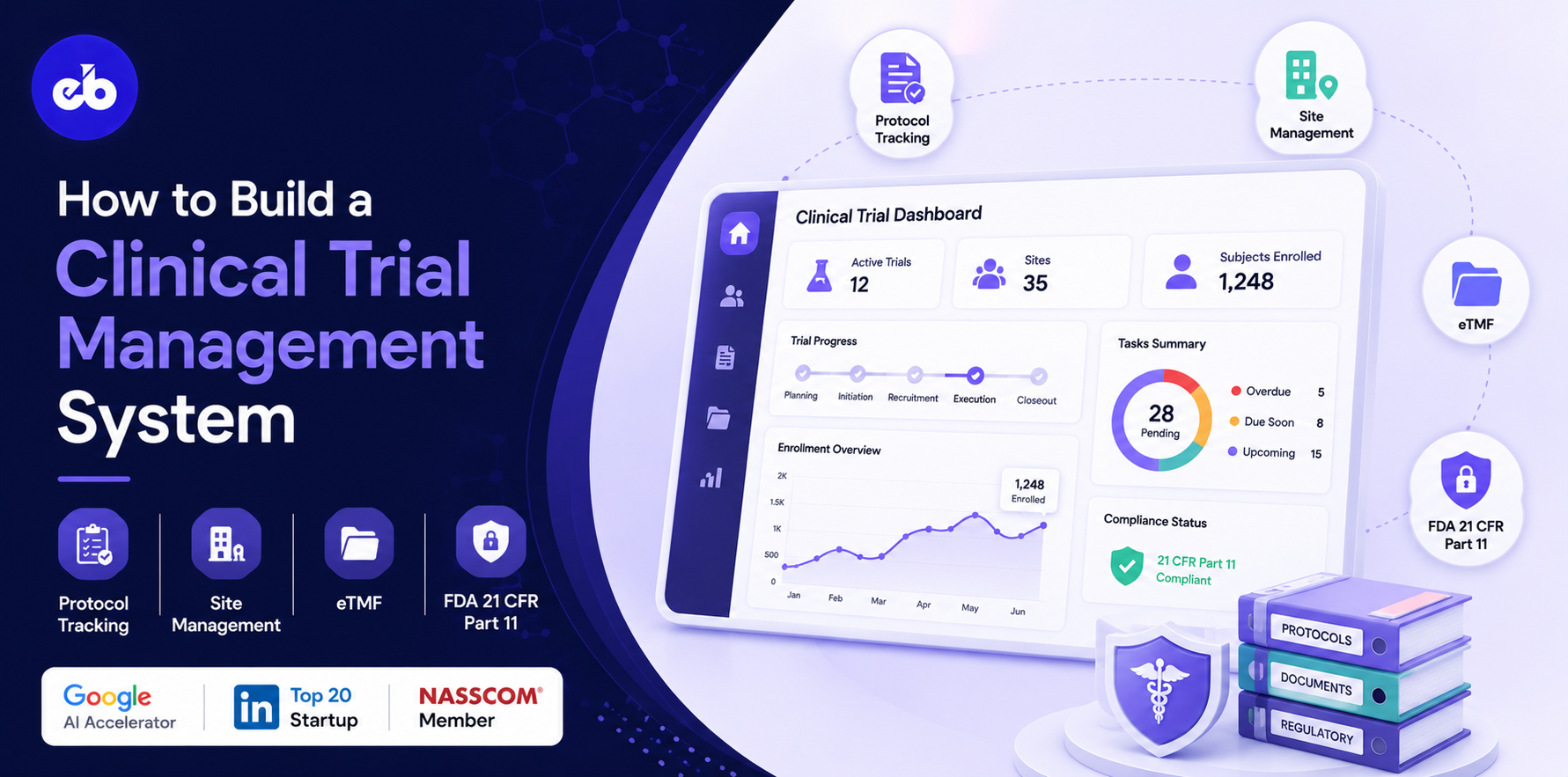
A Phase III clinical trial may involve 200 sites across 30 countries, 5,000 patients, 50,000 data points per patient, and 10 years of regulatory documentation that must be preserved with complete auditability for FDA inspection.
The CTMS is the operational backbone, tracking every site, every patient, every protocol amendment, every adverse event, and every document against a regulatory requirement framework that cannot be violated.
FDA 21 CFR Part 11 requires that all electronic records and signatures in regulated clinical research meet specific technical controls for integrity, auditability, and authenticity.
A Clinical Trial Management System (CTMS) is the operational platform used by pharmaceutical companies, biotechnology firms, CROs, medical device manufacturers, and research institutions to plan, manage, monitor, and document clinical trials from study startup through closeout.
Modern clinical trials generate massive volumes of operational, regulatory, and patient data across multiple sites and countries. A CTMS centralizes this information into a single platform, helping study teams coordinate investigators, monitor enrollment, manage protocol changes, track adverse events, schedule monitoring visits, and maintain inspection-ready documentation throughout the study lifecycle.
A well-designed CTMS improves operational efficiency while ensuring compliance with regulatory standards such as FDA 21 CFR Part 11, ICH-GCP, and regional ethics committee requirements.
A comprehensive Clinical Trial Management System typically includes:
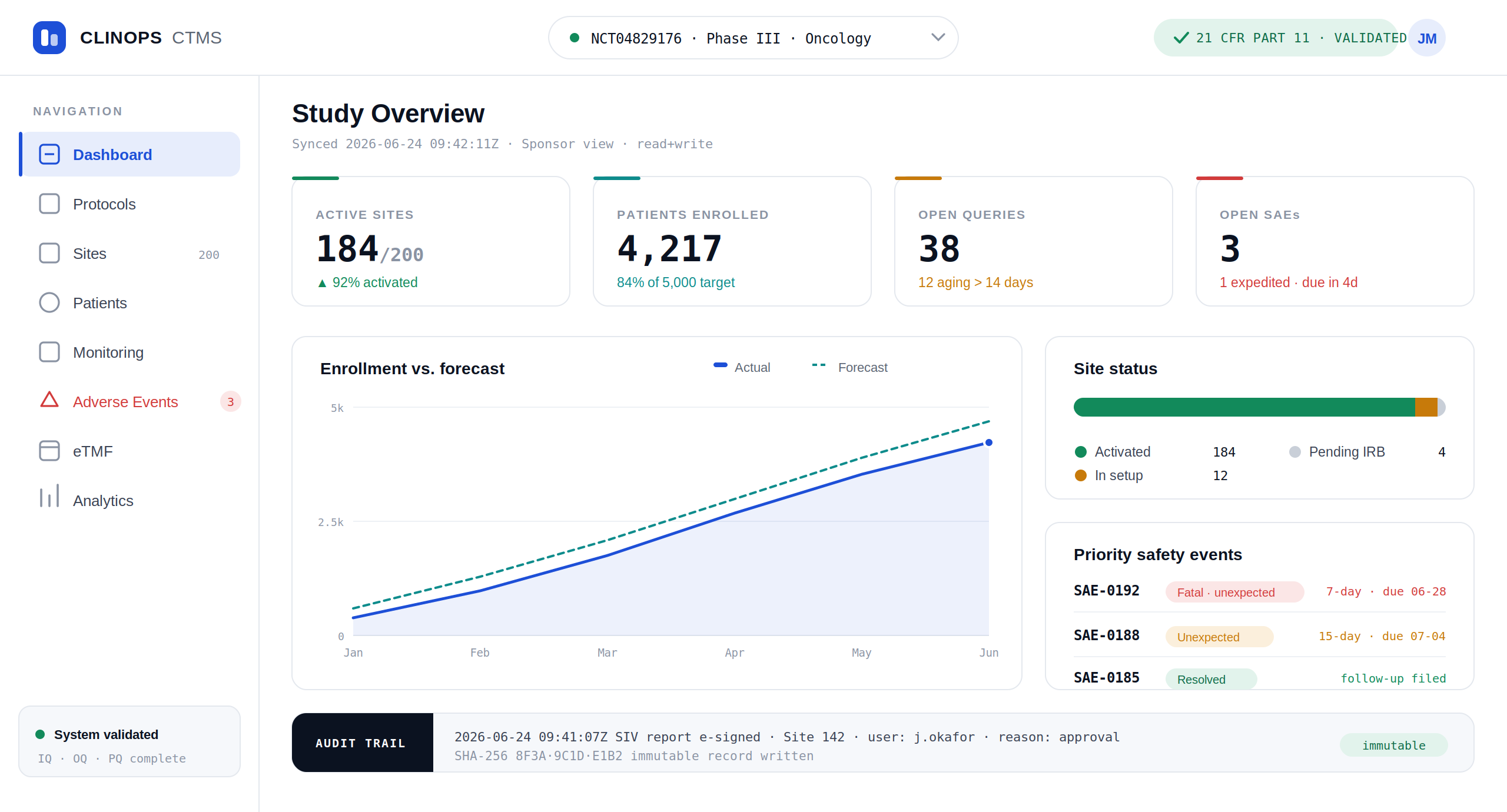
Protocol elements tracked:
| Element | Details |
| Study ID | Unique identifier + NCT number |
| Phase | I / II / III / IV |
| Primary endpoint | The outcome measure that determines success |
| Inclusion/exclusion criteria | Patient eligibility and disqualification |
| Visit schedule | Study visits and assessments at each visit |
| Investigational product | Drug/device being studied |
Protocol amendment management:
Every amendment is version-controlled with: the date, reason, and IRB approval status. All sites are automatically notified of protocol changes and their acknowledgement is documented.
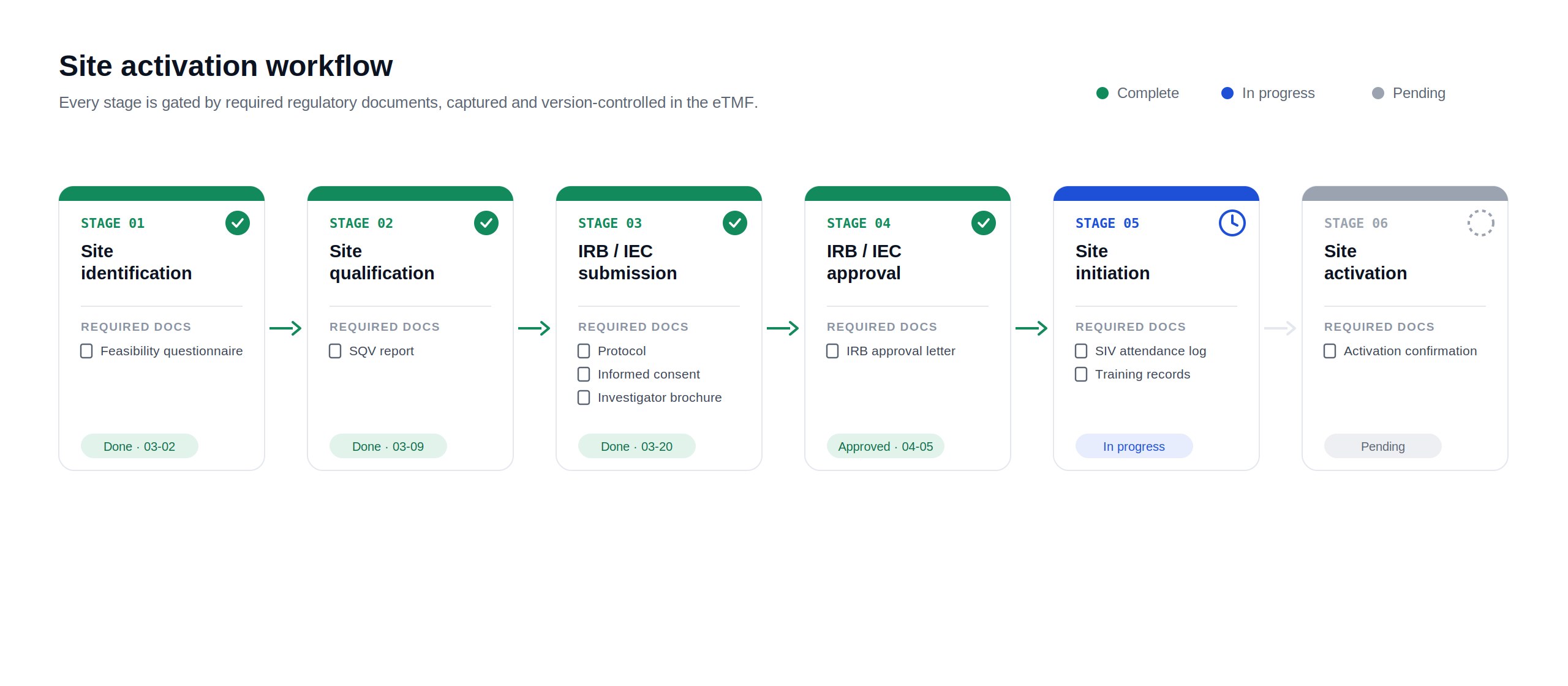
Site activation workflow:
| Stage | Documents Required |
| Site identification | Feasibility questionnaire |
| Site qualification | SQV report |
| IRB/IEC submission | Protocol, ICF, investigator brochure |
| IRB/IEC approval | IRB approval letter |
| Site initiation | SIV attendance log, training records |
| Site activation | Activation confirmation |
Site dashboard per site:
| Metric | Value |
| Enrolled patients | N of N target |
| Protocol deviations | Count + severity |
| Outstanding queries | Requiring site response |
| Next monitoring visit | Date + type |
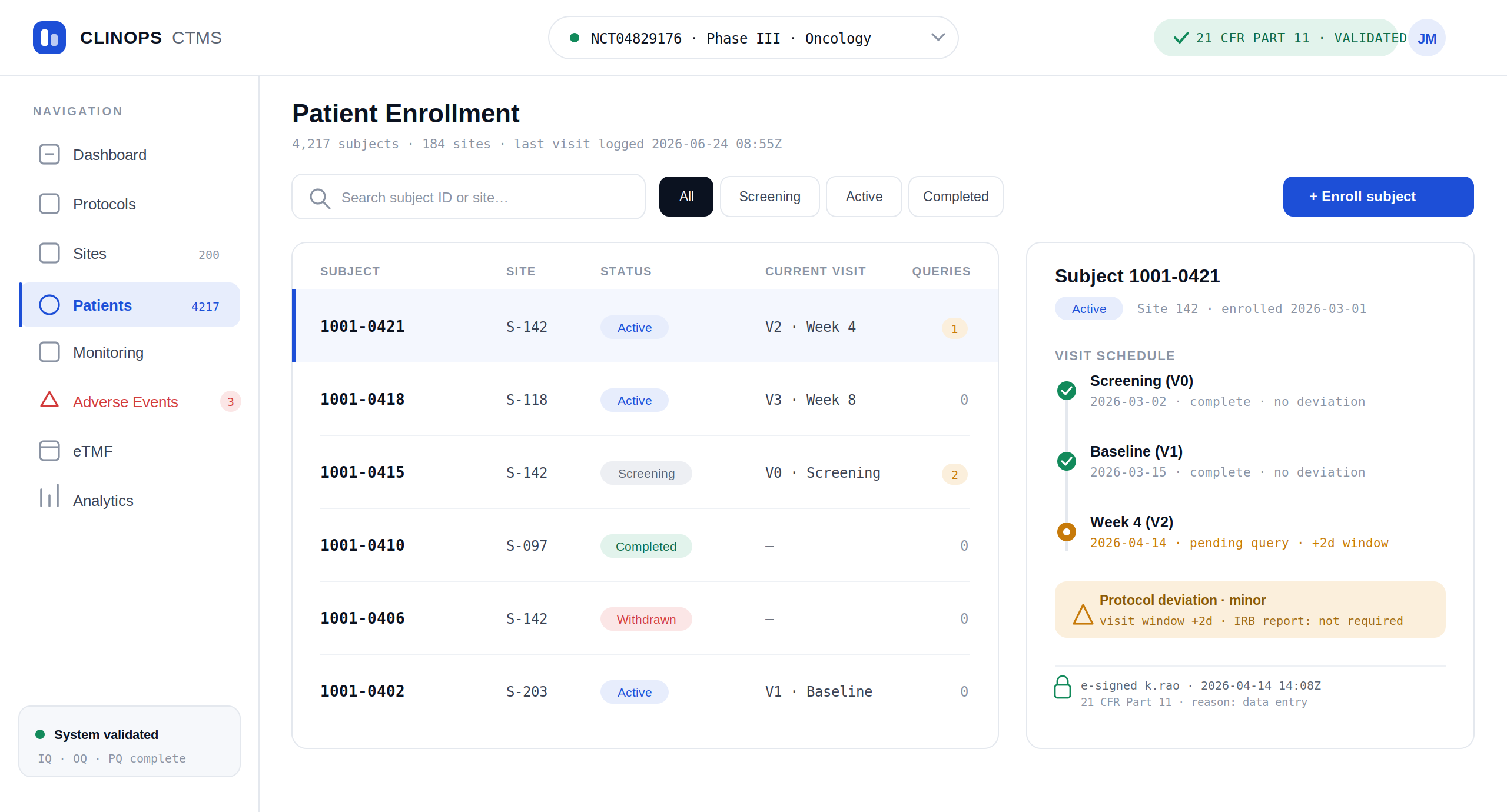
Visit tracking per patient:
| Visit | Date Planned | Completed | Deviations | Data Status |
| Screening (V0) | 2026-03-01 | 2026-03-02 | None | Complete |
| Baseline (V1) | 2026-03-15 | 2026-03-15 | None | Complete |
| Week 4 (V2) | 2026-04-12 | 2026-04-14 | 2-day delay | Pending query |
Protocol deviation management:
All deviations documented, categorised (major vs minor), reported to IRB if major, and analysed for data integrity impact.
FDA 21 CFR Part 11 technical requirements:
| Requirement | Implementation |
| Electronic signatures | Digital signatures with identity authentication + reason + timestamp |
| Audit trail | Immutable log of every document creation, modification, access, signature |
| Record integrity | Document checksums validated at storage and retrieval |
| Access controls | Role-based – monitors see trial documents, sites see their documents only |
| System validation | IQ/OQ/PQ documentation |
Document lifecycle in eTMF:
| Stage | Electronic Signature Required |
| Draft → Review | Yes (review signature) |
| Review → Approved | Yes (approval signature) |
| Approved → Superseded | Yes (superseding signature) |
| Trial end → Archived | Yes (archive signature) |
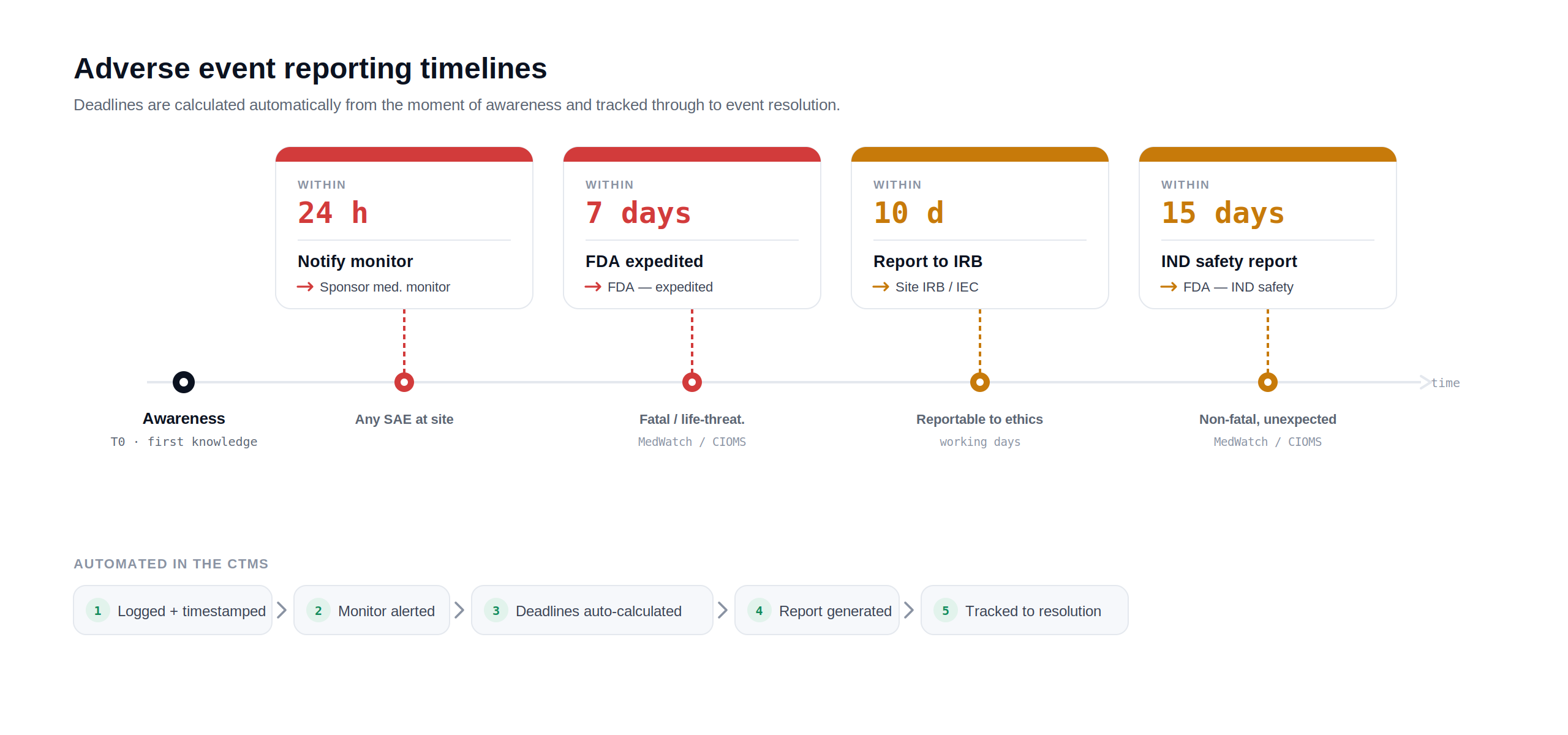
Reporting timelines:
| Event Type | Timeline | Report To |
| SAE (non-fatal, unexpected) | 15 calendar days | FDA (IND safety report) |
| SAE (fatal or life-threatening, unexpected) | 7 calendar days | FDA (expedited report) |
| SAE at site | 24 hours | Sponsor medical monitor |
| SAE to IRB | Within 10 working days | Site IRB |
The AE workflow:
| Module | Cost Range (USD) | Notes |
| Protocol management + version control | $8K – $15K | |
| Site management + activation workflow | $8K – $15K | |
| IRB/IEC submission tracking | $5K – $10K | |
| Patient enrollment + visit tracking | $8K – $15K | |
| Protocol deviation management | $5K – $10K | |
| eTMF with 21 CFR Part 11 compliance | $12K – $22K | Audit trail + e-signatures |
| DIA TMF Reference Model taxonomy | $4K – $8K | |
| Adverse event reporting workflow | $8K – $15K | MedWatch + CIOMS |
| Monitoring visit management | $5K – $10K | |
| Analytics + enrollment forecast | $5K – $10K | |
| AWS + 21 CFR 11 validation + VAPT | $8K – $15K | |
| Total | $76K – $145K | Full CTMS platform |
Contact: mayank@engineerbabu.com
A Clinical Trial Management System is essential for managing complex clinical studies while maintaining regulatory compliance, operational efficiency, and complete auditability. The right CTMS helps sponsors and CROs streamline trial operations from protocol planning to study closeout.
If you’re looking to build a secure, scalable, and FDA-compliant healthcare software, EngineerBabu can help. Contact us at mayank@engineerbabu.com to discuss your project and get a tailored development estimate.
FDA 21 CFR Part 11 governs electronic records and electronic signatures in regulated industries including clinical research. It requires: a complete audit trail of all modifications, electronic signatures legally equivalent to handwritten signatures, system access controls preventing unauthorised access, and data integrity controls ensuring records cannot be altered undetected. A CTMS that does not comply cannot be used for trials intended for FDA submissions, the data it generates may not be accepted as valid clinical evidence.
The DIA TMF Reference Model is the industry-standard taxonomy for Trial Master File document organisation, defining zones (administrative, investigator site file, regulatory), sections within each zone, and specific artefact types within each section. A CTMS structured according to the DIA Reference Model can be inspected by regulators or auditors who are familiar with the model, enabling efficient review without requiring the sponsor to explain their filing system.
A CTMS manages the operational aspects of a clinical trial, including study planning, site management, patient enrollment, monitoring visits, regulatory documentation, and trial progress. An Electronic Data Capture (EDC) system is designed specifically for collecting and managing clinical data entered during patient visits. In most clinical trials, the CTMS and EDC integrate with one another, allowing operational teams and data management teams to work from synchronized information.
Yes. Modern CTMS platforms commonly integrate with Electronic Data Capture (EDC) systems, eConsent platforms, Interactive Response Technology (IRT/IVRS/IWRS), ePRO applications, Laboratory Information Management Systems (LIMS), safety databases, Electronic Trial Master File (eTMF) platforms, and enterprise systems such as CPM or ERP solutions. These integrations reduce duplicate data entry and improve data consistency throughout the clinical trial lifecycle.
A CTMS is used by multiple stakeholders involved in clinical research, including sponsors, Contract Research Organizations (CROs), clinical operations teams, clinical research associates (CRAs), study coordinators, investigators, regulatory affairs teams, medical monitors, and quality assurance personnel. Each user receives role-based access so they can perform their responsibilities while maintaining compliance with regulatory requirements and protecting sensitive study data.