How to Build a Food Delivery App Like Uber Eats in 2026


Create engaging, high-performance mobile applications tailored to your business needs. We craft future-ready apps that offer smooth user experiences on all devices.
Build robust and scalable websites and CMS platforms that help you manage content effortlessly. Our development ensures a seamless digital presence.
Launch secure, feature-rich online stores with intuitive shopping experiences. We build tailored eCommerce platforms designed for growth.
Design captivating games with immersive gameplay and stunning graphics. From concept to launch, we build engaging experiences that players love.
Enhance your customer relationships with customized Salesforce implementations. Drive growth and efficiency with smarter CRM solutions.
Harness artificial intelligence and machine learning to automate workflows and gain actionable insights. Our AI transforms data into smart decisions.
Accelerate your software delivery lifecycle with continuous integration, delivery, and infrastructure automation to boost efficiency.
Hire app developers ready to turn your ideas into sleek, high-performing mobile apps for any platform.
Bring in frontend pros who craft smooth, beautiful, and user-friendly interfaces that your visitors will love.
Get backend developers who build fast, secure, and reliable systems to keep everything running behind the scenes.
Hire eCommerce developers who build secure, scalable online stores designed to offer seamless shopping and grow your sales.
Get dedicated developers committed to your projects, delivering consistent quality and speed as an extension of your team.
The unit economics problem in food delivery is famous. DoorDash lost $667 million in 2020 on $2.9 billion in revenue. Swiggy burned hundreds of crores building density in Indian cities. Delivery Hero has never posted a full-year profit.
The incumbents can afford to lose money per order because they’re buying market share and network density. A new entrant cannot.
Here’s where most food delivery app projects go wrong from an engineering perspective: they build the consumer app beautifully and underinvest in the dispatch engine.
The dispatch engine, the system that assigns orders to delivery partners, optimises routes, and manages delivery time estimates, is the component that directly determines the unit economics. A dispatch engine that consistently delivers in 25 minutes retains customers and enables favorable restaurant commissions. One that delivers in 45 minutes loses customers and drives commission pressure.
I co-founded EngineerBabu 14 years ago. The team has built logistics and supply chain systems including BURQ, a US logistics platform where fintech meets operations, and an FMCG supply chain system for Simba Beer India’s No.1 premium craft beer where custom AI inventory intelligence recovered millions in blocked working capital. The patterns from those logistics builds are directly applicable to food delivery dispatch systems.
The team also builds on a deeper insight: food delivery is not primarily a consumer app problem. It’s a logistics orchestration problem with a consumer app front end. Get the logistics right and the consumer app is table stakes. Get it wrong and no amount of consumer UX investment saves you.
If you’re ready to build email mayank@engineerbabu.com
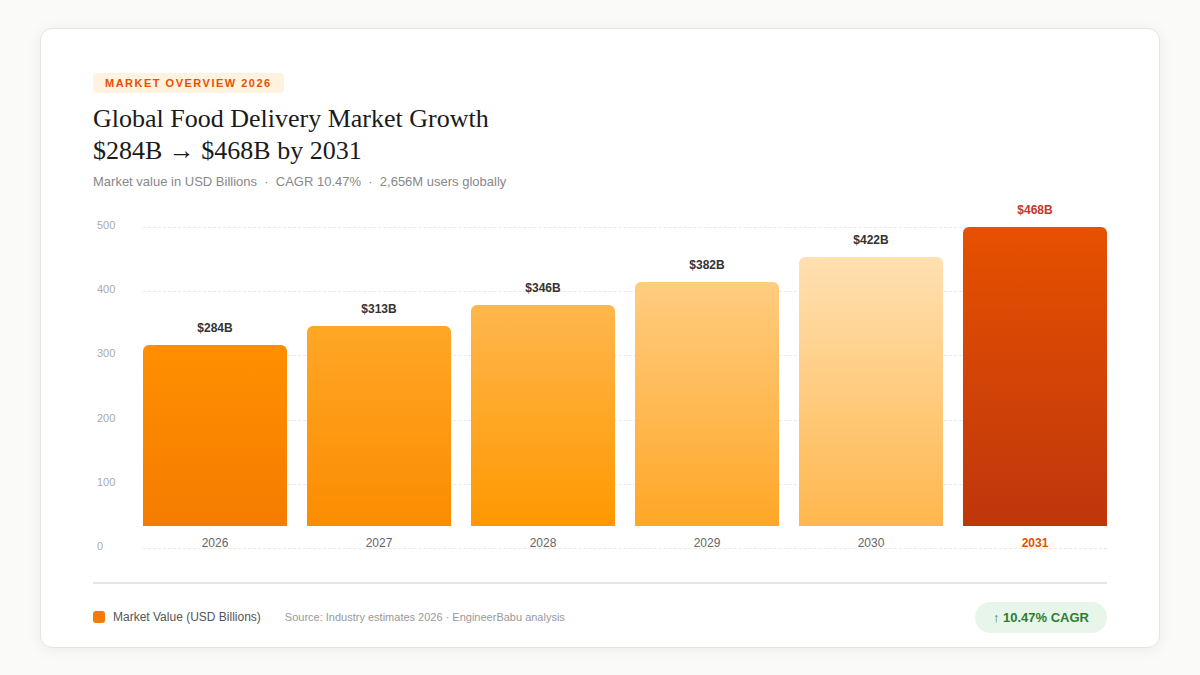
The online food delivery market was valued at $284 billion in 2026, growing to $468 billion by 2031 at a CAGR of 10.47%. 2,656 million users globally. Mobile apps capture 82.76% of all orders.
The market is enormous. It’s also dominated.
DoorDash holds 65%+ of the US market. Uber Eats is the most downloaded food delivery app globally. Meituan owns China. Zomato and Swiggy own India between them. These platforms have network density restaurants are already on them, drivers are already on them, customers are already on them.
But here’s where new entrants consistently find white space:
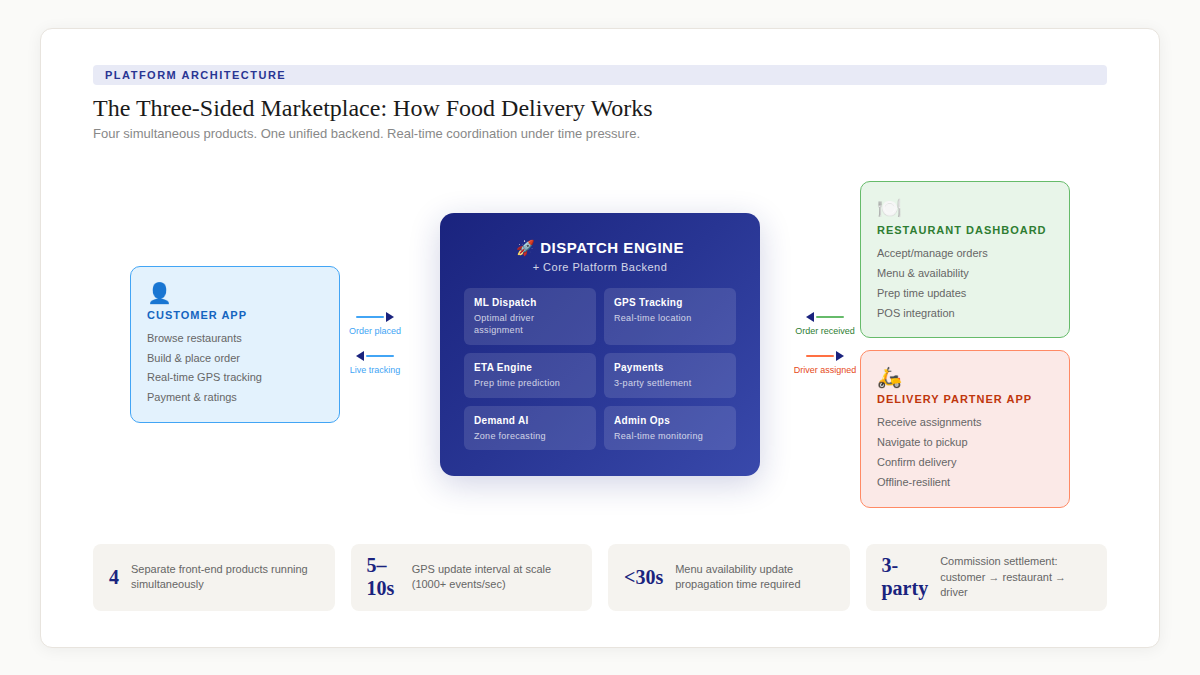
This is the architectural complexity that makes food delivery genuinely difficult. It’s not one product. It’s three simultaneous products that must work in perfect coordination.
Four separate front-end products. One unified backend. The backend must serve all four simultaneously in real time.
The dispatch engine is the most technically complex component in a food delivery platform.
When a customer places an order, the dispatch engine must:
The naive implementation: find the nearest available driver. This works until the platform has enough orders that driver availability, not proximity, becomes the bottleneck.
The production implementation uses a multi-factor scoring model:
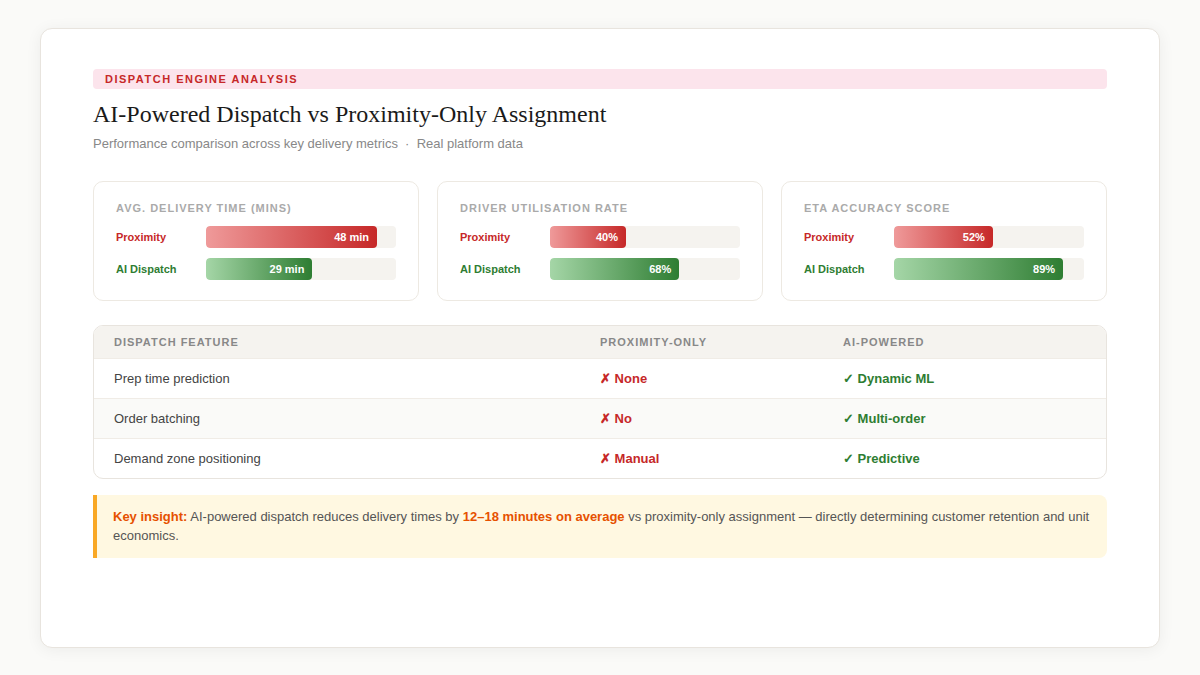
AI-powered dispatch reduces delivery times by 12–18 minutes on average compared to proximity-only assignment. The team applies production ML to the dispatch engine using the same engineering discipline from the BURQ logistics platform and the Simba Beer supply chain AI.
The customer tracking screen “your food is 8 minutes away” with a moving dot on a map is the feature that directly reduces customer anxiety and inbound support contacts.
Building it correctly:
The restaurant side of the marketplace has a specific technical challenge that consumer-facing food delivery platforms consistently underestimate: the menu management problem.
A restaurant has 80 items on its menu. 12 of them change every day based on what’s available. 3 of them have modifier options (burger → bun type, sauce type, extra toppings). 5 of them are sold out by 8pm every evening.
The menu management system must support:
The payment architecture in a food delivery platform is more complex than a two-sided marketplace because there are three parties who need to be settled:
The commission tracking and settlement system must handle:
Tax compliance adds another layer: GST on restaurant food, GST on delivery services, TDS on delivery partner payments above threshold in India. The tax calculation and deduction system must be accurate, auditable, and jurisdiction-specific.
One of the most value-generating features in a food delivery platform is one that customers never see: demand forecasting.
If the platform knows that Friday evenings in Koramangala will have 40% more orders than average, it can:
The Simba Beer supply chain AI that the team built which recovered millions in blocked working capital by predicting demand patterns and preventing overstock and understock cycles applies the same predictive pattern. The data inputs differ (restaurant orders vs. FMCG inventory movements) but the modeling approach is identical: historical demand patterns + external signals (weather, events, day of week) → next-period demand forecast.
AI-powered demand forecasting in food delivery reduces delivery times and improves delivery partner utilisation simultaneously. The team builds these models as production systems with weekly retraining, drift monitoring, and A/B testing infrastructure.
The most common reason for poor delivery ETA accuracy is the gap between what the restaurant claims as their preparation time and what actually happens.
A restaurant says their preparation time is 15 minutes. In practice, during the dinner rush, it’s 30 minutes. The dispatch engine assigned a driver based on the 15-minute promise. The driver arrives in 12 minutes and waits 18 minutes. The delivery is 18 minutes late.
This is the ETA accuracy problem. It’s not a technical problem, it’s a data quality problem. The technical solution:
The dark kitchen / ghost kitchen model changes the food delivery platform architecture in specific ways.
A ghost kitchen operator might run 5 different restaurant brands from one kitchen. On the delivery platform, they appear as 5 separate restaurants. But operationally, they share one kitchen team and one prep capacity.
This creates two platform requirements:
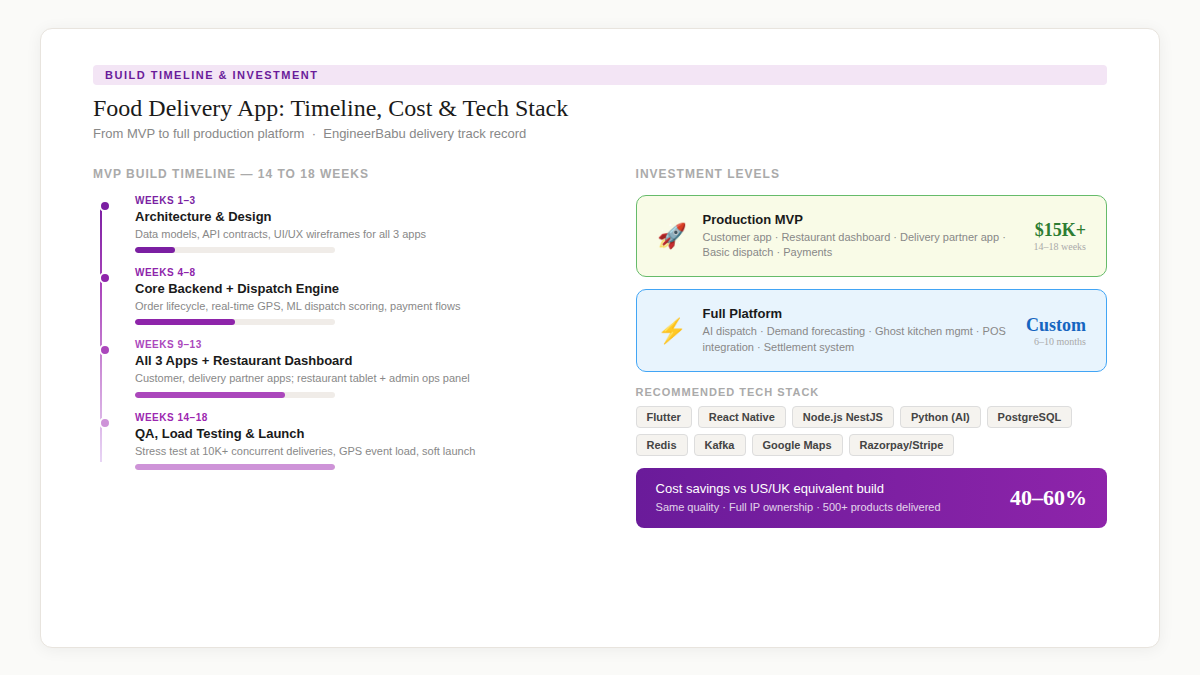
Flutter for customer and delivery partner high-performance maps rendering, real-time location updates, smooth animations. React Native for the restaurant tablet app the restaurant industry uses a mix of Android tablets, and React Native’s wider device compatibility matters here.
NestJS handles order lifecycle management, restaurant integration, payment orchestration, and notification delivery. Python handles the dispatch scoring model, demand forecasting, and route optimization.
PostgreSQL for orders, restaurants, menus, delivery partners, and financial settlements. Redis for real-time driver locations (updated every 5–10 seconds, read by customer tracking screens), active order state, and surge pricing calculations. Kafka for the event stream connecting order events to the dispatch engine, notification service, and analytics pipeline.
Google Maps Directions API for route polylines and ETA calculation. Distance Matrix API for multi-point distance calculations in dispatch scoring. Places API for restaurant address validation and geocoding.
Razorpay for Indian market UPI, cards, net banking, wallets. Stripe for international markets. Both require webhook infrastructure for payment event handling and refund processing.
FCM for all three app types. Order status updates for customers. New order notifications for restaurants. Assignment notifications for delivery partners. The notification pipeline must be low-latency: a 30-second delay in notifying a restaurant of a new order materially impacts the delivery experience.
The Simba Beer supply chain AI built the demand forecasting and inventory intelligence capability that the team now brings to food delivery dispatch systems. The core insight: logistics problems that look like operational problems are usually data problems. The FMCG distributor who was losing money on dead stock wasn’t suffering from bad operations; they were suffering from demand forecasting that was done on gut feel rather than data. The AI system that replaced gut feel with a demand prediction model recovered millions in blocked working capital.
The BURQ US logistics platform extended the team’s experience to a market with different logistics constraints (US urban delivery corridors, different payment infrastructure) and a different product model (B2B rather than B2C). The architectural patterns real-time assignment, route optimization, ETA accuracy are consistent across both builds.
The 500+ products across 20 countries include multiple marketplace builds two-sided and three-sided. The patterns the team has observed across all of them: the operations panel is always the most underbuilt product at launch and always the most critical to fix first. Every hour the operations team spends without good tooling is an hour of manual work that doesn’t scale.
The team can scope your food delivery architecture and have a proposal in your inbox within a week. mayank@engineerbabu.com
Dispatch assigns the nearest available driver. No prep time prediction. No batching. No demand positioning. Delivery times are inconsistent. Driver utilisation is poor. Unit economics don’t work.
The fix: ML-powered dispatch from day one. Estimated time to pickup (driver ETA + remaining prep time) as the primary dispatch signal.
Restaurant menus are managed in an offline spreadsheet, uploaded once at onboarding, never updated. Items that are 86’d still appear as available. Prices are wrong. Modifier options are missing. Customer orders items that can’t be made; restaurant calls to apologise; customer demands refund.
The fix: Real-time menu management as a restaurant tool requirement from day one. Item availability toggling that takes effect in under 30 seconds.
Commission settlement is manual; the finance team runs spreadsheets weekly. Restaurants dispute commissions. Delivery partners dispute payments. The manual process can’t keep up at scale.
The fix: Automated settlement reporting from day one. Every order’s financial breakdown tracked at transaction level. Restaurant and delivery partner dashboards show their earnings in real time.
The platform is built for one city. The data model, the geo-fencing logic, and the restaurant zone management are all hardcoded for that city. Expanding to a second city requires a full architecture change.
The fix: Multi-market architecture from day one. Cities as first-class entities in the data model. Zone management, delivery radius, and pricing configured per city.
White-label food delivery platforms: Fast to market, proven mechanics, 30–60 days to launch. No data ownership (the platform owns the restaurant and customer relationships). Commission structure fixed. Difficult to differentiate. Right for validating a niche before committing to a custom build.
Custom build: Required for any platform that needs differentiated dispatch logic (dark kitchen management, B2B catering, specific logistics constraints), data ownership, or customised commission structures. The team’s recommendation: white-label to validate market and restaurant supply, then migrate to custom once unit economics are validated.
Food delivery app development starts from $15K for a production MVP customer app (browse, order, track), restaurant dashboard (receive orders, update menu), delivery partner app (accept assignments, navigate), basic dispatch, and payment processing.
Full platforms AI dispatch engine, demand forecasting, cloud kitchen multi-brand management, POS integration, financial settlement system, analytics scoped based on market, feature set, and logistics complexity.
Timeline: Three-app MVP in 14–18 weeks. Full platforms in 6–10 months.
40–60% cost savings vs US/UK equivalent. Simba Beer supply chain AI experience directly applicable to dispatch and demand forecasting. Full IP ownership.
Mayank leads personally.
BURQ US logistics platform real-time dispatch, route optimisation, operations at scale. Simba Beer supply chain AI demand forecasting, inventory intelligence, millions recovered. These are not case studies from a conference. They’re the team’s production logistics experience.
500+ products across 20 countries. Multiple marketplace builds are two-sided and three-sided. The operations panel failures that every marketplace build encounters, caught at the architecture stage rather than discovered post-launch.
Google AI Accelerator 2024. Production ML for dispatch scoring and demand forecasting. CMMI Level 5. Full IP ownership.
A food delivery startup came to the team after launching with proximity-only dispatch. Average delivery time: 48 minutes in a city where the market expectation was 30 minutes. Restaurant complaints about drivers arriving before food was ready. Driver utilisation at 40%.
The dispatch engine rebuild was ML-powered, with prep time prediction and batching took 8 weeks. Average delivery time dropped to 29 minutes. Driver utilisation reached 68%.
Every week a food delivery platform runs with poor dispatch is a week of customer churn and driver attrition that unit economics can’t recover from.
30 minutes. Honest assessment of your market, your supply density challenge, and what dispatch architecture actually requires.
Food delivery app development is building a three-sided marketplace platform connecting customers, restaurants, and delivery partners with real-time dispatch, GPS tracking, menu management, payment processing, and settlement systems that work simultaneously under time pressure.
Three-app MVP (customer, restaurant, delivery partner): 14–18 weeks. Full platform with AI dispatch, demand forecasting, POS integration, and financial settlement: 6–10 months.
MVP from $15K. Full platform scoped based on market, feature set, and logistics complexity. US/UK equivalent quality costs 40–60% more.
The dispatch engine assigns delivery partners to orders based on multiple factors: distance, prep time prediction, current driver workload, and batching opportunities. AI-powered dispatch reduces delivery times by 12–18 minutes vs proximity-only assignment and directly determines unit economics.
Building the consumer app beautifully and underinvesting in dispatch. The delivery time experience is determined by the dispatch engine, not the consumer UI. Proximity-only dispatch consistently produces delivery times 15–20 minutes worse than ML-powered dispatch and delivery time is the primary driver of customer retention.
Demand forecasting predicts order volume by area and time window Friday evening in Koramangala will have 40% more orders than average. This enables proactive driver positioning, restaurant staffing alerts, and dynamic pricing. AI-powered demand forecasting improves driver utilisation and reduces delivery times simultaneously.
A ghost kitchen is a restaurant brand with no physical dining presence, serving delivery only. A ghost kitchen operator may run multiple brands from one kitchen. The platform needs multi-brand management (one operator, multiple menu brand identities) and capacity coordination (shared kitchen prep capacity across brands) as specific features.
Flutter for customer and delivery partner apps, React Native for restaurant tablet, Next.js for admin panel, Node.js NestJS for core logic, Python for dispatch AI and demand forecasting, PostgreSQL + Redis + Kafka for data, Google Maps for routing, Razorpay (India) or Stripe (international) for payments.