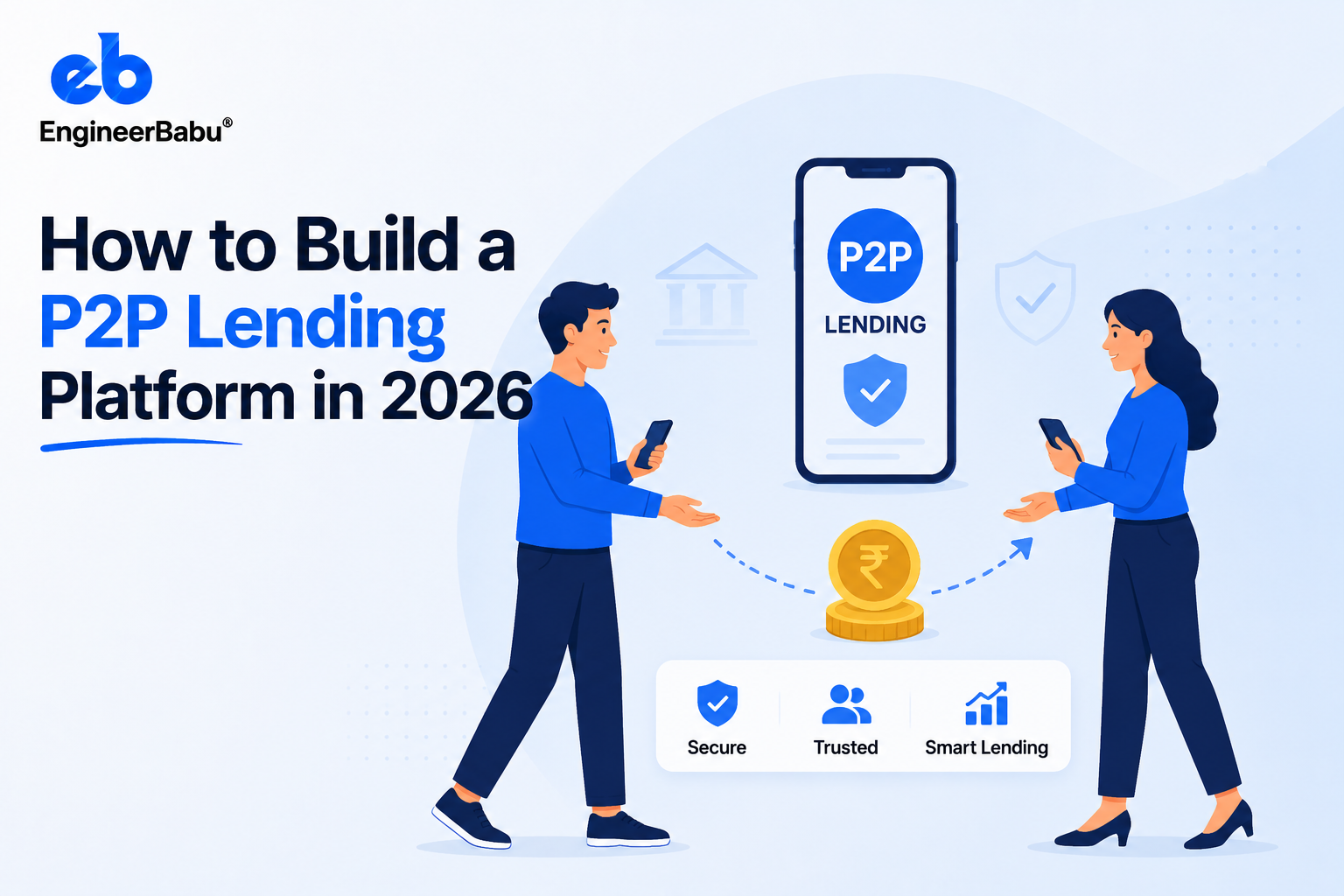
How to Build a P2P Lending Platform in 2026


Create engaging, high-performance mobile applications tailored to your business needs. We craft future-ready apps that offer smooth user experiences on all devices.
Build robust and scalable websites and CMS platforms that help you manage content effortlessly. Our development ensures a seamless digital presence.
Launch secure, feature-rich online stores with intuitive shopping experiences. We build tailored eCommerce platforms designed for growth.
Design captivating games with immersive gameplay and stunning graphics. From concept to launch, we build engaging experiences that players love.
Enhance your customer relationships with customized Salesforce implementations. Drive growth and efficiency with smarter CRM solutions.
Harness artificial intelligence and machine learning to automate workflows and gain actionable insights. Our AI transforms data into smart decisions.
Accelerate your software delivery lifecycle with continuous integration, delivery, and infrastructure automation to boost efficiency.
Here’s the failure pattern nobody publishes case studies about.
A P2P lending platform launches with good intentions. Borrower onboarding is smooth. The investor dashboard looks professional. The first ₹2 crore in loans gets funded. The team celebrates.
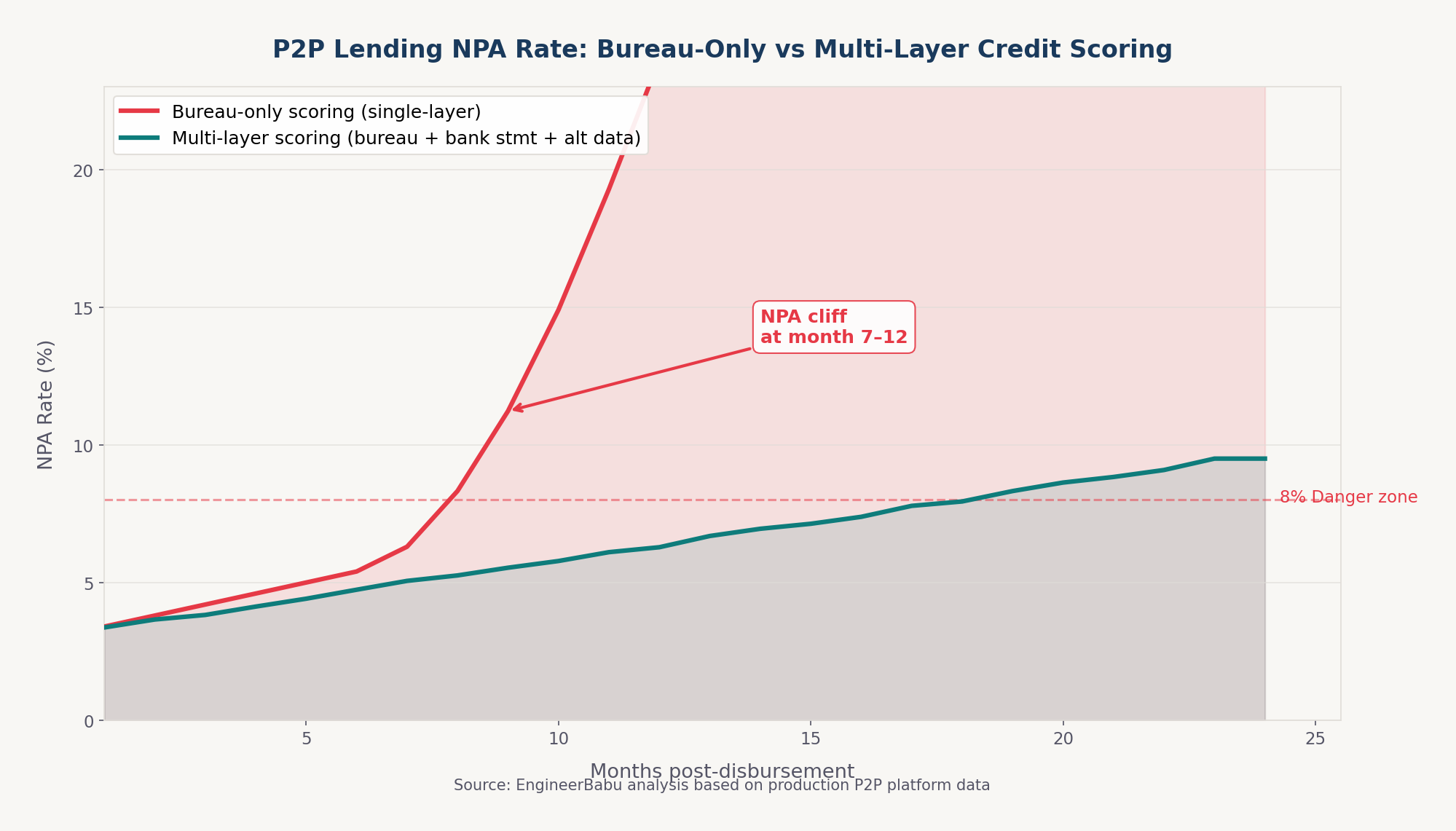
Month 6: default rate climbs to 18%. The credit scoring module was using bureau data alone, thin-file borrowers who looked acceptable on CIBIL had no bank statement analysis, no income verification beyond self-declaration, and no alternative data layer. The scoring model was optimistic by design because higher approval rates meant more transactions and more revenue.
Month 9: the collections module is a WhatsApp group. There are no automated reminders, no NACH bounce handling, no escalation workflows. The team is manually chasing recoveries. Three investors have filed complaints with the RBI.
This is not a hypothetical. The RBI’s tightened P2P lending regulations in August 2024 explicitly forbidding platforms from guaranteeing returns, creating assured products, or using automated algorithmic investment tools without investor consent came directly from seeing this pattern across multiple platforms.
I co-founded EngineerBabu 14 years ago. The team’s CTO spent 17 years at Wishfin, one of India’s largest credit marketplaces. The team has built lending platforms that together process thousands of crores annually including one that has disbursed over ₹10,000 crore and LoanOS, the team’s own modular lending platform, currently processing ₹1,000 crore annually through a DSA. We know what breaks. This guide is how to prevent it.
If you’re ready to build and want a team that’s built at this scale email mayank@engineerbabu.com.
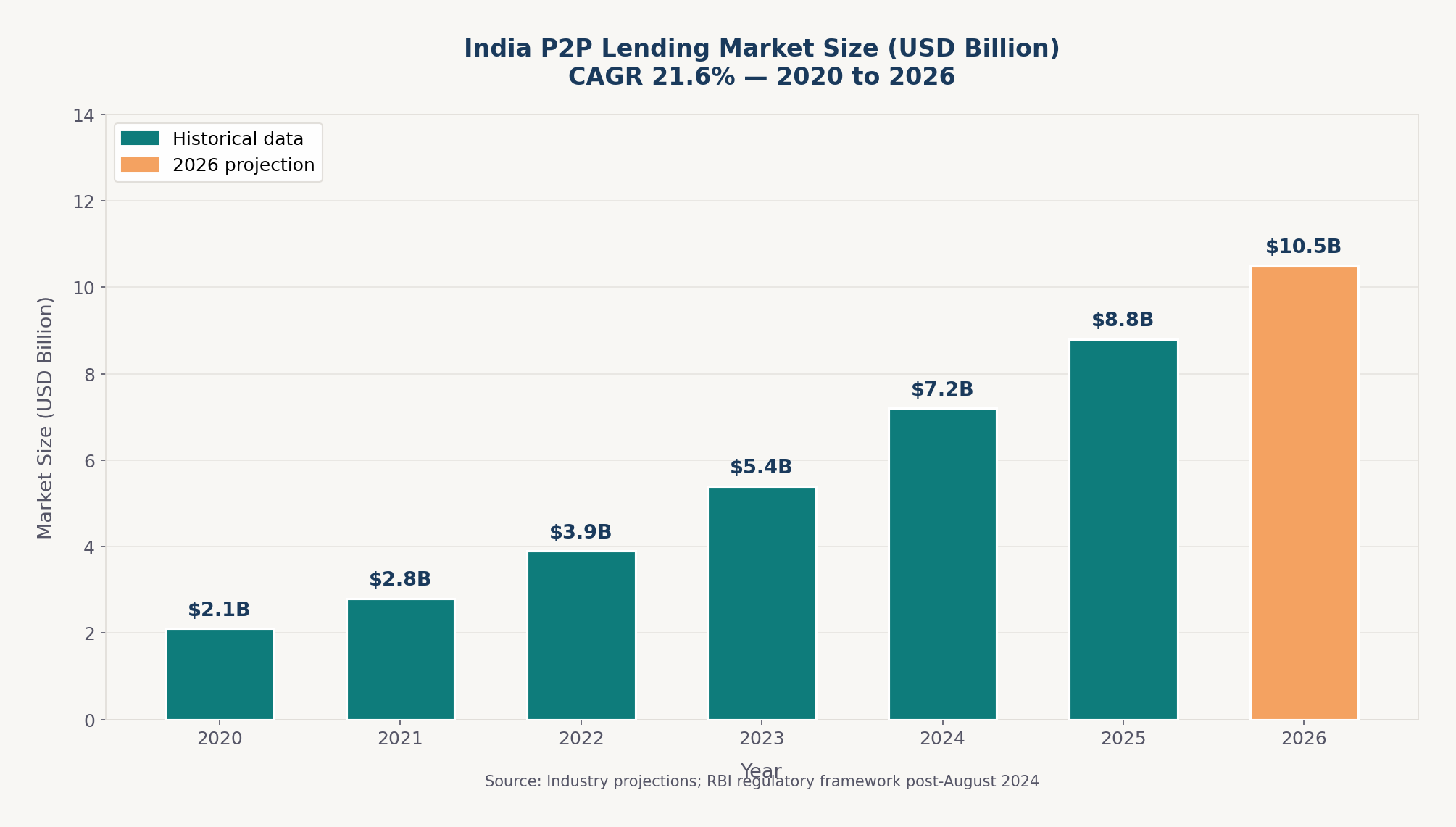
India’s P2P lending market is projected to reach $10.5 billion by 2026, growing at a CAGR of 21.6%. The global P2P lending market was valued at $176 billion and is projected to reach $1.38 trillion by 2034 at a 25% CAGR.
The structural drivers: 1.59 lakh registered startups in India as of 2025, a massive gig economy with 2+ crore workers, and MSME entrepreneurs who face systemic credit rejection from traditional banks. These are creditworthy borrowers with no bureau history. P2P platforms when built correctly serve them with returns of 10–18% per annum for investors.
But here’s the context the market numbers miss.
The RBI cracked down on India’s P2P sector in August 2024. The revised Master Directions explicitly banned guaranteed returns, algorithmic investment without investor consent, and a number of practices that platforms had been using to simulate fixed-income products. Platforms that built their product on regulatory grey areas had to reconstruct their entire model.
The NPA rate in India’s P2P lending sector reportedly rose to approximately ₹1,163 crore in FY24. The platforms that survived the regulatory tightening and the NPA cycle were the ones that had built their credit scoring, collections, and compliance architecture correctly from the start.
A P2P lending platform is a digital marketplace that connects individual or institutional investors directly with individual or business borrowers, enabling loans to be originated, funded, managed, and collected entirely through the platform without a bank as the intermediary. The platform earns fees from the transaction, not interest from its own balance sheet. The platform bears the credit risk of the marketplace design, not the principal risk of individual loans.
That distinction marketplace mechanics, not balance sheet lending, is what defines a P2P platform architecturally and what the RBI’s framework regulates.
India (RBI NBFC-P2P): All P2P lending platforms in India must be registered as NBFC-P2P under the RBI. Key requirements: minimum net owned fund of ₹2 crore, maximum aggregate exposure per lender of ₹50 lakh across all P2P platforms, maximum loan exposure per borrower of ₹10 lakh, maximum loan tenure of 36 months, and no guarantee of returns or creation of assured products.
The August 2024 revised Master Directions added: T+1 settlement (funds must reach borrowers within 1 business day of loan sanction), escrow account requirements through a bank or promoted escrow agent, and mandatory disclosure of NPA rates in real time.
United States (SEC/State): US P2P lending platforms that issue notes to investors are regulated as securities offerings. Platforms must register offerings with the SEC or qualify for an exemption (Regulation D, Regulation A+, Regulation Crowdfunding). State money transmitter licenses required for fund movement. LendingClub, Prosper, and Funding Circle all operate under SEC registration as a multi-year, multi-million-dollar compliance investment.
UK (FCA): FCA authorisation as a P2P lending platform under the loan-based crowdfunding regulations. Investor appropriateness assessments required. Wind-down plan required. NPA disclosure requirements similar to India’s.
The honest answer: for most startups in 2026, the India NBFC-P2P path is the most achievable regulatory route with the clearest framework. The US path is viable but requires a minimum 18-month regulatory runway and significant legal investment before a single loan is processed.
P2P lending is a marketplace. Matching borrowers and lenders isn’t just a UX feature, it’s a regulatory obligation and a risk management system.
Under India’s revised framework, platforms cannot automatically allocate lender funds to borrowers without explicit investor consent for each loan. Every lender must actively choose which borrower’s loan to fund, or explicitly consent to an auto-invest algorithm’s decisions.
This changes the architecture significantly:
Loan listing: every approved loan must be listed with full disclosure: borrower risk profile, credit score, purpose, tenure, interest rate, LTV ratio, and the platform’s internal risk classification. The listing is a disclosure document, not just a product card.
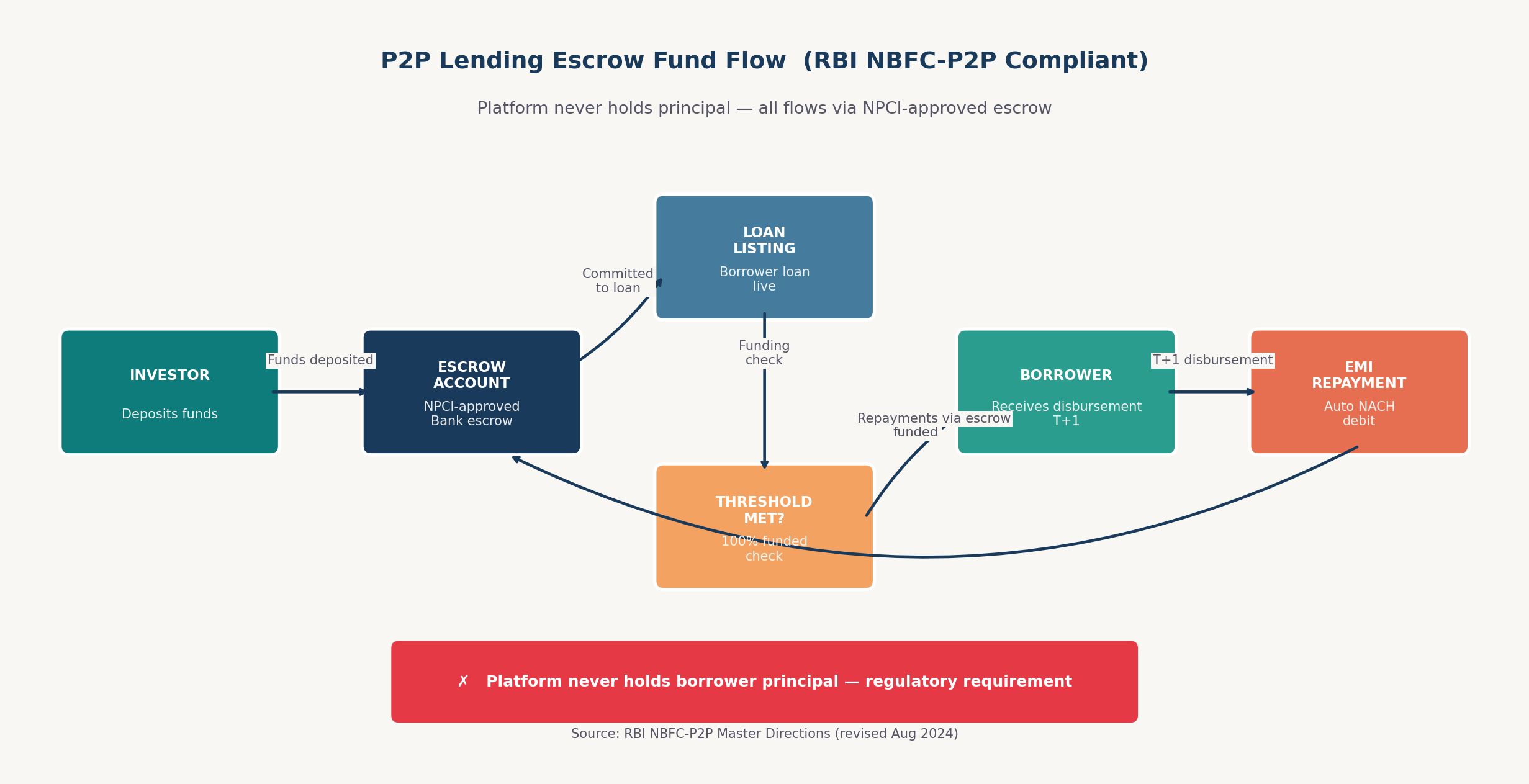
Investor allocation flow the lender selects a loan, commits a specific amount, and the commitment is escrowed. When the loan reaches its funding threshold (100% of the requested amount), disbursement is triggered. If the threshold isn’t reached within the listing period, committed funds are returned.
Auto-invest with consent if the platform offers an auto-invest feature (the investor sets criteria, the system allocates automatically), explicit informed consent must be obtained and documented for each auto-invest rule change.
Partial funding mechanics most P2P platforms allow multiple investors to fund portions of one loan. The platform needs to track each investor’s contribution, calculate their proportional share of repayments, and attribute NPAs to the correct investor accounts.
The matching engine is not complex algorithmically. But the regulatory mechanics around consent, disclosure, escrow sequencing are where most platforms fail.
The NPA rate on a P2P platform is almost entirely determined by the quality of the credit scoring engine.
The failure pattern described at the start of this guide bureau data alone, no alternative data produces a specific NPA curve: low defaults for the first 6 months (the loans that were genuinely creditworthy by any measure), then a cliff at months 7–12 as the edge cases begin defaulting.
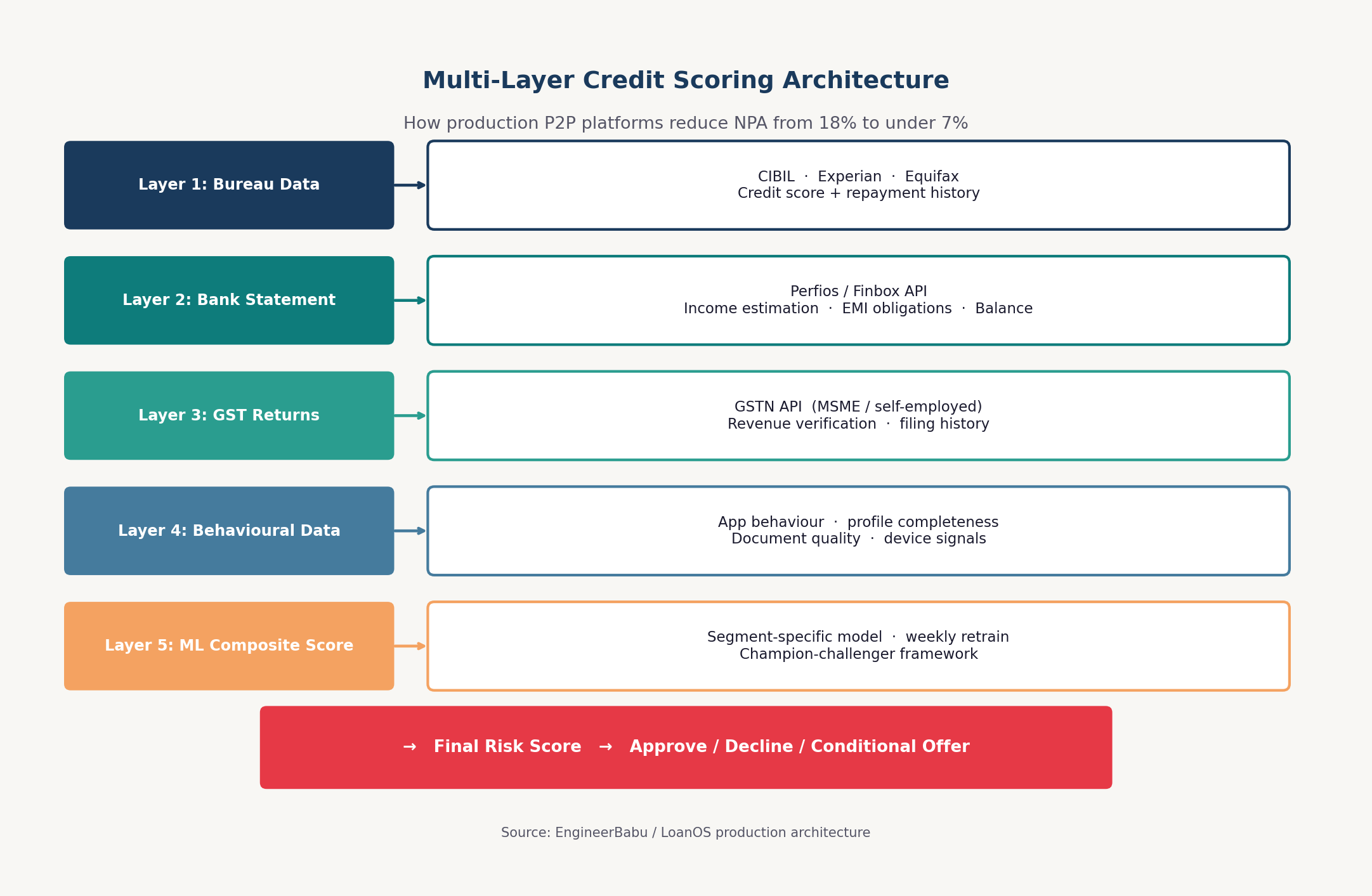
Production credit scoring for a P2P platform:
Bureau data CIBIL, Experian, Equifax. The starting point, not the complete picture. The CTO’s 17 years at Wishfin means the team has built bureau integrations for every major Indian credit bureau, understands the edge cases in each bureau’s data model, and knows which bureau’s data is most predictive for which borrower segment.
Bank statement analysis income estimation, expense patterns, existing EMI obligations, average balance trends. This is the most predictive alternative data source for thin-file borrowers. APIs like Perfios or Finbox can analyse 6–12 months of bank statements in minutes and return structured income signals.
GST returns for self-employed and MSME borrowers, GST return data is a strong revenue verification signal. GSTN API integration is available for consenting borrowers.
Behavioral data time-on-platform, completeness of profile, document submission quality. These signals are weak individually but contribute to a composite risk score.
Separate scoring models for separate segments a salaried employee in a Tier 1 city has a fundamentally different credit profile than an MSME owner in Tier 3. One model applied to both will underperform for both. The team builds separate scoring models per borrower segment, validated on historical performance data before production deployment.
As a Google AI Accelerator 2024 team, the approach to ML credit scoring is production-oriented: champion-challenger model framework, weekly retraining pipeline, automated NPA attribution back to the scoring model that approved each defaulted loan. The feedback loop is built from day one.
The escrow requirement in India’s revised P2P framework isn’t just a compliance checkbox. It’s the trust infrastructure that makes the whole marketplace function.
Every fund movement on a P2P platform must flow through NPCI-approved escrow accounts:
The platform itself never holds the principal. This is the regulatory requirement that the platform is a facilitator, not a lender.
Building this correctly requires:
Escrow account integration partnership with a bank that provides NBFC-P2P-compliant escrow accounts. ICICI, HDFC, and Axis all offer escrow services for P2P platforms.
Funds flow accounting every rupee entering and leaving each escrow account must be tracked at the transaction level. The escrow ledger is the regulatory audit trail. It must be immutable.
T+1 settlement once a loan is sanctioned and funded, disbursement must reach the borrower within 1 business day. This is an SLA that the platform’s payment processing architecture must support consistently.
Investor account reconciliation: Each investor sees a real-time breakdown: committed (in escrow against a specific loan), disbursed (loan is live), repaying (EMI received), and available (ready to reinvest). This reconciliation view must be accurate to the rupee, updated in real time.
Collections is where P2P platforms distinguish between sustainable businesses and short-term volume machines.
The automated collections stack:
NACH mandate registered at loan disbursement, not after first missed payment. Every borrower who receives a loan signs up for NACH (National Automated Clearing House) auto-debit at disbursement. The NACH mandate covers the full loan tenure.
Pre-due reminders SMS and WhatsApp 7 days, 3 days, and 1 day before EMI due date. Not optional. The platforms with the lowest NPAs have the most aggressive pre-due reminder infrastructure.
Bounce handling when NACH debit bounces, the system detects it within 4 hours (NPCI provides near-real-time bounce notifications), triggers a retry logic, sends a payment link to the borrower, and escalates to the collections queue. The difference between a 1-day bounce and a 7-day bounce in terms of recovery probability is enormous.
Escalation workflows Day 1: automated reminder + payment link. Day 7: escalation to collections team with full account context. Day 30: NPA classification + legal notice generation. Day 90: writeoff + recovery agent assignment.
Investor NPA attribution when a loan defaults, the investor who funded it sees their exposure shift to NPA in their portfolio. The NPA calculation must match the RBI’s classification criteria exactly; the platform’s NPA numbers must be auditable by the regulator.
LoanOS, the team’s own lending platform, has automated collections as a core module. The module was built after seeing manual collections at multiple platforms fail catastrophically at scale. It is the most underestimated investment in a P2P platform build and the one that most directly determines whether investors return.
Investors in a P2P platform are the liquidity providers. Losing investors is existentially dangerous. The investor portfolio management experience determines whether they return capital for new loans.
Production investor portfolio management:
Risk-diversified auto-invest investors set risk tolerance and investment parameters. The platform allocates across multiple borrowers automatically, diversifying the investor’s exposure. No single borrower can represent more than a defined percentage of any investor’s total P2P portfolio.
Real-time portfolio dashboard net returns (XIRR), outstanding principal, loan-wise performance, NPA tracking, upcoming repayments, and cash available for reinvestment. Every number must be accurate to the rupee and updated within minutes of any transaction.
Tax reporting P2P returns are taxed as interest income in India. The platform must generate Form 26AS-compliant interest certificates for investors. This is a non-negotiable feature for institutional investors and a strong trust signal for individual investors.
Withdrawal mechanics investors must be able to withdraw available (uninvested) funds on demand. The T+2 withdrawal SLA is standard. Building this reliably requires the escrow architecture to support immediate fund release for uninvested balances.
The RBI’s oversight of NBFC-P2P platforms is data-intensive. The platform must be able to produce specific reports on demand:
Monthly NPA disclosure gross NPA ratio, net NPA ratio, NPA by tenure bucket. Must match the borrower-level ledger exactly.
Lender exposure report proof that no lender has aggregate P2P exposure above ₹50 lakh.
Borrower exposure report proof that no borrower has aggregate P2P loans above ₹10 lakh across all platforms (requires cross-platform data sharing through the CIC/credit bureau system).
Escrow reconciliation weekly reconciliation of escrow account balances against platform ledger.
IS audit support annual IS audit is mandatory. The platform must provide complete audit logs, access records, and system documentation.
Building regulatory reporting as an engineering system automated, scheduled, with defined data sources and reconciliation checks is the difference between a platform that passes audits and one that scrambles for data every quarter.
P2P lending fraud has three distinct vectors:
Synthetic identity borrowers fraudsters create loan applications using a mix of real and fabricated data. They pass basic KYC because the PAN is real and the Aadhaar is real. But the address, the employment, and the bank statements are fabricated or manipulated. Detection requires device fingerprinting, velocity checks across multiple applications from the same device, and network analysis of connected borrower profiles.
Multiple platform borrowing borrowers simultaneously apply to multiple P2P platforms to exceed the ₹10 lakh cap. Detection requires integration with CIBIL’s P2P lending database (which tracks all P2P loan inquiries) and real-time enquiry checks at application submission.
Investor-side fraud money laundering attempts using investor accounts to layer funds. AML monitoring on investor deposits and withdrawals, suspicious transaction reporting to FIU-IND.
The team builds ML fraud detection for P2P platforms using the same production AI pipeline applied to the fintech platforms built under the Google AI Accelerator 2024 program.
Frontend: Flutter (mobile borrower and investor apps) + Next.js (admin and regulatory reporting panel)
Backend: Python FastAPI (credit scoring + ML models) + Node.js NestJS (loan lifecycle management, escrow orchestration, collections automation)
Database: PostgreSQL the loan ledger, investor accounts, escrow tracking. ACID compliance is non-negotiable when every transaction involves real money and regulatory audit obligations.
Redis session management, NACH queue processing, real-time portfolio calculations.
Escrow integration NPCI NACH for auto-debit, bank escrow API integration (ICICI/HDFC), UPI for disbursement and voluntary repayments.
Credit scoring infrastructure CIBIL API, Experian API, Perfios/Finbox for bank statement analysis, GSTN for GST verification. All orchestrated through a unified credit assessment service.
Cloud: AWS Mumbai RBI data localisation requirement. All financial data on Indian servers.
The lending platform that has disbursed over ₹10,000 crore taught the team one lesson above all others: the credit scoring model that works at ₹100 crore AUM breaks at ₹1,000 crore AUM, and the collections infrastructure that works at ₹100 crore AUM is the difference between ₹1,000 crore and insolvency.
For the early salary advance product (which became one of India’s first to process thousands of daily credit decisions), the critical challenge wasn’t building the scoring model. It was building the retraining pipeline the system that automatically ingests new performance data, detects model drift, and retrains the scoring model on a weekly cadence.
When the borrower mix changes, a new employer segment enters the platform, macroeconomic shift affects repayment behavior, and the scoring model that was calibrated on the previous population becomes less predictive. Without a retraining pipeline, that degradation is invisible until NPA rates start climbing.
LoanOS, the team’s own modular lending platform, has the retraining pipeline as a core component. Not an optional ML feature. A production system.
The CTO’s 17 years at Wishfin adds specific credibility to every credit scoring and collections architecture decision. He has seen bureau API failures at scale, NACH rejection cascades, and scoring model drift in production. These patterns are designed around, not discovered.
The team can have a scoped P2P lending architecture in your inbox within a week. mayank@engineerbabu.com. \
Credit scoring model designed for approval rate, not default rate. Thin-file borrowers approved on bureau data alone. NPA cliff at month 7. Investor complaints follow.
The fix: Multi-layer scoring (bureau + bank statement + alternative data) validated against historical performance before production deployment. Approval rate is an outcome of good scoring, not a design parameter.
Platform built without proper escrow architecture. Funds flow through the platform’s bank account rather than NBFC-P2P-compliant escrow. RBI inspection finds the gap. Platform operations suspended pending remediation.
The fix: Escrow architecture designed in sprint one, before any other financial infrastructure. T+1 settlement SLA baked into the payment processing design.
Collections handled manually WhatsApp messages, phone calls, spreadsheets. Works at ₹10 crore AUM. Fails catastrophically at ₹100 crore AUM when the collections team is managing 5,000 active loans simultaneously.
The fix: Automated collections from day one. NACH mandate at disbursement. Pre-due reminders. Bounce handling within 4 hours. Escalation workflows with defined triggers.
Platform launches, grows to meaningful AUM, then discovers that RBI’s revised Master Directions require changes to the auto-invest feature, the assured returns language, and the lender exposure tracking. Three months of platform restructuring at peak growth.
The fix: Regulatory requirements mapped to technical controls before sprint 1. RBI Master Directions for NBFC-P2P read and implemented as design constraints, not legal documents.
White-label P2P software: Available, faster to market, but designed for generic use cases. The credit scoring engine is not customizable. The collections workflows don’t account for NACH-specific failure modes. The regulatory reporting doesn’t map to India’s RBI requirements specifically.
Custom build: Required for any platform that needs differentiated credit scoring (the actual competitive moat), compliance with India’s specific NBFC-P2P framework, and collections infrastructure at scale. Custom build is the only path to the level of credit quality control that separates platforms with 5% NPA from those with 18% NPA.
P2P lending platform development starts from $15K for a production MVP borrower onboarding, KYC, basic credit assessment, loan listing, investor registration, escrow integration, and basic collections.
Full platform AI credit scoring with bank statement analysis, full escrow architecture, automated collections, investor portfolio management, regulatory reporting, ML fraud detection scoped after understanding the target borrower segment, compliance markets, and loan volume projections.
Timeline: MVP in 14–18 weeks. Full platform in 6–10 months. NBFC-P2P registration with the RBI runs in parallel; it takes 6–12 months and should be filed immediately.
40–60% cost savings vs US/UK equivalent quality. CTO 17 years Wishfin. Google AI Accelerator 2024 ML capabilities. Full IP ownership.
Mayank leads personally.
The CTO spent 17 years at Wishfin building credit infrastructure that processes millions of loan decisions. Bureau integrations, NACH systems, NPA management not theoretical knowledge. Production experience.
The team built a lending platform that has disbursed over ₹10,000 crore. LoanOS processes ₹1,000 crore annually. The credit scoring, collections, and regulatory architecture in this guide is what those platforms run on.
Google AI Accelerator 2024. Production ML credit scoring not Kaggle models. Production systems with retraining pipelines, model monitoring, and drift detection.
CMMI Level 5. RBI audit-ready documentation. 4 unicorn clients. 75 YC-selected builds. Full IP ownership.
A fintech team came to the team after their P2P platform accumulated 18% NPA in 9 months bureau-only scoring, no alternative data, no automated collections. The rebuild took 16 weeks. The new scoring model reduced NPA by 11 percentage points in the first loan cohort.
Every week a P2P platform operates with weak credit scoring is a week of NPA accumulating that investor trust cannot recover from.
30 minutes. Honest assessment of your borrower segment, your compliance path, and what a P2P platform that survives its first regulatory inspection actually requires.
P2P lending platform development is building a digital marketplace that connects individual or institutional investors directly with borrowers handling loan origination, credit assessment, escrow-based fund flows, repayment collection, and regulatory compliance without the platform holding the principal on its balance sheet.
NBFC-P2P (Non-Banking Financial Company Peer to Peer Lending Platform) is the RBI-mandated regulatory category for all P2P lending platforms in India. Every platform that matches lenders and borrowers for loans must register as NBFC-P2P. Requirements: minimum net owned fund of ₹2 crore, maximum lender exposure of ₹50 lakh, maximum borrower exposure of ₹10 lakh, escrow-based fund flows, and no guaranteed returns.
MVP: 14–18 weeks. Full platform with AI credit scoring, escrow architecture, automated collections, investor portfolio management, and regulatory reporting: 6–10 months. NBFC-P2P registration with the RBI takes 6–12 months in parallel and should be filed immediately.
The credit scoring architecture. A scoring model optimised for approval rate rather than default quality produces an NPA cliff 6–9 months post-launch. Production credit scoring requires multi-layer assessment: bureau data + bank statement analysis + alternative data, with separate models per borrower segment and a weekly retraining pipeline.
RBI’s revised Master Directions require all P2P funds to flow through NPCI-approved escrow accounts. The platform cannot hold principal in its own bank account. Investor funds are escrowed until a loan reaches funding threshold; disbursement goes directly to the borrower’s bank account; repayments flow through escrow back to investors. T+1 settlement (funds to borrower within 1 business day of sanction) is mandatory.
NACH (National Automated Clearing House) mandate is registered at loan disbursement for every borrower, covering the full loan tenure. Pre-due reminders at 7, 3, and 1 day before EMI. Bounce handling within 4 hours with automated retry and payment link. Escalation to collections team at Day 7, legal notice at Day 30, NPA classification at Day 90. Manual collections without this automation fail at any meaningful AUM.
Synthetic identity borrowers (real PAN/Aadhaar, fabricated employment and bank statements), multi-platform borrowing to exceed ₹10 lakh cap (requires CIBIL P2P database integration), and investor-side AML risks. ML-based detection for synthetic identity, real-time CIBIL enquiry checks for multi-platform exposure, and transaction monitoring for AML are all required for a production platform.
Flutter for mobile (borrower and investor apps), Next.js for admin and regulatory reporting, Python FastAPI for credit scoring and ML models, Node.js NestJS for loan lifecycle and collections automation, PostgreSQL for the lending ledger, Redis for real-time processing, NACH integration for auto-debit, AWS Mumbai for RBI data localisation compliance.