How to Build an AI Chatbot for Business in 2026


Create engaging, high-performance mobile applications tailored to your business needs. We craft future-ready apps that offer smooth user experiences on all devices.
Build robust and scalable websites and CMS platforms that help you manage content effortlessly. Our development ensures a seamless digital presence.
Launch secure, feature-rich online stores with intuitive shopping experiences. We build tailored eCommerce platforms designed for growth.
Design captivating games with immersive gameplay and stunning graphics. From concept to launch, we build engaging experiences that players love.
Enhance your customer relationships with customized Salesforce implementations. Drive growth and efficiency with smarter CRM solutions.
Harness artificial intelligence and machine learning to automate workflows and gain actionable insights. Our AI transforms data into smart decisions.
Accelerate your software delivery lifecycle with continuous integration, delivery, and infrastructure automation to boost efficiency.
Hire app developers ready to turn your ideas into sleek, high-performing mobile apps for any platform.
Bring in frontend pros who craft smooth, beautiful, and user-friendly interfaces that your visitors will love.
Get backend developers who build fast, secure, and reliable systems to keep everything running behind the scenes.
Hire eCommerce developers who build secure, scalable online stores designed to offer seamless shopping and grow your sales.
Get dedicated developers committed to your projects, delivering consistent quality and speed as an extension of your team.
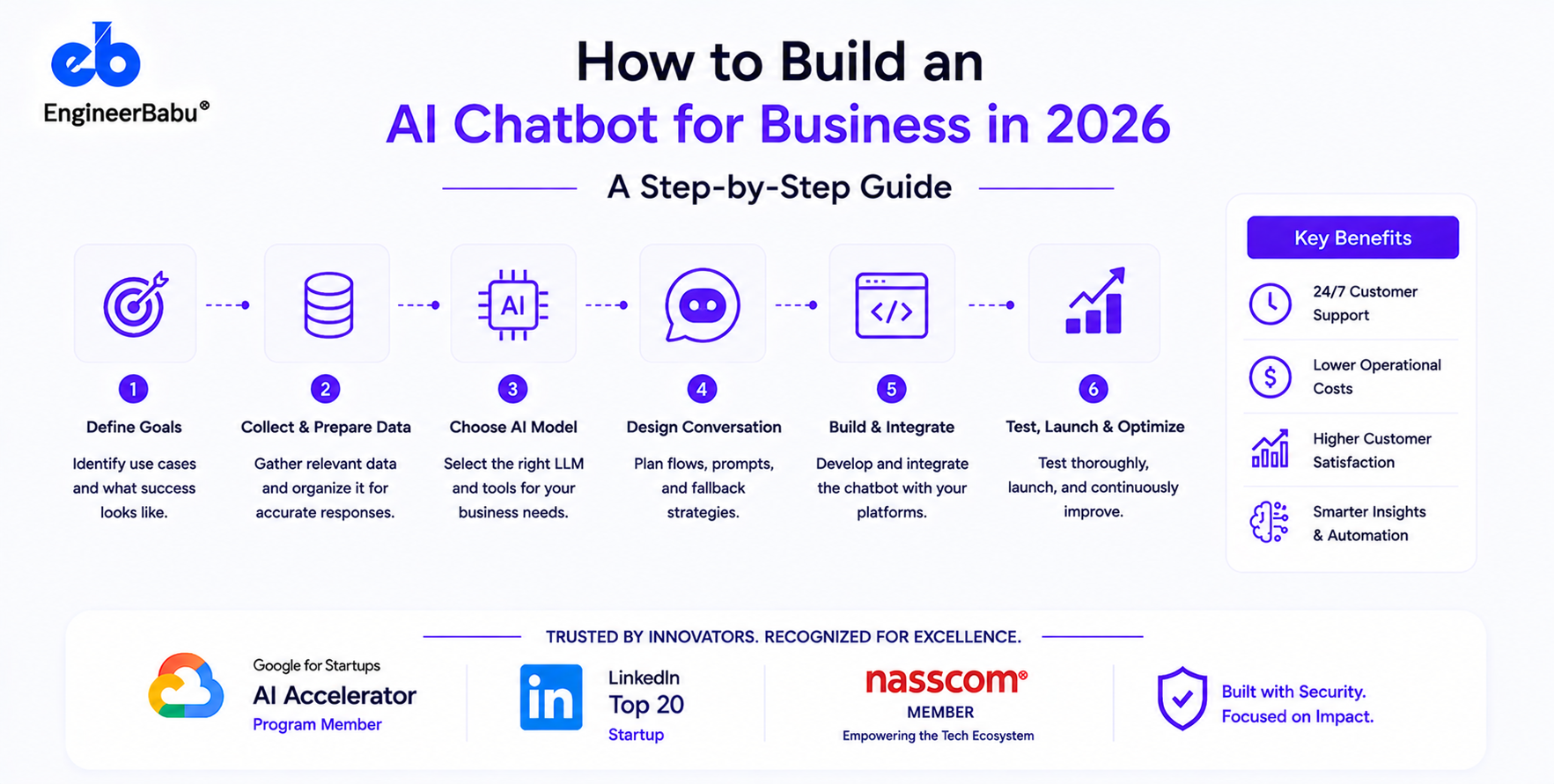
A large NBFC came to the EngineerBabu team after 18 months and $200,000 spent on an “AI chatbot” that their customer service team had stopped routing queries to.
The problem wasn’t the model. The chatbot used GPT-4. The model was capable.
The problem was the architecture. The chatbot had no connection to the company’s actual knowledge base, their loan products, their current interest rates, their specific eligibility criteria, their documented processes. When customers asked “what’s the current interest rate for a personal loan?”, the chatbot answered from GPT-4’s training data, which was 18 months stale and didn’t reflect this company’s products at all.
The company had paid for a very expensive wrapper around a public LLM and called it an AI chatbot.
This is the most common failure pattern in enterprise AI chatbot deployment in 2026.
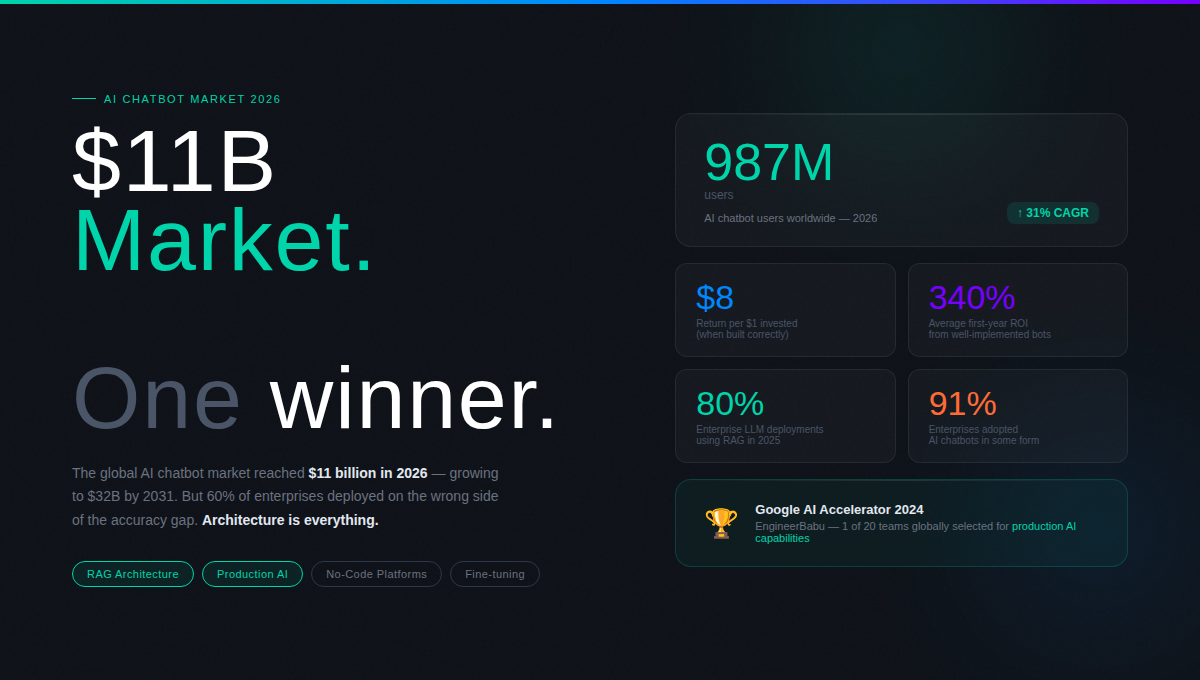
The global AI chatbot market reached $11 billion in 2026. 987 million users worldwide. $8 in returns for every $1 invested, when the chatbot is built correctly. And that’s the qualifier that most chatbot project briefs don’t contain: when it’s built correctly.
I co-founded EngineerBabu 14 years ago. The team was selected for Google AI Accelerator 2024 as one of 20 teams globally, specifically for production AI capabilities. Not demos. Not prototypes. Systems that run in production, answer correctly, and don’t hallucinate about your products.
This guide is about what “built correctly” actually means.
If you’re ready to build and want a team selected specifically for production AI capabilities, email mayank@engineerbabu.com.
The global AI chatbot market reached $11 billion in 2026, growing to $32 billion by 2031 at a CAGR of 23%. The generative AI chatbot segment specifically, LLM-powered, context-aware, multi-turn is valued at $13 billion in 2026 and growing at 31% annually.
40% of enterprise applications will embed task-specific AI agents by the end of 2026, up from less than 5% in 2025. 91% of enterprises have adopted AI chatbot tools in some form. Businesses report an average 340% first-year ROI from well-implemented chatbots.
But here’s what those numbers hide. 60% of consumers still worry chatbots can’t understand their queries. 84% say human interaction must always remain an option. The satisfaction gap between a well-built AI chatbot and a poorly-built one is enormous and most of the $11 billion market is on the wrong side of that gap.
An AI chatbot for business is a conversational interface powered by a large language model that can understand natural language queries, retrieve relevant information from a connected knowledge base, and generate accurate, contextually appropriate responses, grounded in the company’s actual data, not the model’s training data.
The distinction between an AI chatbot that works and one that doesn’t is almost entirely an architecture decision.
This is the decision that determines whether a chatbot answers correctly or confidently hallucinates. It needs to be made before any development starts.
Tell the LLM who it is and what it should do via a system prompt. Fast, cheap, no data infrastructure.
Train the model on your company’s documents and data to embed that knowledge into the model weights.
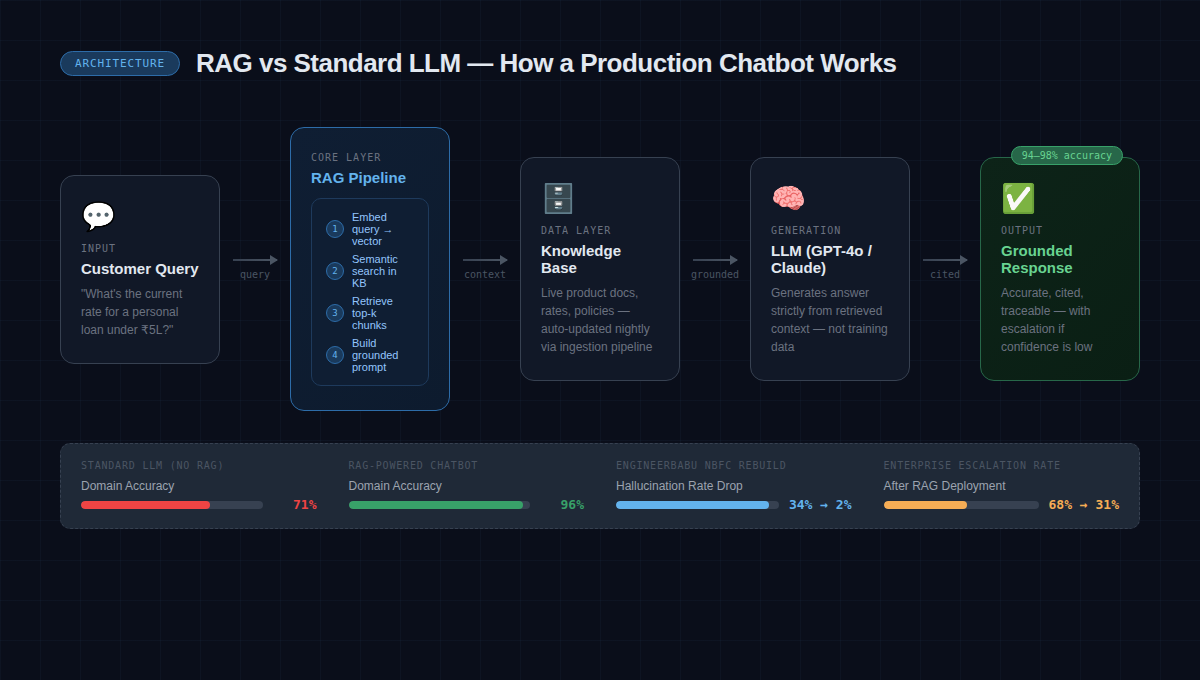
Connect the LLM to a live knowledge base. Every query retrieves relevant chunks from your documents, products, and data in real time, then generates a response grounded in that retrieved context.
Why RAG is the standard: Retrieval-augmented LLMs achieve 94–98% accuracy on domain-specific questions when backed by well-structured knowledge bases (vs. 71% for standard LLMs). The knowledge base can be updated in minutes, new product, new policy, new pricing and the chatbot is immediately accurate. Responses can be traced back to source documents, satisfying compliance and auditability requirements.
80% of successful enterprise LLM deployments in 2025 use RAG architecture. For any chatbot that needs to answer questions about your specific business, products, policies, processes, support cases, RAG is the correct architecture.
The nuance: RAG is not a plug-and-play solution. The quality of the knowledge base, the chunking strategy, the embedding model, and the retrieval logic all directly affect answer quality. A poorly configured RAG system still hallucinates. The engineering work is in making RAG perform.
RAG is only as good as the knowledge base it retrieves from.
The most common enterprise chatbot failure after deployment: the chatbot gives outdated answers because the knowledge base wasn’t updated when products changed. Or the chatbot gives incomplete answers because the relevant document was uploaded as a scanned PDF that wasn’t OCR’d and indexed correctly.
Production knowledge base requirements:
In a consumer chatbot, a hallucination is annoying. In an enterprise chatbot handling customer inquiries, it can be a compliance violation, a legal liability, or a reputational disaster.
A chatbot that tells a customer the wrong interest rate, the wrong return policy, or the wrong eligibility criteria is creating a potential false representation of your business.
Hallucination prevention in production:
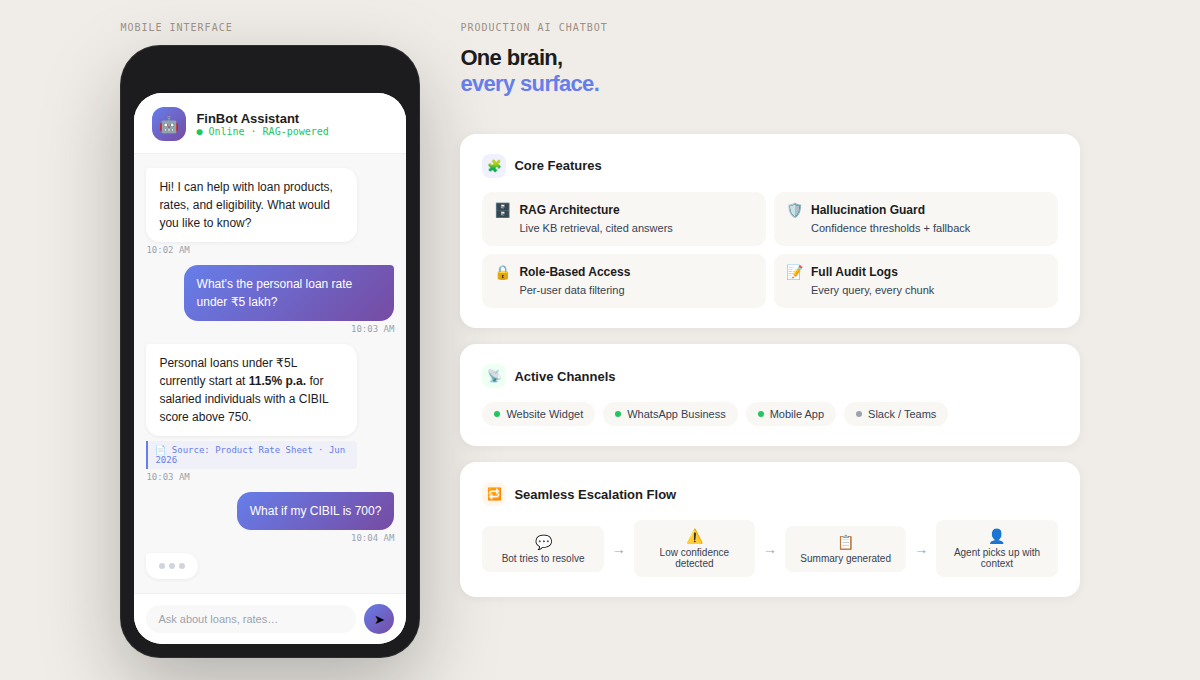
Enterprise chatbots in 2026 operate across multiple surfaces simultaneously: website widget, WhatsApp Business API, mobile app, internal Slack/Teams, email.
The mistake: building a separate chatbot for each channel. Different knowledge bases, different conversation histories, different analytics.
The correct architecture: a single conversation engine (the LLM + RAG pipeline) with channel-specific adapters. The WhatsApp adapter formats responses for messaging. The website widget adapter renders rich UI components. The Slack adapter follows Slack’s message formatting. But all three are calling the same conversation engine with the same knowledge base.
This requires:
Enterprise chatbots have access to sensitive data. Customer PII, product pricing, internal policies, support ticket history. The security requirements are materially different from consumer applications.
The difference between a chatbot that feels intelligent and one that feels stupid is almost entirely how it handles multi-turn conversation state.
The stupid chatbot: every message is independent. The user says “what are your loan products?” The chatbot responds. The user says “which one has the lowest rate?” The chatbot has no memory of the previous message and asks “which products are you referring to?”
The intelligent chatbot: every message carries the context of the conversation. The retrieval query for “which one has the lowest rate?” includes the context that the previous query was about loan products. The response is coherent.
Building this requires:
Every enterprise chatbot needs a human escalation pathway. The question is not whether to build it, it’s how to build it so that the transition from bot to human is seamless rather than infuriating.
The infuriating escalation: the user has explained their problem twice to the chatbot. They escalate to a human. The human agent asks them to explain the problem again. The user leaves a 1-star review.
The seamless escalation: when the user is routed to a human agent, the agent receives a full conversation summary, what the user asked, what the chatbot answered, what the chatbot couldn’t resolve, and the sentiment of the conversation. The human picks up exactly where the chatbot left off.
Building this requires:
The NBFC that came to the team after $200,000 and 18 months: the rebuild took 14 weeks.
The architecture change: from prompt-only to RAG. The knowledge base was built from the NBFC’s product documentation, interest rate tables, eligibility criteria, and FAQ database, all ingested automatically from their existing systems with a nightly refresh.
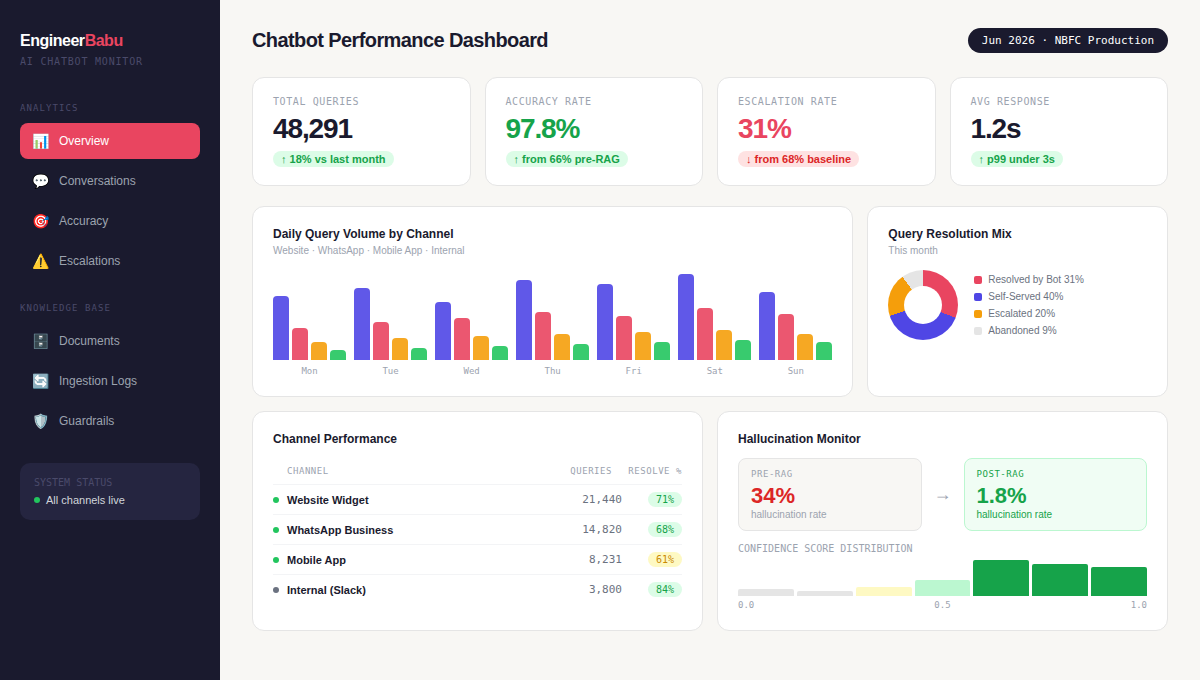
The immediate metric: hallucination rate on the standard test query set dropped from 34% to under 2%.
The business metric: customer service escalation rate dropped from 68% (customers escalating from the chatbot to human agents) to 31% in the first month. The chatbot was now answering correctly often enough that customers didn’t need to escalate.
The Google AI Accelerator 2024 selection reflects specifically what the team brings to these builds: not the ability to call an LLM API, but the engineering discipline to build production AI systems, knowledge base quality management, hallucination monitoring, conversation quality scoring, model drift detection. The same engineering rigour applied to ML systems in lending and fraud detection applies to conversational AI.
The process: Before any model choice, the team maps the query taxonomy — what types of questions will this chatbot receive? From this taxonomy, the knowledge base structure is designed, the retrieval strategy is defined, and the guardrails are specified. Model selection is the last decision, not the first.
The team can scope your AI chatbot architecture and have a proposal in your inbox within a week. mayank@engineerbabu.com.
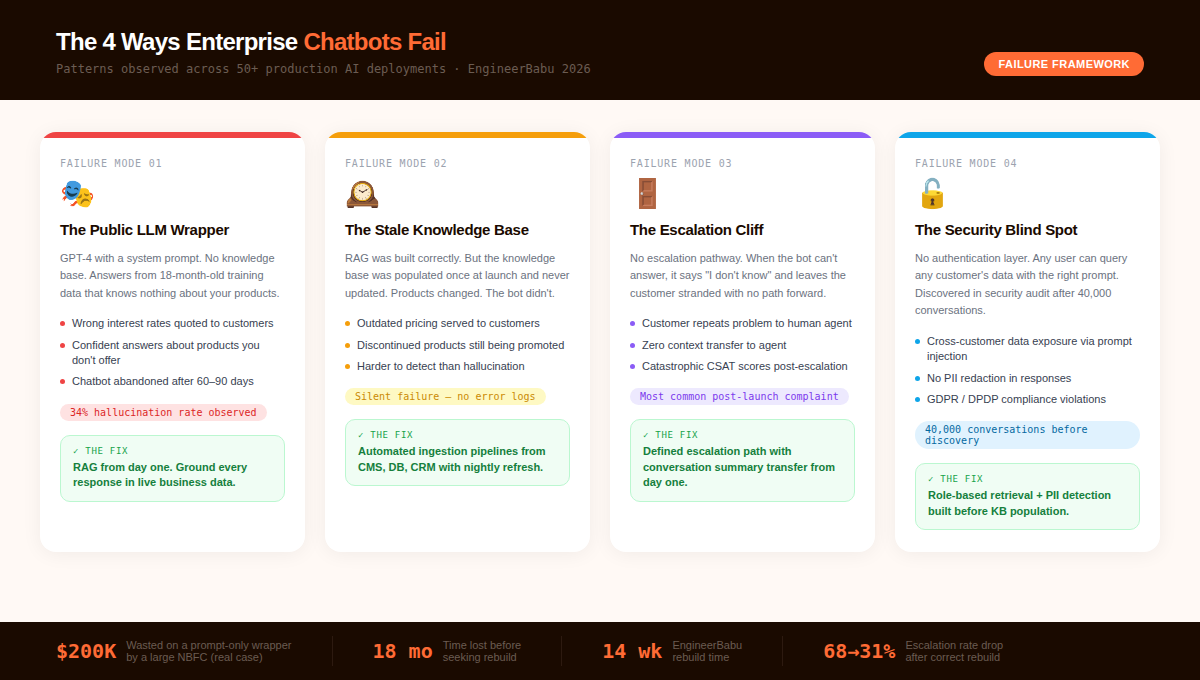
The chatbot calls GPT-4 with a basic system prompt and no knowledge base. It answers confidently about your business from training data that doesn’t know your products. Customers get wrong information and escalate. The chatbot is abandoned after 90 days.
The fix: RAG from day one. The LLM must be grounded in your actual business data, not its training data.
The chatbot is built correctly with RAG. The knowledge base is populated once at launch. Three months later, products change, pricing changes, policies change. The knowledge base doesn’t update. The chatbot gives accurate-sounding but outdated answers. Harder to detect than outright hallucination. Equally damaging.
The fix: Automated ingestion pipelines from source systems. The knowledge base is a live data product, not a one-time upload.
The chatbot has no escalation pathway. When it can’t answer, it says “I don’t know.” The user is stuck. They leave. The CSAT is catastrophic.
The fix: Every chatbot needs a defined escalation pathway from day one, what triggers escalation, where the escalation routes to, and what context transfers to the human agent.
The enterprise chatbot is deployed without proper authentication. Any user can query any customer’s data by crafting the right question. A security audit discovers the vulnerability after 40,000 customer conversations.
The fix: Role-based retrieval and PII protection are architectural requirements built before the knowledge base is populated. The security model is designed at the start, not audited at the end.
The team’s observation: no-code platforms work for FAQ deflection. The moment the chatbot needs to handle queries that require reasoning across multiple documents, remember conversation context, enforce access controls, or integrate with proprietary business systems, custom build is the right answer.
AI chatbot development starts from $15K for a production RAG chatbot, knowledge base setup for one document corpus, conversational interface on one channel, basic guardrails, human escalation pathway.
Enterprise chatbots, multi-channel, multi-corpus knowledge base, role-based access control, compliance logging, analytics dashboard, scoped based on knowledge base complexity, channel count, and integration requirements.
Timeline: Single-channel MVP with one knowledge base in 6–10 weeks. Multi-channel enterprise chatbots in 3–6 months.
40–60% cost savings vs US/UK equivalent quality. Google AI Accelerator 2024 production AI capabilities. Full IP ownership.
The Google AI Accelerator 2024 selection, one of 20 teams globally was specifically for production AI capabilities. The team ships AI systems that run in production, not demos that run on clean test data.
RAG architecture, knowledge base quality management, hallucination monitoring, conversation quality scoring, these are not features the team learns on your project. They’re capabilities refined across multiple production AI deployments.
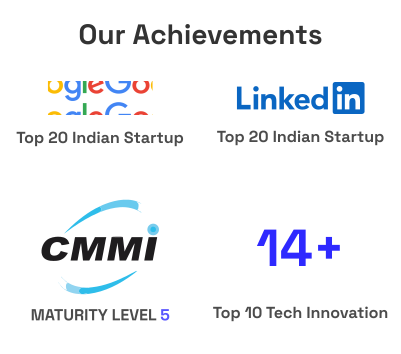
Mayank leads personally. CMMI Level 5 process quality. 4 unicorn clients. 75 YC-selected builds. Full IP ownership.
The NBFC that came after $200,000 of failed chatbot: 14-week rebuild, hallucination rate from 34% to under 2%, escalation rate from 68% to 31%.
Every week a poorly-built chatbot operates is a week of customer trust erosion. Enterprise chatbots that give wrong answers don’t just lose the conversation, they lose the customer.
30 minutes. Honest assessment of your use case, your knowledge base, and what a production AI chatbot actually requires.
Mayank Pratap | Co-founder, EngineerBabu | mayank@engineerbabu.com | engineerbabu.com Google AI Accelerator 2024 · CMMI Level 5 · 4 Unicorn Clients · 75 YC Selections · 200+ VC-funded Products · Backed by Vijay Shekhar Sharma · LinkedIn Top Startup India (Twice)
AI chatbot development is building a conversational interface powered by a large language model (LLM) that understands natural language, retrieves relevant information from a connected knowledge base (RAG architecture), and generates accurate responses grounded in your actual business data not the model’s training data.
RAG (Retrieval-Augmented Generation) connects the LLM to your knowledge base so every response is grounded in your actual documents, products, and policies. Without RAG, the LLM answers from training data that doesn’t know your specific business. RAG-based chatbots achieve 94–98% accuracy on domain-specific questions vs. 71% for standard LLMs. 80% of successful enterprise LLM deployments use RAG.
Single-channel RAG chatbot starts from $15K. Multi-channel enterprise chatbots with role-based access, compliance logging, and analytics: scoped based on complexity. US/UK equivalent quality costs 40–60% more.
Single-channel MVP with one knowledge base: 6–10 weeks. Multi-channel enterprise chatbot: 3–6 months. The critical path is knowledge base quality and ingestion pipeline design, not the LLM integration.
Fine-tuning embeds company knowledge into model weights, expensive, slow, stale when data changes. RAG connects the model to a live knowledge base, fast to update, cheaper to maintain, auditable. For most enterprise use cases, RAG is the right architecture. Fine-tuning adds value only for highly specialised language patterns, not for keeping current on business data.
Hallucination is when the LLM generates a confident-sounding answer that’s factually wrong, either fabricated from training data or incorrectly inferred. Prevention: ground every response in retrieved knowledge base content, require citations, set confidence thresholds below which the chatbot routes to human agents, and implement guardrails that prevent generation when no relevant content is found.
Authentication and authorisation (users only see their own data), role-based retrieval (knowledge base access filtered by permission level), audit logs of every conversation and retrieved chunk, PII detection and redaction in responses, and data residency controls for GDPR/DPDP compliance.
No-code for simple FAQ deflection on well-defined question sets. Custom for multi-channel deployments, complex knowledge bases, strict compliance requirements, or domain-specific retrieval that no-code platforms can’t support. No-code platforms hit limits when query complexity exceeds their retrieval sophistication.