Healthcare Data Interoperability in the USA: What Every Builder and CIO Needs to Know in 2026


Create engaging, high-performance mobile applications tailored to your business needs. We craft future-ready apps that offer smooth user experiences on all devices.
Build robust and scalable websites and CMS platforms that help you manage content effortlessly. Our development ensures a seamless digital presence.
Launch secure, feature-rich online stores with intuitive shopping experiences. We build tailored eCommerce platforms designed for growth.
Design captivating games with immersive gameplay and stunning graphics. From concept to launch, we build engaging experiences that players love.
Enhance your customer relationships with customized Salesforce implementations. Drive growth and efficiency with smarter CRM solutions.
Harness artificial intelligence and machine learning to automate workflows and gain actionable insights. Our AI transforms data into smart decisions.
Accelerate your software delivery lifecycle with continuous integration, delivery, and infrastructure automation to boost efficiency.
Hire app developers ready to turn your ideas into sleek, high-performing mobile apps for any platform.
Bring in frontend pros who craft smooth, beautiful, and user-friendly interfaces that your visitors will love.
Get backend developers who build fast, secure, and reliable systems to keep everything running behind the scenes.
Hire eCommerce developers who build secure, scalable online stores designed to offer seamless shopping and grow your sales.
Get dedicated developers committed to your projects, delivering consistent quality and speed as an extension of your team.
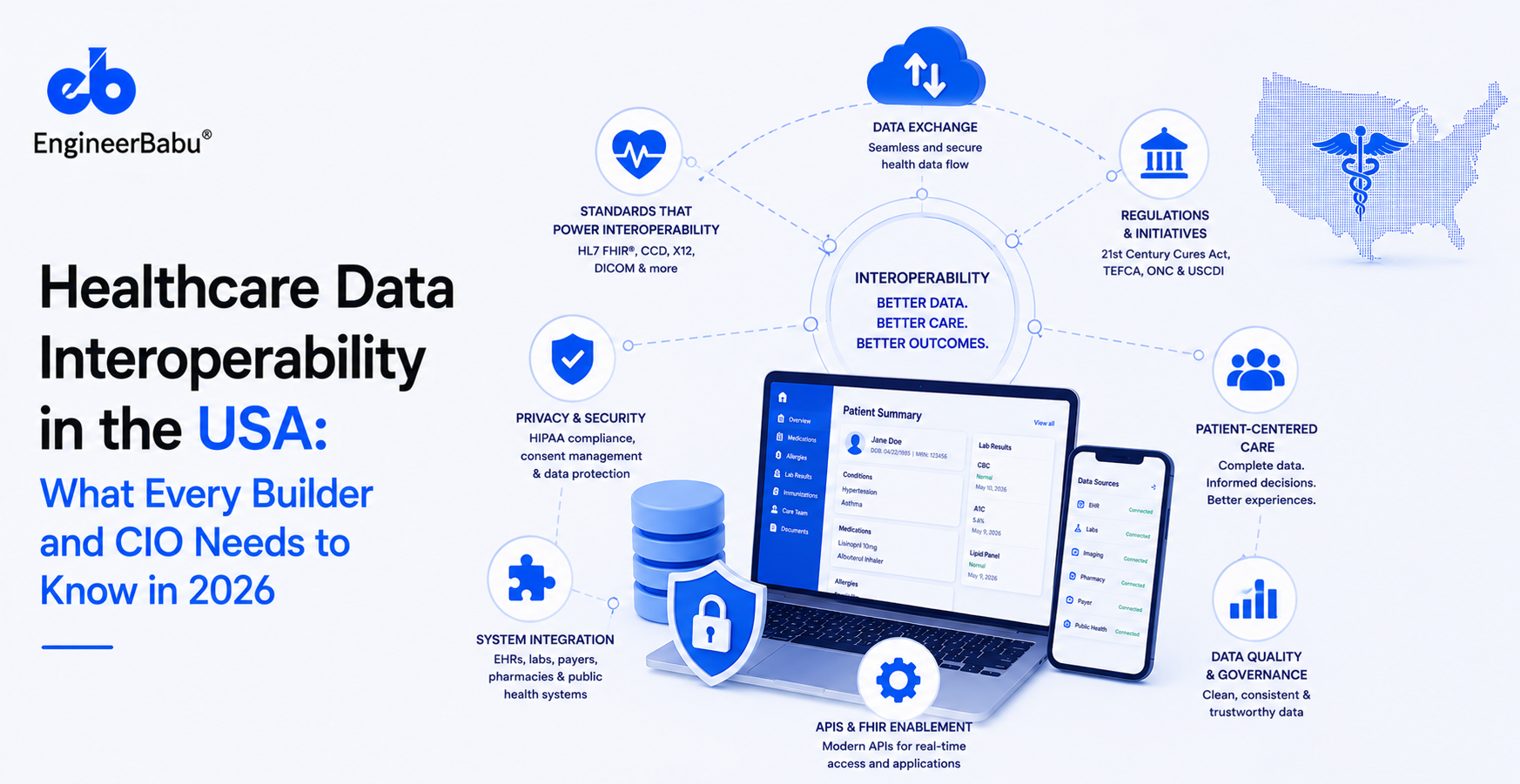
The US healthcare system loses between $265-$570 billion annually to administrative inefficiencies. A significant portion of that is not waste in the traditional sense, it’s friction cost from systems that can’t talk to each other.
A patient sees three specialists, a primary care physician, and an urgent care center in one year. Five separate EHR systems. No shared record. The cardiologist doesn’t know what the endocrinologist prescribed. The urgent care center doesn’t know the patient has a documented penicillin allergy. The PCP reconciles three paper printouts at the annual visit.
Healthcare data interoperability in the USA, the ability for clinical systems to exchange patient data seamlessly, in a standardized format, without custom integration for every new connection is what closes that gap.
The regulatory framework mandating it has been building since 2016, and as of 2026 it is fully in enforcement. What was once a goal is now a legal requirement.
Healthcare data interoperability is the ability of different health information technology systems, EHRs, labs, pharmacies, payers, patient apps, public health systems to exchange, interpret, and use patient health data accurately without requiring custom integration for every new connection.
In the USA in 2026, interoperability is achieved through a framework of four interconnected standards and regulations: FHIR R4 (the technical data exchange standard), USCDI (the minimum dataset that must be exchangeable), TEFCA (the national trust network connecting health information systems), and the 21st Century Cures Act / ONC Information Blocking Rules (the legal requirement to share rather than silo data).
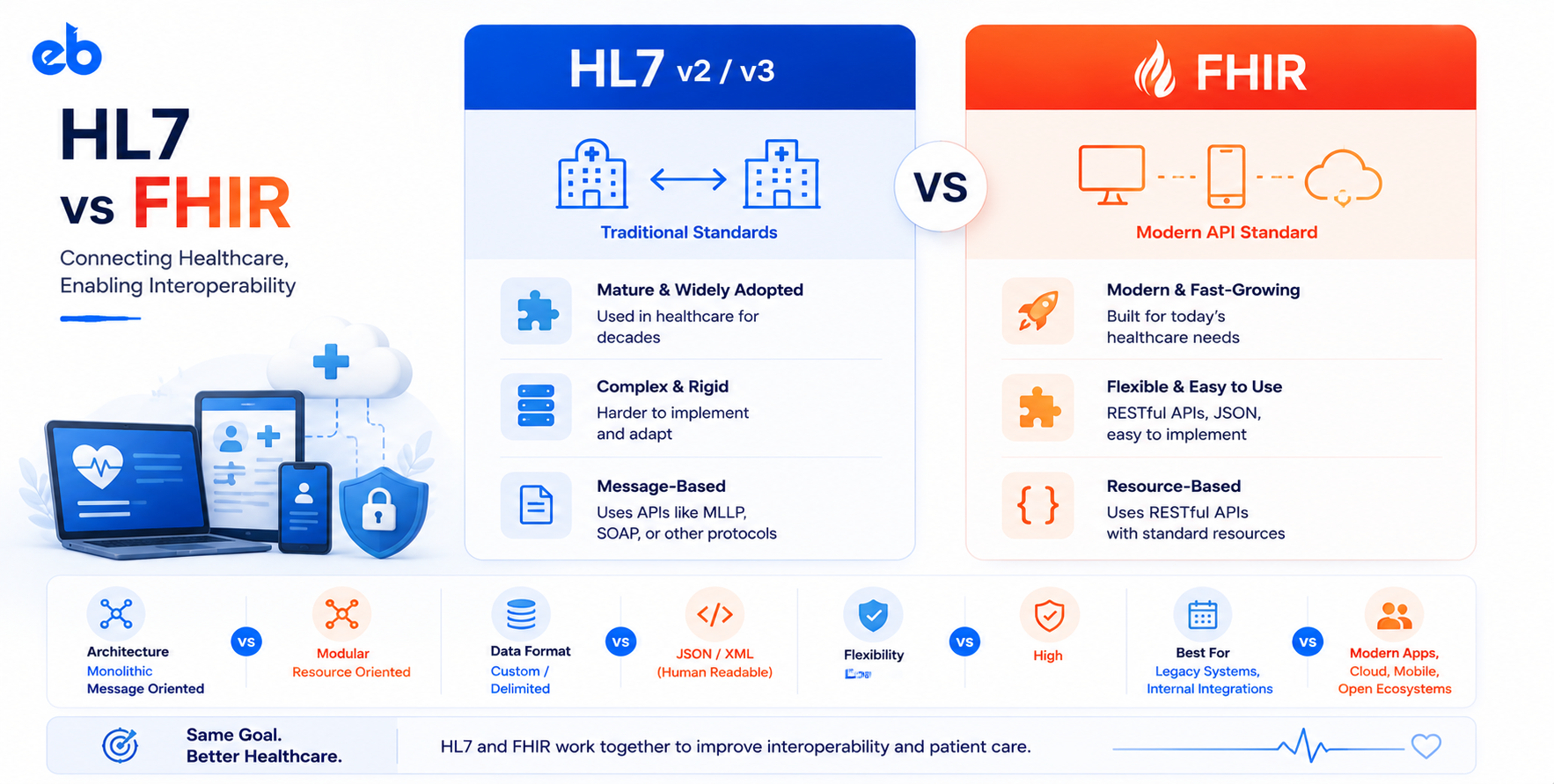
HL7 FHIR (Fast Healthcare Interoperability Resources) R4 is the data exchange standard that replaced the fragmented HL7 v2 landscape. Where HL7 v2 used pipe-delimited messages with hospital-specific implementations that required custom translation for every new connection, FHIR uses RESTful APIs, JSON, and OAuth 2.0, the same patterns that web developers already know.
What FHIR R4 provides:
What FHIR doesn’t fully solve: FHIR standardizes the format, not the semantics. Two hospitals can both expose Observation resources in FHIR R4 that have structurally valid but clinically incompatible content, different coding systems, different value representations, different local extensions. Semantic interoperability. Thus, ensuring that “blood glucose 120 mg/dL” means the same thing in two different systems, requires additional work beyond FHIR structural compliance.
HTI-1 (effective January 1, 2026): Raised the ONC certification baseline to USCDI v3, requiring certified EHRs to support a broader minimum dataset. Systems that were certified against USCDI v1 or v2 must update to maintain certification.
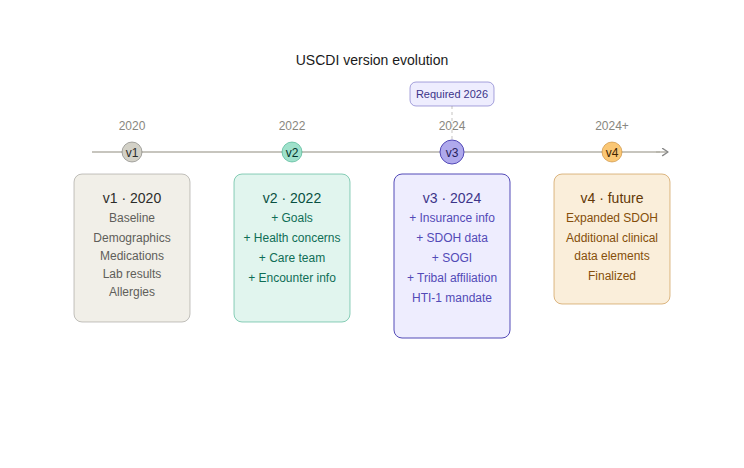
The United States Core Data for Interoperability (USCDI) defines the minimum set of data classes and elements that must be exchangeable via FHIR APIs in all ONC-certified health IT systems.
| USCDI Version | Status | Key Additions |
| USCDI v1 (2020) | Baseline | Demographics, diagnoses, medications, allergies, procedures, lab results, vital signs, clinical notes |
| USCDI v2 (2022) | Certification requirement | Goals, health concerns, care team members, encounter information |
| USCDI v3 (2024) | HTI-1 requirement (Jan 2026) | Health insurance, tribal affiliation, sexual orientation/gender identity, social determinants of health |
| USCDI v4 (2024) | Finalized, future requirement | Expanded SDOH data, additional clinical data elements |
The practical implication for builders: if you’re building a healthcare app that needs to access patient data, the data elements in USCDI v3 are the ones you can reliably expect to find in ONC-certified EHRs starting January 2026. Data elements not in USCDI may or may not be available via FHIR APIs at specific EHR vendors.
TEFCA (Trusted Exchange Framework and Common Agreement) is the federal framework establishing nationwide health information exchange. Operated by ONC with The Sequoia Project as the Recognized Coordinating Entity, TEFCA defines the governance, policy, and technical standards for a “network of networks” enabling data exchange across previously siloed health information systems.
How TEFCA works: Organizations participate through Qualified Health Information Networks (QHINs), networks that have met TEFCA’s requirements and can exchange data with all other QHINs.
Epic’s QHIN (Epic Nexus), CommonWell, Carequality, and others are TEFCA participants. Once your organization connects through a QHIN, you gain access to patient records from any participating system nationwide.
The patient data access use case: A patient receiving care at a Cerner hospital and an Epic clinic, previously two isolated systems can have their records accessible to both providers through TEFCA, with patient consent. This is the “network effect” that makes TEFCA different from point-to-point integrations.
TEFCA participation status in 2026: Not yet mandatory for all organizations, but rapidly becoming a competitive and operational expectation. CMS’s 2026 mandate that FHIR networks expose data via FHIR APIs aligned with USCDI v3 by July 4, 2026 accelerates TEFCA adoption.
The legal layer. Healthcare organizations, EHR vendors, and health information networks that block or delay patient data access face penalties up to $1 million per violation for health IT developers, and potential OIG investigation for providers.
As of September 2025, HHS increased enforcement actions. Approximately 1,300 complaints have been filed with ONC since information blocking rules took effect. The compliance posture that avoids liability: default to sharing EHI unless a specific, documented exception applies.
The eight defined exceptions where information blocking is permitted:
Outside these specific exceptions, sharing EHI is not optional. It is the legal baseline.
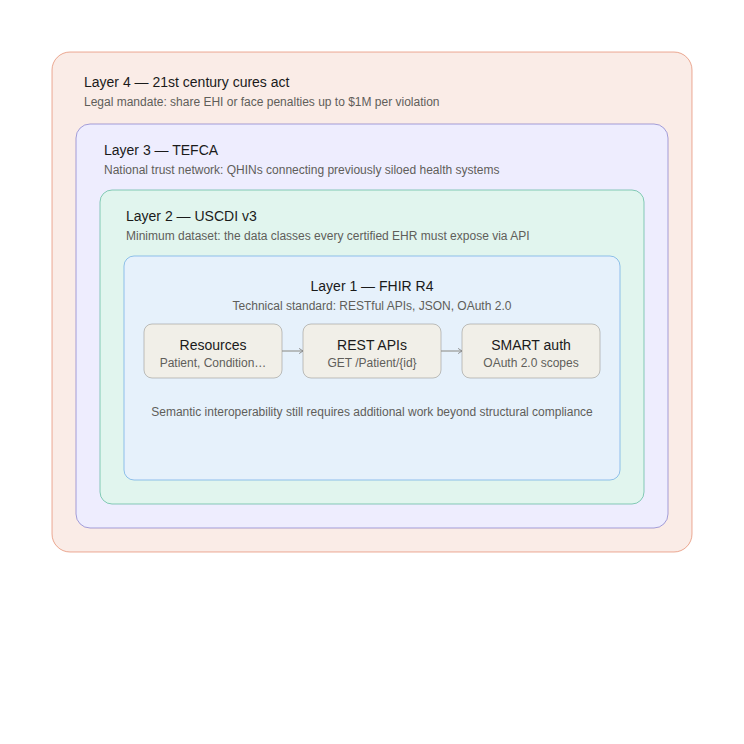
The Cures Act creates a legal right for patients to authorize your app to access their EHR data. FHIR R4 APIs are how you retrieve it. SMART on FHIR is how you authenticate. EHRs are legally required to cooperate.
The technical complexity is not regulatory, it’s implementation variability. Each EHR implements FHIR differently. Epic’s FHIR endpoints behave differently from Cerner’s, which differ from Athenahealth’s. Building a robust FHIR integration requires handling these differences with a normalization layer.
TEFCA participation through a QHIN is increasingly expected by CMS programs and value-based care contracts. If your organization is still on point-to-point HL7 v2 interfaces for all external data exchange, the migration to FHIR R4 APIs and TEFCA participation should be on your 2026–2027 roadmap.
ONC certification to USCDI v3 (HTI-1, effective January 2026) is a compliance requirement. SMART on FHIR app authorization, CDS Hooks support, and bulk FHIR data export are increasingly expected features. The HTI-5 proposed rule (December 2025) signals that future certification requirements will be even more tightly focused on FHIR-based API access and AI-ready data infrastructure.
The MCP layer emerging in 2026: The Model Context Protocol is emerging as a new interoperability layer for AI systems. Thus, enabling AI models to access structured health data through standardized “tool” interfaces without requiring developers to know the details of FHIR API implementation.
Healthcare IT teams are beginning to build MCP servers on top of FHIR endpoints to give AI systems direct, safe access to clinical data. This will become significant for ambient AI applications, clinical decision support, and population health analytics over the next 12–24 months.
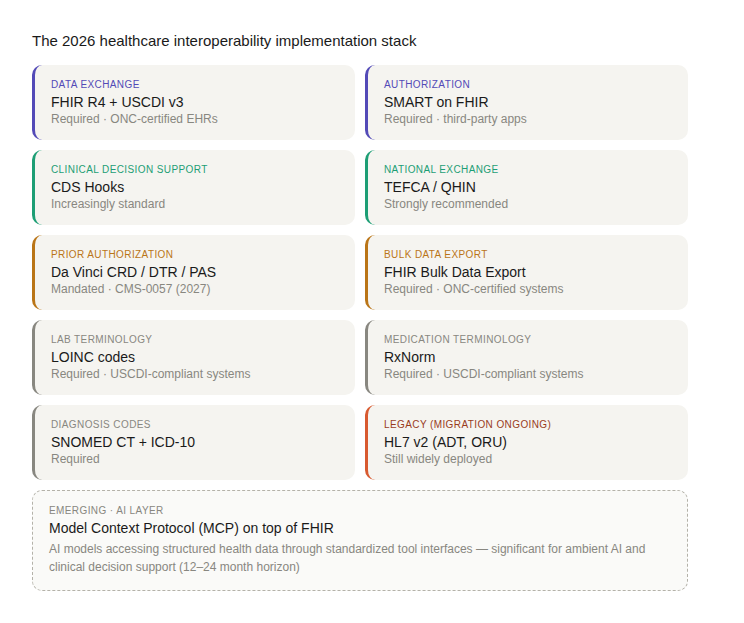
For health system CIOs and digital health builders, the 2026 interoperability implementation stack:
| Component | Standard | Status |
| Patient data exchange API | FHIR R4 + USCDI v3 | Required (ONC-certified EHRs) |
| Patient authorization | SMART on FHIR (OAuth 2.0) | Required for third-party apps |
| Clinical decision support | CDS Hooks | Increasingly standard |
| Prior authorization | Da Vinci CRD/DTR/PAS | Mandated by CMS-0057 (2027) |
| National exchange | TEFCA / QHIN | Strongly recommended |
| Lab data | LOINC codes | Required in USCDI-compliant systems |
| Medication data | RxNorm | Required in USCDI-compliant systems |
| Diagnosis codes | SNOMED CT + ICD-10 | Required |
| Bulk data export | FHIR Bulk Data Export | Required for ONC-certified systems |
| Legacy clinical events | HL7 v2 (ADT, ORU) | Still widely deployed; migration ongoing |
Author: Mayank Pratap | Co-Founder, EngineerBabu | Google AI Accelerator 2024 · CMMI Level 5
The ability for different healthcare IT systems to exchange patient data accurately and automatically. So a cardiologist can see what the PCP prescribed, the pharmacy knows about allergies, and the patient can access all their records from any device through any app.
All ONC-certified EHRs are required to support FHIR R4 APIs meeting USCDI v3 (HTI-1, effective January 2026). Non-certified systems are not directly mandated, but information blocking rules apply to all healthcare providers who maintain electronic health information.
TEFCA is the national trust network enabling data exchange across QHINs. Participation is not currently mandatory for all organizations, but is increasingly expected by CMS programs, value-based care contracts, and health system partners. Connecting through a QHIN gives access to patient records from any participating system nationwide.
Information blocking is any practice that unreasonably restricts, delays, or prevents access, exchange, or use of electronic health information. Penalties reach $1 million per violation for health IT developers and information networks. Provider penalties are referred to OIG. The default compliance posture: share EHI unless a specific documented exception applies.
USCDI (United States Core Data for Interoperability) defines the minimum data elements that ONC-certified EHRs must expose via FHIR APIs. USCDI v3 (effective 2026) is the current baseline. If you’re building apps that access EHR data, USCDI tells you what data you can reliably expect to find in any certified system.