Why Australian Companies Are Outsourcing Software Development to India in 2026


Create engaging, high-performance mobile applications tailored to your business needs. We craft future-ready apps that offer smooth user experiences on all devices.
Build robust and scalable websites and CMS platforms that help you manage content effortlessly. Our development ensures a seamless digital presence.
Launch secure, feature-rich online stores with intuitive shopping experiences. We build tailored eCommerce platforms designed for growth.
Design captivating games with immersive gameplay and stunning graphics. From concept to launch, we build engaging experiences that players love.
Enhance your customer relationships with customized Salesforce implementations. Drive growth and efficiency with smarter CRM solutions.
Harness artificial intelligence and machine learning to automate workflows and gain actionable insights. Our AI transforms data into smart decisions.
Accelerate your software delivery lifecycle with continuous integration, delivery, and infrastructure automation to boost efficiency.
Hire app developers ready to turn your ideas into sleek, high-performing mobile apps for any platform.
Bring in frontend pros who craft smooth, beautiful, and user-friendly interfaces that your visitors will love.
Get backend developers who build fast, secure, and reliable systems to keep everything running behind the scenes.
Hire eCommerce developers who build secure, scalable online stores designed to offer seamless shopping and grow your sales.
Get dedicated developers committed to your projects, delivering consistent quality and speed as an extension of your team.
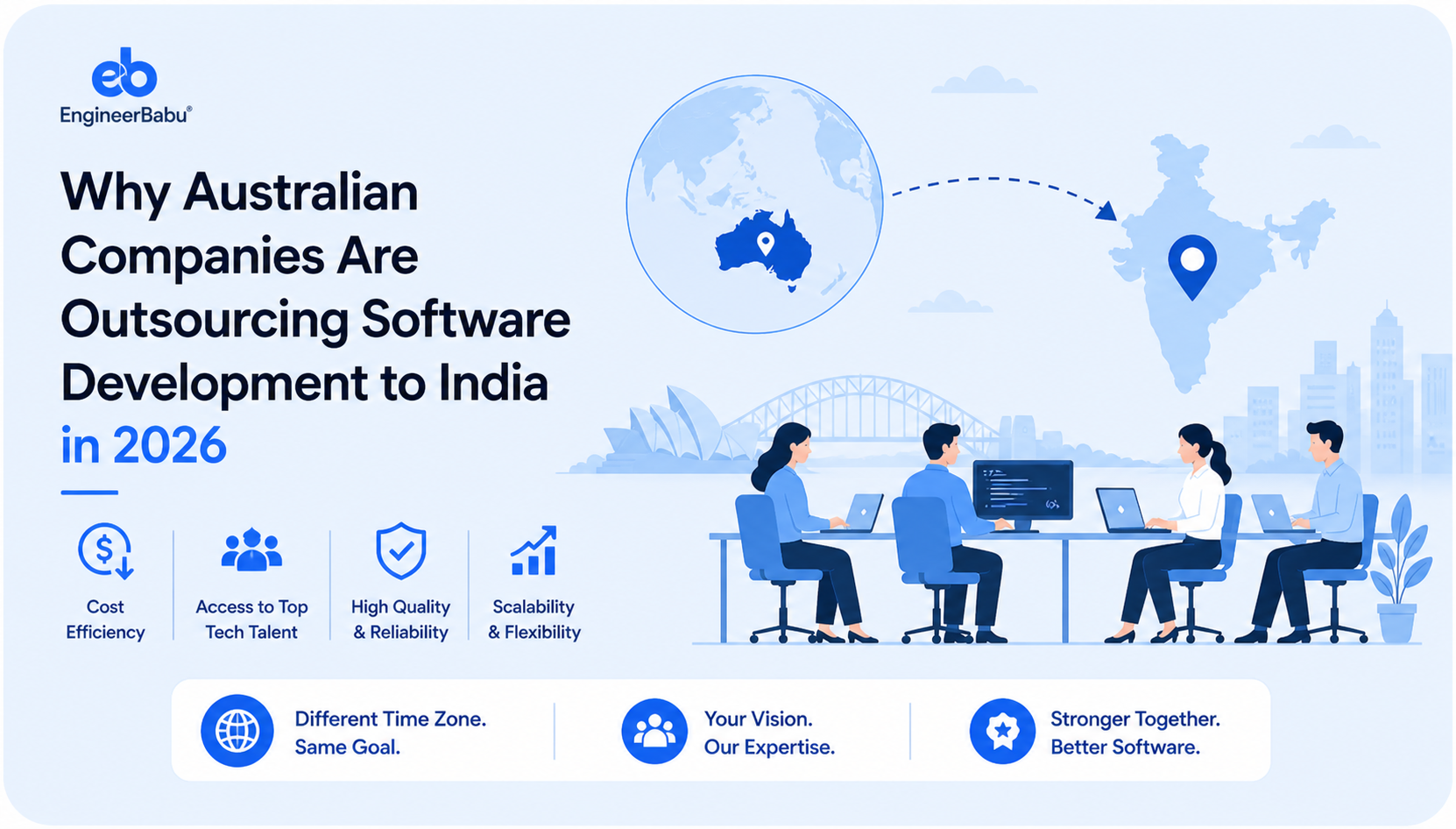
Australia has a problem nobody’s solving fast enough.
The country is digitalizing at breakneck speed. Every bank, every insurer, every healthcare provider, every retailer, every logistics company needs software. Custom platforms. Mobile apps. AI-powered systems. Cloud migrations. The demand is enormous.
The developer supply isn’t.
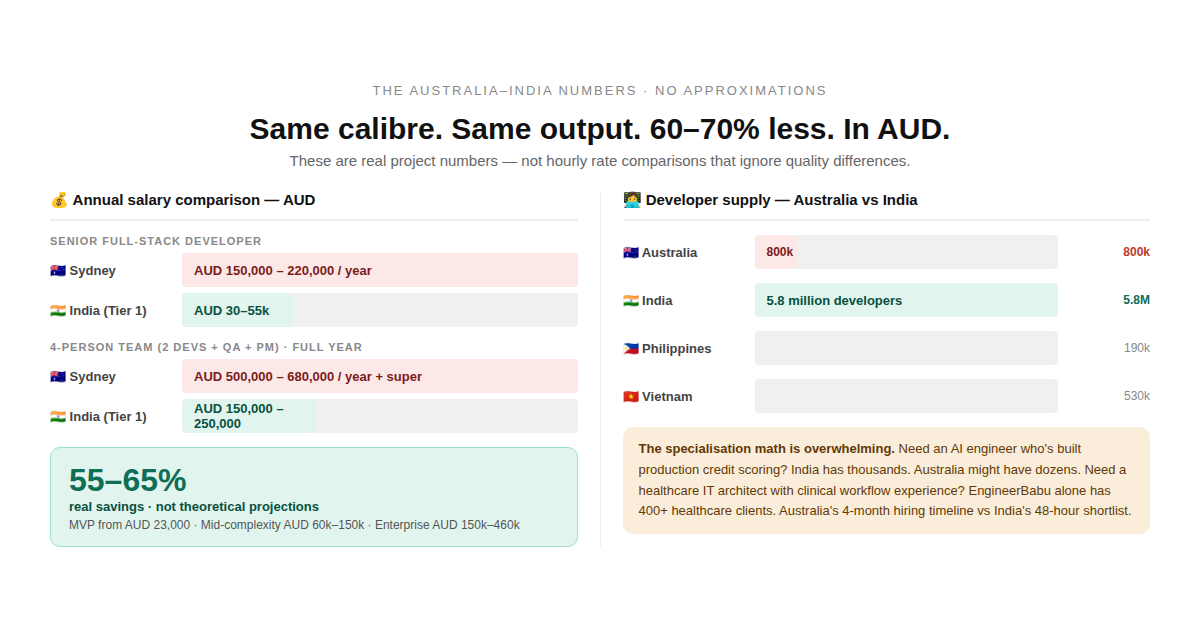
Australia has roughly 800,000 IT workers. The Tech Council of Australia estimates the country needs 1.2 million technology workers by 2030 to meet demand — a gap of 400,000 people. Senior developer salaries in Sydney and Melbourne have crossed AUD 180,000-220,000 ($120,000-$145,000 USD). Finding a specialized fintech engineer or AI developer in Australia takes 4-6 months. Finding one who’ll stay longer than 18 months is a prayer, not a strategy.
Meanwhile, 3 hours and 30 minutes northwest — timezone-wise — sits India. 5.8 million developers. 1.5 million new engineering graduates per year. Senior developers at a fraction of Australian cost. Domain specialization across fintech, healthcare, AI, and enterprise that rivals anywhere on Earth.
The timezone overlap between Sydney and India is 4.5 hours of shared business day. That’s more overlap than Sydney has with San Francisco.
And yet, Australian companies are some of the last in the developed world to embrace Indian software outsourcing at scale. UK companies outsource aggressively to India. US companies spend $200 billion on Indian IT annually. UAE companies treat Indian development teams as natural extensions of their own.
Australia is behind. And the companies that figure this out first have a massive competitive advantage over those that don’t.
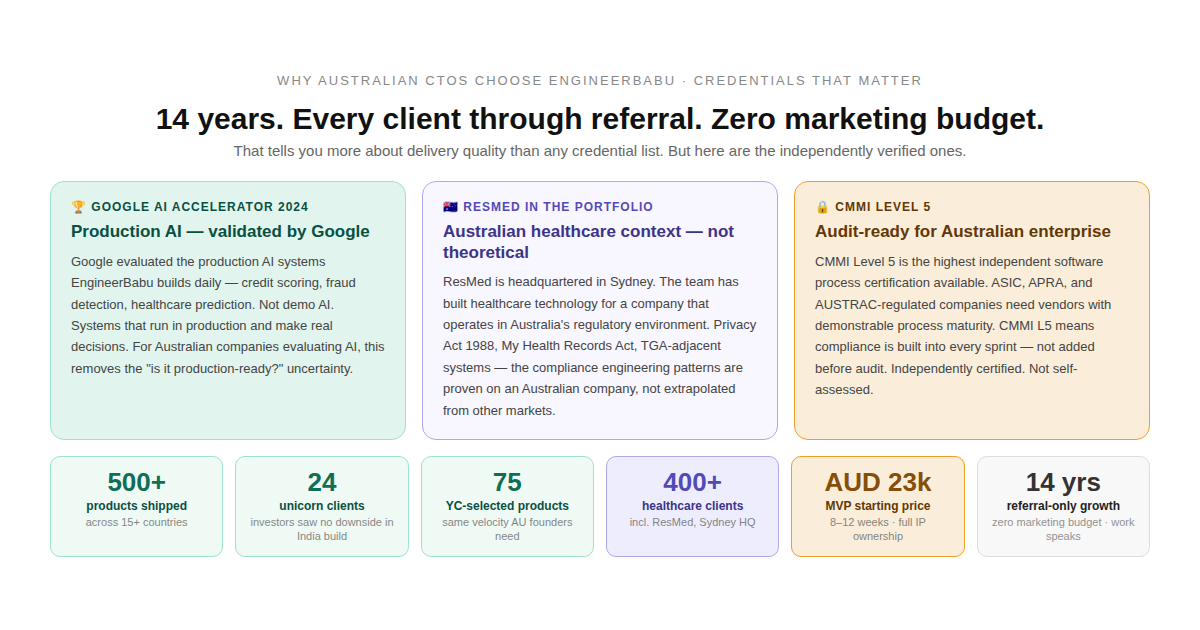
I know this because the EngineerBabu team works with companies across 15+ countries — including Australian businesses. My name is Mayank Pratap. I co-founded EngineerBabu 14 years ago. The team has shipped 500+ products. 200+ for VC-funded companies. 75 for Y Combinator-selected startups. 4 clients that became unicorns.
EarlySalary — one of India’s first salary advance platforms. The team built the lending infrastructure. ₹10,000 crore disbursed. Khatabook — tens of millions of users. Bank Open — neobank that became a unicorn. OpenMoney — full-stack financial platform. TaptapSend — remittance across five countries. Kulu Fintech — GCC financial infrastructure. Apollo Hospitals, Manipal, ResMed, 1MG — healthcare platforms. Adani Group — enterprise technology.
Google selected EngineerBabu for the AI Accelerator 2024. CMMI certified us at Level 5. Vijay Shekhar Sharma — the founder of Paytm — backs us personally.
This blog is specifically for the Australian CTO, VP Engineering, or founder who’s considering India but hasn’t made the move yet. Everything you need to know. No fluff. No generic advice. Real answers from someone who’s been delivering to international clients for 14 years.
Let me give you the data that most comparison blogs skip.
The cost equation: A mid-level full-stack developer in Sydney costs AUD 130,000-170,000/year ($85,000-$112,000 USD). The same level of talent in India — from a quality Tier 1 company with CMMI certification, international clients, and verifiable track records — costs AUD 30,000-55,000/year ($20,000-$36,000 USD). That’s not a 20% savings. It’s 60-70%.
A four-person development team in Australia (2 developers, 1 QA, 1 PM) costs AUD
500,000-700,000/year including superannuation, benefits, office space in Sydney or Melbourne, and equipment. The same team from a quality Indian company: AUD 150,000-250,000/year.
The talent equation: Australia produces approximately 7,000 IT graduates per year. India produces 1.5 million. The specialization math is overwhelming. Need an AI engineer who’s built production credit scoring systems? India has thousands. Australia might have dozens.
Need a healthcare IT architect who’s navigated HIPAA and understands clinical workflows? The EngineerBabu team alone has served 400+ healthcare clients.
The timezone equation: India Standard Time is 4.5 hours behind AEST (Australian Eastern Standard Time — Sydney, Melbourne). If the Australian team starts at 9 AM AEST, the Indian team’s day extends to 4:30 PM IST (9 AM AEST). A 4.5-hour overlap window — 9 AM to 1:30 PM AEST / 4:30 AM to 9 AM IST… no. Let me recalculate correctly.
Actually, let me give this to you precisely. IST is UTC+5:30. AEST is UTC+10 (or UTC+11 during daylight saving). The difference is 4.5 hours (5.5 during AEDT).
India is 4.5 hours BEHIND Sydney. When it’s 9 AM in Sydney, it’s 4:30 AM in India. When the Indian team starts at 9:30 AM IST, it’s 2 PM AEST in Sydney.
So the overlap window works like this: the Indian team’s afternoon (2 PM – 6:30 PM IST) coincides with the Australian team’s morning (6:30 AM – 11 AM AEST). That’s 4-4.5 hours of overlap during Australian business hours.
Here’s the practical reality: the EngineerBabu team runs standups with Australian clients at 10 AM AEST (5:30 PM IST). Sprint reviews happen at 11 AM AEST (6:30 PM IST). Both teams are in their work day — the Australian team in their morning peak, the Indian team wrapping their afternoon. It’s comfortable. Nobody’s awake at 2 AM. Nobody’s sacrificing dinner with their family.
Compare this to other outsourcing destinations from Australia’s perspective. Eastern Europe: 7-9 hours behind — the overlap is brutal. US: 14-17 hours behind — practically the opposite side of the clock. Philippines: 2-3 hours behind — slightly better overlap than India, but with 190,000 developers versus India’s 5.8 million, the talent depth trade-off is severe.
India gives Australia the best combination of timezone overlap AND talent depth. Not the best timezone (that’s Philippines or Singapore). Not the cheapest (that’s Vietnam). But the best combination — which is what matters when you’re building complex software that requires specialized talent.
The conversation has shifted in the past three years. Australian companies used to outsource maintenance work and minor development tasks to India. Now they’re outsourcing core product engineering. The shift happened because Australian CTOs realized that Indian teams — the good ones — don’t just write code. They architect products.
Australia’s Big Four banks spend billions on technology annually. The open banking regime (Consumer Data Right) is creating new fintech opportunities. Digital lending, neobanking, payment platforms, insurance technology, wealth management apps — the fintech ecosystem is expanding rapidly.
Australian fintech companies are increasingly building with Indian teams because the domain expertise is exceptional.
The EngineerBabu team’s fintech depth is the deepest the team carries across any vertical. EarlySalary’s lending platform — ₹10,000 crore disbursed, real-time credit decisioning processing thousands of daily decisions. The CTO’s 17 years at Wishfin building credit infrastructure for one of India’s largest credit marketplaces. Bank Open’s neobank — became a unicorn with core banking integrations built by the team. OpenMoney’s multi-product financial platform — payments, investments, and credit unified. Razorpay ecosystem payment orchestration. TaptapSend’s 5-country regulated remittance. LoanOS — the team’s own lending technology product, processing ₹1,000 crore annually through a DSA.
For Australian fintech companies, this depth means faster builds, fewer architectural mistakes, and compliance patterns already proven in production across multiple regulatory jurisdictions.
Australia’s regulatory environment — ASIC, APRA, AUSTRAC — is different from India’s RBI or UAE’s CBUAE. But the engineering discipline of building compliant financial software is universal. The team has navigated RBI, CBUAE, SAMA, FCA, and multi-jurisdiction compliance through TaptapSend. Australian financial regulations are rigorous but well-documented. The team translates regulatory requirements into compliant architecture — the compliance expertise is in the engineering patterns, not the specific regulator.
Australia’s healthcare system is going digital. My Health Record, telehealth expansion post-COVID, practice management systems, pathology platforms, health insurance technology — the demand for healthcare IT is enormous.
The EngineerBabu team has the broadest healthcare portfolio of any development company their size. 400+ healthcare clients globally. Apollo Hospitals, Manipal, Shalby, CHL Hospitals, ResMed, 1MG, Fortis, Practo, Thyrocare, Tata Health, Somnoware. HIPAA-compliant platforms for US healthcare — and the engineering practices that make HIPAA compliance achievable transfer directly to Australian healthcare compliance requirements (Privacy Act 1988, My Health Records Act).
ResMed — one of the team’s healthcare clients — is an Australian company. It’s headquartered in Sydney. The team has built healthcare technology for a company that operates in
Australia’s regulatory environment. That’s not theoretical compliance capability. That’s actual Australian healthcare context.
Google AI Accelerator 2024 means the AI capabilities — predictive analytics, clinical decision support, patient risk stratification, intelligent scheduling — are validated. For Australian hospitals and health systems evaluating AI, working with a Google-validated team removes the “is this AI production-ready?” uncertainty.
Australia’s e-commerce market crossed AUD 63 billion in 2025. Kogan, Catch, The Iconic, marketplace platforms, direct-to-consumer brands — all need technology. Inventory management, order fulfillment, customer analytics, loyalty platforms, omnichannel retail systems.
The EngineerBabu team has built marketplace and supply chain technology across multiple projects. Supersourcing — the B2B marketplace platform Mayank co-founded — proves the team builds and operates their own marketplace, not just client marketplaces. Simba Beer’s supply chain platform recovered millions in blocked capital. Khatabook scaled to tens of millions of small business users — the kind of SME commerce platform that Australian retail and wholesale businesses need.
Australia’s SaaS ecosystem is one of the strongest outside the US. Atlassian, Canva, SafetyCulture — Australian-founded SaaS companies that became global leaders. The next generation of Australian SaaS founders is building now, and many of them are building with Indian engineering teams.
The EngineerBabu team has built 75 products for YC-selected startups — many of them SaaS companies. The Harvard Innovation Lab winner in the portfolio was a SaaS product. Supersourcing is a B2B SaaS platform. LoanOS is a SaaS lending product.
For Australian SaaS founders, the value proposition is clear: build with a team that’s shipped 75 YC-grade products, at 60% of what a local Sydney team would cost, with a 4.5-hour timezone overlap that enables daily collaboration.
This section matters more than most Australian CTOs realize.
Australia and India have a business relationship that goes back decades. 800,000+ people of Indian origin live in Australia. Indian culture isn’t foreign to Australian companies — it’s familiar. The work ethic is aligned. The professional communication norms are compatible. The humour translates (mostly).
Indian developers trained at top companies — companies like EngineerBabu with international exposure across 15+ countries — communicate in a direct, clear, professional style that Australian clients appreciate. No excessive formality. No hidden miscommunication. Straightforward technical discussions between engineers who speak the same professional language.
The EngineerBabu team’s communication style has been refined across 500+ deliveries to international clients. The team pushes back when requirements don’t make sense. They raise concerns proactively, not after missing a deadline. They explain trade-offs in plain language, not technical jargon designed to impress.
One practical indicator: every EngineerBabu client for 14 years has come through referral. No marketing. No outbound sales. Referral-only means the communication and relationship quality is strong enough that clients actively recommend the team to others. That’s the strongest signal of cultural and professional compatibility available.
Week 1-2: Discovery. Mayank (that’s me — the founder) gets on a call with the Australian CTO or founder. The timezone makes this easy — 10 AM AEST is a comfortable 5:30 PM IST. The conversation covers the business model, target users, competitive landscape, regulatory requirements, and technical vision. If the project isn’t a fit — if it needs something outside the team’s expertise — I say so.
Week 2-3: Scoping and architecture. The team produces a detailed technical architecture document, user flows, and a product roadmap. Not a generic template — specific architecture informed by the team’s experience. CMMI Level 5 processes mean the scoping is rigorous. What’s in scope is documented. What’s out is documented. No ambiguity.
Week 3-4: Design. Figma prototypes. The Australian team reviews and approves. This phase catches UX problems before they become engineering problems — saving weeks of rework later.
Week 5 onwards: Development. Two-week sprints. Sprint demo every two weeks at 10-11 AM AEST (5:30-6:30 PM IST). The Australian team sees working software — not slides. Feedback incorporated same sprint or next sprint. Daily standups on Slack or video call during the overlap window.
At delivery: Complete code and IP ownership transfer. Deployment to the client’s infrastructure. Documentation. Training. Two months of post-launch support for production issues.
The rhythm: The Indian team’s afternoon is the Australian team’s morning. The Indian team builds during their morning (Australian night). By the time Australia’s day starts, fresh work is ready for review. Feedback goes back during the overlap. The Indian team incorporates it in their next morning. It’s nearly a continuous development cycle — build, review, feedback, build — with minimal dead time.
The team ships MVPs in 8-12 weeks. Not rushed. Efficient. 500+ shipped products create pattern recognition that eliminates wasted effort. The team knows what to build in phase one, what to defer, and what to skip.
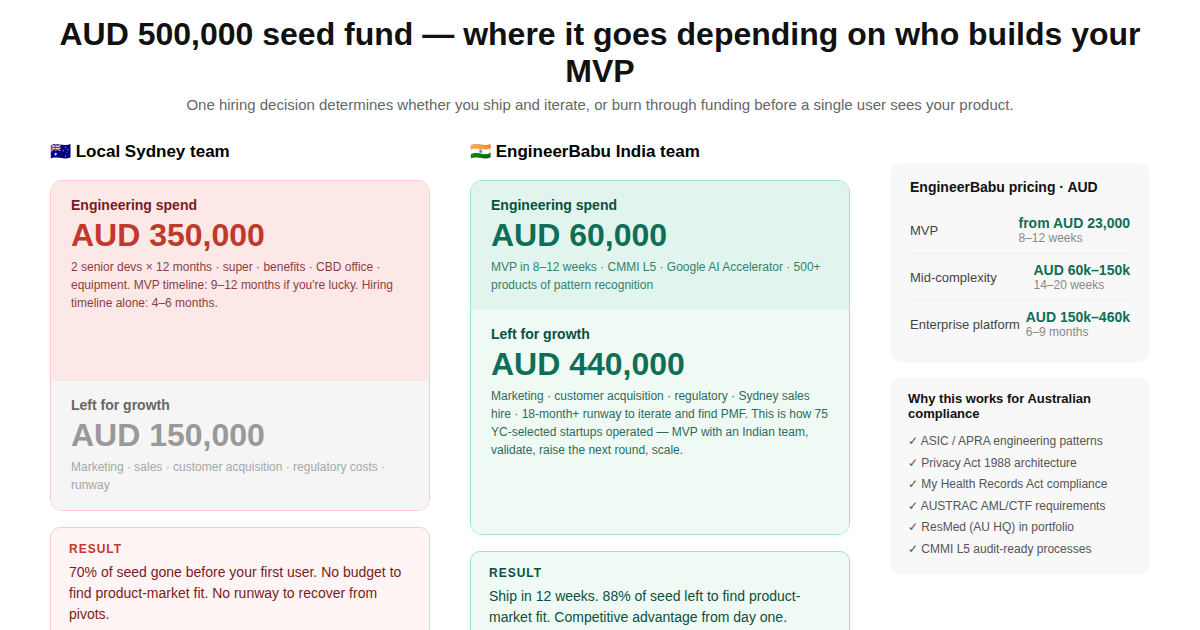
Let me put this in AUD so the numbers land clearly. Building locally in Australia:
Building with a quality Indian team (Tier 1 — CMMI certified, international track record):
The savings are 55-65%. And they’re real — not theoretical projections based on hourly rate comparisons that ignore quality differences.
Here’s what those savings mean practically. An Australian fintech startup with AUD 500,000 in seed funding can either hire 2 local developers for 12 months — and hope they build the MVP — or engage the EngineerBabu team, get the MVP in 8-12 weeks for AUD 40,000-80,000, and have AUD 400,000+ left for marketing, customer acquisition, regulatory costs, and runway.
That’s the difference between a startup that ships and iterates quickly, and one that burns through its funding on salaries before the product reaches a single user.
This is exactly how many of the 75 YC-selected startups the team built for operated. MVP with an Indian team. Validate. Raise the next round. Scale.
Three reasons. All fixable.
Unfamiliarity bias. UK and US companies have outsourced to India for decades. Australian companies have less institutional experience with Indian outsourcing. The horror stories — and there are genuine horror stories — have created a caution that’s disproportionate to the actual risk when the right partner is selected. CMMI Level 5 certification, Google AI Accelerator selection, 4 unicorn clients, 75 YC projects — these aren’t vague promises. They’re independently verified credentials that de-risk the decision.
Overestimating the timezone challenge. 4.5 hours sounds like a lot. In practice, it creates a 4-4.5 hour overlap window that’s more than sufficient for daily collaboration. The EngineerBabu team has delivered 500+ products to clients across timezones ranging from 1.5 hours (UAE) to 12.5 hours (US Pacific). 4.5 hours with Australia is comfortable. Not perfect. Comfortable. And the near-continuous development cycle it enables — build during Indian morning, review during Australian morning — is actually more productive than same-timezone development where both teams idle-wait for each other.
Assuming local is always better. It isn’t. A local team with a 4-month hiring timeline, 18-month average tenure, and limited domain specialization isn’t better than an Indian team with 14 years of continuity, 500+ products of pattern recognition, and deep specialization in the exact domain the client needs. “Local is better” is a default assumption, not an evaluated conclusion. The evaluated conclusion — for complex software requiring specialized talent — usually favours the team with more experience, regardless of geography.
Mayank Pratap leads the company personally. The Australian client talks to the founder from first call through launch. 4.5 hours of timezone difference means daily real-time collaboration during overlapping business hours. A 3.5-hour flight from Indian tech hubs to Singapore or an 8-hour flight to Sydney for in-person milestones when needed.
Custom builds from scratch. Full code and IP ownership. No white-label. No shared codebases. No vendor lock-in. The client’s product. The client’s property.
Google AI Accelerator 2024. CMMI Level 5. CTO with 17 years at Wishfin. Vijay Shekhar Sharma’s personal backing. 4 unicorn clients. 75 YC selections. 200+ VC-funded products. 500+ total products shipped.
ResMed — an Australian company — is in the healthcare client portfolio. The team understands Australian business context. Not theoretically. Through actual delivery.
EarlySalary. Khatabook. OpenMoney. Bank Open. Razorpay. TaptapSend. Kulu Fintech. Simba Beer. Adani Group. Apollo Hospitals. Manipal. ResMed. 1MG.
Every client through referral. Fourteen years. Zero marketing budget. That tells you more about delivery quality than any credential list.
Starting from AUD 23,000 ($15K USD) depending on scope and complexity. Exact numbers after understanding the specific project.
If you’re an Australian company evaluating technology partners — or if you’ve tried outsourcing before and it didn’t work — email me directly.
mayank@engineerbabu.com. Not a form. Not a chatbot. The founder.
Tell me about the product, the market, the regulatory requirements. I’ll spend 30 minutes understanding the business. If EngineerBabu is the right fit, we’ll move forward. If not, I’ll tell you why and what might work better.
We’re 4.5 hours apart. It’s 10 AM in Sydney right now? It’s 5:30 PM in Indore. Let’s talk.
Mayank Pratap Co-founder, EngineerBabu mayank@engineerbabu.com | engineerbabu.com
Google AI Accelerator 2024 · CMMI Level 5 · Backed by Vijay Shekhar Sharma · 4 Unicorn Clients · 75 YC Selections · 200+ VC-funded Products · LinkedIn Top 20 Startups India · NASSCOM Member
India offers 55-65% cost savings versus Australian development, 5.8 million developers with deep domain specialization, 4.5 hours of daily timezone overlap with AEST, strong English proficiency, and process maturity (CMMI-certified companies). EngineerBabu has built for Australian-headquartered companies including ResMed, and serves clients across 15+ countries with Google AI Accelerator capabilities and CMMI Level 5 processes.
Projects with quality Indian teams start from AUD 23,000 ($15K USD) for MVPs. Mid-complexity products range AUD 60,000-150,000. Enterprise platforms range AUD 150,000-460,000. Compared to local Australian development — where a 4-person team costs AUD 500,000-680,000/year — the savings are 55-65%. EngineerBabu provides exact estimates after understanding the specific project scope.
India is 4.5 hours behind Sydney (AEST). The practical overlap window is 4-4.5 hours during business hours — the Indian team’s afternoon aligns with the Australian team’s morning. EngineerBabu runs standups at 10 AM AEST (5:30 PM IST) and sprint reviews at 11 AM AEST (6:30 PM IST). Both teams are in their work day. The team has delivered 500+ products across timezones from 1.5 to 12.5 hours — 4.5 hours with Australia is comfortable and productive.
For complex software — fintech, healthcare, AI, enterprise — India is significantly stronger. India has 5.8 million developers versus Philippines’ 190,000, deeper domain specialization, more CMMI-certified companies, and stronger AI/ML capabilities. Philippines has slightly better timezone overlap (2-3 hours behind Sydney vs India’s 4.5) and stronger average English proficiency. For BPO and straightforward applications, Philippines is viable. For complex product engineering, India’s talent depth is decisive.
Yes. EngineerBabu has built for Australian companies including ResMed. The team has compliance engineering experience across HIPAA (US healthcare), PCI-DSS (payments), CBUAE/SAMA (Gulf fintech), GDPR (EU data), and RBI (Indian finance). Australian regulatory requirements — Privacy Act 1988, APRA standards, ASIC compliance — use engineering patterns that the team has already proven across other jurisdictions. CMMI Level 5 processes ensure compliance is built into the architecture from sprint one.
EngineerBabu | Product Engineering for Companies That Build for the World