India vs Philippines vs Vietnam - Where Should You Outsource Software Development in 2026?


Create engaging, high-performance mobile applications tailored to your business needs. We craft future-ready apps that offer smooth user experiences on all devices.
Build robust and scalable websites and CMS platforms that help you manage content effortlessly. Our development ensures a seamless digital presence.
Launch secure, feature-rich online stores with intuitive shopping experiences. We build tailored eCommerce platforms designed for growth.
Design captivating games with immersive gameplay and stunning graphics. From concept to launch, we build engaging experiences that players love.
Enhance your customer relationships with customized Salesforce implementations. Drive growth and efficiency with smarter CRM solutions.
Harness artificial intelligence and machine learning to automate workflows and gain actionable insights. Our AI transforms data into smart decisions.
Accelerate your software delivery lifecycle with continuous integration, delivery, and infrastructure automation to boost efficiency.
Hire app developers ready to turn your ideas into sleek, high-performing mobile apps for any platform.
Bring in frontend pros who craft smooth, beautiful, and user-friendly interfaces that your visitors will love.
Get backend developers who build fast, secure, and reliable systems to keep everything running behind the scenes.
Hire eCommerce developers who build secure, scalable online stores designed to offer seamless shopping and grow your sales.
Get dedicated developers committed to your projects, delivering consistent quality and speed as an extension of your team.
I run an Indian software company. So you’d expect me to tell you India is the best. Case closed. Read no further.
I’m not going to do that.
I’m going to give you the honest comparison — India, Philippines, Vietnam — with real data, real trade-offs, and real context that most comparison blogs skip because they’re written by marketing teams with no firsthand experience in any of these markets.
I have firsthand experience. My name is Mayank Pratap. I co-founded EngineerBabu 14 years ago in Indore, India. The team has shipped 500+ products for clients in 15+ countries — USA , UK, UAE, Saudi Arabia, Singapore, Australia, Dubai and beyond. 24 of those clients became unicorns. 75 were selected by Y Combinator. 200+ were VC-funded.
I also co-founded Supersourcing — a B2B IT staffing platform that connects global companies with Indian developers. So I operate on both sides of the outsourcing equation — I build products, and I help other companies find builders. I’ve seen what works, what fails, and why.
Here’s the truth. India isn’t better than Philippines and Vietnam at everything. Philippines and Vietnam aren’t better than India at everything. But for most complex software projects — especially fintech, healthcare, AI, and enterprise — the answer is usually India. And I’ll show you exactly why, without pretending the other two don’t have genuine strengths.
Let’s start with facts, not opinions.
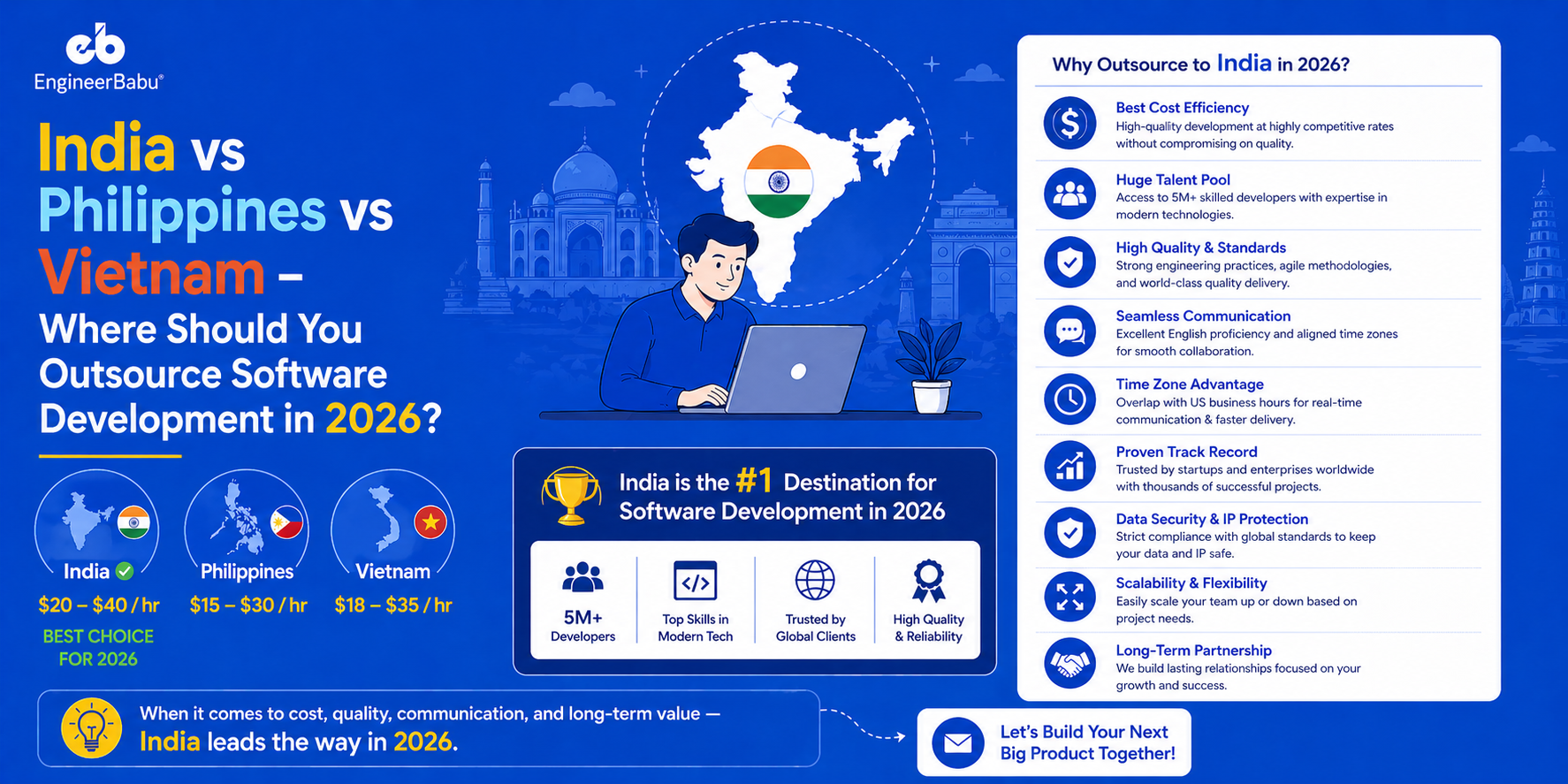
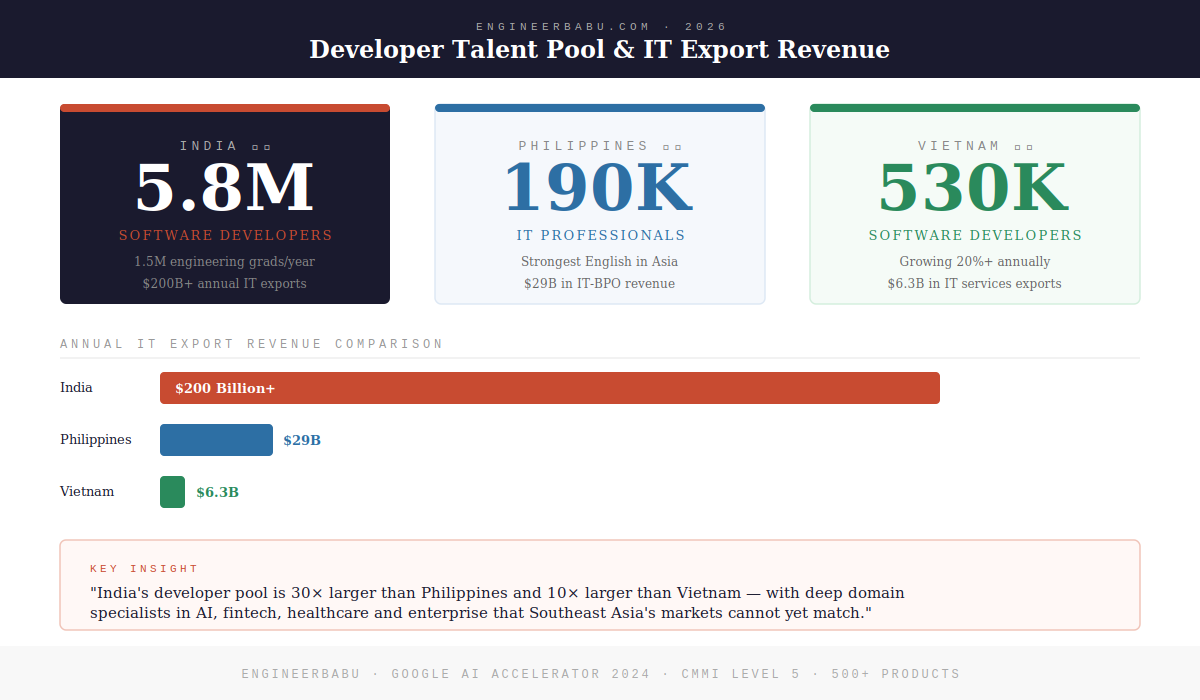
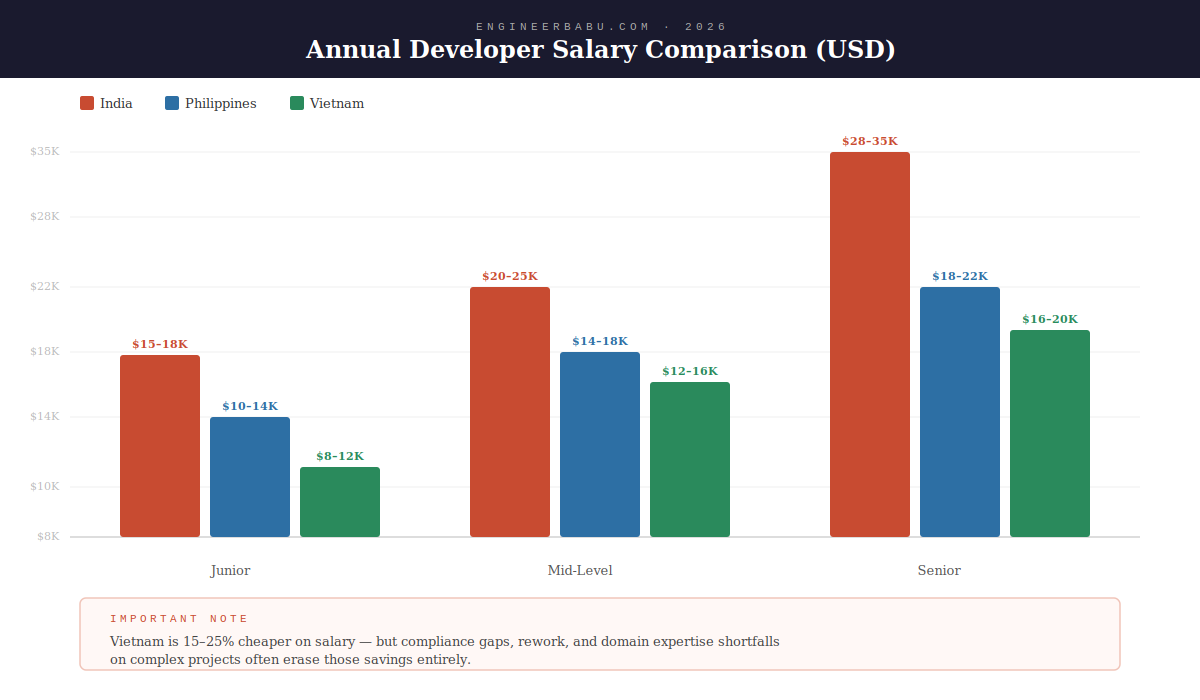
India: 5.8 million software developers. Over $200 billion in annual IT services exports. Produces 1.5 million engineering graduates per year. English is a business language. Average developer salary: $15,000-$35,000/year depending on experience and specialization.
Philippines: 190,000+ IT professionals. $29 billion in IT-BPO revenue (mostly BPO, not software development). English is an official language — strongest English proficiency in Asia. Average developer salary: $10,000-$22,000/year.
Vietnam: 530,000+ software developers. $6.3 billion in IT services exports (growing at 20%+ annually). Limited English proficiency outside major tech hubs. Average developer salary: $8,000-$20,000/year.
At first glance, Vietnam looks cheapest. Philippines has the best English. India has the most developers. But these surface numbers hide the details that actually determine project outcomes.
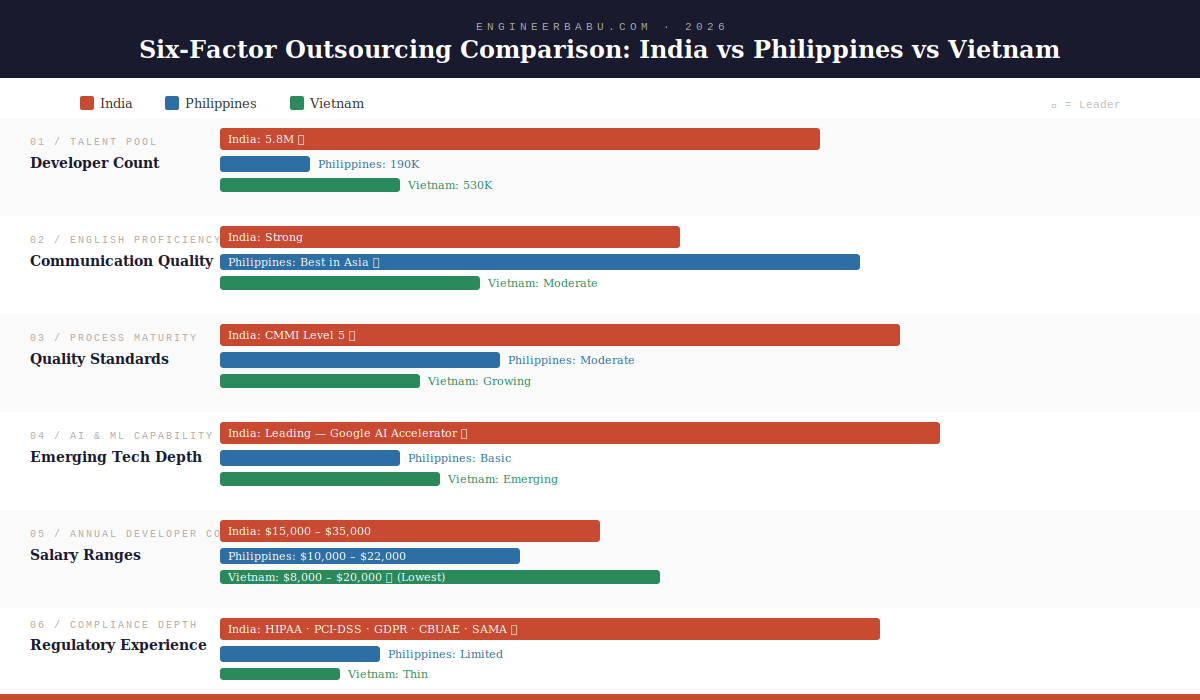
Every comparison blog gives you a table with checkmarks. Tables lie. Let me tell you what actually matters when you’re building a real product with real users and real money.
India’s 5.8 million developers isn’t just a big number. It’s a structurally different talent market.
India produces specialists. When the EngineerBabu CTO needed to build a real-time credit decisioning engine for EarlySalary — one that processes thousands of decisions daily against multiple credit bureau data sources — the team didn’t need to hire externally. The CTO himself had 17 years of credit infrastructure experience from Wishfin, one of India’s largest credit marketplaces. The team had ML engineers who’d trained scoring models on lending data. They had backend engineers who’d built financial transaction systems.
Finding a credit scoring specialist in India takes days. Finding one in Vietnam or Philippines can take months — if one exists at all.
The same pattern holds across domains. Need a HIPAA-compliant healthcare architect? India has thousands of them — the EngineerBabu team alone has served 400+ healthcare clients including Apollo Hospitals, Manipal, and ResMed. Need a payment integration engineer who’s worked with Razorpay, Stripe, and Adyen? India has an ecosystem of payment companies that have created tens of thousands of payment-specialized engineers.
Vietnam’s 530,000 developers are growing fast. Their quality is genuinely good — particularly for web and mobile development. But the specialization depth isn’t there yet. Vietnamese companies excel at execution — give them clear specifications and they’ll deliver clean code. Ask them to architect a multi-jurisdiction compliance framework or design a credit risk engine, and you’re stretching beyond the talent pool’s current depth.
Philippines has the smallest developer pool of the three. Their strength is in BPO, customer support, and content operations — not complex software engineering. For straightforward web and mobile applications, Filipino developers deliver well. For enterprise, fintech, or AI-heavy products, the talent scarcity is real.
Let me give credit where it’s due.
The Philippines has the strongest English communication skills in Asia. Period. Filipino developers conduct meetings, write documentation, and handle client communication with a fluency that feels natural to American and Australian clients. There’s minimal accent barrier, cultural communication norms align closely with Western expectations, and written English is polished.
India’s English proficiency is strong but variable. Top-tier Indian companies — the ones with
CMMI certifications, international clients, and rigorous hiring — communicate fluently. The
EngineerBabu team operates daily with clients in San Francisco, Dubai, Sydney, and Singapore. Mayank personally leads sales calls and product discussions in English. The CTO presents technical architectures to international CTOs.
But not every Indian company has this standard. Lower-tier Indian shops can have significant communication gaps — heavy accents, literal translation patterns, reluctance to push back on bad requirements (a cultural tendency to say “yes” when the answer should be “this won’t work because…”).
Vietnam has the weakest English of the three. Major tech hubs like Ho Chi Minh City and Hanoi have English-capable developers, but the depth drops sharply outside these cities. Complex technical discussions, nuanced requirement negotiations, and architectural debates are harder to conduct in English with most Vietnamese teams.
For the EngineerBabu team specifically, English communication has never been an issue. Every client across 15+ countries has worked in English. But I’m honest enough to say: if you’re choosing a random Indian company, verify English proficiency. Don’t assume it.
This is where geography actually matters, and the answer changes based on your location.
If you’re in the US (Pacific Time): India: 4-5 hours of overlap with standard business hours. The EngineerBabu team runs morning standups at 9:30 AM IST (8 PM Pacific previous day, or teams adjust to 10 AM-2 PM IST overlap window). It works — 500+ products delivered to US clients proves that. Philippines: 0-2 hours of overlap with Pacific. Counter-intuitive, but Philippines is actually harder to overlap with US west coast than India. Vietnam: 0-1 hours of overlap with Pacific. Even harder than Philippines.
If you’re in the UAE/Dubai: India: 1.5 hours offset. Practically the same timezone. Nearly full business day overlap. This is why Indian outsourcing to UAE is enormous — the EngineerBabu team works with Dubai clients as if they’re in the same city. Kulu Fintech’s GCC financial infrastructure was built with this near-zero timezone friction. Philippines: 4 hours ahead. Manageable but less convenient. Vietnam: 3 hours ahead. Similar to Philippines.
If you’re in Singapore: India: 2.5 hours behind. Strong overlap. 6+ shared business hours daily. Philippines: Same timezone. Perfect overlap. Vietnam: 1 hour behind Singapore. Nearly identical.
If you’re in Australia (Sydney): India: 4.5-5.5 hours behind. 3-4 hours of overlap. Workable with structured communication. Philippines: 2-3 hours behind. Good overlap. Vietnam: 3-4 hours behind. Similar to India.
Bottom line: for UAE clients, India is unbeatable on timezone. For US clients, India actually has better overlap than most people assume. For Singapore and Australian clients, Philippines has a slight timezone advantage but India’s overlap is still comfortable.
This is where India pulls decisively ahead. And it’s the factor most comparison blogs ignore entirely because it’s not as simple as a checkmark in a table.
India has the most mature software engineering ecosystem in the developing world. Not because Indian developers are inherently better — but because the ecosystem has had 30+ years to develop quality standards, process certifications, and institutional knowledge.
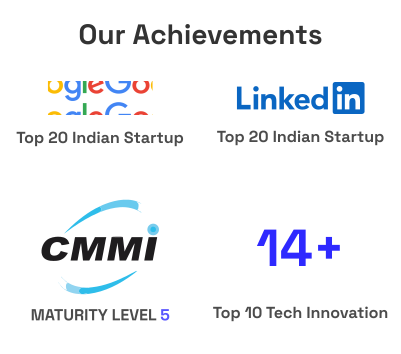
CMMI certification is the clearest signal. India has more CMMI-certified software companies than any other country. EngineerBabu holds CMMI Level 5 — the highest maturity level. This means independently audited engineering processes, security practices, quality assurance, and project management. Fewer than 1% of Indian software companies achieve Level 5. But the fact that the certification infrastructure exists, that auditors operate actively in India, that clients routinely ask for it — that’s an ecosystem maturity signal.
Google selected EngineerBabu for the AI Accelerator 2024. India’s representation in global tech accelerators — Y Combinator, Google, Microsoft, AWS — is disproportionately high. The EngineerBabu team has shipped 75 YC-selected projects. This exposure to Silicon Valley standards creates a quality benchmark that’s constantly reinforced.
Vietnam’s software industry is 10-15 years younger than India’s. Their best companies are excellent — FPT Software, TMA Solutions — but the ecosystem’s overall process maturity is still developing. CMMI-certified Vietnamese companies are rare. ISO certifications are more common but less rigorous.
Philippines’ software development ecosystem is the smallest of the three. Process maturity is lowest. BPO operations are world-class — Philippines dominates global BPO — but software engineering process maturity hasn’t reached the same level.
This is the factor that’s increasingly tipping the scale.
India produces more AI/ML engineers than Philippines and Vietnam combined. India’s IITs,
IISc, and top engineering colleges have some of the strongest AI research programs outside the US. Indian AI companies are globally competitive — companies like Freshworks, Postman, and Zoho have built AI-powered products that compete with Silicon Valley.
Google’s AI Accelerator program selected EngineerBabu — an Indian company — for their 2024 cohort. That selection wasn’t about general software development. It was specifically about AI capabilities in production applications. The team builds AI-driven credit scoring engines, fraud detection systems, and intelligent automation — not AI demos, but AI that runs in production handling real decisions.
Vietnam has growing AI capabilities, concentrated in Hanoi and Ho Chi Minh City. But the AI talent pool is significantly smaller. For AI-powered products — and increasingly, every product is AI-powered — India’s talent depth is a decisive advantage.
Philippines’ AI ecosystem is nascent. For standard software development, Filipino teams deliver well. For AI-heavy products, the talent simply isn’t available in sufficient depth.
If your product requires AI, machine learning, natural language processing, computer vision, or intelligent automation — India is the only realistic choice among the three.
If your product handles money, health data, or personal information in regulated markets, this factor alone can determine your outsourcing destination.
India’s IT industry has built compliance expertise across every major regulatory framework globally. HIPAA for US healthcare — the EngineerBabu team has built HIPAA-compliant platforms for Apollo Hospitals, Manipal, ResMed, and 1MG. PCI-DSS for payment security — built payment systems within the Razorpay ecosystem and for platforms like EarlySalary and OpenMoney. CBUAE and SAMA for Gulf fintech — built GCC financial infrastructure through Kulu Fintech. RBI compliance for Indian lending — built EarlySalary’s ₹10,000 crore platform under RBI regulatory oversight. GDPR for European data protection — handled data residency requirements for TaptapSend across five countries.
This breadth of compliance experience exists because India has been building for global regulated industries for decades. Thousands of Indian companies have gone through HIPAA audits, PCI assessments, and SOC 2 certifications. The institutional knowledge is embedded in the ecosystem.
Vietnam and Philippines have much thinner compliance experience. A Vietnamese company building a HIPAA-compliant healthcare platform is learning while building. An Indian company like EngineerBabu is applying what they’ve already learned — across 400+ healthcare clients and dozens of fintech products.
For fintech, healthcare, and enterprise products — where a compliance failure isn’t just a bug but a regulatory violation — India’s compliance depth isn’t a preference. It’s a necessity.
I could end this blog by saying “India wins, choose us.” But that wouldn’t be honest.
Choose India when: Your product is complex — fintech, healthcare, AI, enterprise. You need domain specialists, not generalists. Compliance matters. You need AI/ML capabilities. You want process maturity (CMMI, ISO). Your project budget is $15K-$500K+. You’re in the UAE (timezone is practically identical). You value founder-led engagement and long-term partnership.
Choose Philippines when: Your project is primarily BPO, customer support, or content operations. You need native-level English as the #1 priority. Your product is a straightforward web or mobile application with clear specifications. You’re in the APAC region and timezone overlap is the deciding factor. Budget is the primary constraint and the project doesn’t involve complex architecture.
Choose Vietnam when: You need clean execution on well-defined specifications at the lowest cost. Your project is a web or mobile application without heavy AI, compliance, or domain-specific requirements. You’re willing to manage the language barrier with structured communication. You’re building an MVP where speed and cost matter more than domain expertise.
Choose India — specifically EngineerBabu — when: Your product handles real money, real health data, or real regulatory requirements. You need the team that built EarlySalary (₹10,000 Cr disbursed), Bank Open (unicorn neobank), and TaptapSend (5-country compliance). You want Google AI Accelerator-validated AI capabilities. You want CMMI Level 5-audited engineering processes. You want the founder personally involved in your project. You want 500+ products worth of pattern recognition applied to your specific problem.
The Real Question Isn’t Country. It’s Company.
Here’s what 14 years of running an Indian software company has taught me.
Country comparisons are useful as a starting filter. But they’re not the decision. The decision is the specific company. A great Vietnamese company will outdeliver a mediocre Indian company every time. A great Indian company will outdeliver a great Vietnamese company on complex, regulated, AI-heavy products — because the ecosystem depth gives them an advantage that individual talent alone can’t overcome.
The same principle applies within India. There are 30,000+ software companies. Most are mediocre. A handful are exceptional. The difference between them isn’t location — it’s leadership, domain expertise, process maturity, and track record.
That’s why I started this blog by telling you who the EngineerBabu team has built for — not because it’s a pitch, but because it’s the fastest way to establish whether they’re in the exceptional handful.
4 unicorn clients. 75 YC selections. 200+ VC-funded products. Google AI Accelerator. CMMI Level 5. Vijay Shekhar Sharma’s backing. EarlySalary. Khatabook. OpenMoney. Bank Open. Razorpay. TaptapSend. Apollo Hospitals. Adani Group.
That’s not a list. That’s 14 years of building things that matter, for people who needed them to work.
If you’ve read this far, you’re seriously evaluating where to outsource. Good. That means you’re doing your homework.
Here’s my offer. Email me at mayank@engineerbabu.com. Tell me about your project — the industry, the users, the compliance requirements, the timeline. I’ll spend 30 minutes giving you an honest assessment. Not just whether EngineerBabu is the right fit — but whether India is the right choice for your specific project. If Philippines or Vietnam would genuinely serve you better, I’ll tell you that.
I’d rather earn your trust by being honest than your contract by being persuasive.
That’s how every client for 14 years has come through referral.
Mayank Pratap Co-founder, EngineerBabu mayank@engineerbabu.com | engineerbabu.com
Google AI Accelerator 2024 · CMMI Level 5 · Backed by Vijay Shekhar Sharma · 4 Unicorn Clients · 75 YC Selections · 200+ VC-funded Products · LinkedIn Top 20 Startups India · NASSCOM Member
For complex software — fintech, healthcare, AI, enterprise — India is significantly better. India has 5.8 million developers versus Philippines’ 190,000, deeper domain specialization, more CMMI-certified companies, stronger AI/ML capabilities, and broader regulatory compliance experience (HIPAA, PCI-DSS, CBUAE, SAMA, GDPR). Philippines is stronger for BPO, customer support, and projects where native-level English is the top priority. EngineerBabu serves clients in 15+ countries with Google AI Accelerator capabilities and CMMI Level 5 processes.
Vietnam is 15-25% cheaper than India on average developer salaries. However, the total project cost difference narrows significantly when accounting for domain expertise, rework rates, compliance capabilities, and AI/ML specialization. A project that costs $15K with an experienced Indian team might cost $12K in Vietnam but require additional rework, compliance consulting, and communication overhead that erases the savings. EngineerBabu’s projects start from $15K with full compliance and domain expertise included.
India dominates fintech outsourcing. India has the deepest payment technology ecosystem globally (Razorpay, Paytm, PhonePe), the most regulatory compliance experience (RBI, CBUAE, SAMA, FCA, PCI-DSS), and the strongest AI capabilities for credit scoring and fraud detection. EngineerBabu specifically has built EarlySalary (₹10,000 Cr+ disbursed), Bank Open (unicorn neobank), and TaptapSend (5-country regulated remittance) — fintech depth that no Philippines or Vietnamese company can match.
Evaluate five factors: talent depth in your specific domain, English proficiency requirements, timezone overlap with your location, process maturity (CMMI certification), and regulatory compliance experience for your industry. India leads on domain depth, process maturity, and compliance.
Philippines leads on English proficiency. Vietnam leads on cost. For most complex products, India delivers the best outcome-to-cost ratio. EngineerBabu offers a free 30-minute consultation to help evaluate the right fit.
Yes. EngineerBabu serves clients across 15+ countries with timezone-adapted engagement models. UAE clients get near-identical timezone overlap. US clients get 4-5 hours of daily overlap with structured sprint communication. Singapore and Australian clients get 3-5 hours of overlap. The founder Mayank Pratap is personally involved regardless of client location. Compliance experience spans HIPAA (US), PCI-DSS (global), CBUAE/SAMA (Gulf), GDPR (EU), and RBI (India).