Custom Software Development Company in India - What 500 Products Teach You That Frameworks Can't


Create engaging, high-performance mobile applications tailored to your business needs. We craft future-ready apps that offer smooth user experiences on all devices.
Build robust and scalable websites and CMS platforms that help you manage content effortlessly. Our development ensures a seamless digital presence.
Launch secure, feature-rich online stores with intuitive shopping experiences. We build tailored eCommerce platforms designed for growth.
Design captivating games with immersive gameplay and stunning graphics. From concept to launch, we build engaging experiences that players love.
Enhance your customer relationships with customized Salesforce implementations. Drive growth and efficiency with smarter CRM solutions.
Harness artificial intelligence and machine learning to automate workflows and gain actionable insights. Our AI transforms data into smart decisions.
Accelerate your software delivery lifecycle with continuous integration, delivery, and infrastructure automation to boost efficiency.
Hire app developers ready to turn your ideas into sleek, high-performing mobile apps for any platform.
Bring in frontend pros who craft smooth, beautiful, and user-friendly interfaces that your visitors will love.
Get backend developers who build fast, secure, and reliable systems to keep everything running behind the scenes.
Hire eCommerce developers who build secure, scalable online stores designed to offer seamless shopping and grow your sales.
Get dedicated developers committed to your projects, delivering consistent quality and speed as an extension of your team.
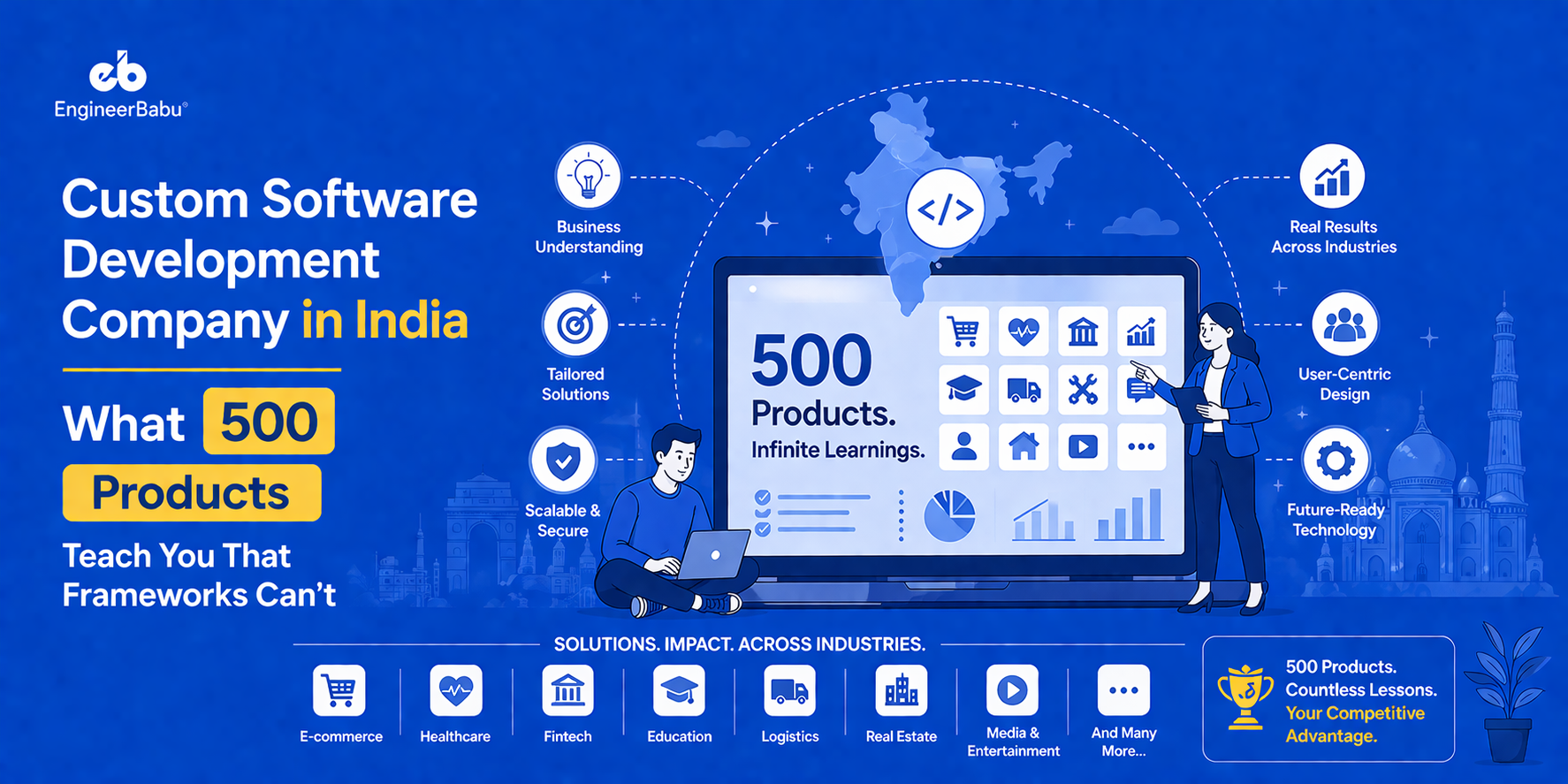
At some point, every growing company hits the wall.
The Salesforce instance that was perfect for 50 people can’t handle 500. The Shopify store that worked for 100 SKUs breaks at 10,000. The off-the-shelf ERP that ran the business for five years now requires workarounds for every new process. The industry-specific SaaS platform that promised “configurable for your needs” requires three consultants just to change a workflow.
The wall isn’t a technology failure. It’s a fit failure. Off-the-shelf software is built for average needs. Your business isn’t average. And the further your business grows from average, the more painful the workarounds become — until the workarounds cost more than building exactly what you need.
That’s when companies start searching for “custom software development.”
I know this because the EngineerBabu team has built 500+ custom products for companies that hit exactly this wall. Not 500 websites. Not 500 WordPress customisations. Five hundred distinct software products — each one built from scratch to solve a specific problem that no off-the-shelf solution could address.
My name is Mayank Pratap. I co-founded EngineerBabu 14 years ago. Let me tell you who comes to us and why.
Adani Group — one of India’s largest conglomerates — needed enterprise-grade custom technology. Off-the-shelf couldn’t handle the complexity or the scale. Paytm’s ecosystem — India’s largest digital payments platform — needed custom product engineering within their infrastructure. EarlySalary needed a lending platform customised to India’s specific credit bureau landscape, regulatory requirements, and borrower demographics — no off-the-shelf lending product could accommodate all three. Bank Open needed a neobank platform architecture that could support multiple financial services scaling independently — no template product supports that.
Apollo Hospitals, Manipal, Shalby, CHL — hospital chains that needed clinical software adapted to Indian healthcare workflows, not American ones. ResMed — an Australian medical device company — needed platforms customised to their specific device ecosystem. Khatabook — a product for tens of millions of Indian SMEs — needed UX designed for bookkeepers on ₹8,000 phones, not the business users that American SaaS products are designed for.
Every one of these was custom. Built from scratch. Designed for the specific problem. Owned entirely by the client.
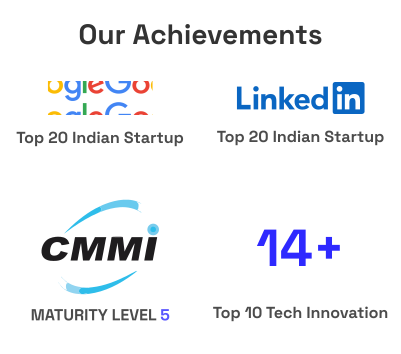
Google selected us for the AI Accelerator 2024. CMMI certified us at Level 5 — the highest maturity level for engineering processes. Vijay Shekhar Sharma backs us personally. 24 clients became unicorns. 75 were Y Combinator-selected.
500+ products don’t make the team faster at typing code. They make the team smarter about which code to write.
I’m going to be honest about something most custom software development companies won’t tell you.
You probably don’t need custom software.
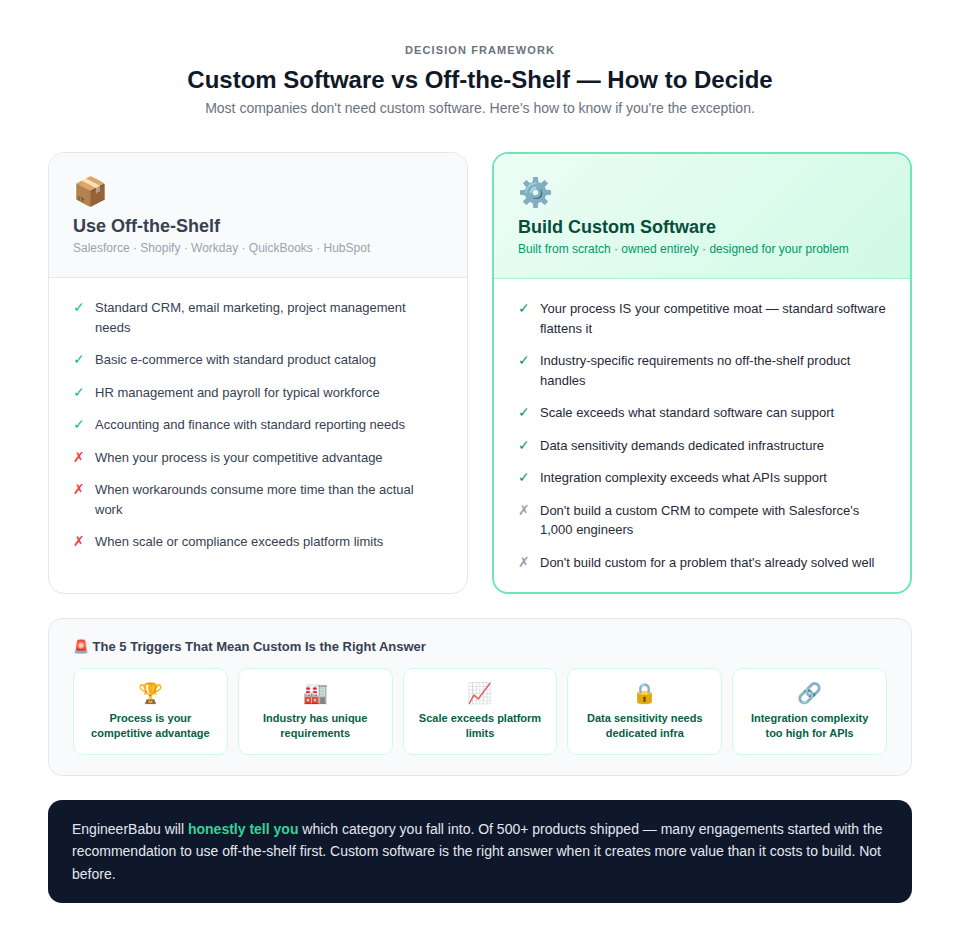
If your problem is standard — CRM, email marketing, project management, basic e-commerce,
HR management, accounting — off-the-shelf solutions are better. Salesforce, HubSpot, Shopify, Workday, QuickBooks — these products have thousands of engineers, decades of refinement, and ecosystems of integrations. Building a custom CRM to compete with Salesforce is like building a custom car to compete with Toyota. Technically possible. Financially insane.
Custom software is the right answer when one or more of these conditions is true:
If none of these apply to your situation, use off-the-shelf software. Save your money. Focus your resources elsewhere.
If one or more apply — keep reading. Because the difference between custom software that works and custom software that becomes a money pit is entirely in the execution.
Let me share the patterns. Not theory — observations from building 500+ distinct products across 14 years, for companies ranging from pre-seed startups to one of India’s largest conglomerates.
Not slightly wrong. Fundamentally wrong. In at least 80% of projects, the requirements the client articulates in week one are significantly different from what actually gets built by week twelve.
This isn’t the client’s fault. It’s the nature of software. You can’t fully understand what you need until you start seeing it take shape. Features that seemed essential prove unnecessary. Features nobody mentioned become critical. Interactions between components create unexpected complexity.
The team’s process accounts for this. CMMI Level 5 doesn’t mean rigid waterfall. It means structured flexibility — agile sprints with process discipline. Requirements are living documents. Sprint demos every two weeks let the client see the product evolving and redirect before misalignment becomes expensive.
When the team built OpenMoney’s financial platform — payments, investments, and credit under one architecture — the initial requirements covered payments and investments. Credit emerged as a requirement in month three, based on user behaviour data from the first two products. The architecture absorbed credit without a rebuild because it was designed for extensibility from the start. Not because anyone predicted credit would be added. Because 500+ products taught the team to build for the requirements you haven’t thought of yet.
The database schema designed in week one determines whether the system handles 10,000 records or 10 million. The API structure designed in week two determines whether the system can integrate with future services or requires a rewrite. The deployment architecture designed in week three determines whether the system auto-scales for traffic spikes or crashes during peak usage.
These decisions are invisible to the client. They don’t show up in demos. They don’t appear in feature lists. They only reveal themselves 12-18 months later when the system either scales gracefully or buckles under pressure.
Bank Open’s neobank architecture was designed in the early weeks. Multiple financial services — accounts, payments, cards, lending — each as independent microservices. Each independently scalable. Each independently deployable. The architecture was designed to support services that didn’t exist yet. When Bank Open added new products, the architecture absorbed them. The ncompany grew to a unicorn without rebuilding the foundation.
The CTO’s 17 years at Wishfin shaped that architecture. Not from reading about microservices. From building financial systems that scaled and financial systems that didn’t — and understanding exactly why some scaled and others broke.
This is what 500+ products teaches you. Not how to write better code. How to make better architectural decisions. Decisions that look identical to inexperienced teams look fundamentally different to a team that’s seen the consequences of each choice play out across hundreds of projects.
Building new software is relatively straightforward. Connecting it to everything that already exists in the client’s technology landscape — that’s where projects get stuck.
Legacy ERP systems with undocumented APIs. CRM platforms with rate-limited webhooks. Payment gateways with idiosyncratic error handling. Government databases with unreliable uptime. Credit bureaus with varying data formats across jurisdictions.
The team has integrated with Razorpay, Stripe, Adyen, Checkout.com (payment gateways). CIBIL, Experian, CRIF, SIMAH, Al Etihad (credit bureaus). Emirates ID, Aadhaar (government identity systems). SADAD, mada (regional payment networks). HL7, FHIR, DICOM (healthcare interoperability standards). Salesforce, HubSpot, SAP (enterprise platforms). AWS, GCP, Azure (cloud infrastructure). Firebase, Twilio, SendGrid (communication platforms).
Each integration has its own quirks, its own edge cases, its own failure modes. A team doing a CIBIL integration for the first time spends weeks understanding the data format, handling timeout scenarios, and debugging authentication issues. A team that’s done it across multiple lending platforms completes it in days.
500+ products means the team has integrated with practically every major platform, API, and system that matters. The integration risk — the most common source of delays and cost overruns in custom software projects — is dramatically reduced.
Custom software that handles sensitive data — financial, healthcare, personal, enterprise — must be secure by design. Not secured after the fact by a penetration test that reveals vulnerabilities too late to fix architecturally.
The team builds security into the architecture from day one. Encryption at rest and in transit. Role-based access controls. Audit logging. Input validation. SQL injection prevention. XSS protection. CSRF protection. API rate limiting. Secret management. Dependency vulnerability scanning.
CMMI Level 5 processes make this systematic. Security review is a sprint gate — code doesn’t ship without it. Penetration testing happens before deployment. Vulnerability scanning runs continuously. Security isn’t one person’s responsibility. It’s embedded in the process.
When the team built HIPAA-compliant platforms for Apollo, Manipal, and ResMed — and
PCI-DSS compliant payment systems — the security architecture wasn’t an afterthought. It was the first architectural decision. PHI encryption before the first API endpoint. Access controls before the first user story. Audit logging before the first feature.
For enterprise clients — where a security breach isn’t just a technical incident but a regulatory violation, a legal liability, and a reputational catastrophe — CMMI Level 5 security processes are the difference between sleeping well and hoping nothing goes wrong.
After 500+ products, the team has used every major programming language, every major framework, every major cloud platform. The technology choice matters — but not as much as the team’s ability to make the right technology choice for the specific problem.
Flutter isn’t always the right mobile framework. PostgreSQL isn’t always the right database. AWS isn’t always the right cloud. The right answer depends on the product’s specific requirements — performance characteristics, scale expectations, integration needs, team familiarity, and long-term maintenance considerations.
A team that only knows one stack recommends that stack for every problem. A team that’s built 500+ products across every major stack recommends the technology that best fits the specific problem. That recommendation is informed by having seen the consequences of each choice across hundreds of projects.
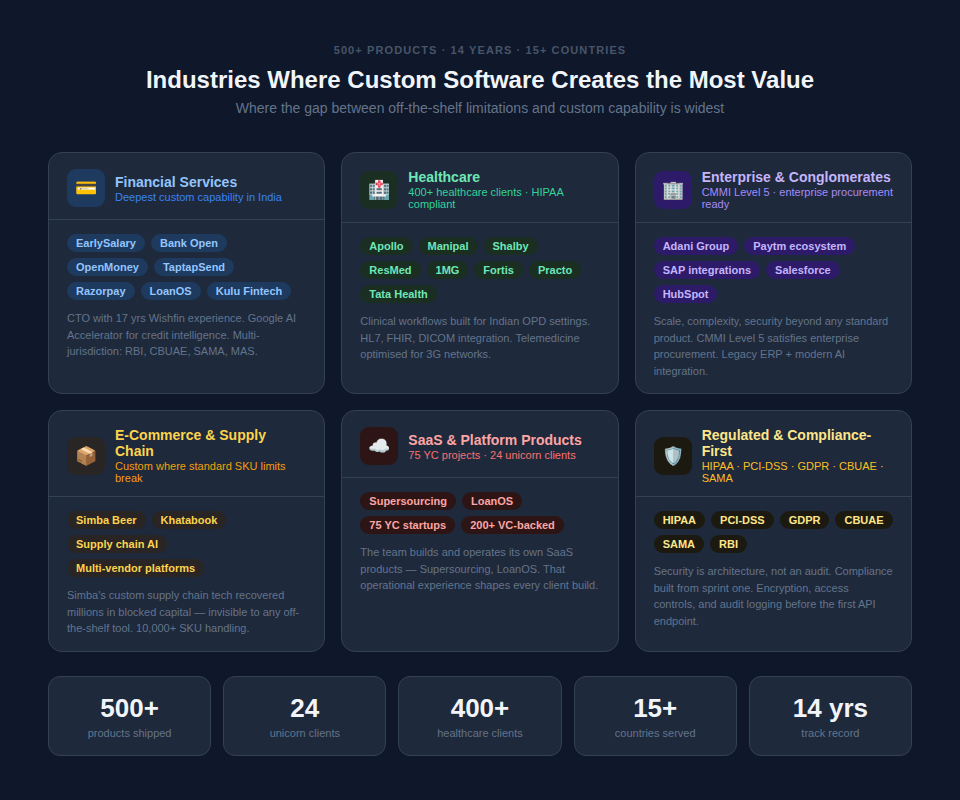
The team has built custom software across every major industry. Here’s where custom development creates the most dramatic value — where the gap between off-the-shelf limitations and custom capability is widest.
Off-the-shelf lending platforms don’t handle Indian DSA operations. Standard payment systems don’t support the specific settlement requirements of Gulf markets. Generic neobank platforms can’t accommodate the regulatory specifics of each jurisdiction.
EarlySalary. Bank Open. OpenMoney. Razorpay. TaptapSend. Kulu Fintech. LoanOS. The team’s fintech portfolio represents the widest and deepest custom financial software development capability in India. The CTO’s 17 years at Wishfin. Google AI Accelerator for credit intelligence. Vijay Shekhar Sharma’s backing.
Hospital workflows vary by country, by hospital size, by specialty mix, by patient demographics. A Hospital Management System designed for American hospitals doesn’t work in Indian OPD settings with 100+ patients per day. A telemedicine platform designed for broadband doesn’t work in Tier 3 Indian towns on 3G connections.
Apollo. Manipal. Shalby. CHL. ResMed. 1MG. Fortis. Practo. Thyrocare. Tata Health. Somnoware. 400+ healthcare clients. HIPAA compliant. The team builds healthcare software that works in the clinical environment it’s designed for — not healthcare software that looks good in a demo and fails in an OPD.
Adani Group doesn’t use off-the-shelf solutions for core operations. The scale, the complexity, the integration requirements, and the security demands exceed what any standard product can provide.
CMMI Level 5 is the credential that enterprise buyers require. It’s not a marketing badge. It’s a process maturity standard that procurement committees evaluate against. The EngineerBabu team holds it. Most Indian development companies don’t.
Simba Beer’s supply chain technology recovered millions in blocked capital — because the standard supply chain software couldn’t track the specific money flow patterns that were causing capital to get stuck. Custom technology, designed for the specific problem, identified and resolved what off-the-shelf tools couldn’t see.
Supersourcing — the B2B IT staffing platform Mayank co-founded — is a custom-built SaaS product. LoanOS is a custom-built lending platform. The team doesn’t just build custom software for clients. They build and operate custom software for themselves. That operational experience — understanding what happens after the software launches, how users actually behave, what breaks under real load — fundamentally changes how the team builds.
Custom software development is an investment. Let me give you the real cost landscape.
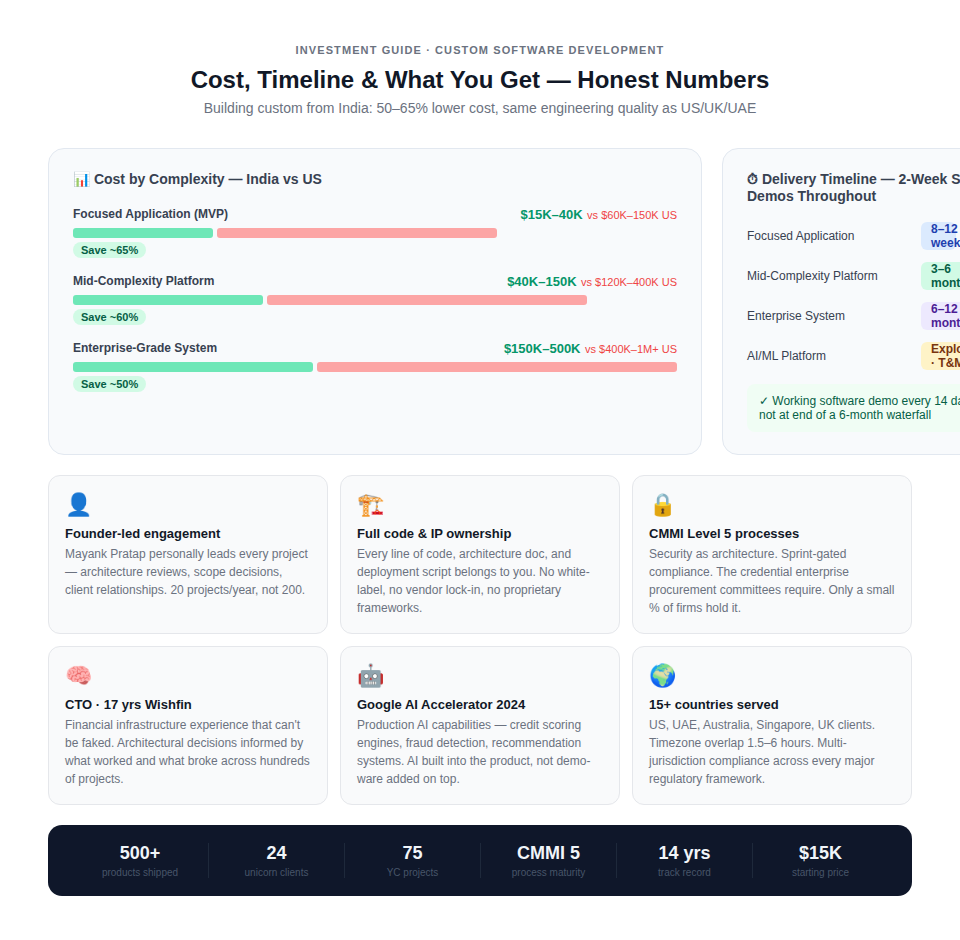
From India (Tier 1 — EngineerBabu level): Starting from $15K for focused applications.
Mid-complexity custom platforms: $40,000-$150,000. Enterprise-grade custom systems: $150,000-$500,000+.
The same software built locally: US: 2.5-3x the India cost. UK: 2-2.5x. UAE: 2-2.5x. Australia: 2-2.5x. Singapore: 2x.
The cost advantage of building custom software with an Indian team is the difference between “custom software is too expensive for us” and “custom software makes financial sense.” Many of the team’s clients could not have afforded to build custom if they’d built locally. India’s cost structure makes custom development accessible to companies that would otherwise be stuck with ill-fitting off-the-shelf solutions.
But — and this is important — the cheapest custom software development is also the most expensive. A $20,000 custom project that needs to be rebuilt costs more than a $60,000 project done right the first time. The team’s pricing reflects CMMI Level 5 processes, senior technical leadership, Google AI Accelerator capabilities, and 500+ products of experience. This isn’t the cheapest option. It’s the option that works.
Mayank Pratap leads every engagement. The founder. Fourteen years of personal involvement in architecture reviews, scope decisions, and client relationships. Not a practice that scales infinitely — which is why the company takes 20 projects a year, not 200.
The CTO — 17 years at Wishfin — on every architecture decision. Google AI Accelerator 2024 for AI capabilities. CMMI Level 5 for process discipline. 24 unicorn clients. 75 YC selections. 200+ VC-funded products. 500+ total products shipped.
Custom builds from scratch. Full code and IP ownership. No white-label. No shared infrastructure. No vendor lock-in. The client’s product. The client’s property.
150+ engineers across full-stack, mobile, cloud, AI/ML, and DevOps. Clients across 15+ countries. Products serving millions of users across fintech, healthcare, enterprise, e-commerce, and SaaS.
EarlySalary. Bank Open. Khatabook. OpenMoney. Razorpay. TaptapSend. Kulu Fintech. Adani Group. Paytm ecosystem. Apollo Hospitals. Manipal. ResMed. 1MG. Supersourcing. LoanOS.
Starting from $15K. Exact scope and pricing after understanding the specific business problem — because custom software, by definition, requires custom scoping.
If you’ve hit the wall — if off-the-shelf software is holding your business back, if workarounds are consuming more time than the work itself, if your process is your competitive advantage and standard software is flattening it — email me. mayank@engineerbabu.com. The founder.
Tell me about the problem. Not the solution you think you need — the problem. The team has solved 500+ problems. There’s a good chance your problem is a variant of one the team has already solved. The architecture, the technology, the approach — informed by what worked and what didn’t across all 500.
No commitment. No pitch deck. Just an honest assessment of whether custom software is the right answer and what it would take to build it.
Mayank Pratap Co-founder, EngineerBabu mayank@engineerbabu.com | engineerbabu.com
Google AI Accelerator 2024 · CMMI Level 5 · Backed by Vijay Shekhar Sharma · 24 Unicorn Clients · 75 YC Selections · 500+ Products Shipped · LinkedIn Top 20 Startups India · NASSCOM Member
Custom software development from India starts from $15K for focused applications. Mid-complexity platforms range $40K-$150K. Enterprise-grade systems range $150K-$500K+. These represent 50-65% savings versus US, UK, UAE, or Australian development. EngineerBabu provides exact estimates after understanding the specific business problem — custom software requires custom scoping by definition.
Custom software is the right choice when your process is your competitive advantage, your industry has requirements no standard product handles, your scale exceeds off-the-shelf limits, your data sensitivity requires dedicated infrastructure, or integration complexity exceeds what APIs support. If your needs are standard — CRM, basic e-commerce, project management — use off-the-shelf. EngineerBabu will honestly tell you which category your situation falls into.
Focused custom applications: 8-12 weeks.
Mid-complexity platforms: 3-6 months. Enterprise-grade systems: 6-12 months. EngineerBabu ships in two-week sprint cycles with demos every two weeks — the client sees working software every 14 days, not at the end of a six-month waterfall. 500+ products of pattern recognition means the team makes fewer wrong turns and delivers faster.
Yes. EngineerBabu transfers complete code and IP ownership. Every line of code, architecture document, and deployment script belongs to the client. No white-label. No shared codebases. No proprietary frameworks. No vendor lock-in. The client can take the code to another vendor, hire in-house, or continue with EngineerBabu — because the product is the client’s property from day one.
Yes. EngineerBabu serves enterprise clients across 15+ countries. Enterprise-grade references include Adani Group (one of India’s largest conglomerates) and Paytm ecosystem. CMMI Level 5 certification satisfies enterprise procurement requirements. Compliance experience spans HIPAA, PCI-DSS, CBUAE, SAMA, GDPR, and RBI. Timezone overlap with US (4-5 hours), UAE (1.5 hours), Australia (4.5 hours), and Singapore (6 hours) enables daily collaboration.
EngineerBabu | 500+ Custom Products Shipped. The Next One Could Be Yours.