Types of Inventory Management System


Create engaging, high-performance mobile applications tailored to your business needs. We craft future-ready apps that offer smooth user experiences on all devices.
Build robust and scalable websites and CMS platforms that help you manage content effortlessly. Our development ensures a seamless digital presence.
Launch secure, feature-rich online stores with intuitive shopping experiences. We build tailored eCommerce platforms designed for growth.
Design captivating games with immersive gameplay and stunning graphics. From concept to launch, we build engaging experiences that players love.
Enhance your customer relationships with customized Salesforce implementations. Drive growth and efficiency with smarter CRM solutions.
Harness artificial intelligence and machine learning to automate workflows and gain actionable insights. Our AI transforms data into smart decisions.
Accelerate your software delivery lifecycle with continuous integration, delivery, and infrastructure automation to boost efficiency.
Hire app developers ready to turn your ideas into sleek, high-performing mobile apps for any platform.
Bring in frontend pros who craft smooth, beautiful, and user-friendly interfaces that your visitors will love.
Get backend developers who build fast, secure, and reliable systems to keep everything running behind the scenes.
Hire eCommerce developers who build secure, scalable online stores designed to offer seamless shopping and grow your sales.
Get dedicated developers committed to your projects, delivering consistent quality and speed as an extension of your team.
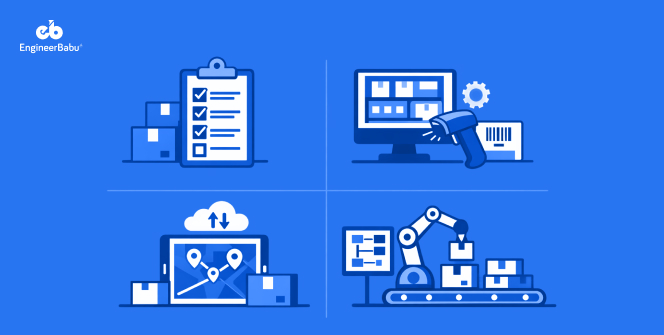
Have you ever opened your warehouse or storeroom and realized you have either too much stock gathering dust or too little of what you actually need? It happens to the best of us. Managing inventory can feel like juggling a dozen balls at once, especially when your business is growing.
Here’s something that might surprise you: according to a study, more than 30% of companies report inventory inaccuracies, which often leads to stockouts, overstocking, and lost revenue. That’s almost half of businesses struggling with keeping track of their own products.
This is where understanding the types of inventory management system comes in. Picking the right system can not only save time and money but also make running your business a lot less stressful.
Whether you’re managing a small store or a complex supply chain, knowing your options is the first step toward smarter inventory control.
At its core, an inventory management system is a tool or process that helps you track, organize, and control your stock in real time.
Instead of guessing what’s available or manually counting items every few days, it gives you clear visibility into what you have, what’s running low, and what needs to be reordered.
Think of it as the backbone of your operations. It connects purchasing, storage, and sales so everything runs smoothly. A good system helps reduce errors, avoids stockouts, and improves order fulfillment without adding extra stress to your workflow.
When exploring the different types of inventory management system, you’ll notice that each one is designed to solve specific business challenges, whether it’s handling high-volume sales or managing limited stock efficiently.
Before you jump into picking one, it helps to pause and think about what your business actually needs. Not every system fits every situation, and choosing the wrong one can create more headaches than it solves.
Let’s break down a few things you should keep in mind while exploring the types of inventory management system.
A small retail shop and a large manufacturing unit won’t have the same inventory needs. If you’re running a startup, a simple system might do the job. But as your operations grow, you’ll need something more robust that can handle multiple products, locations, and higher order volumes without slowing you down.
Your inventory system shouldn’t work in isolation. It should connect smoothly with tools you already use like accounting software, ERP systems, or e-commerce platforms. This saves you from double work and reduces errors. Among the types of inventory management system, some are built specifically to integrate better than others.
Ask yourself how important real-time updates are for your business. If you deal with fast-moving products, knowing your stock levels instantly can make a big difference. Real-time tracking helps avoid stockouts and keeps your customers happy, especially in e-commerce or retail environments.
It’s tempting to go for the cheapest option, but that can backfire later. Look for a system that fits your current budget while also allowing room to grow. The right choice from the types of inventory management system should scale with your business without requiring a complete overhaul later.
Now that you know what to look for, let’s get into the real options. There isn’t a one-size-fits-all solution here. Different businesses use different approaches depending on their size, industry, and how complex their operations are.
Understanding the types of inventory management system will help you figure out what actually fits your day-to-day workflow.
This is the old-school way of managing inventory using spreadsheets or even pen and paper. It’s simple and doesn’t require any special tools, which makes it appealing when you’re just starting out.
The upside is low cost and easy setup. But honestly, it can get messy quickly. Human errors, missed entries, and time-consuming updates make it hard to rely on as your business grows.
In this system, you count and update inventory at fixed intervals, like weekly or monthly. It’s straightforward and doesn’t demand constant monitoring, which is great if your operations are relatively slow.
However, the gap between counts can lead to inaccuracies or unexpected stockouts. Among the types of inventory management system, this one works best when transactions are limited and predictable.
This is where things start getting smarter. A perpetual system tracks inventory in real time using software, barcodes, or scanners. You always know what’s in stock, which helps avoid surprises.
It’s highly accurate and great for fast-moving businesses. The only catch is the initial setup cost and the need to adopt technology. But once it’s in place, it saves a lot of time and effort.
With JIT, you only order stock when you actually need it. Sounds efficient, right? It helps reduce storage costs and minimizes waste, especially for perishable or expensive goods. But there’s a flip side.
You need extremely reliable suppliers, because any delay can disrupt your operations. Still, many businesses prefer this among the types of inventory management system for its cost-saving potential.
This system groups your inventory into three categories based on value and importance. ‘A’ items are high-value, ‘B’ are moderate, and ‘C’ are low-value. It helps you focus more on what really matters instead of treating all products equally.
While it’s a smart way to prioritize resources, it does require careful analysis and regular updates to keep everything accurate.
If you don’t want to deal with storing products at all, dropshipping might be your thing. Here, the supplier handles inventory and shipping, and you simply manage orders. It keeps costs low and removes the need for storage space.
The downside is less control over stock and delivery. Still, it’s a popular choice for e-commerce startups looking to keep things lean and simple.
Now that we’ve walked through each option, it helps to see everything side by side. This makes it much easier to compare the types of inventory management system and quickly figure out which one aligns with your business needs.
| System Type | Cost | Accuracy | Complexity | Best Suited For | Pros & Cons |
| Manual Inventory Management | Low | Low | Very Low | Small businesses with limited stock |
|
| Periodic Inventory System | Low | Moderate | Low | Businesses with low transaction volume |
|
| Perpetual Inventory System | Medium-High | High | Medium-High | Retail, e-commerce, manufacturing |
|
| Just-in-Time (JIT) System | Medium | High (if managed well) | Medium | Businesses with predictable demand |
|
| ABC Inventory System | Medium | High | Medium | Businesses with diverse product ranges |
|
| Dropshipping Inventory System | Low | Moderate | Low | E-commerce startups |
|
This quick comparison gives you a clearer picture of how the different types of inventory management system stack up in real-world scenarios.
By now, you’ve seen that choosing the right system is not just about features, it’s about finding something that actually fits your business workflow. That’s where engineerbabu.com comes in as a reliable tech partner.
EngineerBabu helps businesses design and build custom solutions tailored to different types of inventory management system, whether you need a simple setup or a fully feature-rich inventory management, scalable platform.
From integrating with your existing ERP or e-commerce tools to building real-time tracking systems, their team focuses on making your operations smoother and more efficient.
What really stands out is their hands-on approach. Instead of offering one-size-fits-all software, they work closely with you to understand your needs and deliver solutions that grow with your business. Plus, you get ongoing support, so you’re not left figuring things out on your own.
At the end of the day, managing inventory doesn’t have to feel overwhelming. Once you understand the different types of inventory management system, it becomes much easier to choose something that actually fits your business style and scale.
The right system can save you time, cut unnecessary costs, and give you better control over your operations. Start simple if you need to, but always think ahead and pick a solution that can grow with you.
The perpetual inventory system is widely used today, especially in retail and e-commerce, because it provides real-time tracking and better accuracy.
Yes, many modern tools are scalable and affordable, making it easy for small businesses to start simple and upgrade as they grow.
It depends on your business size, budget, and how complex your operations are. Start by identifying your needs and then match them with the system’s capabilities.
It can be a great option for startups since it requires low investment, but it comes with less control over stock and delivery.
Better accuracy, reduced stockouts, improved efficiency, and smoother operations are some of the biggest advantages.