How to Build an App like Zomato?


Create engaging, high-performance mobile applications tailored to your business needs. We craft future-ready apps that offer smooth user experiences on all devices.
Build robust and scalable websites and CMS platforms that help you manage content effortlessly. Our development ensures a seamless digital presence.
Launch secure, feature-rich online stores with intuitive shopping experiences. We build tailored eCommerce platforms designed for growth.
Design captivating games with immersive gameplay and stunning graphics. From concept to launch, we build engaging experiences that players love.
Enhance your customer relationships with customized Salesforce implementations. Drive growth and efficiency with smarter CRM solutions.
Harness artificial intelligence and machine learning to automate workflows and gain actionable insights. Our AI transforms data into smart decisions.
Accelerate your software delivery lifecycle with continuous integration, delivery, and infrastructure automation to boost efficiency.

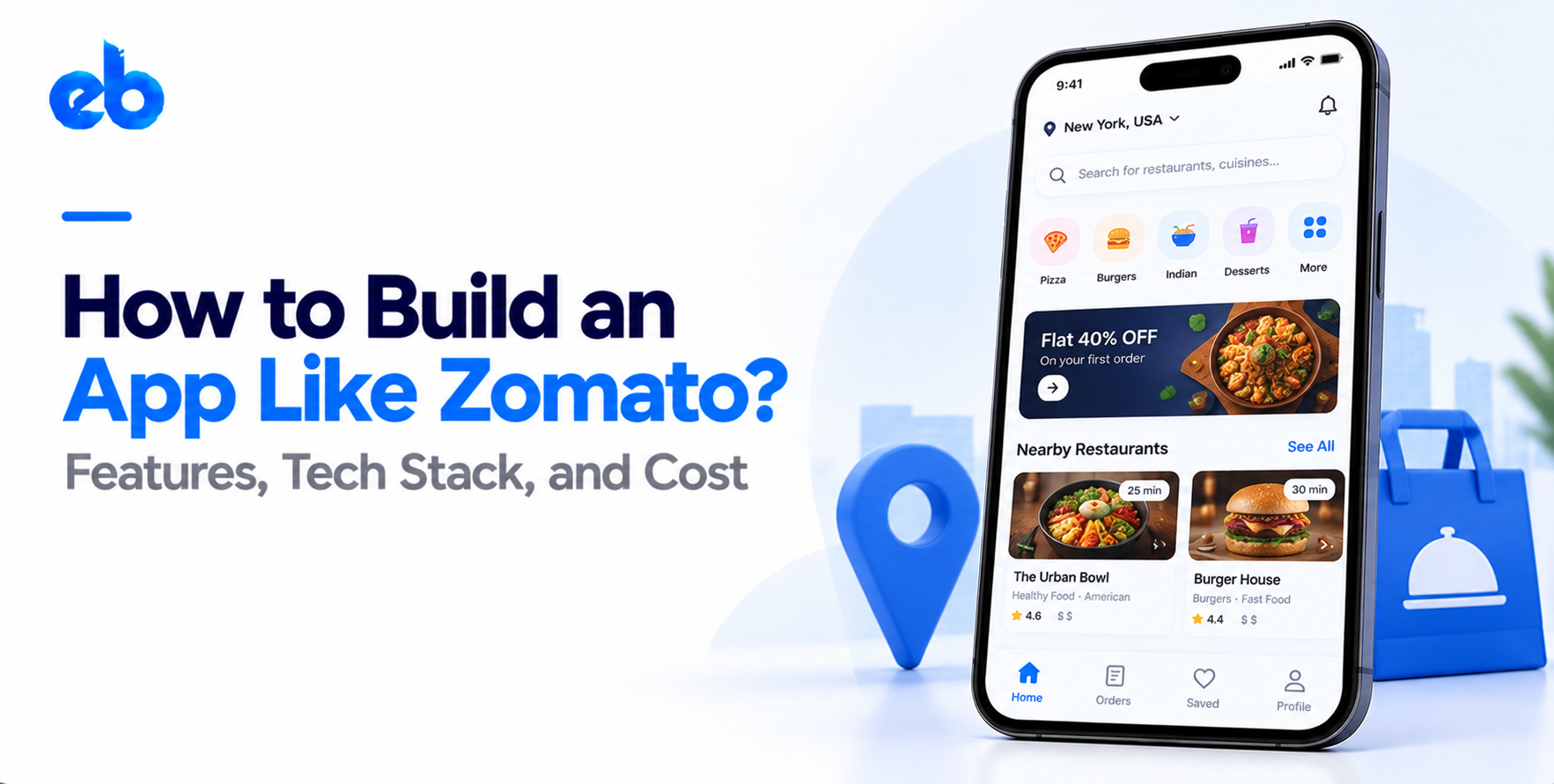
Ordering food online stopped being a convenience story a long time ago. It became infrastructure.
The India online food delivery market grew from USD 55.58 billion in 2025 to USD 67.90 billion in 2026, and is projected to reach USD 337.15 billion by 2034 (IMARC Group). That is not a market closing its doors.
What has changed is where the gaps sit. Tier 2 cities, regional cuisines, campus delivery, office lunch subscriptions, and cloud kitchen networks are all underserved.
Founders who want to build an app like Zomato today usually win by owning one of those slices, not by cloning the whole thing. This guide covers what you actually need to ship, in the order you need it.
To build an app like Zomato, you need four synchronized applications, a real-time order engine, a dispatch and routing system, payment and payout rails, and a restaurant onboarding pipeline.
A single-city MVP typically takes 4 to 6 months with a team of 6 to 8 people. Most of the cost sits in logistics and backend work, not in the customer interface.
This is the first thing that breaks budgets. Founders scope the customer app, then discover three more products hiding behind it.
Skip any one of these and your operations team ends up running the marketplace over WhatsApp. That works for 200 orders a day and collapses at 2,000.
Keep the first version narrow. These are the features that genuinely affect order completion.
Search and filters matter less than serviceability. A restaurant 9 km away in traffic should not appear at all. Serviceability logic driven by geofencing keeps your delivery times honest and your cancellations low.
Every order moves through placed, accepted, prepared, picked, and delivered. All four apps must see the same state within seconds. Sockets, not polling.
Rider location streams to the customer app at a controlled frequency. Over-broadcasting drains phone batteries and inflates your server bill fast.
You are not just collecting money. You are splitting it between restaurant, rider, and platform. Choosing the right payment gateways for startups early saves painful reconciliation work later.
Rate the food and the delivery separately. Merged ratings punish restaurants for late riders and teach you nothing.
Do not launch nationwide. Choose one city, one radius, and one clear customer promise, like 30-minute regional thali delivery or late-night campus orders. A narrow wedge lets you hand-recruit 40 restaurants and 25 riders, which is enough to test unit economics honestly. It also keeps your first build small. Founders who try to launch three cities at once usually burn their runway on rider incentives before they learn whether anyone reorders in week three.
Your first release should prove one thing: people order, and orders arrive on time. That means customer app, restaurant dashboard, rider app, and basic admin. Nothing else. Loyalty tiers, dine-in bookings, and referral engines can wait. Deciding between MVP vs full-scale development is the single choice that determines whether you get a second funding conversation. A focused MVP to build an app like Zomato usually ships in 14 to 18 weeks.
Before UI work starts, map every order state and every failure path. Restaurant rejects after acceptance. Rider cancels mid-pickup. Payment succeeds but the order fails. Customer is unreachable at the door. Each needs a defined outcome, a refund rule, and a notification. Teams that skip this step end up patching states into production, which is how ghost orders and double refunds appear. Write it as a diagram, get operations to sign off, then build.
This is the heart of the product. Dispatch decides which rider gets which order, batching nearby pickups and accounting for prep time. Assigning on straight-line distance alone will wreck your delivery times. The same allocation logic that powers ride-hailing applies here, which is why the mechanics behind building an app like Uber map closely onto food delivery. Start rule-based, measure, then layer in prediction once you have real trip data.
Maps, payments, SMS, push, KYC, and POS systems all plug in here. Abstract each behind your own service so swapping a provider does not touch application code. Solid API development also makes restaurant POS integration viable later, which is what serious chains ask for before signing. Treat every third-party call as something that will fail during dinner rush, and build timeouts, retries, and fallbacks from day one.
Go live in one zone with your operations team physically watching orders. Track three numbers daily: order completion rate, promised versus actual delivery time, and rider idle time. These tell you more than downloads ever will. Fix the worst number, ship, repeat. Only after delivery times stabilize should you open a second zone. Scaling a broken dispatch model across cities multiplies losses instead of revenue.
| Layer | Practical choice |
| Mobile apps | Flutter or React Native for customer and rider apps |
| Backend | Node.js or Go, service-oriented from the start |
| Real-time | WebSockets, Redis pub/sub |
| Database | PostgreSQL with PostGIS for location queries |
| Maps and routing | Google Maps Platform or Mapbox |
| Infrastructure | Auto-scaling containers, queue-based order processing |
Cross-platform is the sensible default for early stage teams, though the native vs cross-platform tradeoff matters more for the rider app, which runs GPS for hours.
Peak dinner traffic is spiky and predictable, so cloud computing for app scalability is what keeps 7 PM from taking your servers down.
| Scope | Range | Timeline |
| Single-city MVP, four apps | $40,000 to $70,000 | 4 to 6 months |
| Multi-zone platform with analytics | $80,000 to $150,000 | 6 to 9 months |
| Multi-city, AI dispatch, POS integrations | $150,000 to $250,000+ | 9 to 14 months |
Roughly 45% of that goes to backend and dispatch, 25% to the four front ends, 15% to design, and the rest to QA and infrastructure. Broader mobile app development cost benchmarks apply, but delivery marketplaces sit at the higher end because you are shipping four products. Budget 15 to 20% of build cost annually for maintenance.
Related: How to Build an App like Zepto
Commission alone rarely gets a delivery marketplace to profit. The platforms that work stack revenue: delivery fees, restaurant commissions, sponsored placements, subscription memberships, and surge pricing during peak windows.
Advertising becomes meaningful only after you have order density in a zone. Personalization helps here too, since data science applied to a food ordering app lifts basket size through smarter recommendations.
Many operators also add a supply layer of their own, and cloud kitchen app development lets them capture full margin on high-demand dishes instead of splitting it.
Skip the chatbot. The useful AI in this product is quieter. Prep-time prediction per restaurant. Demand forecasting to position riders before the rush. Dynamic delivery radius by hour. Automated refund decisions on low-value disputes.
These are the practical AI use cases in restaurant apps that reduce cost per order rather than decorate the interface. Every one of them needs live data first, which is another reason to launch narrow and learn fast.
The decision to build an app like Zomato is really a decision to run a logistics company with an app attached. The screens are the easy part. Dispatch accuracy, restaurant supply, and rider retention decide whether the business survives past month six.
Start in one city, keep the MVP honest, and build the order engine properly before you scale anything. If you want the same guide applied to a Western market, our breakdown on building an app like Deliveroo covers the operational differences.
And if you are ready to scope a build, EngineerBabu’s team works on restaurant and food delivery app development from first wireframe to live order volume.
A single-city MVP with customer, restaurant, rider, and admin apps takes 4 to 6 months. Multi-city platforms with AI dispatch and POS integrations take 9 to 14 months.
No. Restaurants need an acceptance interface and riders need assignment and navigation. Running either manually works only at very low volume and breaks quickly.
Dispatch and delivery-time accuracy. Assignment logic, prep-time prediction, and order batching determine your cost per delivery more than anything in the customer app.
Not initially. Many platforms launch with third-party logistics partners, then build an in-house fleet once order density in a zone justifies the fixed cost.
Expect $40,000 to $70,000 for a single-city MVP built with an experienced offshore team, rising toward $150,000 and above as cities, integrations, and automation increase.
Yes, but not head-on. Regional cuisines, tier 2 cities, campus and corporate delivery, and cloud kitchen networks remain far less contested than metro restaurant delivery.