Telemedicine App vs Patient Portal: What's the Difference?


Create engaging, high-performance mobile applications tailored to your business needs. We craft future-ready apps that offer smooth user experiences on all devices.
Build robust and scalable websites and CMS platforms that help you manage content effortlessly. Our development ensures a seamless digital presence.
Launch secure, feature-rich online stores with intuitive shopping experiences. We build tailored eCommerce platforms designed for growth.
Design captivating games with immersive gameplay and stunning graphics. From concept to launch, we build engaging experiences that players love.
Enhance your customer relationships with customized Salesforce implementations. Drive growth and efficiency with smarter CRM solutions.
Harness artificial intelligence and machine learning to automate workflows and gain actionable insights. Our AI transforms data into smart decisions.
Accelerate your software delivery lifecycle with continuous integration, delivery, and infrastructure automation to boost efficiency.
A patient opens her phone at 10 PM, sees a flagged lab value, and feels her stomach drop. Her portal offers a secure message box and a 48-hour reply window. What she actually wants is a clinician’s face on the screen in ten minutes.
That ten-minute gap is the whole Telemedicine App vs Patient Portal question, compressed into a single bad evening.
Founders and practice administrators use these two terms as if they describe the same product. They do not. One delivers care. The other delivers records.
Getting the Telemedicine App vs Patient Portal distinction wrong is how teams end up six months into a build with the wrong architecture.
In 2024, 65% of individuals nationwide accessed their online medical record or patient portal at least once, up from 57% in 2022, per ASTP/ONC’s HINTS 7 data brief. Adoption is no longer the hard part. Picking the right tool for the job is.
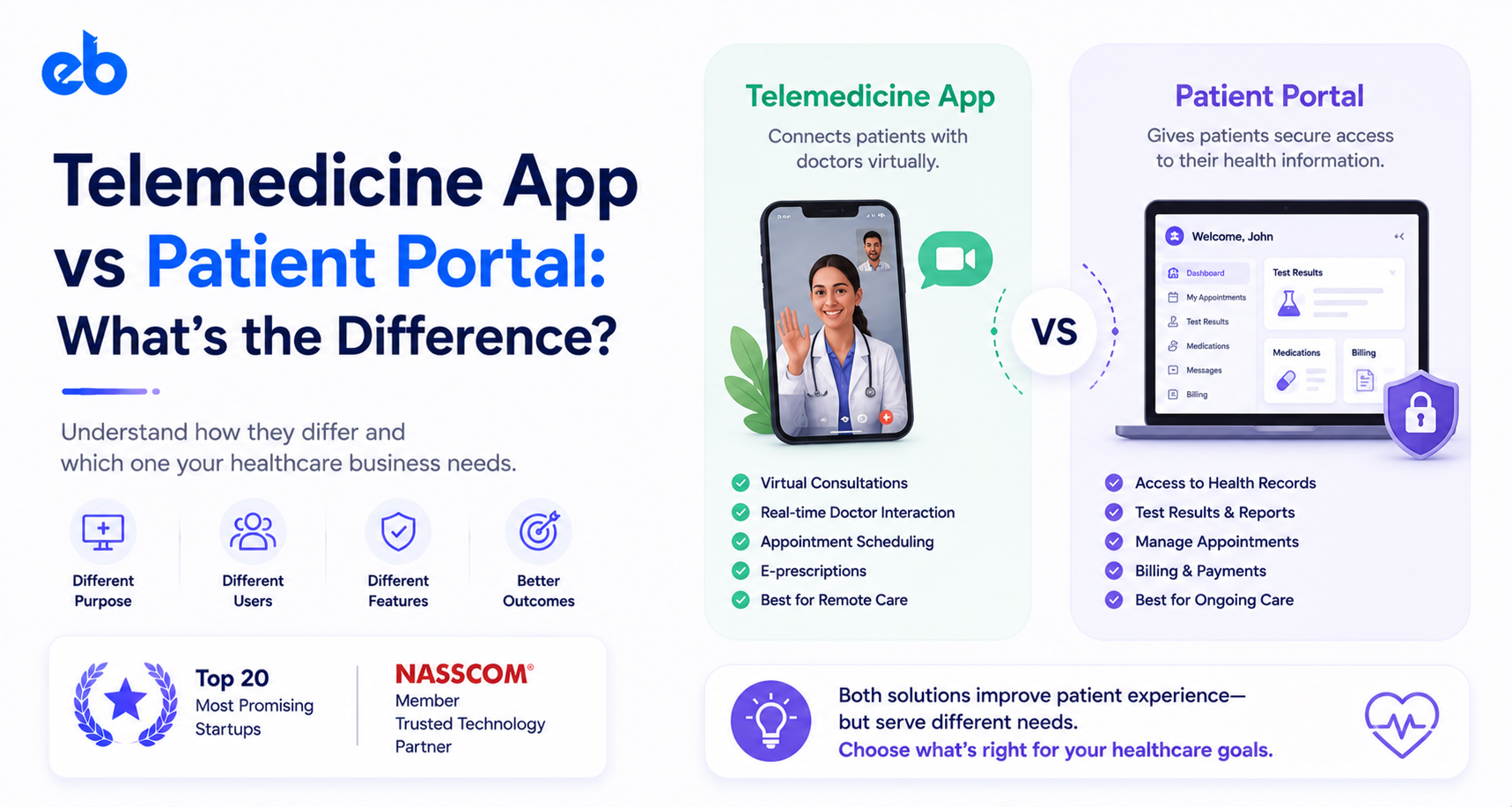
A telemedicine app is where a clinical encounter happens. Video, audio, triage, prescribing, and payment for that visit all live inside it. It is synchronous and event-driven.
A patient portal is where clinical data sits after the encounter. Lab results, visit summaries, medication lists, billing, and secure messages live there. It is asynchronous and record-driven.
Put simply, the Telemedicine App vs Patient Portal split is care delivery versus record access. Everything else follows from that one distinction.
A telemedicine app exists to replace a room. This is the side that carries the weight of a real clinical visit, not just a record of one.
Core capabilities usually include:
The hard engineering sits in latency, session reliability, and state. A dropped call mid-consult is a clinical event, not a bug ticket. Teams that treat this as serious mobile app development work, not a video widget bolted onto a website, ship far fewer of those failures.
A patient portal exists to make a health system transparent. It is the record-keeping half of the Telemedicine App vs Patient Portal pairing, and it rarely creates new clinical data of its own. It surfaces what the EHR already holds.
Typical features include:
Most of that data moves through FHIR endpoints owned by Epic, Cerner, athenahealth, or a similar vendor. So the real workload is API development and data mapping, not front-end screens. Teams consistently underestimate this and blame the wrong part of the stack.
| Dimension | Telemedicine app | Patient portal |
| Primary job | Deliver a clinical encounter | Deliver access to records |
| Interaction model | Synchronous, real time | Asynchronous, on demand |
| Core technology | WebRTC, queuing, session state | FHIR/HL7 reads and writes |
| Who starts it | Patient or provider, on demand | Patient, whenever they want |
| Revenue link | Directly billable visits | Lower admin and call volume |
| Compliance focus | Licensure, prescribing, payer rules | Access rights, information blocking |
| Success metric | Completed visits, wait time | Active users, message resolution |
| Failure mode | Dropped or unusable consult | Stale or missing records |
Overlap is why the Telemedicine App vs Patient Portal comparison confuses buyers, and it keeps growing. Portals now embed video visits. Telemedicine apps now display past results so the clinician and patient see the same chart.
Both products also need the same foundation: identity verification, role-based access, audit logging, and a live connection to the EHR. That shared base absorbs a large slice of either build.
The difference is what sits on top. One layer handles a live conversation. The other handles a data contract. If you already have a portal running, adding video is an extension. If you have neither, building the patient portal first usually creates the plumbing the telemedicine layer will need anyway.
Ask any agency about Telemedicine App vs Patient Portal pricing and you get a range, not a number. Neither product has a fixed price, but the cost drivers differ in predictable ways.
A telemedicine app spends budget on real-time infrastructure. Video minutes, TURN servers, device and network testing, and multi-state licensure routing all add hours. Expect a serious first version in roughly four to seven months.
A patient portal spends a budget on integration. Every EHR sandbox, field mapping, and result-release rule eats development time before a single screen looks finished. Three to five months is realistic when one EHR is in scope.
If cash is tight, scope one workflow instead of the full product. An MVP development approach that ships lab results or urgent-care video alone will teach you more than a feature-complete launch nobody uses.
This is where the Telemedicine App vs Patient Portal decision stops being a product debate and becomes a legal one.
Clinicians must be licensed in the state where the patient is physically located during the visit. Your booking logic has to enforce that, not just record it.
Controlled-substance prescribing follows Ryan Haight Act rules and DEA telehealth flexibilities, which have shifted repeatedly. Payer reimbursement policies vary by state and plan, so eligibility checks belong at booking, not at billing.
The 21st Century Cures Act information blocking provisions require that patients get their electronic health information without unreasonable delay.
Automatic result release is now the default, which means designing for sensitive findings a patient may read before a clinician calls. Proxy and adolescent access rules add real complexity, since a parent’s view must legally differ from the patient’s own.
Both carry the same HIPAA baseline: encryption, audit trails, BAAs with every vendor, and breach notification workflows.
In practice, Telemedicine App vs Patient Portal is a sequencing question, not an either-or one. Answer three questions honestly and the order usually picks itself.
Your revenue depends on visits you cannot currently deliver. Direct-to-consumer care, behavioral health, dermatology, and urgent care all sit here. Patients are choosing you for access, not recordkeeping, so every week without video is lost revenue.
Start with one condition or one specialty. Get scheduling, intake, video, and prescribing working end to end for that slice. A narrow launch surfaces licensure gaps and payer friction while the fixes are still cheap, and it gives you real utilization data before you widen the catalog.
You already deliver plenty of visits and your staff drowns in phone calls. Result requests, refill calls, and form chasing are portal problems, and the return shows up as reduced admin load rather than new billable encounters.
Begin with the two or three requests that generate the most calls, usually results and refills. Wire those to live EHR data instead of a nightly export. Patients abandon a portal fast when it shows information they already saw somewhere else, so freshness matters more than feature count.
You are replacing a legacy system or launching a payer-facing product where members expect one login for everything. Plan the shared identity and integration layer before either surface, or you will build it twice and reconcile two patient records later.
Sequence the work anyway. Ship one surface, keep the other in the same codebase and data model, and release it a quarter later. Parallel teams on a shared EHR integration usually create more merge pain than speed.
AI is quietly erasing the boundary between the two. Ambient scribes now draft visit notes during a consult and push a plain-language summary into the portal minutes after the call ends. The patient reads it while the visit is still fresh.
On the portal side, AI development work is translating lab values into language patients actually understand. It also routes incoming messages, so clinical questions reach a nurse instead of a billing queue.
Predictive work goes further. ML development models flag no-show risk before an appointment and surface patients who have not refilled a critical medication. Both features need portal data and telemedicine data together, which is a strong argument for shared infrastructure from day one.
The Telemedicine App vs Patient Portal choice is not about which product is more modern. It is about which problem is currently costing you the most.
If patients cannot reach a clinician, you have a care access problem and you need a telemedicine app. If patients cannot reach their own information, you have a transparency problem and you need a portal. Most mature health products eventually run both on shared plumbing.
Build the one that fixes this quarter’s pain, and design the data layer so the second one is an extension rather than a restart.
The app hosts live clinical encounters through video or phone. The portal gives patients access to records, messages, and billing after care happens. One creates the visit, the other stores and shares its output.
Yes, and that blurring is part of why Telemedicine App vs Patient Portal confuses buyers. Most major EHR portals now bundle video consults. The tradeoff is flexibility, since portal-native video follows the vendor’s roadmap. A separate app gives you control over triage, queueing, and consumer-grade experience.
For clinical use, yes. Without write-back, visit notes and prescriptions sit outside the legal medical record. That creates duplicate charting and compliance exposure. Read-only integration is a workable starting point for pilots.
Costs land in similar ranges, but the drivers differ. Telemedicine spends on real-time video and licensure logic. Portals spend on EHR integration and data mapping. Scope, not category, decides the final number.
No. Most teams start with one and extend later. Just design shared identity, consent, and integration layers early so the second product plugs in instead of forcing a rebuild.