How Much Does It Cost to Build an App in New York?


Create engaging, high-performance mobile applications tailored to your business needs. We craft future-ready apps that offer smooth user experiences on all devices.
Build robust and scalable websites and CMS platforms that help you manage content effortlessly. Our development ensures a seamless digital presence.
Launch secure, feature-rich online stores with intuitive shopping experiences. We build tailored eCommerce platforms designed for growth.
Design captivating games with immersive gameplay and stunning graphics. From concept to launch, we build engaging experiences that players love.
Enhance your customer relationships with customized Salesforce implementations. Drive growth and efficiency with smarter CRM solutions.
Harness artificial intelligence and machine learning to automate workflows and gain actionable insights. Our AI transforms data into smart decisions.
Accelerate your software delivery lifecycle with continuous integration, delivery, and infrastructure automation to boost efficiency.
Hire app developers ready to turn your ideas into sleek, high-performing mobile apps for any platform.
Bring in frontend pros who craft smooth, beautiful, and user-friendly interfaces that your visitors will love.
Get backend developers who build fast, secure, and reliable systems to keep everything running behind the scenes.
Hire eCommerce developers who build secure, scalable online stores designed to offer seamless shopping and grow your sales.
Get dedicated developers committed to your projects, delivering consistent quality and speed as an extension of your team.
Two founders, same product idea, offices eleven blocks apart in Flatiron. One was quoted $45,000. The other was quoted $290,000.
Neither agency was lying. They were pricing two very different products, and neither founder could spot the difference.
New York pricing starts from a hard number. Software developers in the New York-Newark-Jersey City metro earn an annual mean wage of $152,100, per the Bureau of Labor Statistics. Agencies price hours on top of that payroll, plus Manhattan rent.
So the cost to build an app in New York depends less on screen count and more on who bills you, for how long, against what spec.
Four levers move the number more than anything else in a proposal.
Feature depth comes first. Login, a feed, and static content is a different animal from real-time matching, payments, and offline sync.
Platform count comes second. Native iOS and Android mobile app development means two codebases, which adds 40 to 60% more engineering hours.
Third is your backend. Every integration you bolt on, from Stripe to a client’s legacy ERP, brings its own edge cases and testing load.
Fourth is your vendor’s cost structure, which swings the cost to build an app in New York further than any spec detail.
Take the same 1,200-hour build. The invoice lands between $30,000 and $300,000 on that row alone, which explains most published ranges for the cost to build an app in New York.
Six to ten screens, one platform, social login, a light backend, no heavy integrations. Think a booking tool, an internal operations app, or a single-purpose utility. Timelines run 8 to 14 weeks.
Most first versions belong here. Disciplined MVP Development holds the cost to build an app in New York inside this bracket, instead of drifting into six figures before one user signs up.
Two platforms, payments, push notifications, an admin dashboard, role-based access, and several integrations. Delivery apps, marketplaces, and B2B field tools sit here.
Expect four to seven months with a team of five or six. At this tier, the cost to build an app in New York is driven by integration count rather than screen count. Overruns trace back to integrations nobody scoped, like tax calculation, ID verification, or a client’s aging inventory system.
Custom AI, financial rails, clinical data, or multi-sided marketplace logic. Add SOC 2 readiness, audit trails, encryption at rest, and penetration testing.
Timelines pass nine months and the team needs a security lead. New York is thick with fintech and healthtech founders, so this bracket appears here more often than elsewhere.
| App Type | Estimated Cost | Key Features | Timeline |
| Simple App / MVP | $30,000–$65,000 | 6–10 screens, one platform, social login, basic backend, simple functionality | 8–14 weeks |
| Mid-Complexity App | $80,000–$180,000 | iOS + Android, payments, push notifications, admin dashboard, role-based access, multiple integrations | 4–7 months |
| Complex / Regulated App | $200,000–$450,000+ | Custom AI, financial integrations, clinical data, marketplace logic, encryption, audit trails, penetration testing, compliance requirements | 9+ months |
By stage, the cost to build an app in New York follows a predictable split.
Expect 8 to 12% of the total. Two to three weeks of user flows, technical architecture, and a feature list that also states what is out of scope.
It feels like the stage to skip when runway is tight. It is also the stage that prevents a $60,000 change order in month four. Ask for a clickable flow map and a signed scope document. A vendor offering to start coding Monday with no discovery is selling speed you pay for twice.
Budget 15 to 20%. That covers wireframes, a design system, high-fidelity screens for every state, and a prototype your testers can tap through.
New York consumer apps compete with products already sitting on someone’s home screen, so polish does real work. Empty, error, and loading states are the first things cheap quotes drop, and they get rebuilt later at full price. Ask how many screens are included and what a second design direction costs.
This takes 45 to 55% of the total. Frontend, backend, database work, and third-party wiring all land in this window.
API Development for payments, maps, and identity checks eats more hours than founders expect, since sandboxes rarely behave like production. Insist on two-week sprints that each end with an installable build. If you cannot use something on your own phone by week six, you cannot verify progress against the invoice.
Set aside 10 to 15% for functional testing, device coverage on older Android hardware, security testing, and submission to both stores.
Apple review adds days and sometimes rejections over privacy labels or missing account deletion. Load testing matters if you plan a launch campaign, because a traffic spike on a fragile backend is an expensive lesson in connection pooling. A defect caught in QA costs a fraction of one caught by users.
A few local realities lift the cost to build an app in New York above national benchmarks.
An AI feature usually adds 20 to 40% to the engineering line. A retrieval chatbot over your own content sits at the low end. Recommendation engines, document extraction, and voice interfaces sit higher, since they need data pipelines and evaluation harnesses.
Two costs get missed. First, AI Development includes prompt evaluation and guardrails, which is ongoing work rather than a one-time build. Second, inference is a monthly bill that grows with usage.
When off-the-shelf models fall short, custom ML Development for scoring or forecasting adds specialist salary and weeks of timeline.
Where you build changes the cost to build an app in New York more than what you build.
A Manhattan agency buys same-timezone standups, in-person workshops, and people who know local compliance. You pay two to four times offshore rates for that access.
Freelancers are cheapest to start and riskiest to finish. One person disappearing mid-build can cost more than the savings.
Offshore partners give most NYC founders the strongest ratio on a first build. Many keep product and design in New York, run engineering with a team in India, then hire locally once revenue exists. Compare mobile app development companies by domain fit, and if you sell to schools, narrow to EdTech app development companies that already understand FERPA.
You can cut the cost to build an app in New York without shipping something fragile.
Launch on one platform first, whichever your users actually hold. Buy rather than build for auth, payments, notifications, and analytics. Trim the v1 list by half and write the rest into phase two. Lock scope with a change-order process and a stated rate for extras. Then ask every vendor for a stage-by-stage breakdown, since a lump-sum quote hides where your hours go.
There is no single figure for the cost to build an app in New York. There is a reliable range once you know your complexity tier, platform count, and blended team rate.
Those three inputs explain nearly the whole gap between a $45,000 quote and a $290,000 one. Founders who price stage by stage reach launch with fewer surprises.
For a budget built around your real feature list, EngineerBabu scopes app builds for New York founders across fintech, healthcare, and consumer products.
EngineerBabu is a technology development company building products across fintech, healthtech, and AI, from MVPs to scaled, production-ready platforms.
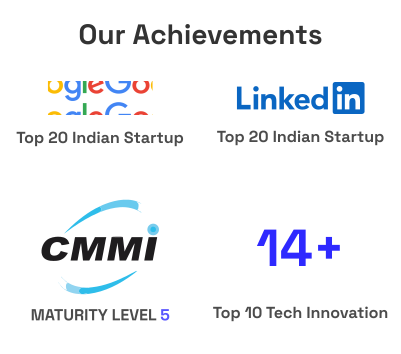
It holds a CMMI Level 5 rating, has worked with 4 unicorn clients, and has supported 200+ VC-funded products. The company is backed by Vijay Shekhar Sharma.
Founded by Mayank Pratap (Co-founder) · mayank@engineerbabu.com
Most projects run from $30,000 for a single-platform MVP to $450,000 or more for a regulated, AI-heavy platform. Mid-complexity apps typically land at $80,000 to $180,000.
Local payroll is the main driver, with metro developer wages averaging over $152,000 a year. Office costs, account management, and compliance expertise add the rest.
An MVP takes 8 to 14 weeks. A mid-complexity app on two platforms takes four to seven months, and regulated products often pass nine months with security reviews.
Yes. Offshore engineering can cut the cost to build an app in New York by 50 to 70%, though you still need product ownership, clear specs, and overlapping hours.
It does. Chatbots and recommendation engines add 20 to 40% to the build, plus a recurring inference bill that scales with active users.