ATS vs CRM: Understanding the Differences

Managing people and processes at work can sometimes feel like juggling flaming torches. Whether you are trying to hire the right talent or keep your customers happy, things can get messy quickly.
Did you know that companies using proper workflow automation systems report up to 30% faster workflow efficiency? This shows how crucial it is to have the right tools in place.
When it comes to organizing your hiring process or handling client relationships, two systems often come up: ATS and CRM. Both sound technical, and sometimes even overlap in some features, but their core purposes are very different.
Understanding ATS vs CRM can save you time, reduce frustration, and help your team focus on what really matters.
An ATS, or Applicant Tracking System, is like a personal assistant for your hiring process. Instead of sifting through countless resumes manually, an ATS helps you collect, organize, and track candidates efficiently. From posting jobs to scheduling interviews, it streamlines every step of recruitment.
For example, a recruiter can see which candidates applied, who has been interviewed, and where each candidate is in the pipeline, all in one place.
Many modern ATS tools also integrate with other platforms, allowing data to flow smoothly through proper API Development.
In short, understanding ATS vs CRM starts with knowing that an ATS focuses entirely on managing talent, not customers. It saves time, reduces errors, and helps hiring teams make data-driven decisions without the usual chaos of manual tracking.
A CRM, or Customer Relationship Management system, is designed to keep your interactions with clients organized and meaningful. It tracks leads, manages contacts, and helps teams follow up at the right time, so no opportunity slips through the cracks.
Think of it as a central hub for your sales and marketing efforts, where every conversation, email, or meeting is recorded. Many businesses also use CRM insights to plan campaigns and measure engagement. Plus, Modern CRM tools leverage machine learning development to quickly screen resumes
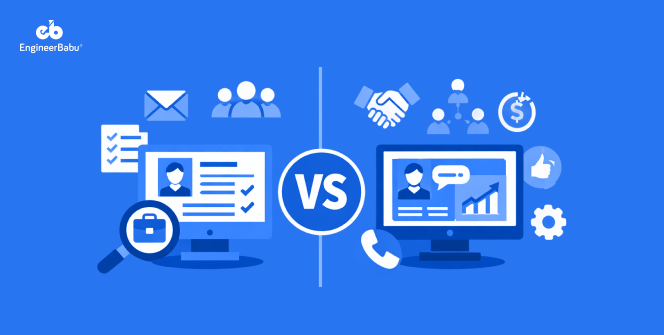
In the context of ATS vs CRM, the key difference is focus. While an ATS manages candidates, a CRM manages customers. Using a CRM effectively can improve relationships, boost conversions, and ensure your team stays aligned, all without juggling spreadsheets or scattered notes.
Understanding the differences between an ATS and a CRM can save a lot of headaches. While both systems organize data and improve workflows, their focus, functionality, and the way teams use them are quite different. Here’s a closer look at how they compare.
ATS: An Applicant Tracking System is all about recruitment. It helps HR teams track candidates from application to hire, manage interviews, and organize resumes. Modern ATS tools also use the latest tech to quickly analyze resumes and rank candidates.
CRM: A Customer Relationship Management system focuses on relationships with clients. It tracks leads, customer interactions, and follow-ups. This ensures sales and marketing teams never miss an opportunity and can personalize outreach based on past interactions.
ATS: Typically follows a linear path: sourcing candidates, interviewing them, and making hires. It’s designed to streamline hiring, reduce errors, and give HR teams a clear view of each candidate’s journey.
CRM: Works through lead generation, engagement, conversion, and retention. It’s more cyclical than an ATS because customer relationships require ongoing interaction and care rather than a one-time outcome.
ATS: Stores candidate profiles, resumes, application history, and interview notes. With the help of AI-driven tools, it can even predict candidate fit or highlight the most promising applicants.
CRM: Stores customer data, communication logs, and sales opportunities. Teams can track interactions, segment customers, and plan personalized campaigns without juggling multiple spreadsheets.
ATS: Often integrates with job boards, HRIS platforms, and sometimes API Development solutions to keep recruitment workflows connected. Automation can handle interview scheduling or resume parsing.
CRM: Integrates with email systems, marketing tools, and sales platforms. Automated reminders and workflows help ensure leads are followed up on promptly and accurately.
ATS: Provides metrics like time-to-hire, source of candidates, and recruitment efficiency. Modern systems may leverage predictive analytics to improve hiring decisions.
CRM: Offers insights into sales performance, conversion rates, and customer engagement trends. Teams can adjust strategies based on clear, data-driven results.
| Feature | ATS | CRM |
| Focus | Recruitment, candidates | Customers, leads |
| Workflow | Sourcing → Interview → Hire | Lead → Engage → Convert → Retain |
| Data | Resumes, applications, interview notes | Customer profiles, interactions |
| Integrations | Job boards, HRIS, API solutions | Email, marketing, sales platforms |
| Analytics | Time-to-hire, candidate sources | Sales performance, engagement |
At engineerbabu, we specialize in building both ATS software development and CRM solutions tailored to your business needs. If your team struggles with managing candidates, tracking applications, or streamlining recruitment workflows, an ATS is the way to go.
On the other hand, if your focus is on nurturing leads, improving customer engagement, and boosting sales efficiency, a CRM will make a significant difference.
Our experience ensures that whichever system you choose, it integrates seamlessly with your existing tools and workflows. Thus, helping your team stay organized and productive without unnecessary complexity.
Understanding ATS vs CRM is essential for any business looking to streamline operations, whether in hiring or managing customer relationships. While an ATS keeps your recruitment process organized and efficient, a CRM ensures your customer interactions are tracked and optimized.
Choosing the right system can save time, improve team collaboration, and help your organization make smarter, data-driven decisions.
At engineerbabu, we help businesses build customized ATS and CRM solutions that fit their unique workflows and needs. Whether you are looking to simplify hiring or enhance customer engagement, our expert team ensures seamless integration and a smooth experience.
Ready to get started? Connect with us today and let’s build the perfect system for your business.
An ATS manages candidates and recruitment workflows, while a CRM focuses on customer interactions, leads, and sales pipelines.
Yes. Many companies use both systems to manage recruitment and customer relationships efficiently without overlap.
Companies that hire frequently, have large talent pools, or want to automate the recruitment process will benefit from an ATS.
Businesses that want to track leads, improve customer engagement, or enhance sales and marketing workflows should invest in a CRM.
Yes. Modern systems often integrate with HR software, email platforms, API solutions, and even AI or machine learning tools to streamline processes.