AI Chatbots for Healthcare: Use Cases and Benefits


Create engaging, high-performance mobile applications tailored to your business needs. We craft future-ready apps that offer smooth user experiences on all devices.
Build robust and scalable websites and CMS platforms that help you manage content effortlessly. Our development ensures a seamless digital presence.
Launch secure, feature-rich online stores with intuitive shopping experiences. We build tailored eCommerce platforms designed for growth.
Design captivating games with immersive gameplay and stunning graphics. From concept to launch, we build engaging experiences that players love.
Enhance your customer relationships with customized Salesforce implementations. Drive growth and efficiency with smarter CRM solutions.
Harness artificial intelligence and machine learning to automate workflows and gain actionable insights. Our AI transforms data into smart decisions.
Accelerate your software delivery lifecycle with continuous integration, delivery, and infrastructure automation to boost efficiency.
Hire app developers ready to turn your ideas into sleek, high-performing mobile apps for any platform.
Bring in frontend pros who craft smooth, beautiful, and user-friendly interfaces that your visitors will love.
Get backend developers who build fast, secure, and reliable systems to keep everything running behind the scenes.
Hire eCommerce developers who build secure, scalable online stores designed to offer seamless shopping and grow your sales.
Get dedicated developers committed to your projects, delivering consistent quality and speed as an extension of your team.
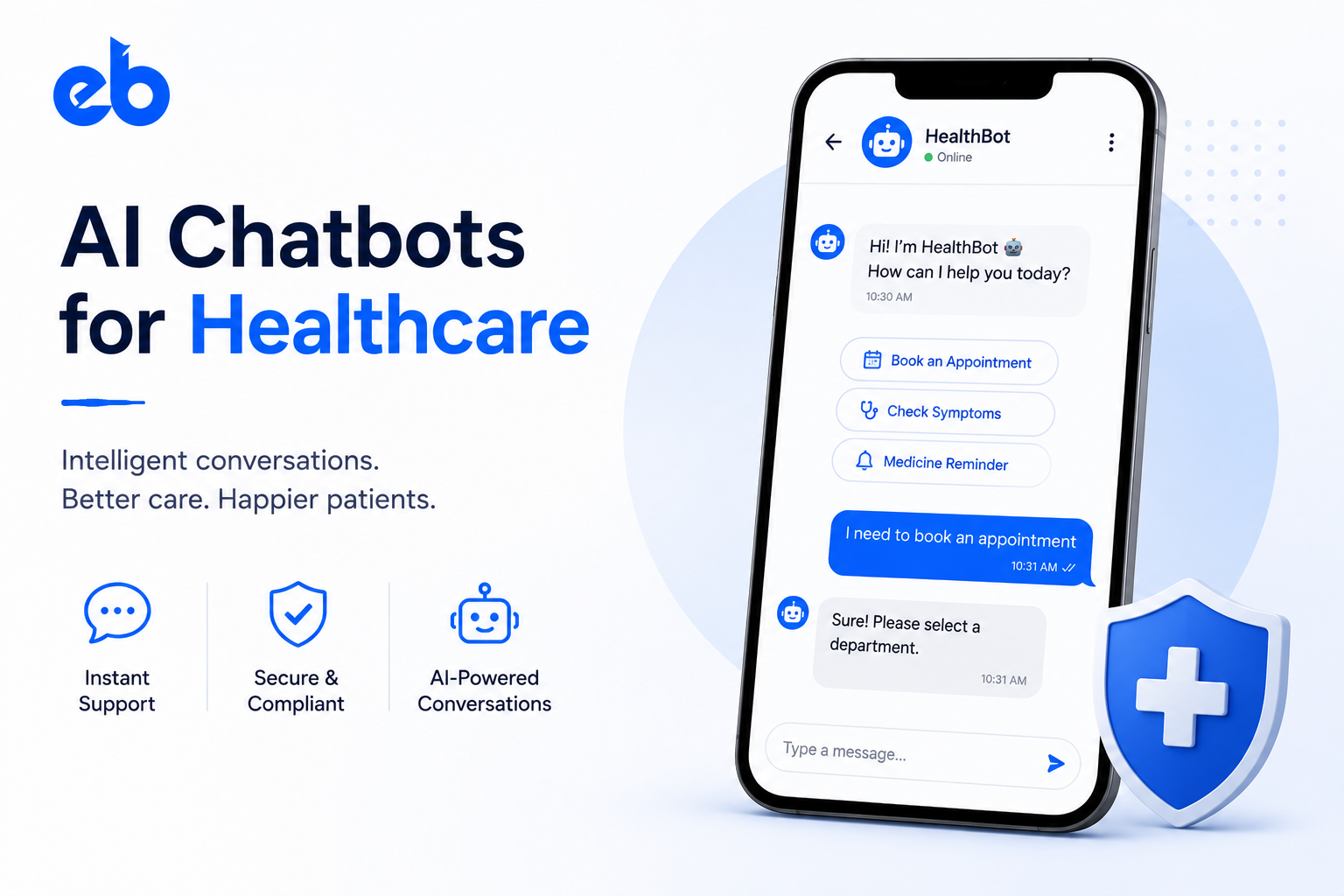
A patient texts a hospital’s help line at 2 AM, chest tight, unsure if it’s anxiety or something worse. No nurse is free to answer. A chatbot is, and it asks the right triage questions, flags the reply as urgent, and tells the patient to call emergency services right away.
That’s not a hypothetical anymore. AI chatbots for healthcare are already doing this kind of work, quietly, at scale, across hospitals, insurers, and telehealth platforms that most patients use without a second thought.
According to Rock Health’s 2025 Consumer Adoption Survey, 32% of U.S. adults now use AI chatbots for health information.
That’s double the rate recorded just a year earlier. A jump like that doesn’t happen because technology is trendy. It happens because it solves a real, recurring problem: healthcare access is slow, and patients want answers now.
This blog breaks down exactly where AI chatbots for healthcare are being used today, what benefits they actually deliver, and what it takes to build one that clinicians and patients both trust.
AI chatbots for healthcare are conversational tools built to handle patient-facing tasks that used to require a human on the other end of the phone. Some run on simple rule-based logic for scheduling and FAQs.
Others use large language models to hold open-ended conversations about symptoms, medications, or mental health.
The difference matters. A rule-based bot can confirm an appointment. A model trained on clinical data can help a patient understand why their doctor changed a prescription dosage. Both count as AI chatbots for healthcare, but they solve very different problems.
Healthcare staffing hasn’t kept pace with patient demand. Front desks are understaffed, nurse lines are backed up, and patients wait on hold for questions that take thirty seconds to answer once someone picks up.
AI chatbots for healthcare fill that gap without adding headcount. They handle the repetitive, high-volume questions around the clock, freeing clinical staff to spend their time on cases that genuinely need a human judgment call.
There’s also a cost angle few founders think about early enough. Every automated conversation is a conversation a call center agent never has to take, and at hospital scale, that adds up fast.
This is the most common entry point. A chatbot collects insurance details, medical history, and reason for visit before the patient ever sees a receptionist. It can also reschedule, send reminders, and cut no-show rates by texting patients the night before.
Patients describe symptoms in plain language, and the chatbot asks follow-up questions modeled on clinical triage protocols. It won’t diagnose anything, but it can route a patient toward urgent care, a telehealth visit, or the ER based on severity.
For patients managing diabetes, hypertension, or other chronic conditions, missed doses are a real problem. AI chatbots for healthcare send reminders, log symptoms between visits, and alert care teams when a patient’s reported numbers drift outside a safe range.
Interestingly, a recent systematic review found AI chatbots were rated more empathetic than human clinicians in text-based interactions across thirteen studies. That doesn’t replace a therapist, but it explains why many mental health apps lean on chatbots for daily check-ins and mood tracking.
Hospitals use chatbots to check in with discharged patients about pain levels, wound healing, or medication side effects. Catching a complication early through a chat message is far cheaper than a readmission.
Billing questions eat up enormous call center hours. A chatbot connected to the right backend systems can explain a claim, estimate out-of-pocket costs, and walk a patient through a payment plan without a single hold-music minute.
The use cases matter, but providers care about outcomes. Here’s where AI chatbots for healthcare actually move the needle.
Building AI chatbots for healthcare isn’t a weekend project, but it’s also not as complicated as most vendors make it sound. Here’s a realistic path from idea to a working product.
Decide exactly what the chatbot will and won’t do before writing a single line of code. Will it handle scheduling only, or move into symptom triage and mental health support? Each layer adds regulatory weight, especially around HIPAA and data storage.
Document what patient data the bot will collect, where it gets stored, and who can access it. Getting this wrong early means expensive rework later, and it’s the single most common mistake teams make when they rush straight into building instead of scoping the compliance boundary first.
Resist the urge to launch with every feature at once. Start with the one or two use cases that solve your biggest operational pain point, usually intake or FAQs.
An MVP development approach lets you test how patients actually interact with the bot before you invest in more complex clinical logic, and it gives your team real usage data to guide what gets built next. Most successful healthcare chatbots started this narrow and expanded gradually.
A chatbot that can’t see appointment slots or claim status isn’t very useful. This step involves connecting the bot to your EHR, scheduling software, and billing platform through secure integrations.
Solid API development work here determines whether the chatbot feels genuinely helpful or just repeats generic answers. This is also where most of the real engineering effort goes, since every healthcare system has its own data formats and access rules.
Generic language models stumble on medical terminology and clinical context, often misreading shorthand or regional phrasing patients use to describe symptoms. Fine-tuning with clinically reviewed data, guided by proper ML development, improves accuracy on symptom descriptions and reduces the risk of confusing or unsafe responses.
This stage should always involve clinicians reviewing sample conversations before launch, not just engineers testing in isolation, since medical nuance is easy to miss without a clinical eye.
Most patients expect to reach a chatbot wherever they already are, whether that means a patient portal, a text message thread, or a dedicated mobile app.
Solid mobile app development work makes sure the chatbot experience feels native rather than bolted on as an afterthought, especially for older patients who may be less comfortable navigating unfamiliar interfaces. Test thoroughly across devices and screen sizes before committing to a full rollout.
None of this matters if the chatbot leaks protected health information. HIPAA compliance isn’t optional, and it shapes nearly every technical decision, from where data gets stored to how long chat logs are retained.
Encryption in transit and at rest is table stakes. So is a clear audit trail showing who accessed what data and when. Any vendor touching patient data needs a signed Business Associate Agreement before a single message gets processed.
Skipping this step to launch faster is how healthcare chatbot projects end up in regulatory trouble instead of production.
The next wave isn’t about adding more chat windows. It’s about making AI chatbots for healthcare proactive instead of reactive, flagging a patient’s declining vitals before they even ask a question, or nudging a caregiver about a missed refill without being prompted.
Voice is also moving fast, with more patients choosing to speak to a chatbot instead of typing, especially older adults managing chronic conditions. Expect the line between chatbot and full virtual assistant to blur significantly over the next couple of years.
AI chatbots for healthcare aren’t a passing trend. They’re becoming the default first point of contact for scheduling, triage, and follow-up care because they solve a problem patients have had for decades: getting a fast, accurate answer without waiting on hold.
Providers that get the compliance foundation right and start with a focused, well-scoped build tend to see the fastest returns. The ones that rush the clinical and regulatory groundwork usually end up rebuilding from scratch.
If you’re planning to build AI chatbots for healthcare and want the architecture done right the first time, working with a team experienced in AI development for regulated industries makes the difference between a chatbot patients trust and one they abandon after one bad conversation.
They’re safe for triage, reminders, and general information, but not for diagnosis. Every credible healthcare chatbot should point patients toward a licensed provider for actual medical decisions.
Costs vary widely based on scope. A basic scheduling bot costs far less than one handling symptom triage and EHR integration, which needs deeper compliance and engineering work.
No. They handle repetitive, high-volume questions so human staff can focus on cases that genuinely need clinical judgment or a personal touch.
Data privacy violations and inaccurate medical responses are the two biggest risks. Both usually come down to weak compliance planning or insufficient clinical review before launch.
Yes, most modern healthcare chatbots support multilingual conversations, which matters significantly for hospitals serving diverse patient populations.