How to Build a Master Data Management Platform, Customer, Product, Supplier Data Governance, and Golden Record 2026


Create engaging, high-performance mobile applications tailored to your business needs. We craft future-ready apps that offer smooth user experiences on all devices.
Build robust and scalable websites and CMS platforms that help you manage content effortlessly. Our development ensures a seamless digital presence.
Launch secure, feature-rich online stores with intuitive shopping experiences. We build tailored eCommerce platforms designed for growth.
Design captivating games with immersive gameplay and stunning graphics. From concept to launch, we build engaging experiences that players love.
Enhance your customer relationships with customized Salesforce implementations. Drive growth and efficiency with smarter CRM solutions.
Harness artificial intelligence and machine learning to automate workflows and gain actionable insights. Our AI transforms data into smart decisions.
Accelerate your software delivery lifecycle with continuous integration, delivery, and infrastructure automation to boost efficiency.
An enterprise operating a CRM, an ERP, an e-commerce platform, and a customer support system has the same customer in four places, with four different names, four different addresses, and four different phone numbers, none of which exactly agree with each other.
When the data warehouse queries customer lifetime value, it creates duplicates. When the marketing team sends a campaign, the same customer gets four emails. When the customer calls support, the agent cannot see the customer’s full history because each system only has part of it.
Master Data Management (MDM) solves this. It identifies which entities, customers, products, suppliers, employees, locations, are duplicated across the enterprise, creates a single authoritative “golden record” for each entity, and either distributes updates back to source systems or provides a reliable reference layer that all systems query.
The global MDM market is projected to reach $28.8 billion by 2030 at a CAGR of 21.5%. The buyers are enterprises, banks, retailers, manufacturers, healthcare systems, and telecoms, whose data quality problems are now creating regulatory risk, operational inefficiency, and customer experience failures.
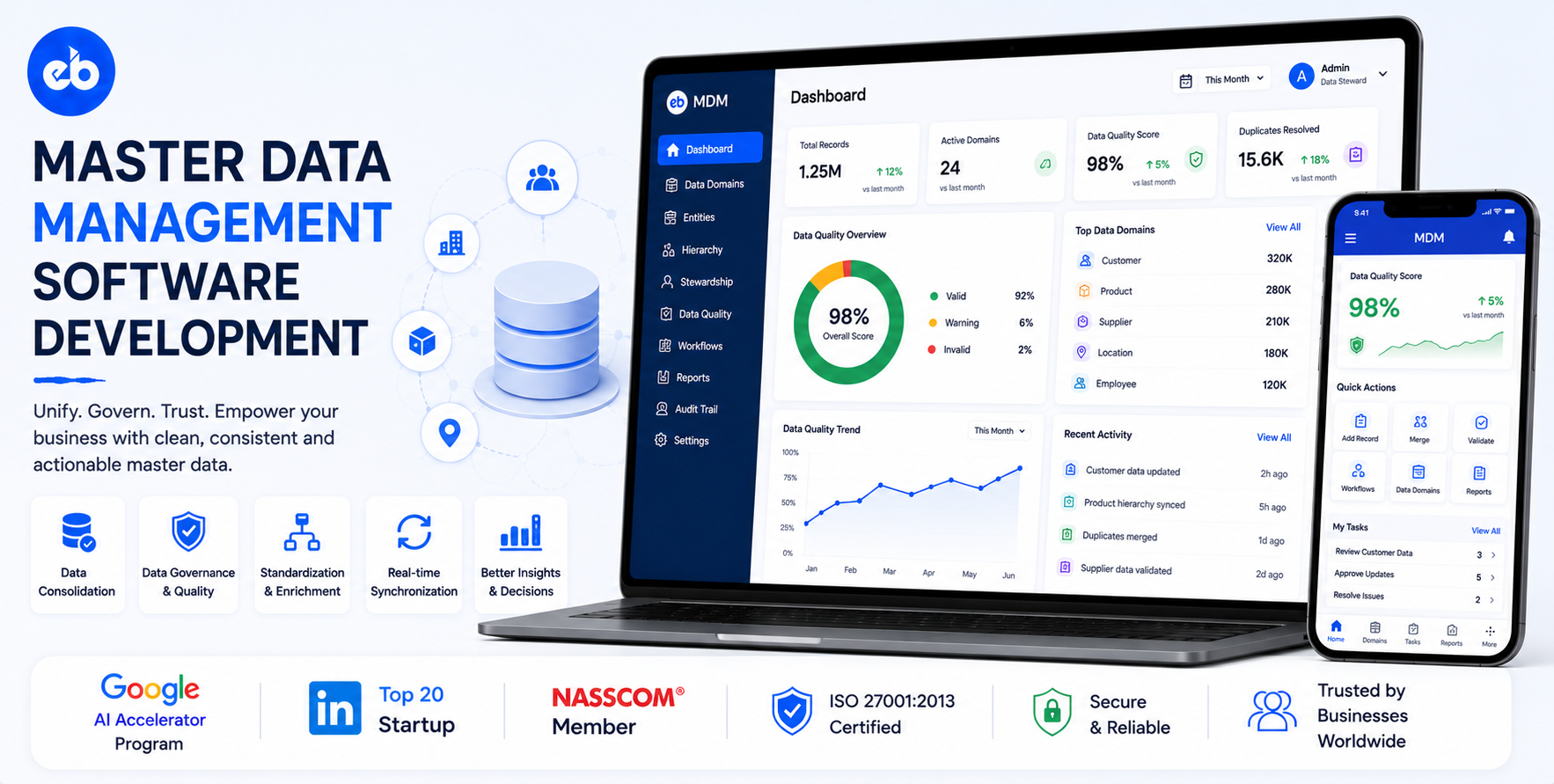
EngineerBabu built enterprise systems for Adani Group, operating across 14 business sectors with data management needs of corresponding complexity, and healthcare platforms for Apollo Hospitals. CMMI Level 5. Google AI Accelerator 2024 Top 20. Contact: mayank@engineerbabu.com
| Function | Module |
| Data ingestion | Pull entity records from all source systems |
| Entity resolution | Identify which records across systems represent the same entity |
| Deduplication | Merge duplicate records into a single golden record |
| Golden record management | Create, maintain, and version the authoritative record |
| Data quality rules | Validate, cleanse, and standardise incoming data |
| Stewardship workflow | Human review of uncertain matches and data exceptions |
| Distribution | Publish golden records back to source systems |
| Data governance | Policies, ownership, lineage, quality metrics |
| Hierarchy management | Parent-child relationships in the entity model |
| Domain support | Customer, Product, Supplier, Employee, Location MDM |
| Analytics | Data quality scores, match rates, steward performance |
The source systems feeding MDM:
For Customer MDM:
| Source System | Customer Data | Integration |
| CRM (Salesforce, HubSpot) | Contact records, company records | REST API |
| ERP (SAP, Oracle) | Customer master | API or database extract |
| E-commerce platform | Registered customer accounts | REST API |
| Loyalty programme | Enrolled members | REST API |
| Customer support (Zendesk) | Contact records | REST API |
| Marketing automation (Marketo) | Lead records | REST API |
| Branch banking system | Account holders | Database extract |
The ingestion architecture:
Every source system feeds into the MDM platform through one of three integration patterns:
Real-time event streaming, source system pushes a message to the MDM every time a customer record is created or updated. Kafka or AWS EventBridge receives the event and routes it to the entity resolution engine.
Scheduled batch extract, for systems without real-time API, a scheduled job extracts all new and updated records since the last extract and submits them to the MDM.
Initial bulk load, for new source system onboarding, a full historical extract loads all existing records for deduplication against the existing golden record population.
The probabilistic matching algorithm:
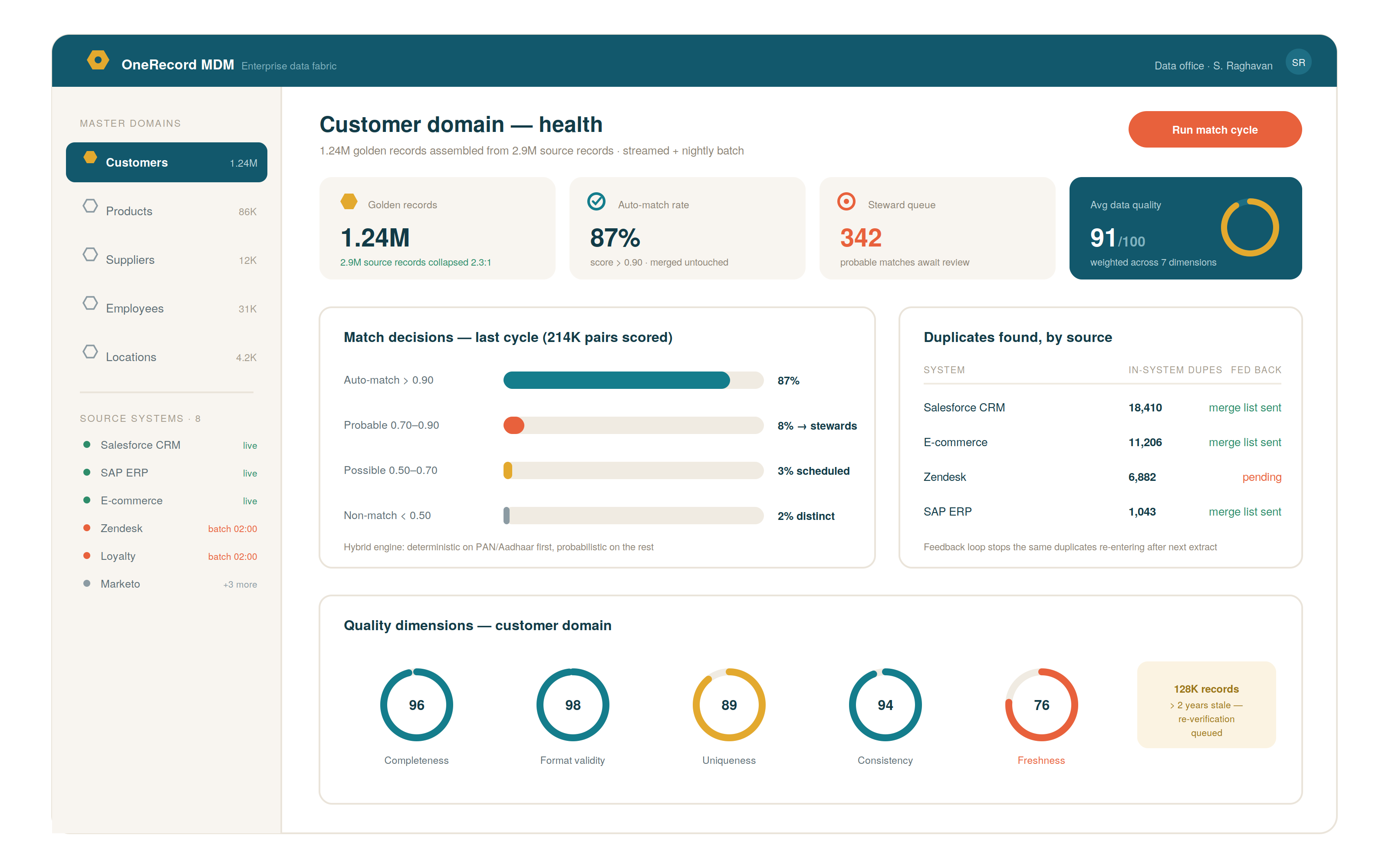
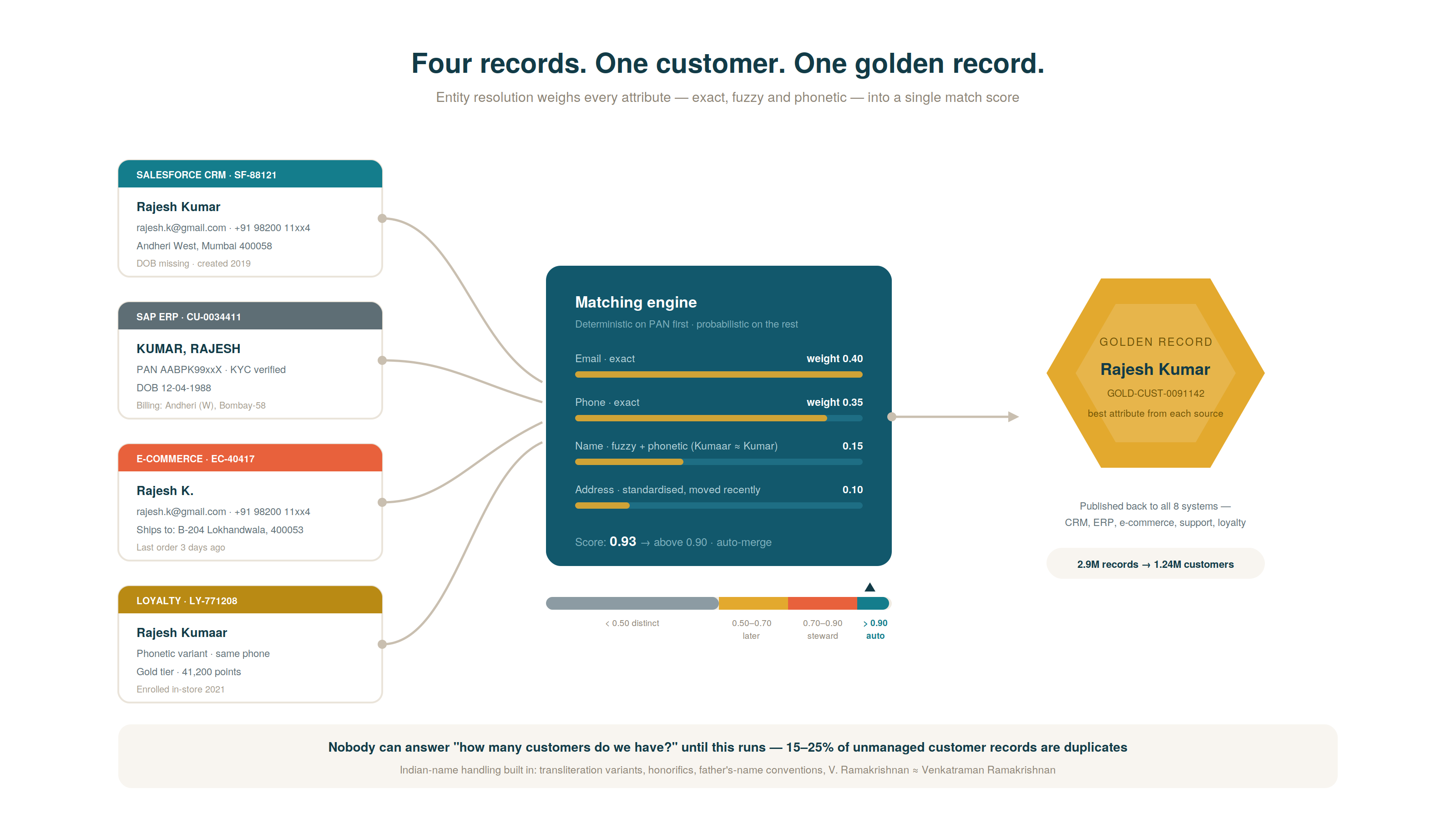
Entity resolution determines whether two records from different systems represent the same real-world entity. It is probabilistic, not binary, because data is rarely perfectly consistent across systems.
Matching attributes for Customer MDM:
| Attribute | Matching Weight | Notes |
| Email address | 0.40 | High weight, unique identifier |
| Phone number | 0.35 | High weight, often more stable than address |
| Full name (exact) | 0.25 | Medium, name spelling inconsistency common |
| Full name (fuzzy) | 0.15 | “Rajesh Kumar” vs “Rajesh K.”, partial match |
| Date of birth | 0.20 | Medium, strong when combined with name |
| Address (exact) | 0.15 | Low, addresses change and formats differ |
| Address (parsed) | 0.10 | Parsed to street, city, PIN for fuzzy match |
| PAN number | 0.45 | Very high, unique government identifier |
| Aadhaar hash | 0.50 | Highest, if available and consented |
The match score thresholds:
| Score | Decision | Action |
| > 0.90 | Auto-match | Records automatically merged |
| 0.70–0.90 | Probable match | Route to data steward for review |
| 0.50–0.70 | Possible match | Flag for scheduled review |
| < 0.50 | Non-match | Records treated as distinct entities |
The golden record construction:
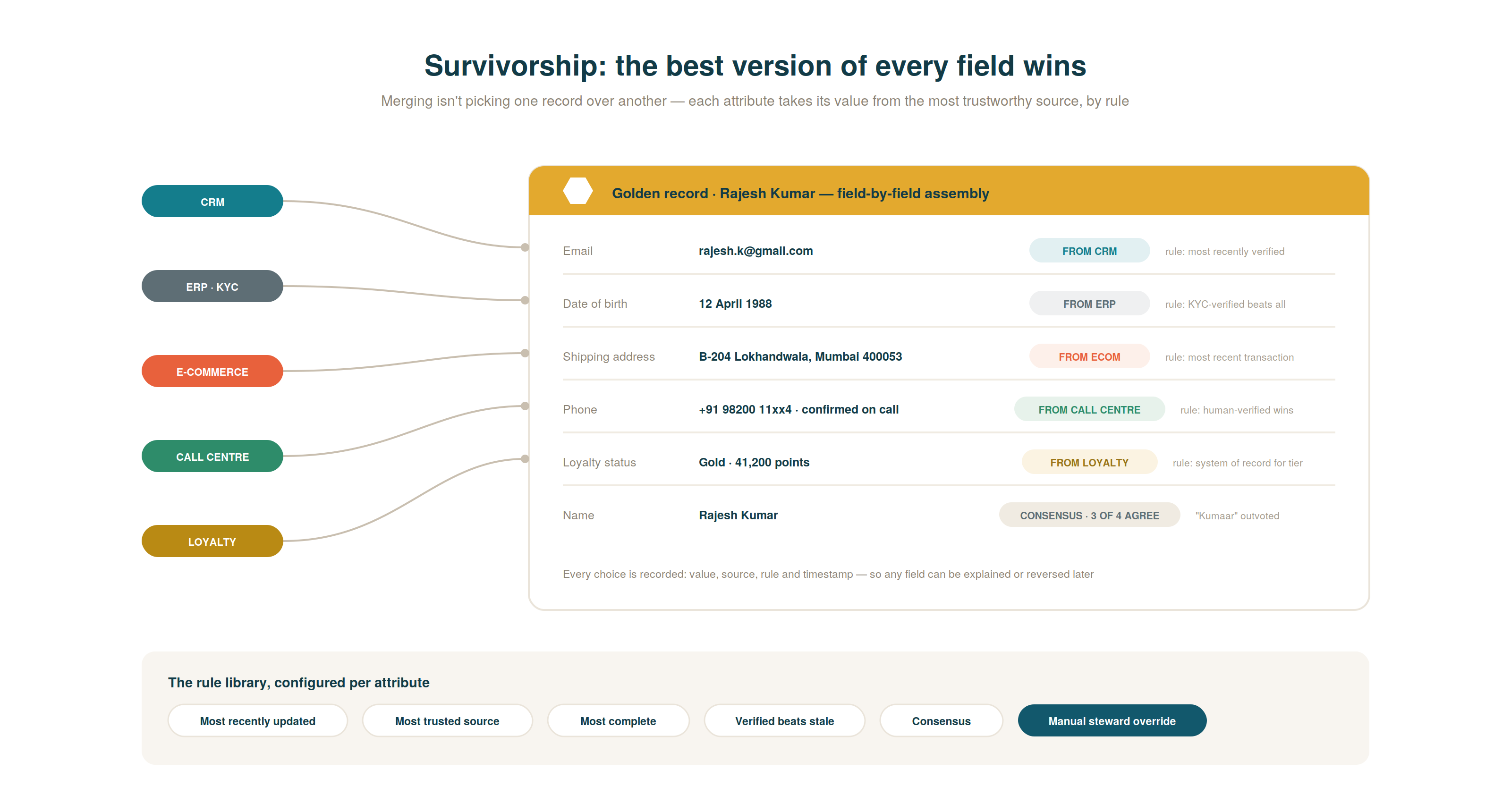
When records from multiple sources are matched and merged, the golden record is constructed by applying survivorship rules, for each attribute, which source system’s value should be used?
| Attribute | Survivorship Rule | Reason |
| Customer name | Most recently updated source | Most current data |
| Email address | CRM preferred | CRM has email validation |
| Phone number | Most frequently confirmed source | Call centre confirmation updates |
| Address | Last verified source + most recent | Verified data preferred |
| Date of birth | ERP preferred | Authoritative for KYC |
| Loyalty tier | Loyalty system | Only system that manages this attribute |
The golden record versioning:
Every change to a golden record is versioned, the complete record state is snapshotted with a timestamp and the reason for the change.
This audit trail answers questions like “what did the customer’s address show on March 15, 2026?”, which is critical for regulatory compliance, legal disputes, and historical reporting accuracy.
Data quality dimensions and rules:
| Dimension | Rule Example | Error Handling |
| Completeness | Mandatory fields (name, email/phone, DOB) must be populated | Flag for steward completion |
| Format validity | Phone in standard format, email with valid domain | Auto-correct if possible, else flag |
| Uniqueness | No two records with the same PAN or Aadhaar | Trigger entity resolution |
| Referential integrity | Customer’s assigned account manager exists in employee master | Flag broken reference |
| Range validity | Date of birth must be in the past, > 18 years | Flag if failed |
| Consistency | If address state is Maharashtra, PIN code must start with 4 | Flag inconsistency |
| Freshness | If last updated > 2 years ago, flag for re-verification | Steward review queue |
The data quality score:
Each golden record has a data quality score, a weighted composite of the quality dimensions that have been evaluated. A customer record with all mandatory fields populated, all formats valid, and a fresh update date might score 95/100.
A record with a missing phone number and an address that has not been updated in 3 years might score 62/100. The data quality score drives prioritisation of steward work, low-scoring records are reviewed first.
The data steward’s work queue:
The stewardship module gives data stewards a structured work queue, prioritised by impact and data quality. Stewards see:
| Queue | Content | Priority |
| Unresolved probable matches | Records with 70–90% match score waiting for human decision | High |
| Low data quality records | Records with quality score below threshold | Medium |
| New exception records | Records that failed validation rules | Medium |
| Stale records | Records not updated in 2+ years | Low |
| Hierarchy exceptions | Subsidiary assigned to wrong parent company | Medium |
The merge/split workflow:
| Action | Description |
| Merge | Steward confirms two records are the same entity, records merged into one golden record |
| Split | Steward determines a golden record actually represents two separate entities, record split |
| Override | Steward overrides the survivorship rule for a specific attribute, golden record updated |
| Enrich | Steward adds verified information not in any source system |
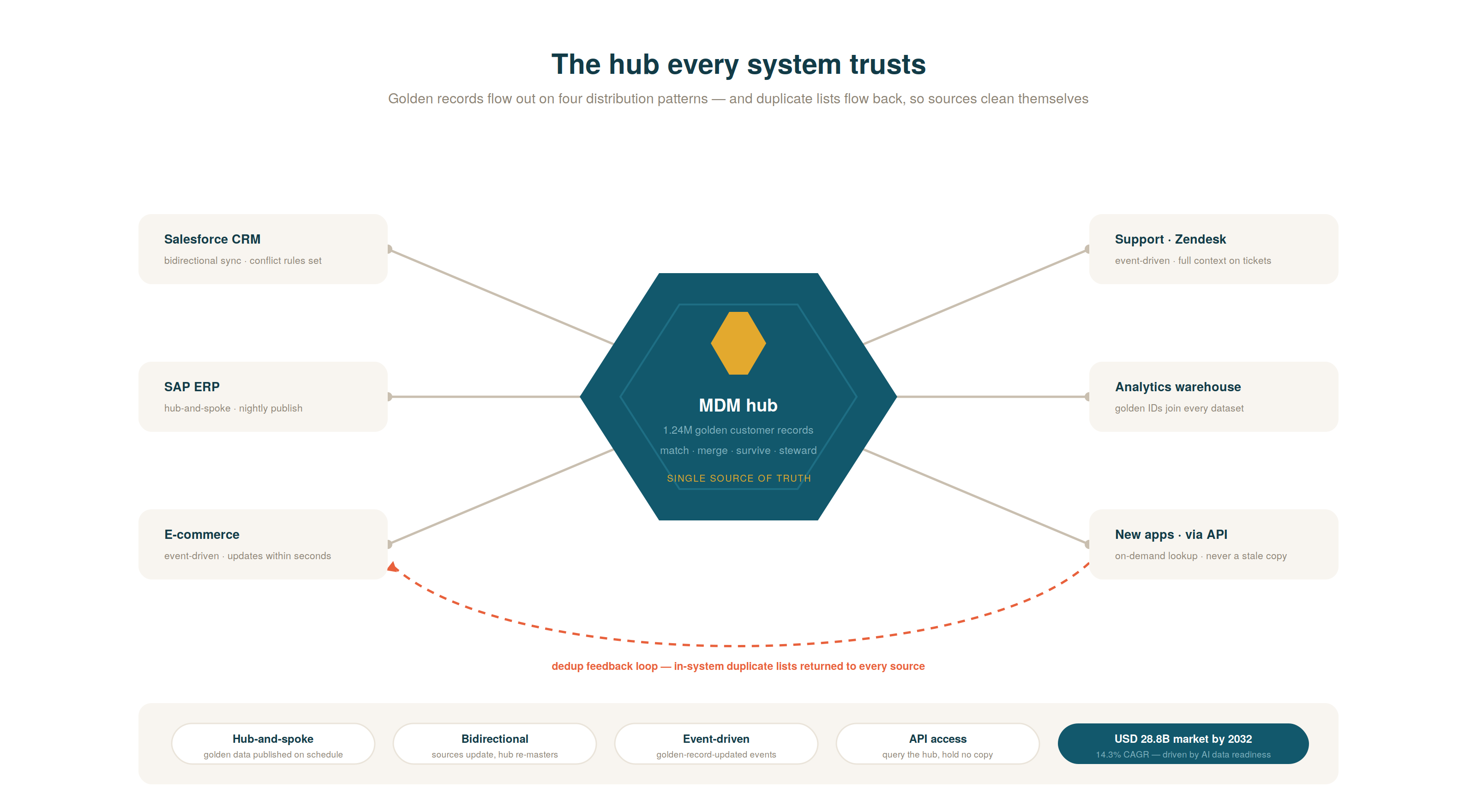
The distribution architecture:
After the golden record is created or updated, the changes must be propagated back to the systems that need them.
| Distribution Pattern | When Used |
| Authoritative hub | All source systems query the MDM for master data, MDM is the single reference |
| Bidirectional sync | MDM updates source systems when the golden record changes |
| Event notification | MDM publishes a change event, each source system subscribes and updates itself |
| API access | Source systems call MDM API to retrieve golden record data on demand |
The deduplication feedback:
When the MDM identifies that two records in the same source system are duplicates, “Customer ID 12345 and Customer ID 67890 in the CRM are the same person”, it notifies the source system’s administrator and provides the merge recommendation.
The source system team can merge the records in their system, preventing the same duplicate from being re-created in the MDM after the next extract.
| Module | Cost Range (USD) | Notes |
| Data ingestion layer (8 source integrations) | $10K – $20K | |
| Probabilistic matching engine | $12K – $22K | Core technical complexity |
| Survivorship rules engine | $6K – $12K | |
| Golden record management + versioning | $8K – $15K | |
| Data quality rules engine | $6K – $12K | |
| Stewardship workflow + work queue | $8K – $15K | |
| Hierarchy management | $5K – $10K | |
| Golden record distribution + API | $6K – $12K | |
| Multi-domain support (Customer + Product + Supplier) | $8K – $15K | Per additional domain |
| Data lineage visualisation | $5K – $10K | |
| Analytics + data quality dashboard | $5K – $10K | |
| AWS + VAPT + Year 1 ops | $5K – $10K | |
| Total | $84K – $163K | Full MDM platform |
EngineerBabu built enterprise systems for Adani Group, managing data across 14 business sectors. CMMI Level 5. Google AI Accelerator 2024 Top 20. Contact: mayank@engineerbabu.com
A golden record is the single authoritative record for a specific entity, a customer, product, supplier, or location, that represents the best available, most accurate version of the truth about that entity, assembled from all available data sources. It is created through a three-step process. First, records from all source systems are ingested and deduplicated, the entity resolution engine identifies which records across different systems represent the same real-world entity. Second, matched records are merged using survivorship rules, for each attribute, the rule determines which source system’s value is most authoritative (most recently verified, most frequently confirmed, most reliable source). Third, the merged record becomes the golden record, versioned, maintained, and distributed back to source systems as the master reference.
Deterministic matching uses exact matches on one or more unique identifiers, two records with the same PAN number are definitively the same entity. Probabilistic matching calculates a match score across multiple attributes, weighting each attribute by its reliability and distinctiveness, to estimate the probability that two records represent the same entity even when no single identifier matches exactly. Deterministic matching is 100% accurate for the records it can match but misses records where the unique identifier is missing or differently formatted. Probabilistic matching achieves much higher coverage but introduces uncertainty, the match score threshold determines the trade-off between false positives (merging records that should be distinct) and false negatives (failing to match records that are the same entity). Production MDM systems typically use a hybrid approach: deterministic matching on available unique identifiers first, probabilistic matching for the remaining unmatched records.
Survivorship rules determine which value “wins” when multiple source systems provide different values for the same attribute on the matched records. Without survivorship rules, the golden record would either take the value from an arbitrary source or require a human decision for every attribute of every merged record. Well-designed survivorship rules encode domain knowledge: the CRM has the most accurate email addresses because it validates email on entry, so the CRM wins for email; the ERP has the most accurate date of birth because it was captured during KYC and verified against PAN, so the ERP wins for DOB; the call centre’s record has the most recently updated address because the agent confirms the address on every call, so it wins for address. Poor survivorship rules, always take the value from system X regardless of attribute, produce golden records that are accurate for some attributes and wrong for others, undermining the entire purpose of MDM.