How to Build a Retail POS System, Omnichannel Sales, Inventory Sync, Loyalty, and Multi-Store Management 2026


Create engaging, high-performance mobile applications tailored to your business needs. We craft future-ready apps that offer smooth user experiences on all devices.
Build robust and scalable websites and CMS platforms that help you manage content effortlessly. Our development ensures a seamless digital presence.
Launch secure, feature-rich online stores with intuitive shopping experiences. We build tailored eCommerce platforms designed for growth.
Design captivating games with immersive gameplay and stunning graphics. From concept to launch, we build engaging experiences that players love.
Enhance your customer relationships with customized Salesforce implementations. Drive growth and efficiency with smarter CRM solutions.
Harness artificial intelligence and machine learning to automate workflows and gain actionable insights. Our AI transforms data into smart decisions.
Accelerate your software delivery lifecycle with continuous integration, delivery, and infrastructure automation to boost efficiency.
The global retail POS software market is projected to reach $116 billion by 2034. The driver is simple, the definition of a retail transaction has changed. A purchase is no longer a simple in-store event.
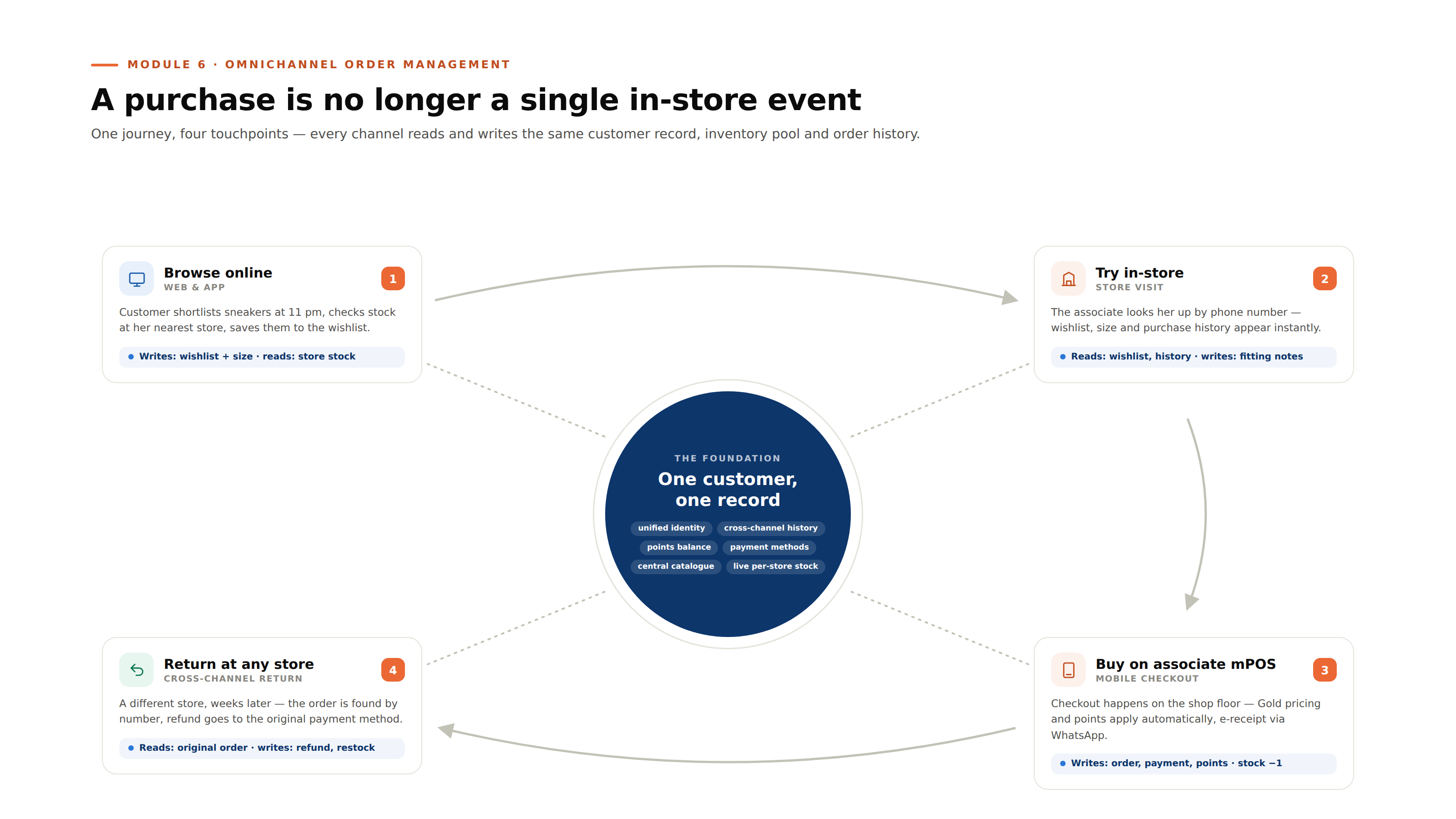
It is an omnichannel interaction where the customer may browse online, try in-store, purchase through a sales associate on a mobile device, and return through a different channel.
The POS system that cannot track this journey, that treats the online order and the in-store visit as separate unrelated events, is failing the fundamental promise of modern retail.
This guide covers how to build a retail POS system that handles the full complexity of modern retail, from the transaction terminal through inventory management, customer profiles, loyalty, multi-store operations, and the omnichannel order management that keeps the customer experience coherent across every touchpoint.
EngineerBabu has built 500+ software products including retail technology, payment systems, and e-commerce platforms for companies across India, the US, and globally. CMMI Level 5. Google AI Accelerator 2024 Top 20. Contact: mayank@engineerbabu.com
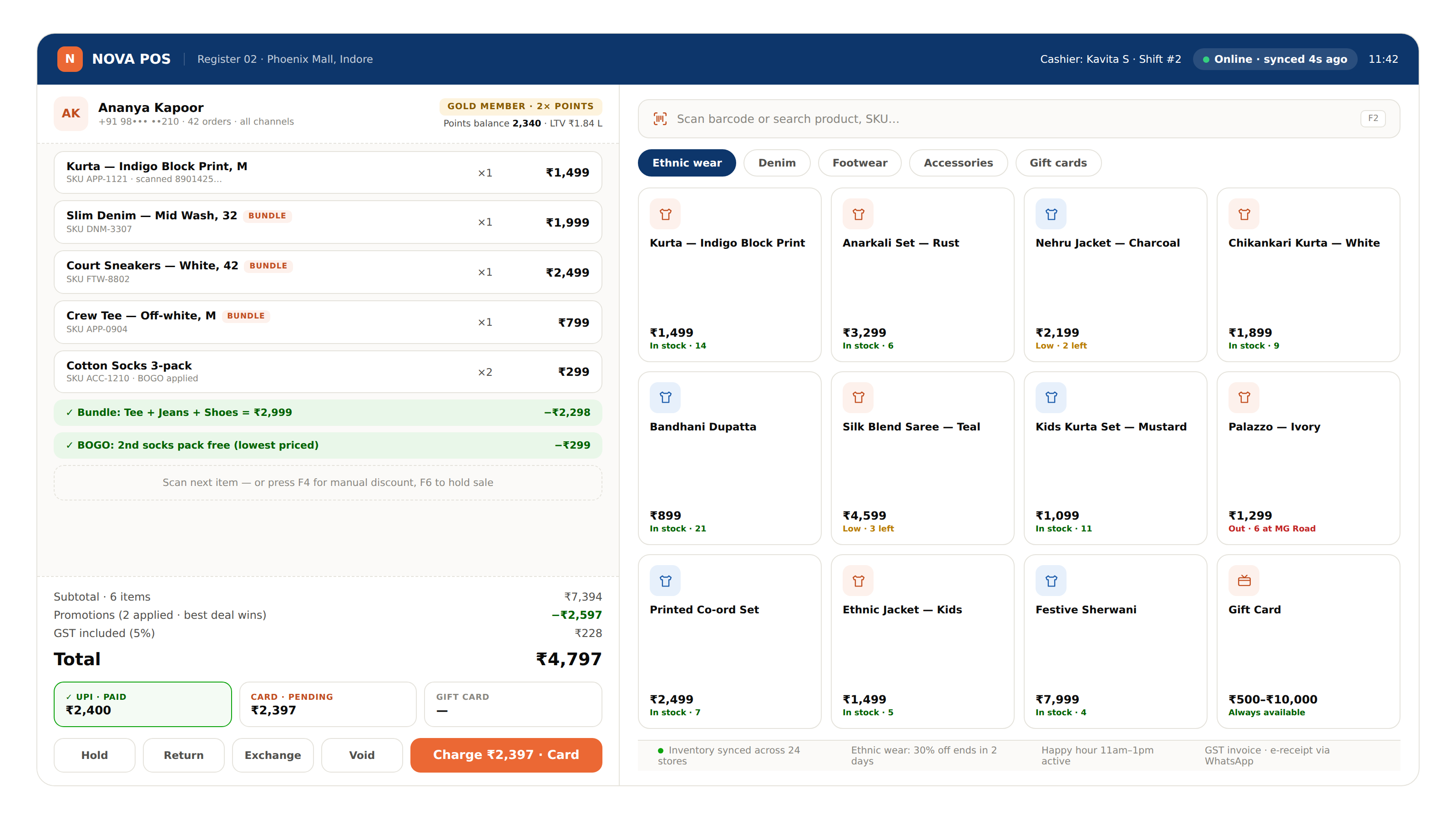
| Function | Module |
| Transaction processing | Sale, return, exchange, discount, tax |
| Payment processing | Cash, card, UPI, wallets, gift cards, credit |
| Product catalogue | SKUs, variants, barcodes, pricing |
| Inventory management | Real-time stock, multi-location, receiving |
| Customer management | Customer profiles, purchase history, preferences |
| Loyalty programme | Points earn and redemption, tier management |
| Promotions engine | Discount rules, bundle offers, BOGO |
| Multi-store management | Centralised product and pricing, store-specific inventory |
| Employee management | Staff accounts, role-based access, sales tracking |
| Reporting | Sales, inventory, staff performance, customer analytics |
| Omnichannel | Online order fulfilment from store, click-and-collect |
| Hardware integration | Barcode scanners, receipt printers, cash drawers, payment terminals |
The transaction flow:
| Step | Action | System |
| Item scan | Barcode scanner reads product | Product lookup by barcode, price retrieved |
| Quantity | Quantity entered or adjusted | Line item added to transaction |
| Discount | Promotion applied or manual discount entered | Discount engine validates and applies |
| Customer lookup | Customer card scanned or phone number entered | Customer profile linked to transaction |
| Payment | Payment method selected and processed | Payment gateway integration |
| Receipt | Digital and/or printed receipt | Email, WhatsApp, or printed |
| Transaction complete | Record saved, inventory decremented | Real-time inventory update |
Transaction types:
| Type | Description |
| Sale | Standard purchase, most common |
| Return | Customer returns item, refund processed |
| Exchange | Item returned and replaced, net transaction |
| Hold / Layaway | Transaction held pending payment completion |
| Quote | Price estimate without payment |
| Void | Transaction cancelled before completion |
| Refund | Cash or credit returned to customer |
Split payment:
A customer paying with a combination of gift card and credit card, or cash and UPI, must be handled in a single transaction.
The split payment module accepts multiple payment methods in one transaction, tracks each payment amount, and produces a receipt showing all payment methods used.
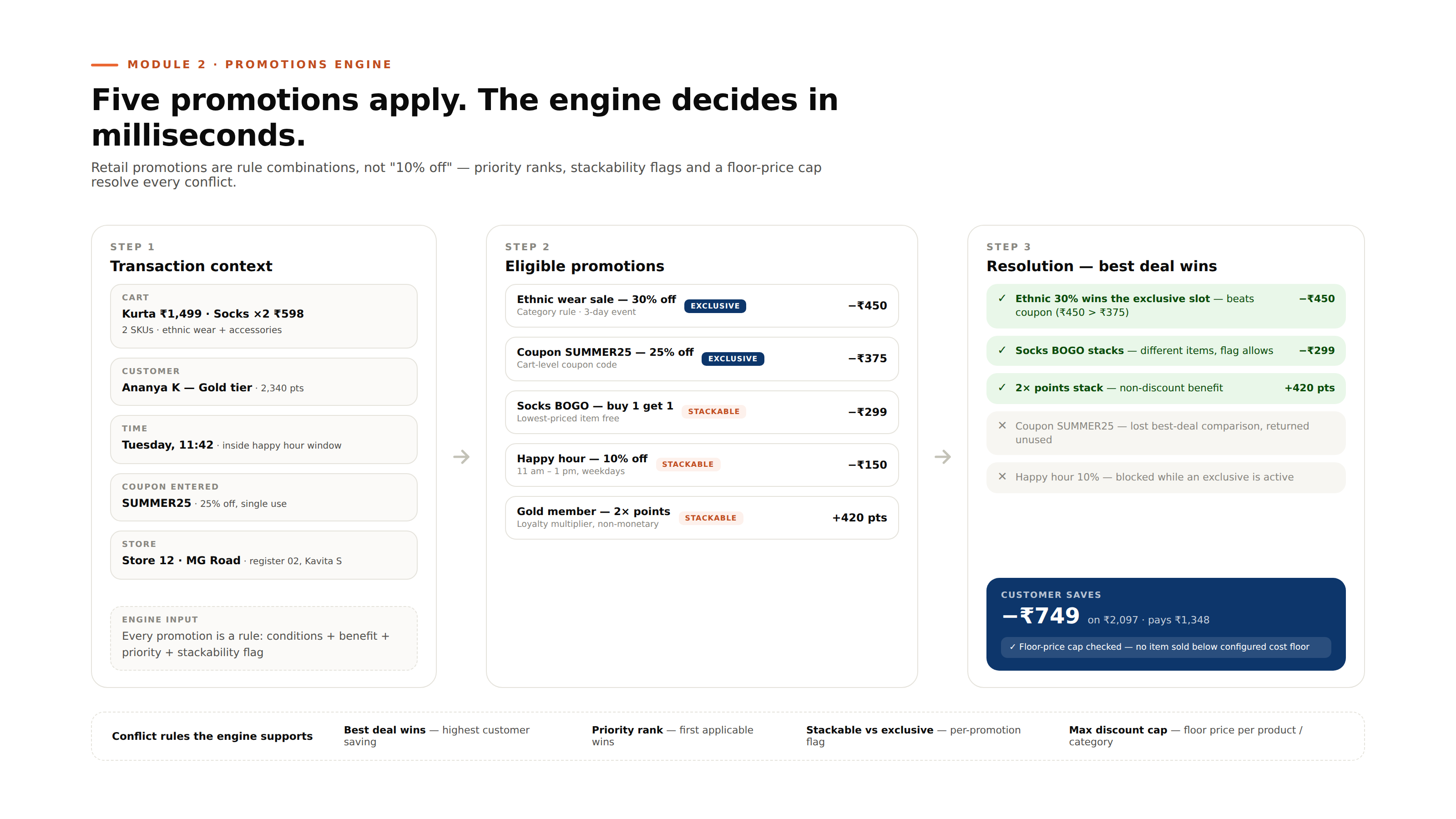
The promotions complexity in retail:
Retail promotions in 2026 are not simple “10% off” rules. They are combinations of conditions and benefits that require a dedicated rules engine:
| Promotion Type | Example |
| Percentage discount | 20% off all footwear |
| Fixed amount off | ₹500 off on purchase above ₹3,000 |
| BOGO | Buy 2, get 1 free, lowest priced item free |
| Bundle pricing | T-shirt + jeans + shoes = ₹2,999 |
| Volume discount | Buy 3 at ₹299 each, buy 6 at ₹249 each |
| Loyalty redemption | 500 points = ₹50 off |
| Staff discount | 15% off for employees |
| Happy hour | 10% off between 11am and 1pm |
| Category specific | All ethnic wear, 30% off for 3 days |
| Coupon code | SUMMER25 = 25% off |
| First purchase | 10% off on first purchase for new customers |
The conflict resolution logic:
When multiple promotions are simultaneously applicable to a transaction, the engine must decide which to apply.
Common rules: best deal wins (apply whichever promotion gives the customer the highest saving), first promotion wins (apply the first applicable promotion and stop), or stackable vs exclusive (some promotions can stack, others cannot).
Real-time inventory at the SKU and location level:
Every sale decrements inventory in real time. Every receiving increments it. Every inter-store transfer moves inventory from one location to another. The system maintains accurate counts at the SKU-variant-location level at all times.
Multi-store inventory visibility:
A store associate who cannot fulfil a customer’s request from current store stock can check availability at other stores and offer:
Ship to customer from another store. Customer collects from another store (click-and-collect from alternate location). Transfer stock from another store to this store, with estimated arrival date.
Inventory replenishment:
| Trigger Type | Threshold | Action |
| Reorder point | Stock falls below minimum quantity | Suggested purchase order to head office or supplier |
| Days-of-cover | Less than 7 days of stock at current sales rate | Alert to store manager |
| Zero stock | Last unit sold | Immediate alert, high priority reorder |
| Seasonal build | Approaching seasonal peak period | Proactive stock allocation |
The customer profile:
| Field | Details |
| Customer ID | Unique identifier, linked to loyalty card or phone number |
| Name | |
| Contact | Phone, email |
| Purchase history | All transactions across all stores and channels |
| Preferences | Category preferences inferred from purchase history |
| Loyalty tier | Bronze, Silver, Gold, Platinum |
| Points balance | Current redeemable points |
| Lifetime value | Total spend since customer acquisition |
| Last visit date | Date and store of last purchase |
| Birthday | For birthday offer personalisation |
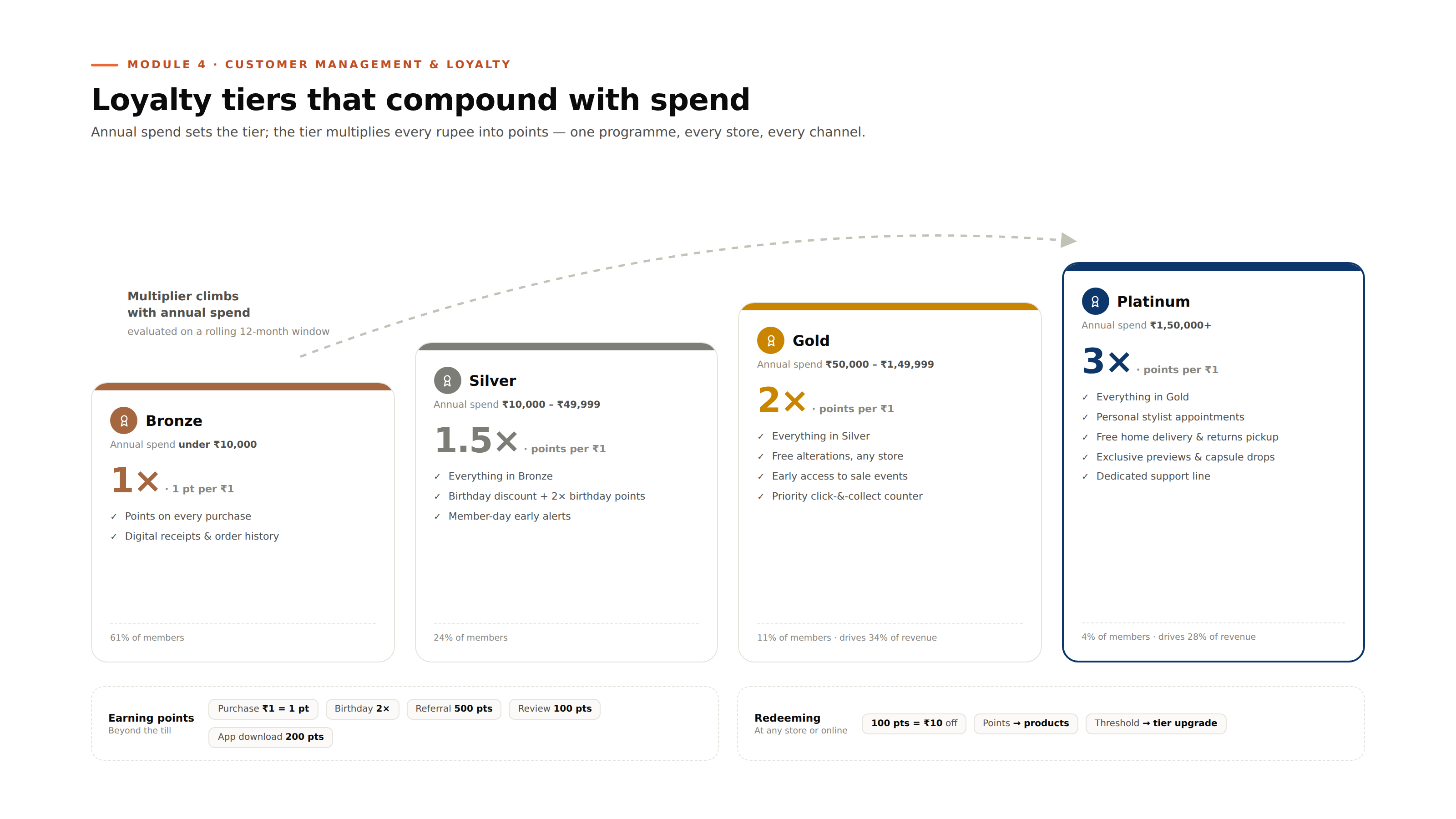
The loyalty programme engine:
| Activity | Points Earned |
| Purchase | ₹1 spent = 1 point |
| Birthday purchase | 2× points multiplier |
| Refer a friend | 500 points when friend makes first purchase |
| Product review | 100 points |
| Social share | 50 points |
| App download | 200 points |
Points redemption:
| Redemption | Rate |
| Discount on purchase | 100 points = ₹10 |
| Free product | Points exchangeable for specific products |
| Tier upgrade | Reaching tier threshold unlocks benefits |
Tier benefits:
| Tier | Threshold (annual spend) | Benefits |
| Bronze | < ₹10,000 | 1 point per ₹1 |
| Silver | ₹10,000–₹49,999 | 1.5 points per ₹1 + birthday discount |
| Gold | ₹50,000–₹1,49,999 | 2 points per ₹1 + free alterations + early access |
| Platinum | ₹1,50,000+ | 3 points per ₹1 + personal stylist + home delivery |
The centralised management layer:
For a retail chain with 20 to 200 stores, the head office needs centralised control over:
| Function | Head Office Control |
| Product catalogue | Master catalogue maintained centrally, stores cannot add products |
| Pricing | Base price set centrally, store managers can apply local discounts within limits |
| Promotions | All promotions designed and scheduled centrally |
| Loyalty | Single loyalty programme across all stores |
| Reporting | Consolidated reporting across all stores |
| Stock transfers | Centralised inter-store transfer approval for large movements |
| Staff management | Staff accounts created centrally, store-level role assignment |
Store-level autonomy:
| Function | Store-Level Control |
| Local promotions | Within central limits, store manager can run local offers |
| Staff scheduling | Store manager manages shifts |
| Local inventory | Store manager places replenishment orders |
| Local customer service | Returns and exchanges handled locally |
The franchise model:
For franchise operations where stores are owned by franchisees rather than the central company, the platform adds a franchise management layer, franchise fees calculated on net sales, royalty reporting, and brand compliance monitoring (are the franchisees following pricing and promotion guidelines?).
Click-and-collect:
A customer places an order online and collects from their nearest store. The POS system receives the online order, reserves the inventory from the store’s stock, and generates a collection notification when the order is ready.
At collection, the customer presents their order reference, the associate verifies and releases the order, and the transaction is closed.
Ship-from-store:
When a customer’s nearest store does not have a product in stock but another store does, the online order can be routed to the store with stock. The store picks and packs the order and hands it to a courier for direct delivery to the customer.
The POS guides the store associate through the ship-from-store workflow, pick confirmation, packing, courier handoff, and tracking number entry.
Return to any store:
A customer who purchased online can return the item to any physical store. The associate processes the return by looking up the online order number, verifying the item, and processing the refund to the original payment method, regardless of whether the original purchase was online or at a different store.
| Module | Cost Range (USD) | Notes |
| Transaction processing engine | $8K – $15K | All transaction types |
| Promotions engine | $8K – $15K | Complex rule combinations |
| Payment gateway integration | $5K – $10K | UPI, card, cash, wallet, gift card |
| Product catalogue + barcode management | $5K – $10K | |
| Inventory management + multi-location | $8K – $15K | Real-time, multi-store |
| Customer management + loyalty engine | $8K – $15K | Points, tiers, redemption |
| Multi-store centralised management | $6K – $12K | Head office control + store autonomy |
| Employee management + role-based access | $4K – $8K | |
| Omnichannel order management | $8K – $15K | Click-and-collect, ship-from-store |
| POS hardware integration | $5K – $10K | Zebra scanner, receipt printer, cash drawer |
| Reporting + analytics | $5K – $10K | Sales, inventory, customer analytics |
| AWS + VAPT + Year 1 ops | $5K – $10K | |
| Total | $75K – $145K | Full retail POS system |
Contact: mayank@engineerbabu.com
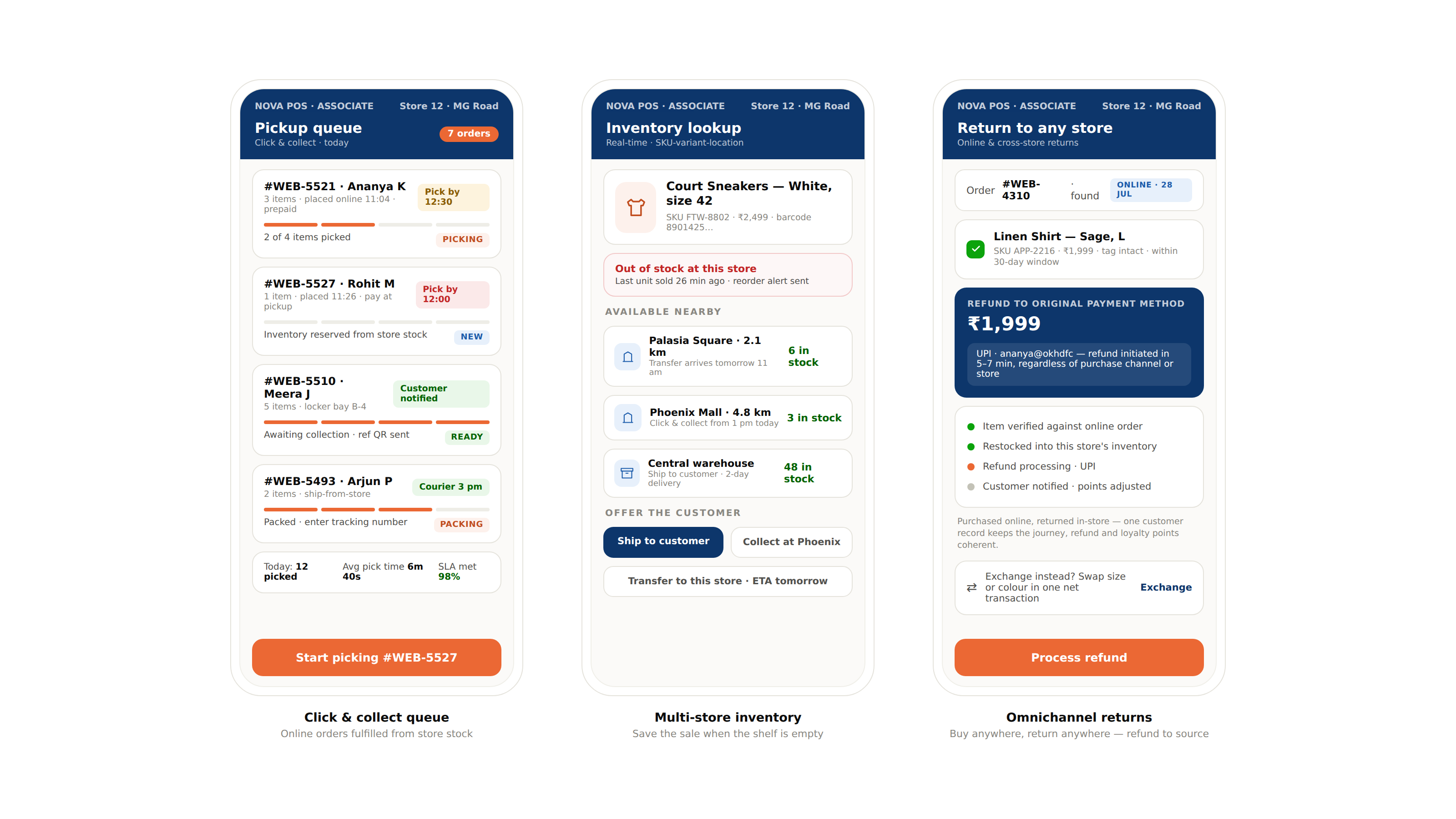
Omnichannel retail means the customer’s experience is seamless regardless of which channel they use, online, in-store, or mobile, and regardless of which specific store they visit. For a POS system, this requires: a unified customer identity that links the same customer across online purchases, in-store transactions, and loyalty programme activity; unified inventory visibility that shows real-time stock across all stores and the online channel simultaneously; order management that can fulfil an online order from a store’s inventory (ship-from-store) or route a store’s customer request to online inventory (reserve-and-collect); and a unified returns process where a customer can return an online purchase to any physical store. The technical foundation is a centralised product catalogue, a centralised inventory database with per-location stock, a centralised customer database with cross-channel transaction history, and a synchronisation architecture that keeps all of these current in real time across every channel and every store.
A retail promotions engine handles conflicting promotions through a priority hierarchy and stackability rules. Every promotion is configured with a priority rank and a stackability flag. When multiple promotions are applicable to the same transaction, the engine evaluates them in priority order. Promotions marked as exclusive, a 30% sale event, a special member day, override all other promotions and prevent any additional discounts from being applied. Promotions marked as stackable, a loyalty points multiplier on top of a sale price, are applied in sequence after the exclusive promotions are resolved. The final discount amount shown to the customer is the result of all applicable, non-conflicting promotions applied in their defined order. The engine also applies a maximum discount cap, preventing a combination of promotions from reducing the transaction value below the cost of goods, which is configured as a floor price per product or per category.
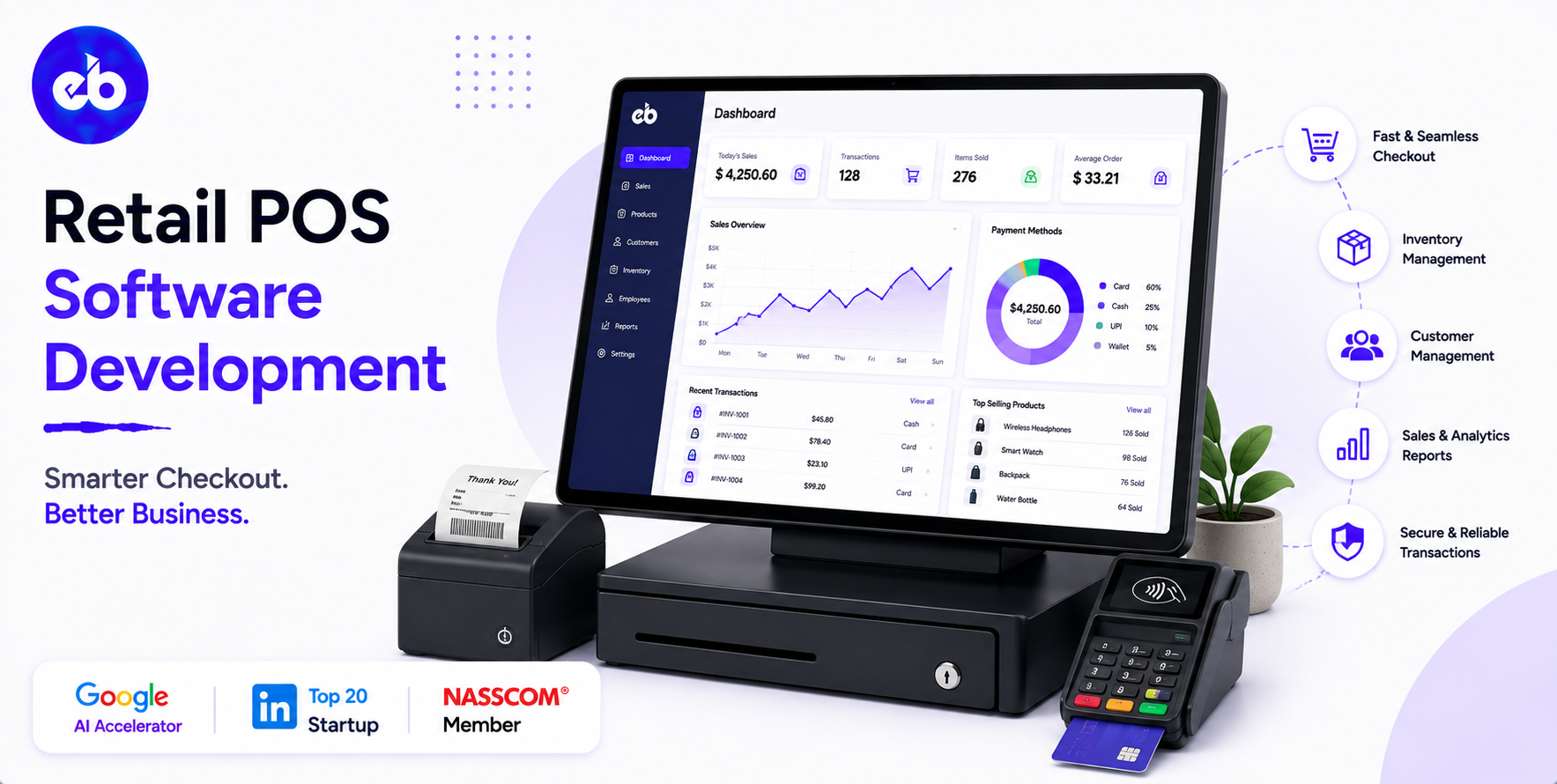
A retail POS system typically integrates with four categories of hardware. Barcode scanners, USB or Bluetooth scanners read product barcodes and pass the barcode string to the POS application through the device’s keyboard input mode, requiring no special integration, just a text input field that accepts barcode strings. Receipt printers, thermal receipt printers communicate via USB, Bluetooth, or network using the ESC/POS protocol, a widely supported receipt printing standard that the POS application speaks to generate and print receipts. Cash drawers, typically connected to the receipt printer and triggered by the printer’s cash drawer kick command when a cash transaction is completed. Payment terminals, card payment terminals (Ingenico, Verifone, PAX) integrate with the POS application through the terminal’s SDK, the POS sends the transaction amount, the customer taps or inserts their card, and the terminal returns an approval or decline code. In India, UPI payment is handled through UPI QR codes generated by the payment gateway, displayed on the customer-facing display or printed on the receipt.