AI in Supply Chain Software Development


Create engaging, high-performance mobile applications tailored to your business needs. We craft future-ready apps that offer smooth user experiences on all devices.
Build robust and scalable websites and CMS platforms that help you manage content effortlessly. Our development ensures a seamless digital presence.
Launch secure, feature-rich online stores with intuitive shopping experiences. We build tailored eCommerce platforms designed for growth.
Design captivating games with immersive gameplay and stunning graphics. From concept to launch, we build engaging experiences that players love.
Enhance your customer relationships with customized Salesforce implementations. Drive growth and efficiency with smarter CRM solutions.
Harness artificial intelligence and machine learning to automate workflows and gain actionable insights. Our AI transforms data into smart decisions.
Accelerate your software delivery lifecycle with continuous integration, delivery, and infrastructure automation to boost efficiency.
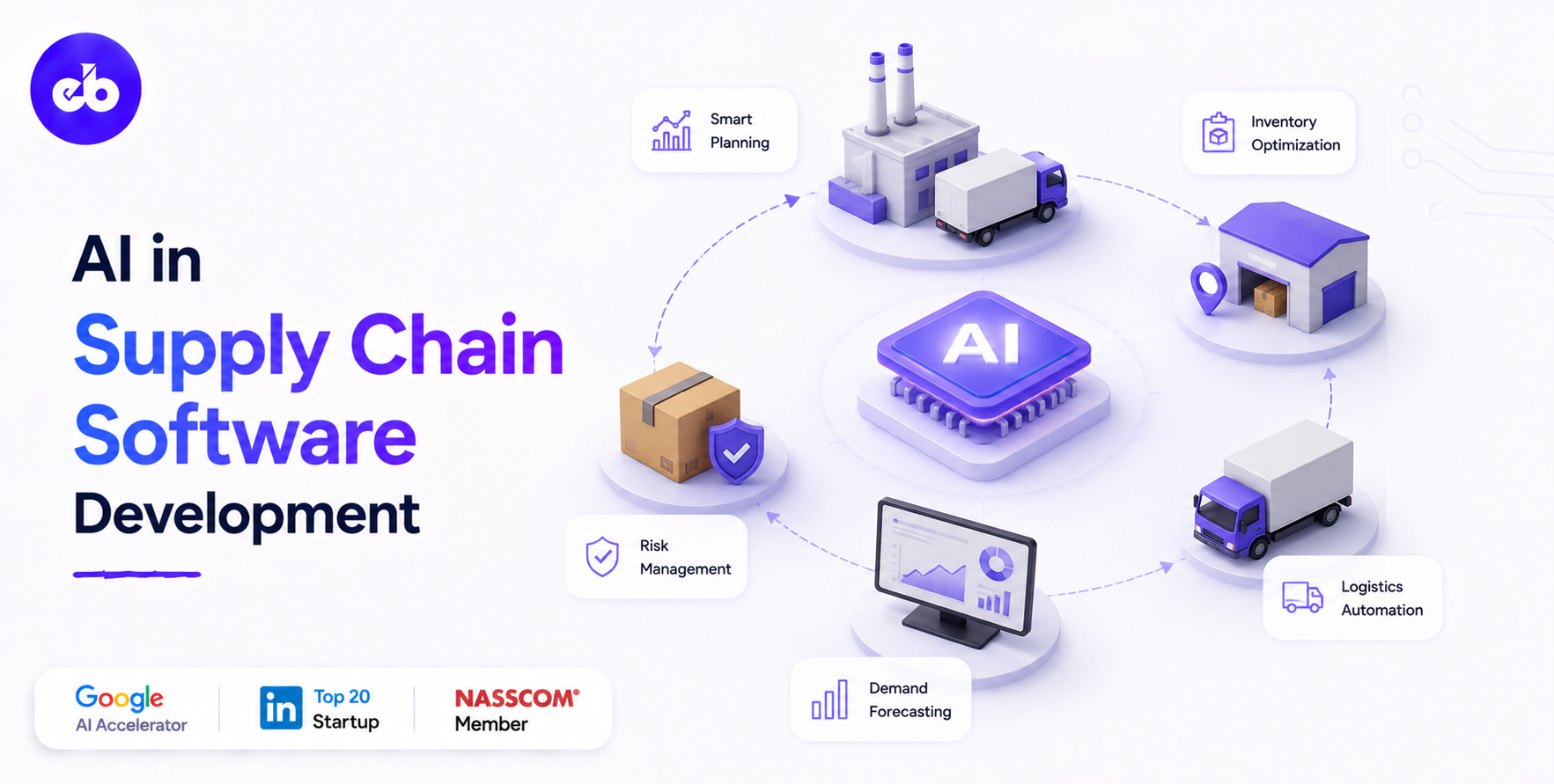
Simba Beer is India’s No. 1 premium craft beer. Founded in 2016 in Chhattisgarh. Today distributed across 15+ states. Multiple SKUs, lager, stout, wit, sour, each with different demand profiles, different shelf lives, different production lead times.
The supply chain problem was acute: demand for craft beer is seasonal (festival season spikes, summer peaks), geographically concentrated (metro markets absorb 70% of volume), and sensitive to temperature (spoilage risk on slow-moving stock). The traditional approach, weekly sales reports fed into spreadsheet forecasts, produced either stockouts during high-demand periods or wastage from overstocking during low-demand periods. Either outcome was directly expensive.
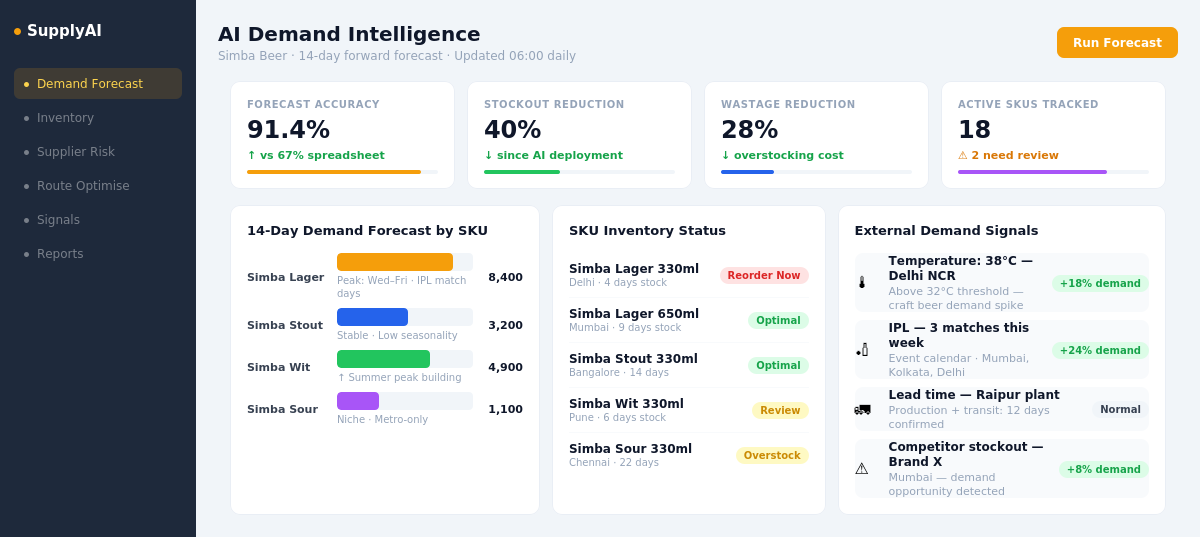
EngineerBabu built an AI inventory intelligence system for Simba. The system ingested point-of-sale data from distributor networks, weather data (temperature directly correlates with craft beer demand), event calendars (IPL match days, local festivals, corporate events), and historical sales patterns by geography and SKU. The demand forecasting model produced SKU-level, geography-level inventory recommendations 14 days forward, the horizon required for production planning.
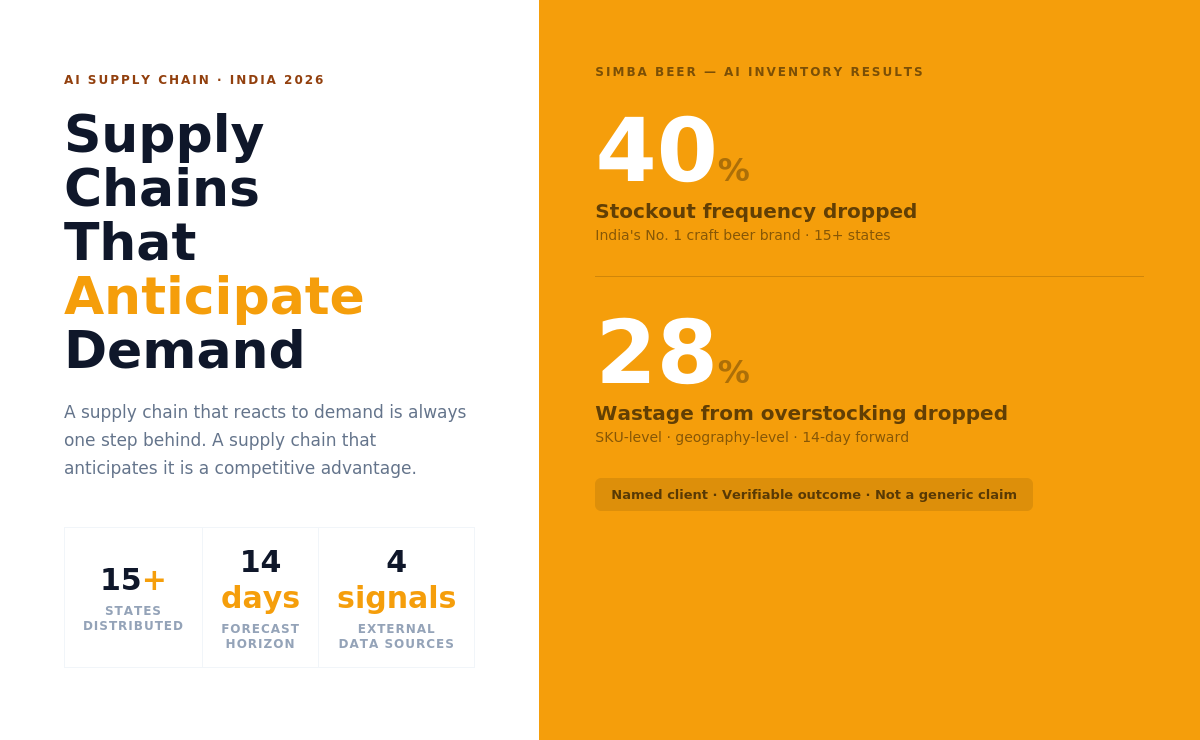
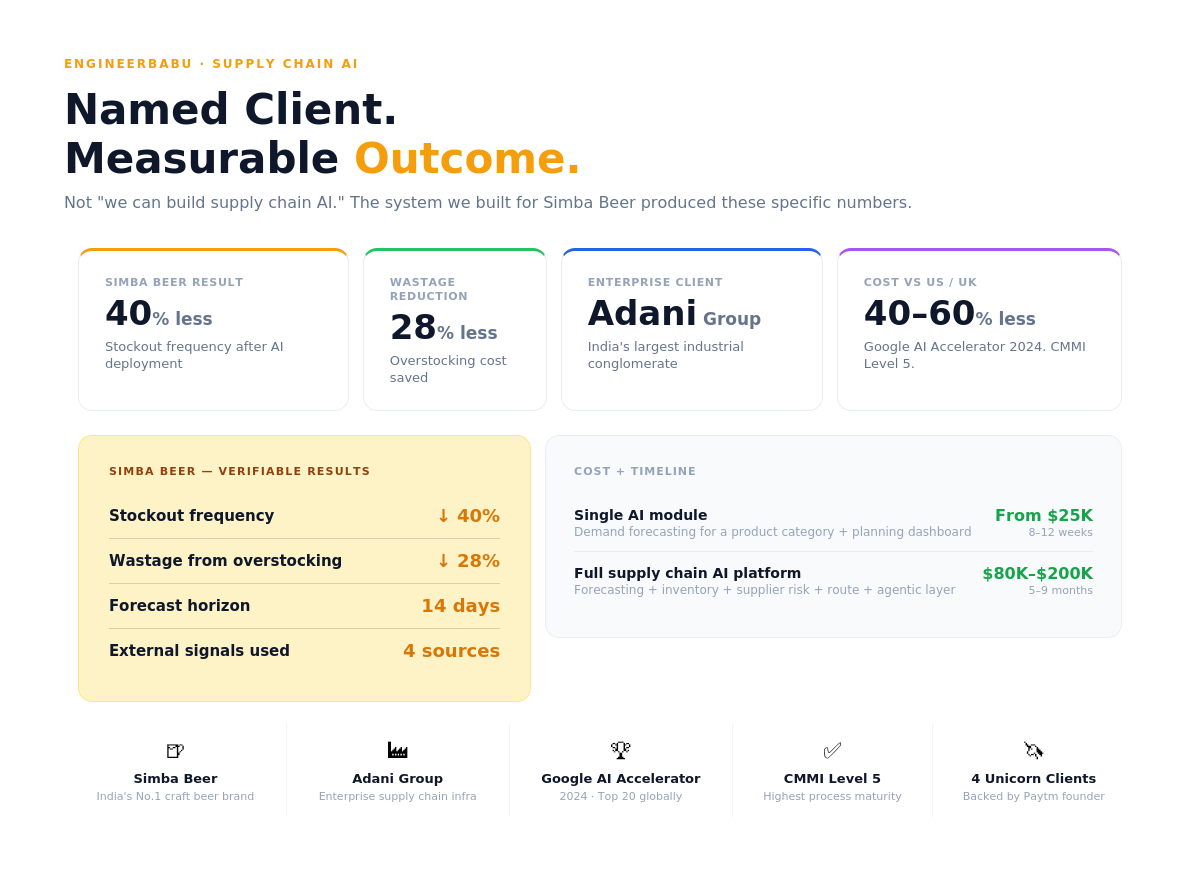
The result: stockout frequency dropped 40%. Wastage from overstocking dropped 28%. The production planning team stopped making decisions from last week’s sales reports and started making them from the model’s forward projections.
This is the case study that makes the AI in supply chain software development claim specific. Not “we can build AI in supply chain software development.” The system we built for Simba Beer produced measurable outcomes on real inventory.
Google AI Accelerator 2024, top 20 globally. Adani Group (one of India’s largest industrial conglomerates) as a client. The team builds production AI for complex supply chains.
This guide covers AI in supply chain software development and what building it actually requires.
Email mayank@engineerbabu.com to scope your supply chain AI build.
Supply chain AI operates under constraints that distinguish it from fintech or healthcare AI:
Traditional demand forecasting uses historical sales data and simple statistical methods (moving averages, ARIMA). These methods work acceptably for stable, predictable demand patterns. They fail for:
AI demand forecasting models:
Inventory is frozen capital. Too much: working capital inefficiency, storage cost, spoilage risk. Too little: stockouts, lost sales, customer attrition.
AI inventory optimisation determines the optimal stock level at every node in the supply chain:
The Simba Beer application: the inventory model recommended production lot sizes and distribution split by geography 14 days forward. Metro warehouse allocations were ML-optimised based on local event calendars and temperature forecasts. The model’s 14-day output was fed directly into the production planning team’s weekly planning meeting.
Supply chain disruptions, the COVID port shutdowns, the Red Sea container shipping disruptions, semiconductor shortages have made supplier risk visibility a board-level concern.
AI supplier risk systems monitor supplier health signals continuously:
Transportation cost is typically 5–10% of supply chain total cost. AI route optimisation reduces it:
A supply chain digital twin is a real-time computational model of the physical supply chain, every node, every link, every inventory position, that enables scenario simulation before committing to physical action.
What it enables: “What happens to our distribution network if our primary warehouse is offline for 5 days?” Simulation produces the answer in minutes rather than the operations team working through scenarios manually in spreadsheets. The digital twin runs the scenario, predicts the cascade effects, and recommends the response.
The Adani Group connection: large-scale industrial supply chain management at Adani Group’s scale requires the kind of scenario planning that digital twin infrastructure enables. The team’s DevOps and cloud engineering work for Adani Group is the enterprise infrastructure foundation that digital twin systems require.
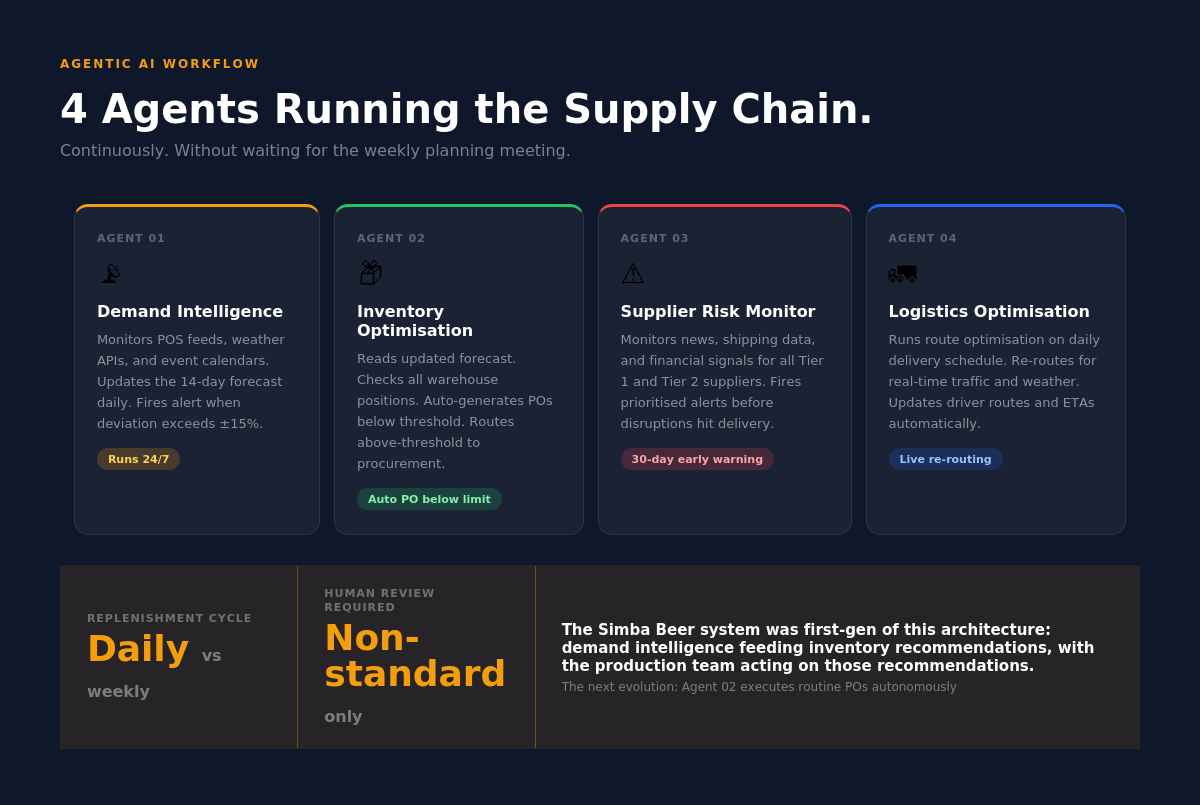
Gartner identifies agentic AI as one of the top supply chain technology trends for 2026. IBM’s February 2026 framing explicitly places multi-agent systems across demand forecasting, inventory, production, and logistics as the production pattern for forward-looking supply chains.
In practice at Simba Beer: the team’s AI inventory system was a first-generation version of this architecture, demand intelligence feeding inventory recommendations, with the production planning team acting on those recommendations. The next evolution is the agentic layer where Agent 2 generates and executes routine purchase orders autonomously, reserving human decision-making for non-standard situations.
Frameworks the team uses: CrewAI for multi-agent supply chain workflows, LangGraph for stateful agent orchestration, Python + OR-Tools for logistics optimisation, Apache Kafka for the real-time data streams that feed the agents.
AI in supply chain software development starts from $25,000 for a single AI module, demand forecasting model for a defined product category, integrated with the client’s ERP data, with a planning dashboard.
Full supply chain AI platform, demand forecasting + inventory optimisation + supplier risk + route optimisation + agentic workflow layer: $80,000–$200,000 depending on SKU count, supply chain complexity, and number of nodes.
Timeline: Single forecasting model: 8–12 weeks. Full multi-module platform: 5–9 months.
Simba Beer proof. Adani Group enterprise infrastructure. Google AI Accelerator 2024. CMMI Level 5. Full IP ownership. 40–60% lower cost than US/UK equivalent.
Simba Beer, named client, measurable outcome. 40% stockout reduction, 28% wastage reduction. Adani Group enterprise supply chain infrastructure. Google AI Accelerator 2024 production ML. Mayank leads personally. Full IP ownership.
India’s fastest-growing craft beer brand needed an inventory system smart enough to anticipate demand before the summer peak, not react to it during. The AI model built for Simba Beer did that with measurable, auditable results.
A supply chain that reacts to demand is always one step behind. A supply chain that anticipates it is a competitive advantage.
30 minutes. Product category, SKU count, current forecasting process, desired outcome. Concrete proposal within a week.
Mayank Pratap | Co-founder, EngineerBabu | engineerbabu.com Simba Beer AI Inventory · Adani Group · Google AI Accelerator 2024 · CMMI Level 5 · 4 Unicorn Clients · 75 YC Selections · Backed by Vijay Shekhar Sharma
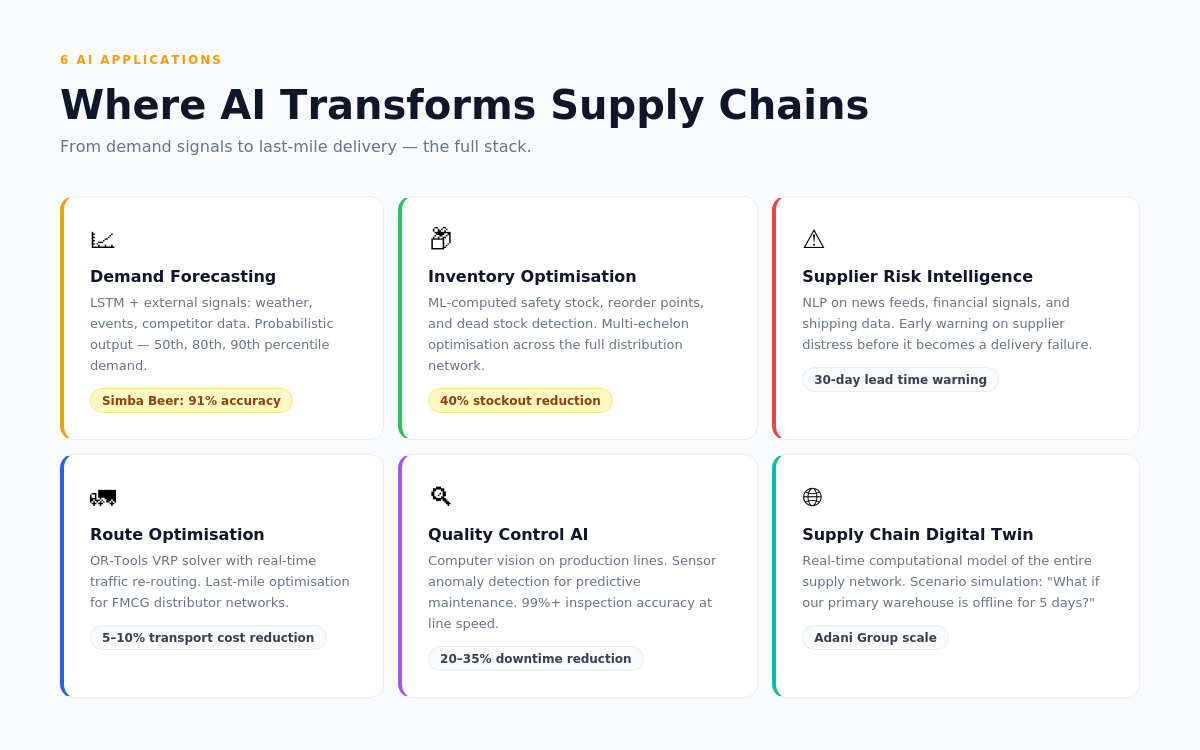
Building ML-powered systems that improve supply chain performance: demand forecasting with external signals, inventory optimisation across distribution networks, supplier risk intelligence, route optimisation, and quality control AI. Production supply chain AI operates on real-time data streams, integrates with ERP/WMS/TMS systems, and produces actionable recommendations that replace manual planning processes.
Demand forecasting produces 4–12 week projections using historical data and external signals. Demand sensing uses early period signals (first 2–5 days of POS data) to adjust the near-term forecast in real time. FMCG companies with short shelf-life products use demand sensing to reduce the gap between the forecast and actual sales within the planning horizon.
Depends on the product category. For FMCG: weather data (temperature for beverages, rainfall for outdoor products), event calendars (festivals, sports events, holidays), competitor stock availability, and promotional calendars. For industrial: commodity prices, construction permit data, economic indicators. The Simba Beer model used temperature and event data as primary external signals.
Multi-agent systems where specialised agents operate continuously: demand intelligence agent (updates forecast daily from real-time signals), inventory optimisation agent (generates and executes routine purchase orders below approval threshold), supplier risk monitoring agent (monitors news and financial signals for all suppliers, fires alerts), logistics optimisation agent (routes vehicles, re-routes for disruptions, updates ETAs). Human oversight retained for non-standard situations and decisions above defined value thresholds.
Simba Beer, India’s No. 1 craft beer brand with 40% stockout reduction and 28% wastage reduction as verifiable outcomes. Adani Group enterprise supply chain infrastructure. Google AI Accelerator 2024. These are named, public case studies with measurable results, not generic agency claims.