How to Build a Job Portal Like LinkedIn in 2026


Create engaging, high-performance mobile applications tailored to your business needs. We craft future-ready apps that offer smooth user experiences on all devices.
Build robust and scalable websites and CMS platforms that help you manage content effortlessly. Our development ensures a seamless digital presence.
Launch secure, feature-rich online stores with intuitive shopping experiences. We build tailored eCommerce platforms designed for growth.
Design captivating games with immersive gameplay and stunning graphics. From concept to launch, we build engaging experiences that players love.
Enhance your customer relationships with customized Salesforce implementations. Drive growth and efficiency with smarter CRM solutions.
Harness artificial intelligence and machine learning to automate workflows and gain actionable insights. Our AI transforms data into smart decisions.
Accelerate your software delivery lifecycle with continuous integration, delivery, and infrastructure automation to boost efficiency.
Hire app developers ready to turn your ideas into sleek, high-performing mobile apps for any platform.
Bring in frontend pros who craft smooth, beautiful, and user-friendly interfaces that your visitors will love.
Get backend developers who build fast, secure, and reliable systems to keep everything running behind the scenes.
Hire eCommerce developers who build secure, scalable online stores designed to offer seamless shopping and grow your sales.
Get dedicated developers committed to your projects, delivering consistent quality and speed as an extension of your team.
Here’s a pattern the team has seen across multiple recruitment platform projects.
A founder builds a job portal. Clean interface. Easy posting. Resume upload works. Search works. They launch.
Six months later, the platform has 3,000 job postings and 15,000 candidate profiles. The employers are getting 200 applications per posting. 180 of them are irrelevant – the wrong location, the wrong seniority, the wrong skills. The recruiters stop using the platform. The candidates stop getting responses. The platform dies.
The problem was never the UI. It was the matching.
A job portal is not a job board. A job board shows listings. A job portal creates matches. The architectural difference between those two products is enormous – and most job portal development guides describe a job board.
I co-founded two companies that live in this space.
EngineerBabu – 14 years, 500+ product builds, has built job portal and marketplace platforms across multiple industries including multiple recruitment platforms for GCCs, staffing companies, and HR tech startups.
Supersourcing – a B2B IT staffing platform the team built and scaled from scratch. LinkedIn Top 20 Startup India – twice. Google AI Accelerator 2024. Backed by Vijay Shekhar Sharma. Currently serving 04 unicorn clients, 132 YC-backed startups, 17 Fortune 500 companies. Supersourcing is not a case study from a conference deck. It’s the team’s own product, built by the same engineers who will build yours.
This guide is written from that experience: knowing what it takes to build a recruitment platform that actually matches.
If you’re ready to build and want the team that built Supersourcing – email mayank@engineerbabu.com.
The online recruitment platform market was valued at $64.66 billion in 2026, projected to reach $132 billion by 2032 at a CAGR of 12.5%. Over 1.6 billion people worldwide use online job platforms.
87% of large enterprises now embed at least one AI module into recruitment workflows. AI platforms can parse résumés, rank applicants, and conduct first-round interviews. LinkedIn’s machine learning-based suggestions lift recruiter response rates by 35%.
But here’s what those numbers obscure: the job portal market is simultaneously massive and dominated. LinkedIn has 900 million members. Indeed processes 250 million unique visitors monthly. Naukri.com owns the Indian market for general employment. Any new job portal trying to compete directly with these on general employment is attempting to build a better Google.
The winning formula for new recruitment platforms in 2026 is niche + matching depth.
The niches that work: specific industries (tech, healthcare, finance), specific geographies (Tier 2/3 cities in India, specific Gulf markets), specific seniority levels (executive search, entry-level), specific employment types (GCC talent, contract/freelance, remote-only). LinkedIn and Indeed serve general employment well. They serve niche segments poorly.
The matching depth that wins: a platform that understands skill adjacency (a React developer who also knows TypeScript and Node.js is likely qualified for a full-stack role even if they’ve never held the title), experience calibration (3 years at a Series B startup is different experience from 3 years at a Fortune 500, even if the CV looks similar), and role-specific scoring (a platform for GCC talent that understands what large multinationals actually need from technology hires, rather than keyword-matching resumes).
Supersourcing won in the B2B IT staffing niche precisely because the matching was built by people who understood the niche – the team itself, having spent years at the intersection of enterprise clients and technology talent in India.
A job portal is a marketplace platform that connects job seekers and employers through structured job listings, candidate profiles, search and filtering, application workflows, and – in the platforms that win – AI-powered matching that surfaces relevant candidates for each role and relevant roles for each candidate.
Every job portal has search. The platforms that win have matching.
The distinction: search shows results based on what the user types. Matching surfaces results based on what the user needs, whether or not they’ve typed the right keywords.
A recruiter posting a “Senior Backend Engineer” role needs candidates who can do the job. Some of those candidates have “Senior Software Engineer” on their LinkedIn. Some have “Software Development Engineer.” Some have never held the exact title but have equivalent experience. Keyword search misses all of them. A matching engine doesn’t.
Building a production matching engine requires:
Skill graph – a graph that encodes relationships between skills. TypeScript and JavaScript are related. PostgreSQL and SQL are related. React and Vue.js are related. The graph is used to expand search queries (“Backend Engineer” → also search for “Software Engineer”, “API Developer”, “Server-Side Developer”) and to score candidate relevance beyond exact keyword match.
Embedding-based similarity – represent job descriptions and candidate profiles as vector embeddings, then use cosine similarity to rank candidates by semantic match, not keyword match. A “payments platform engineer” and a “financial systems developer” are similar by meaning even if they share few exact keywords.
Experience calibration – not all experience is equal. Company tier, company growth stage, team size, and technology scale all affect the quality signal of a given role. A platform that treats “3 years at Google” and “3 years at a two-person startup” as equivalent experience isn’t helping recruiters.
Recency weighting – a candidate’s most recent role is more predictive than roles from 5 years ago. The matching algorithm should weight recent experience more heavily.
The Supersourcing matching engine was built on these principles. The result: recruiters on the platform close significantly more hires per job posting than on general platforms – because the candidates surfaced are genuinely relevant, not just keyword-matching.
Every job portal is a marketplace. Marketplaces have a chicken-and-egg problem: employers won’t post if there are no candidates; candidates won’t register if there are no jobs.
This is not an engineering problem. But it determines the engineering architecture.
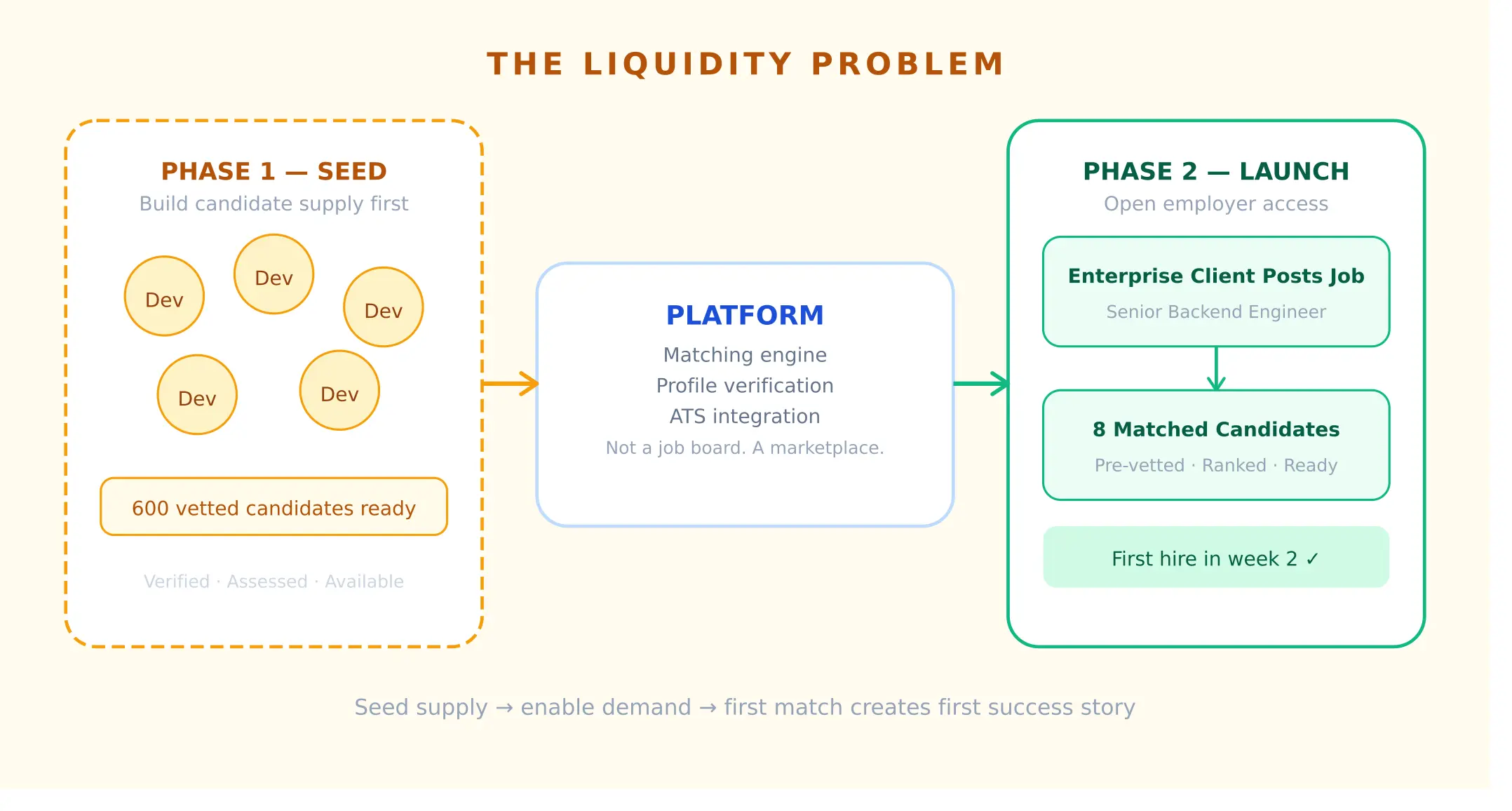
The approach that works: launch with supply-side liquidity. In a job marketplace, supply is candidates. Seed the candidate database before launching employer access. When the first employer posts a job, there are already relevant candidates to match against. The first match creates the first success story. The first success story creates the first referral.
For Supersourcing, the team seeded the platform with pre-vetted IT professionals – a curated supply side- before opening access to enterprise clients. The first client saw immediate relevant candidates. The experience was qualitatively different from launching an empty platform.
The engineering implication: the platform needs a supply-side onboarding flow that is optimised differently from the demand-side flow. Candidates need friction-free profile creation. Employers need confidence that the candidates exist before they commit to posting.
Profile completion scoring – the platform needs to understand how complete each candidate profile is and surface incomplete profiles for improvement. A candidate with a resume but no skills, no portfolio, and no availability signal is not matchable. The platform should guide them to completion with clear UI.
Cold start problem for matching -when a candidate is new with limited profile data, the matching engine has little signal to work with. The cold start solution: explicit preference collection during onboarding (preferred role, preferred stack, preferred company type, location, salary range) to bootstrap matching before behavioral signals accumulate.
The search experience is where candidates and employers spend most of their time. Getting it wrong produces frustration. Getting it right produces loyalty.
Production job portal search in 2026:
Full-text search – job titles, skills, company names, location. Elasticsearch or Algolia. Fast, typo-tolerant, faceted filtering. The ability to filter by location, job type, salary range, and experience level with filter options that update dynamically as results change.
Geosearch – “jobs within 30km of Bangalore” or “remote jobs available to candidates in India.” Elasticsearch’s geo_distance query is the standard implementation. The nuance: “remote” has multiple interpretations – fully remote globally, remote-first with occasional travel, remote until company requires return-to-office. The platform needs structured remote status fields, not free-text.
Semantic search – when the user types “machine learning jobs at unicorns in Bangalore”, the search needs to understand “unicorn” as a company category (companies valued at $1B+), not a keyword. Semantic search combines traditional keyword search with embedding-based matching for intent understanding.
Saved searches and alerts – candidates save search criteria and receive email/push notifications when new matching jobs are posted. This is the retention mechanism that brings candidates back to the platform daily without requiring them to actively search.
Employer search for candidates – the resume database search that employers use is a different product from the job search candidates use. Filtering by availability (actively looking vs. open to opportunities), by years of experience range, by specific skills, by current employer type. The data model must support both search surfaces.
The application management experience determines whether recruiters return to the platform.
A recruiter on a job portal without good application management gets 200 applications per job posting and has no tool to manage them. They spend hours triaging resumes manually. They switch to LinkedIn where the ATS integration works.
Production application tracking:
Kanban-style pipeline – applications move through stages: applied → screened → interviewed → offered → hired. Each stage transition triggers notifications to the candidate and updates the recruiter dashboard.
ATS integration – most enterprise employers already use an ATS (Greenhouse, Lever, Workable, Ashby). They don’t want a second system. The job portal should integrate with their ATS – push job postings from the ATS to the platform, pull applications back into the ATS with the candidate’s full profile. This is the feature that makes the portal indispensable rather than optional.
AI resume screening – after candidates apply, AI screening scores each application against the job requirements and surfaces the top 10–20% for recruiter review. 87% of large enterprises now use at least one AI screening module in their recruitment workflow. Platforms without this are being replaced by those that have it.
Communication workflows – email and SMS templates for common recruiter communications (acknowledgment of application, interview invitation, rejection). GDPR-compliant consent for communications. Tracking of which candidates have been contacted and when.
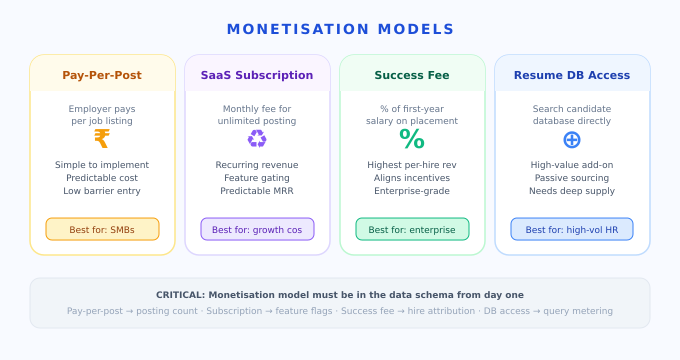
The monetisation model for a job portal needs to be designed into the data architecture from day one, not added as a billing layer after launch.
Job posting fees – employers pay per posting. Simple model, easy to implement, predictable for employers. Risk: employers cap at the number of postings they’re willing to pay for. For a new platform, this model limits early employer adoption.
Subscription/SaaS – employers pay a monthly fee for unlimited or high-volume posting, resume database access, and advanced features. This model creates recurring revenue but requires enough employer utility to justify ongoing payment.
Success fee / staffing model – the platform charges a percentage of placed candidate’s first-year salary when a hire is made. Highest revenue per transaction, but requires confidence that the platform’s matching will produce hires.
Resume database access – employers pay for access to search the candidate database, separate from job posting. Works well when the candidate database has real depth and quality.
Supersourcing operates on a success-fee/retainer hybrid for enterprise clients – this model made sense because enterprise clients value guaranteed quality over price competition. For a general job portal, subscription or pay-per-post is more appropriate.
The architectural requirement: every monetisation model requires different data tracking. Pay-per-post needs posting count tracking. Subscription needs feature gating. Success fee needs hire attribution (which posting led to which hire). These data models need to be in the schema from day one.
The job portal that has 100% verified profiles and employer listings will outperform one that doesn’t – because both sides trust it more.
Employer verification – at minimum, employer email domain verification. Better: LinkedIn company page match. Best: manual verification with company registration document for enterprise accounts. Fake job postings destroy candidate trust faster than anything else.
Candidate verification – email and phone verification at registration. Optional: LinkedIn profile import and validation. For technical roles: integrated coding assessments that validate self-reported skills. Supersourcing uses vetted profiles – candidates go through a technical assessment before being shown to enterprise clients. This is a strong trust signal: the client knows every candidate they see has passed a defined quality bar.
Review and rating system – for platforms with long-term relationships (contractor platforms, staffing platforms), mutual ratings build trust. A candidate knows this employer pays on time and provides structured interviews. An employer knows this candidate delivers what they promise.
Dispute resolution – when a hire doesn’t work out, who is responsible? The platform needs a defined dispute resolution process that protects both sides without creating liability.
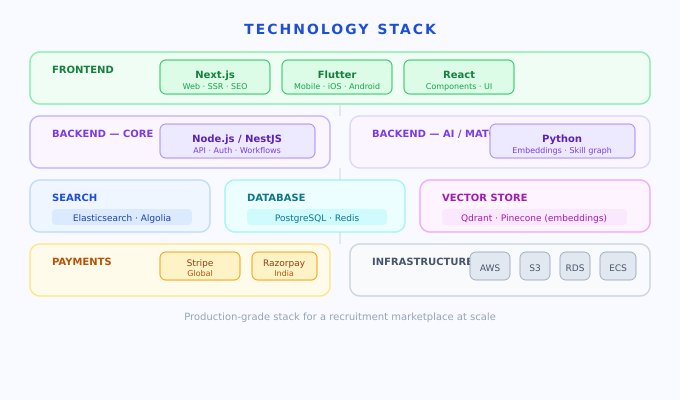
Frontend: Next.js (web – primary surface) + Flutter (mobile)
Next.js for the main platform- job listings, candidate search, recruiter dashboard, application management. Server-side rendering for SEO (job listing pages need to be indexed by Google). React for the interactive components.
Flutter for the mobile app – candidates searching for jobs on mobile. The mobile experience needs to be native-quality for a platform targeting candidates in India where mobile is the primary device.
Backend: Node.js NestJS + Python (matching engine and AI components)
NestJS for the core platform logic – job posting, profile management, application workflow, notification systems. Python for the matching engine (embedding models, similarity scoring, skill graph queries) and AI resume screening.
Search: Elasticsearch
Full-text search, geosearch, faceted filtering, and the semantic search layer. Elasticsearch is the standard for marketplace search at scale. Algolia is a viable alternative for simpler platforms that want managed search without the operational overhead.
Database: PostgreSQL + Redis
PostgreSQL for jobs, profiles, applications, and the matching data model. The graph relationships (skill → related skills, job → required skills, candidate → skills) are stored as PostgreSQL tables with appropriate indexing – not a dedicated graph database, which would be over-engineering for most job portals.
Redis for job alert evaluation (when a new job is posted, evaluate it against all saved searches in near-real-time), session management, and notification queuing.
Matching infrastructure: Custom embeddings + vector store
Candidate and job description embeddings generated using a fine-tuned model (fine-tuned on job description language, not general-purpose language). Stored in a vector database (Qdrant or Pinecone). Similarity queries run at job posting time (to find matching candidates) and at candidate search time (to find relevant jobs).
Payment: Stripe (international) + Razorpay (India)
Stripe for international employer subscriptions and pay-per-post billing. Razorpay for India-market employers who prefer UPI, NEFT, or card billing in INR. Both require webhook infrastructure for payment event handling.
Infrastructure: AWS
EC2 / ECS for the application layer, RDS for PostgreSQL, ElastiCache for Redis, OpenSearch Service for Elasticsearch-compatible search, S3 for resume storage and job description documents.
Supersourcing started as a problem the team lived.
Building products for 500+ clients over 14 years means hiring thousands of engineers. The hiring problem in India’s IT talent market is specific: the best engineers aren’t on general job portals, and the enterprises that need them don’t have time for the noise of general platforms.
The insight that became the product: what if the matching was done upfront, not by the recruiter manually reviewing 200 applications?
The team built the matching engine first – before the UI, before the employer dashboard, before the application workflow. The skill graph, the embedding-based candidate scoring, the experience calibration model. These were built and validated on a test dataset of real job requirements and real candidate profiles before a single employer was onboarded.
When the first enterprise client posted a requirement, they received 8 pre-matched candidates, all of whom had been vetted. Not 200 unscreened applications. 8 matched, vetted candidates.
That experience is qualitatively different from every general job portal. It’s what made enterprise clients pay a premium and return.
The LinkedIn Top 20 Startup India recognition – twice – reflects the platform’s growth. The Google AI Accelerator 2024 selection reflects the matching engine’s sophistication. The 04 unicorn clients, 132 YC-backed startups, and 17 Fortune 500 companies reflect what matching depth, done correctly, produces.
The platform lists jobs and accepts applications. There is no matching – just search. Recruiters get 200 irrelevant applications per posting. They leave for platforms where matching works. The portal dies with traffic but without engagement.
The fix: Build the matching engine before the UI. The matching is the product. Everything else is the wrapper.
The platform launches with employers but no candidates, or candidates but no employers. Neither side sees value. Both leave.
The fix: Seed supply-side first. Curate and verify a candidate database before opening employer access. The first employer experience must include relevant candidates.
The platform doesn’t integrate with employer ATS systems. Recruiters manage applications in two places. They choose the one that integrates with everything else – their existing ATS – and abandon the portal.
The fix: ATS integration (Greenhouse, Lever, Workable) as a launch requirement for enterprise employer acquisition. Employers don’t adopt platforms that create data silos.
The platform launches free to build supply and demand. The transition to paid creates immediate churn. Employers who built workflows around the free platform leave when pricing is introduced. The revenue never materialises.
The fix: Monetisation model is designed and communicated from day one. The data architecture supports it from day one. The transition from free to paid is planned in the product roadmap, not discovered after launch.
White-label job board platforms (Greenhouse jobs site, Workable careers page): Right for a company that wants a careers page, not a marketplace. Cannot support two-sided marketplace mechanics.
Off-the-shelf recruitment ATS (Greenhouse, Lever, Ashby): Right for an internal HR team managing hiring. Not a platform – it’s a tool. Cannot be the basis for a job portal product.
Custom build: Required for any two-sided marketplace recruitment platform with matching, multiple employer accounts, and candidate management. The matching engine, the marketplace mechanics, the monetisation architecture – none of these are available in off-the-shelf tools. The team built Supersourcing from scratch because no off-the-shelf platform could support the matching depth the product required.
Job portal development starts from $15K for a basic job board MVP – listings, candidate profiles, search, application submission.
Full recruitment marketplace platforms – AI matching engine, ATS integrations, resume database search, candidate verification, subscription billing, analytics- scoped based on niche focus, matching sophistication, and integration requirements.
Timeline: Basic job board in 8–12 weeks. Full marketplace platform in 4–8 months, with matching engine development and ATS integration driving the timeline.
40–60% cost savings vs US/UK equivalent quality. The team that built Supersourcing builds your platform. Full IP ownership.
Mayank leads personally.
The team built Supersourcing from a blank document. LinkedIn Top 20 Startup India twice. Google AI Accelerator 2024. 04 unicorn clients, 132 YC-backed startups, 17 Fortune 500 companies on the platform. The matching engine, the two-sided marketplace mechanics, the enterprise client onboarding – built, operated, and refined over years of real-world use.
That is not a reference. That is the exact engineering team building your platform, drawing on exactly that experience.
4 unicorn clients beyond Supersourcing. 75 YC-selected product builds. 200+ VC-funded products. CMMI Level 5. Full IP ownership.
A B2B staffing company came to the team needing a technical recruitment marketplace for the GCC talent segment – enterprise clients needed pre-vetted technology talent, and the existing platforms were delivering unscreened volume, not quality matches.
The team built the matching engine first. The platform launched with 600 pre-vetted candidates and 3 enterprise pilot clients. The first hire happened in week 2. The platform now serves multiple enterprise accounts.
Every week a recruitment marketplace runs without matching is a week of employer churn and candidate frustration that competitors are converting.
30 minutes. Honest assessment of your niche, your matching requirements, and what a platform that competes on quality actually takes to build.
mayank@engineerbabu.com
Mayank Pratap | Co-founder, EngineerBabu | mayank@engineerbabu.com | engineerbabu.com Google AI Accelerator 2024 · CMMI Level 5 · Supersourcing (LinkedIn Top 20 × 2, Google AI Accelerator 2024) · 04 Unicorn Clients · 75 YC Selections · Backed by Vijay Shekhar Sharma · LinkedIn Top Startup India (Twice)
Job portal development is building a two-sided marketplace platform that connects job seekers and employers – with job listings, candidate profiles, AI-powered matching, search, application management, ATS integration, and monetisation. A job portal is fundamentally different from a job board: a board lists jobs, a portal creates matches.
Basic job board MVP: 8–12 weeks. Full recruitment marketplace with AI matching, ATS integrations, resume database search, and subscription billing: 4–8 months. The matching engine and ATS integration timelines drive the critical path.
Basic job board from $15K. Full marketplace platform scoped based on matching sophistication, niche focus, and ATS integration requirements. US/UK equivalent quality costs 40–60% more.
AI matching uses embedding-based similarity scoring, skill graphs, and experience calibration to rank candidate-job relevance beyond keyword matching. A platform with AI matching surfaces candidates who can do the job, even if they don’t have the exact job title. Reduces recruiter time-to-review by surfacing the top 10–20% of relevant applications, not all 200.
ATS (Applicant Tracking System) integration connects the job portal to the employer’s existing recruiting software (Greenhouse, Lever, Workable, Ashby). Employers push job postings to the portal from their ATS and pull applications back into their ATS with full candidate profiles. Without ATS integration, enterprise employers manage two systems and choose the one that integrates with everything else – their existing ATS.
Every job marketplace suffers from the chicken-and-egg problem: employers won’t post without candidates; candidates won’t register without jobs. The solution: seed the supply side (candidates) before launching employer access. When the first employer posts, relevant candidates already exist. The first successful match creates the success story that drives referrals.
A job board displays job listings and accepts application submissions. A job portal is a two-sided marketplace with candidate profiles, AI-powered matching, application workflow management, ATS integration, and recruiter tools. LinkedIn and Indeed are job portals. A company careers page is a job board.
Next.js for the web platform (SSR critical for job listing SEO), Flutter for mobile, Node.js NestJS for application logic, Python for the matching engine, Elasticsearch for full-text and semantic search, PostgreSQL for data, Redis for real-time job alerts. Stripe for international billing, Razorpay for India.
Primary models: job posting fees (pay-per-post), subscription (unlimited posting, resume database access), success fee (percentage of placed candidate’s salary), resume database access fees. Most mature platforms use hybrid models. The monetisation model must be designed into the data architecture from day one – not added as a billing layer after launch.
Supersourcing is a B2B IT staffing marketplace – focused specifically on technology talent for enterprise clients (GCCs, funded startups, large tech companies). The matching engine surfaces pre-vetted candidates matched to specific technical requirements. Employers receive 8–15 matched, verified candidates per requirement rather than 200 unscreened applications. The niche focus and matching depth produce better outcomes for both sides than general platforms can.