AI Revenue Cycle Management Software in the USA: What's Working in 2026


Create engaging, high-performance mobile applications tailored to your business needs. We craft future-ready apps that offer smooth user experiences on all devices.
Build robust and scalable websites and CMS platforms that help you manage content effortlessly. Our development ensures a seamless digital presence.
Launch secure, feature-rich online stores with intuitive shopping experiences. We build tailored eCommerce platforms designed for growth.
Design captivating games with immersive gameplay and stunning graphics. From concept to launch, we build engaging experiences that players love.
Enhance your customer relationships with customized Salesforce implementations. Drive growth and efficiency with smarter CRM solutions.
Harness artificial intelligence and machine learning to automate workflows and gain actionable insights. Our AI transforms data into smart decisions.
Accelerate your software delivery lifecycle with continuous integration, delivery, and infrastructure automation to boost efficiency.
The US revenue cycle management market totals $90.6 billion annually. AI Revenue Cycle Management Software could generate up to $360 billion in annual savings according to McKinsey projections. The AI-in-RCM software market alone is growing from $21.49 billion in 2026 to $71.27 billion by 2031, a 27% CAGR.
63% of healthcare organizations have already integrated AI-powered automation into their revenue cycle workflows. 80% of health systems are actively piloting or implementing generative AI in RCM. The HFMA’s 2026 Revenue Cycle Future survey describes the market as “moving decisively beyond experimentation.”
Yet denial rates sit at 11.65%. $19.7 billion is spent annually just managing denials. AR days remain elevated. The gap between AI investment and realized outcomes tells you something important: having AI in the revenue cycle and deploying it effectively are different things.
This guide covers what AI RCM software actually does in 2026, where the ROI is real, where it’s oversold, and what health systems evaluating or building RCM AI need to know.
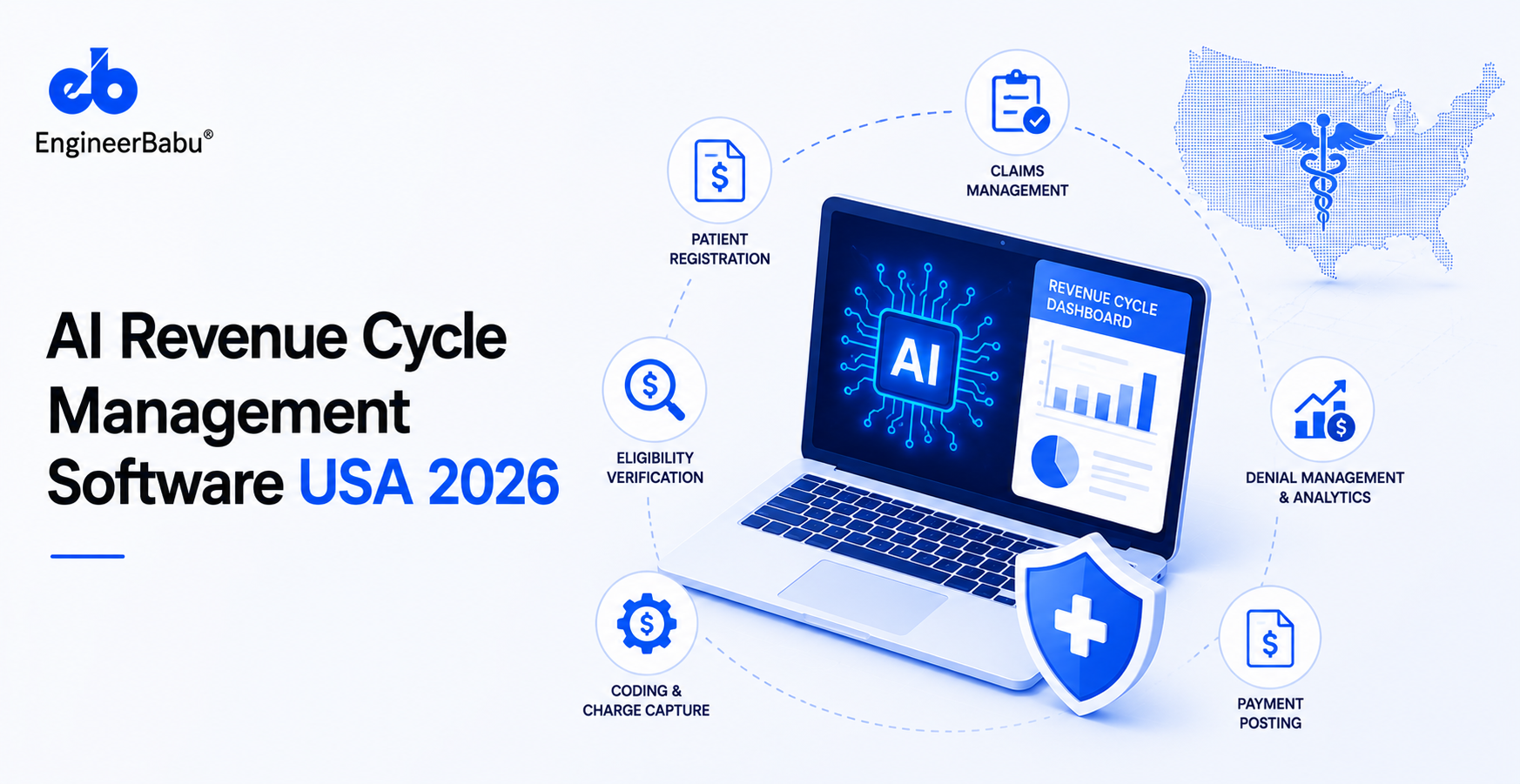
AI revenue cycle management is the application of machine learning, NLP, and process automation to the full financial cycle of US healthcare from patient registration through final payment.
It encompasses eligibility verification, prior authorization, computer-assisted coding, claim scrubbing, denial prediction and prevention, automated appeals generation, payment posting, AR management, and financial analytics.
The $90.6B US RCM market is being reorganized around AI systems that can process claims, predict denials, and optimize reimbursement at a scale no human workforce can match.
What it does: Verifies insurance coverage, benefits, and eligibility at patient registration, automatically, in real time, against payer databases.
ROI evidence: Eligibility errors cause approximately 30% of claim denials. AI eligibility verification with predictive coverage gap detection reduces registration-caused denials by 40–60%.
Status: Mature, widely deployed. Table stakes for any modern RCM platform.
What it does: Automates the full PA workflow, checking requirements via CRD, gathering documentation via DTR, submitting electronically via PAS. (See full prior auth guide: Blog 5)
ROI evidence: First-pass PA approval rates exceed 95% with AI automation versus 65–75% manual. MUSC recovered 5,000+ staff hours per month.
Status: Rapidly expanding. CMS-0057 mandates FHIR PA APIs by 2027, accelerating adoption.
What it does: NLP analyzes clinical documentation, physician notes, discharge summaries, operative reports and extracts ICD-10 diagnoses and CPT procedure codes. Suggests appropriate E/M levels. Flags HCC capture opportunities.
ROI evidence: CAC reduces coding errors by 30–40%, accelerates coding workflow by 2–3× for straightforward cases. Best ROI on high-volume, lower-complexity encounters.
Status: Mature for inpatient facility coding. Expanding to outpatient and professional fee coding. Caution: complex specialty coding still requires certified human coders for final review.
The workforce displacement question: Northwell Health’s CRO captured it directly: “It’s getting harder to attract people into coding, because they look in the marketplace and see all these companies racing to create accurate, autonomous coding tools.”
AI development is not replacing certified coders in 2026, it’s shifting their work from routine extraction to complex case review, CDI, and quality assurance. But the workforce pipeline implication is real.
What it does: Validates claims against a continuously updated payer edit library before submission. Flags coding errors, bundling violations, documentation gaps, and authorization mismatches.
ROI evidence: Clean claim rates of 95%+ with mature AI scrubbing versus 85–90% industry average. Each percentage point improvement in clean claim rate reduces denial rework cost by ~$25/claim × denial volume.
Status: Widely deployed. The differentiator is the payer edit library maintenance, static rule engines go stale; ML models trained on current payer behavior do not.
What it does: ML models score in-flight claims for denial risk based on historical payer behavior patterns. High-risk claims route for human review or proactive supplementation before payer adjudication.
ROI evidence: 30–40% reduction in denial rates. $19.7B in annual US denial management cost is the addressable opportunity.
Status: High-growth, active investment area. The asymmetry between payer AI denial systems and provider prevention systems is the core driver.
What it does: NLP-driven system extracts denial reason, identifies applicable payer policy language, pulls clinical evidence from EHR, and drafts appeals citing specific policy evidence against specific documentation.
ROI evidence: 65% of denied claims currently go unappealed. AI appeals generation at scale recovers revenue from the 65% non-appeal pool while reducing per-appeal labor cost from $25–$80 to near zero.
Status: Emerging. Most sophisticated at vendors with integrated EHR data access. Standalone appeals automation without EHR connectivity is limited by documentation retrieval.
What it does: Automates ERA/EOB parsing, payment posting, contractual adjustment calculation, and underpayment identification. AI identifies patterns in payer underpayment that human analysts miss at volume.
ROI evidence: Payment posting automation reduces AR days. Underpayment recovery rates of 3–7% on contractual variance are achievable with ML-driven payer contract analytics.
Status: Mature for payment posting automation. AI-driven underpayment identification is the value-add layer that differentiates premium platforms.
What it does: Real-time dashboards showing AR aging, denial trends by payer and code, collection rates, cost-to-collect, and cash flow forecasting. ML models predicting patient payment behavior and optimizing collection outreach.
ROI evidence: 35% of healthcare organizations implementing AI RCM analytics report cost savings of 10%+. Predictive AR management reduces bad debt write-off.
Status: Highest current investment priority per HFMA 2026 survey. CFOs and revenue integrity leaders are the primary buyers.
The build opportunity: The market is consolidating around large platforms, but specialty-specific RCM AI, behavioral health, oncology, specialty surgery, multi-state GLP-1 telehealth, remains under-served by generic platforms. Custom AI RCM built for specific clinical and payer contexts consistently outperforms generic platforms on the specific denial patterns that matter for that specialty.
For health system IT teams and healthtech builders evaluating custom RCM AI:
| Component | Technology | Notes |
| Eligibility verification | Availity or Change Healthcare API | Real-time eligibility, benefits, and coverage |
| Prior authorization | FHIR CRD/DTR/PAS + X12 278 | Da Vinci standards for compliant ePA |
| Claim generation | X12 837 EDI | Professional (837P) and institutional (837I) |
| Claim scrubbing | ML model + payer edit library | Custom ML trained on your payer mix |
| Denial prediction | XGBoost or LightGBM | Trained on historical claims and denial patterns |
| CAC/CDI | NLP pipeline + GPT-4o (Azure OpenAI) | Clinical documentation → ICD-10 + CPT extraction |
| Appeals generation | LLM with payer policy database | Policy-cited appeal letter generation |
| Payment posting | X12 835 ERA parsing + ML | Automated EOB parsing and underpayment identification |
| Analytics | Python + Redshift or Snowflake | Real-time RCM dashboards and predictive models |
| EHR integration | FHIR R4 APIs | Clinical documentation access for CAC and appeals |
| HIPAA infrastructure | AWS HIPAA-eligible services | Full BAA coverage required |
Author: Mayank Pratap | Co-Founder, EngineerBabu | Google AI Accelerator 2024 · CMMI Level 5
AI RCM applies machine learning, NLP, and automation to the full healthcare financial cycle from eligibility verification and prior authorization through coding, claim submission, denial management, and payment posting. It is transforming a $90.6B US market by processing claims at scale, predicting denials before submission, and recovering revenue from previously unappealed denials.
Denial prevention (30–40% denial rate reduction), prior authorization automation (95%+ first-pass approval), computer-assisted coding (30–40% error reduction, 2–3× workflow acceleration), and automated appeals generation (recovering the 65% of denials currently abandoned without appeal).
Vendor SaaS platforms: typically priced per claim, per provider, or as a percentage of revenue, ranging from $1–$5 per claim for cloud-based automation to enterprise contracts at $500K–$5M+ annually for large health systems. Custom AI RCM development for specialty-specific workflows: $200K–$600K build plus ongoing ML maintenance.
CAC is shifting coder work from routine code extraction to complex case review, CDI, and quality assurance, not eliminating the role. For high-volume straightforward encounters, AI handles the extraction. For complex specialty coding, oncology staging, and cases requiring clinical judgment, certified coders remain essential and will remain so through 2026 and beyond.
$90.6 billion annually in US RCM market total. AI-in-RCM software specifically: $21.49 billion in 2026, growing to $71.27 billion by 2031 at 27% CAGR. McKinsey projects AI and automation could generate $360 billion in annual healthcare savings, with RCM among the highest-value application areas.