How AI Clinical Decision Support Systems Work in the USA: The 2026 Guide


Create engaging, high-performance mobile applications tailored to your business needs. We craft future-ready apps that offer smooth user experiences on all devices.
Build robust and scalable websites and CMS platforms that help you manage content effortlessly. Our development ensures a seamless digital presence.
Launch secure, feature-rich online stores with intuitive shopping experiences. We build tailored eCommerce platforms designed for growth.
Design captivating games with immersive gameplay and stunning graphics. From concept to launch, we build engaging experiences that players love.
Enhance your customer relationships with customized Salesforce implementations. Drive growth and efficiency with smarter CRM solutions.
Harness artificial intelligence and machine learning to automate workflows and gain actionable insights. Our AI transforms data into smart decisions.
Accelerate your software delivery lifecycle with continuous integration, delivery, and infrastructure automation to boost efficiency.
A physician opens a patient chart in Epic. As the chart loads, three things happen automatically in the background, each taking under two seconds:
The physician didn’t request any of this. The clinical decision support system delivered it at the exact moment it was needed at the point of care, within the existing workflow, without requiring a separate login or application.
That is what modern AI clinical decision support looks like in 2026. It’s a fundamentally different technology from the alert-heavy, interrupt-driven CDS systems that contributed to physician burnout in the 2010s.
An AI clinical decision support system (AI CDSS) is a software system that uses machine learning, natural language processing, and deep learning to analyze patient data and deliver context-aware, actionable clinical recommendations to healthcare providers at the point of care.
Unlike traditional rule-based CDS systems that fire predefined alerts when specific conditions are met, AI CDSS learns from patient outcomes, continuously improves its predictions, and delivers personalized recommendations based on each patient’s complete clinical picture rather than isolated data points.
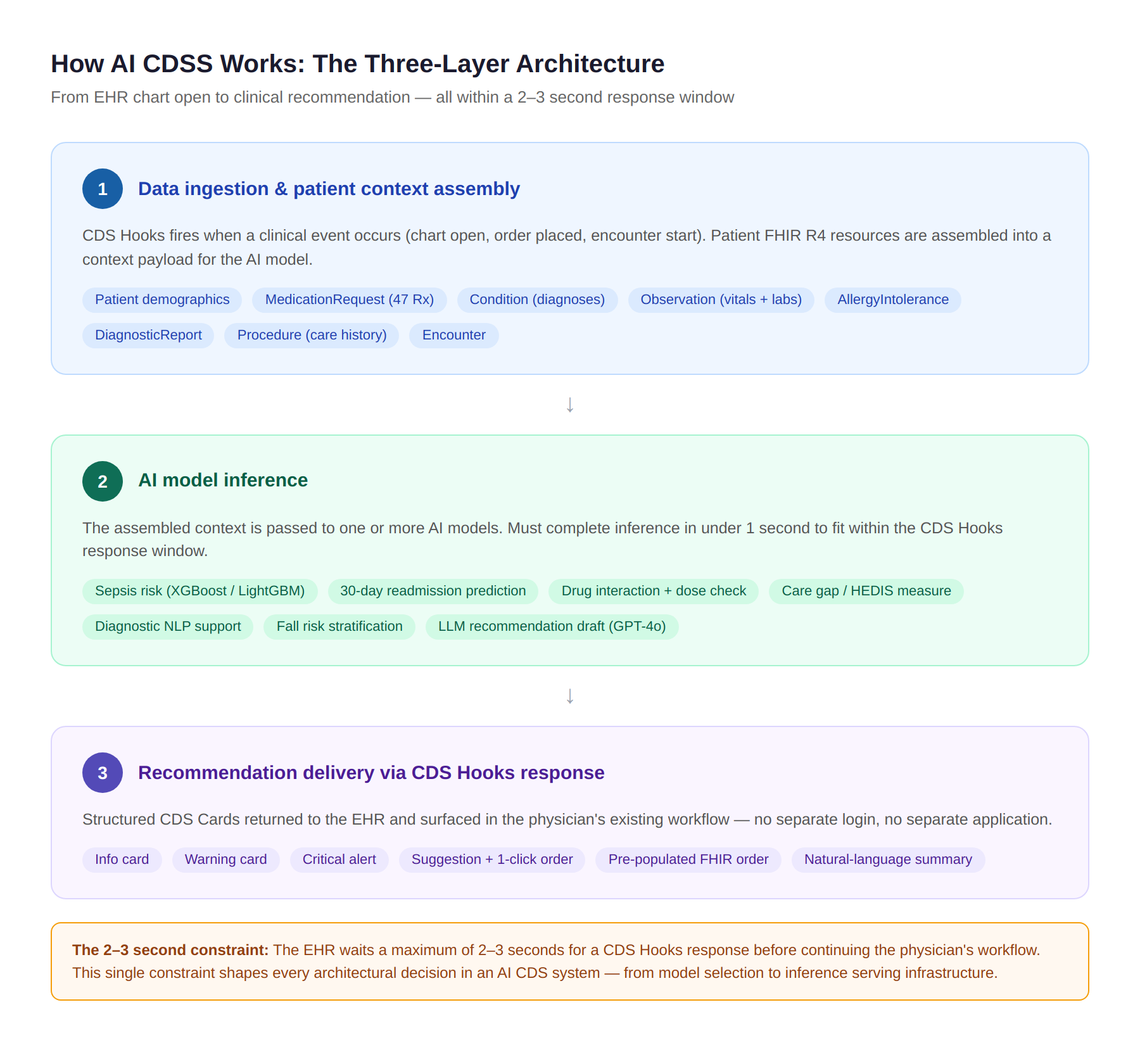
A modern AI CDS system operates in three layers:
At the moment of clinical action, a physician opening a chart, placing an order, documenting an encounter, the CDS system receives a CDS Hooks call from the EHR. CDS Hooks is the open standard for embedding clinical decision support in EHR workflows.
The hook fires with a patient context payload containing the patient’s FHIR resources: current medications, diagnoses (Condition resources), recent vital signs and labs (Observation resources), upcoming appointments, care team members.
The AI system has 2–3 seconds to process this context and return a response before the physician’s workflow is disrupted. This response window constraint shapes everything about how AI CDS systems are engineered.
FHIR resources the system processes:
The clinical context assembled from FHIR resources is passed to one or more AI models:
The AI system returns a CDS Cards response to the EHR within the latency window. CDS Cards are structured UI elements that appear in the physician’s workflow, a notification, a suggestion, a link to a pre-populated order set, an informational alert.
Card types in the CDS Hooks spec:
The critical design principle: fewer alerts with higher accuracy beat more alerts with lower precision. Traditional CDS systems fire 40–60 alerts per provider per day, with override rates exceeding 90%.
Physicians learn to dismiss everything automatically. AI CDSS systems that fire 3–5 high-precision alerts per day, with the right contextual evidence, achieve meaningful clinical impact because physicians trust them.
Alert fatigue: clinicians overriding CDS alerts automatically because alert volume overwhelms clinical utility is the documented failure mode of first-generation CDS systems.
Epic reports override rates for drug interaction alerts exceeding 90% in some health systems. When 9 out of 10 alerts are dismissed without reading, the 10th clinically important alert is also dismissed. Alert fatigue is not a physician compliance problem, it’s a precision problem.
AI CDSS solves alert fatigue through:
The JMIR published a systematic review in May 2026 confirming AI-informed CDS shows measurable improvements in diagnostic accuracy, risk stratification, resource utilization, and patient outcomes versus traditional models across oncology, organ transplantation, diabetic retinopathy, epilepsy, and emergency medicine.
Specific implementations with published outcomes:
This is the part that health system IT teams often discover late and health tech founders frequently overlook.
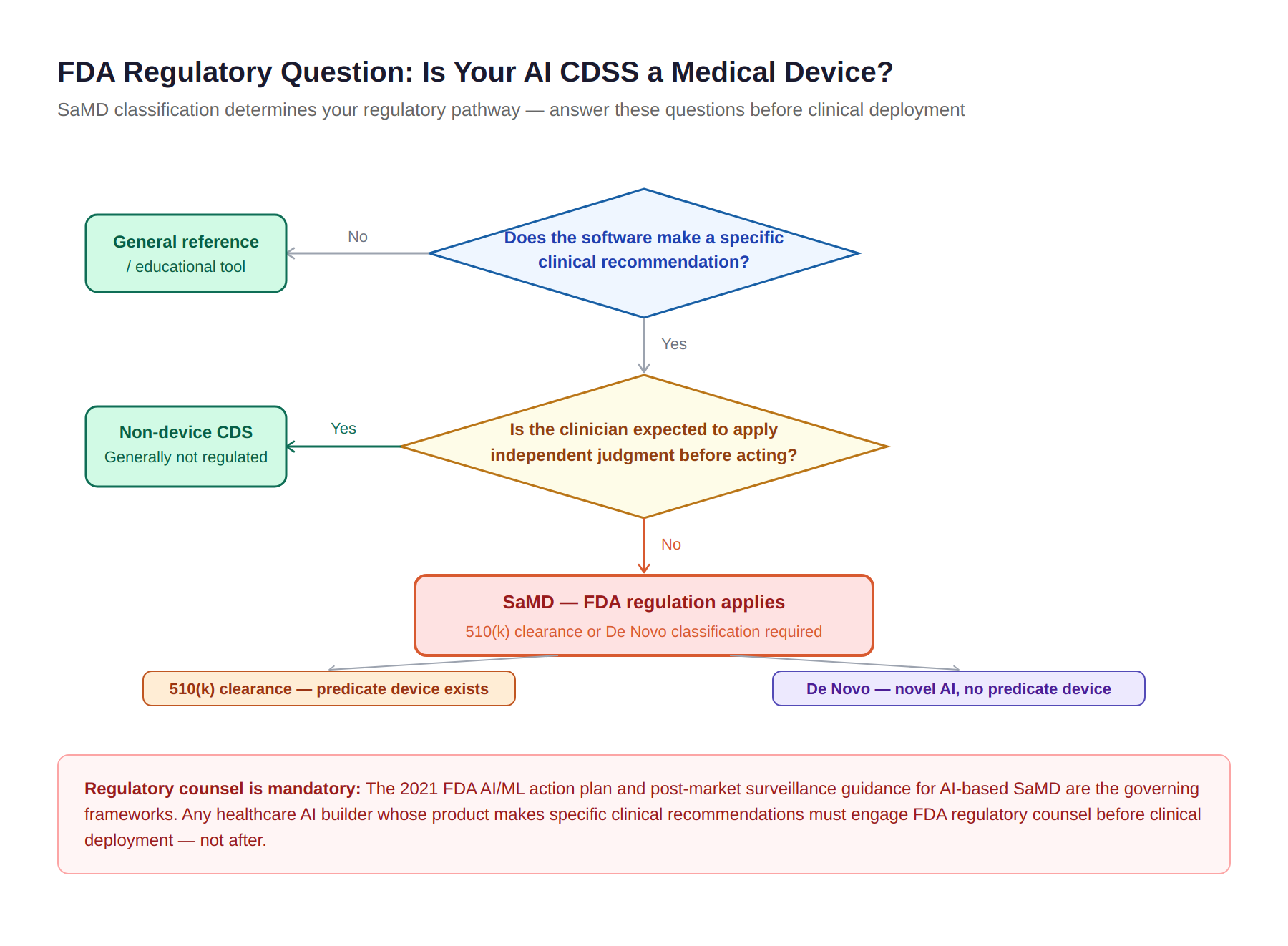
AI clinical decision support systems that make specific clinical recommendations, diagnostic conclusions, treatment recommendations, drug dosing calculations may qualify as Software as a Medical Device (SaMD) under FDA guidance.
The non-device exception: CDS software that provides general reference information, educational tools, or systems where the clinician is expected to independently review the recommendation using their professional judgment is generally not regulated as a medical device. The decisive question is whether the software’s recommendation is the direct basis for clinical action, or whether the clinician applies their own judgment independently.
The SaMD threshold: If your AI system recommends a specific treatment, diagnosis, or dosage and that recommendation is intended to be followed by the clinician, you are in SaMD territory. This triggers FDA 510(k) clearance requirements or De Novo classification for novel AI.
The 2021 FDA AI/ML action plan and the post-market surveillance guidance for AI-based Software as a Medical Device are the governing frameworks. Any healthcare AI builder whose product makes specific clinical recommendations should engage FDA regulatory counsel before the product is clinically deployed.
For health systems and health tech builders, the technical requirements:
Build cost for a specialty AI CDS system: $150,000–$500,000 for a focused specialty CDS tool (sepsis prediction, readmission risk, care gap management). $500,000–$2,000,000 for a comprehensive multi-specialty CDS platform with proprietary models.
A software system that analyzes patient data and delivers clinical recommendations to healthcare providers at the point of care, drug interaction checks, risk stratification, diagnostic suggestions, care gap alerts. AI CDS systems use ML and NLP to deliver personalized, context-aware recommendations rather than static population-level rules.
CDS Hooks is the open standard for integrating clinical decision support services into EHR workflows. When specific clinical events occur (opening a patient chart, placing an order), the EHR sends a webhook-style call to the CDS service with patient FHIR data context. The CDS service returns recommendation cards that appear directly in the physician’s workflow.
By using ML models with high positive predictive value rather than broad population-level rules, firing 3–5 high-precision, patient-specific alerts rather than 40–60 generic alerts. Personalized thresholds, contextual filtering, and outcome-based model learning progressively improve alert accuracy for specific patient populations.
CDS software that provides general reference information for clinician review is generally not regulated as a medical device. CDS software that makes specific clinical recommendations intended to be followed without independent clinician judgment may qualify as SaMD, triggering FDA 510(k) clearance requirements. Consult regulatory counsel before clinical deployment.
Epic, Oracle Health (Cerner), Athenahealth, and most major ONC-certified EHRs support CDS Hooks as part of their interoperability requirements. Epic requires CDS Hooks integrations to be registered through the Epic Vendor Services program and go through the per-site approval process described in the Epic FHIR integration guide.
Author: Mayank Pratap | Co-Founder, EngineerBabu | Google AI Accelerator 2024 · CMMI Level 5