How to Build a Healthcare App in the USA: Complete 2026 Guide


Create engaging, high-performance mobile applications tailored to your business needs. We craft future-ready apps that offer smooth user experiences on all devices.
Build robust and scalable websites and CMS platforms that help you manage content effortlessly. Our development ensures a seamless digital presence.
Launch secure, feature-rich online stores with intuitive shopping experiences. We build tailored eCommerce platforms designed for growth.
Design captivating games with immersive gameplay and stunning graphics. From concept to launch, we build engaging experiences that players love.
Enhance your customer relationships with customized Salesforce implementations. Drive growth and efficiency with smarter CRM solutions.
Harness artificial intelligence and machine learning to automate workflows and gain actionable insights. Our AI transforms data into smart decisions.
Accelerate your software delivery lifecycle with continuous integration, delivery, and infrastructure automation to boost efficiency.
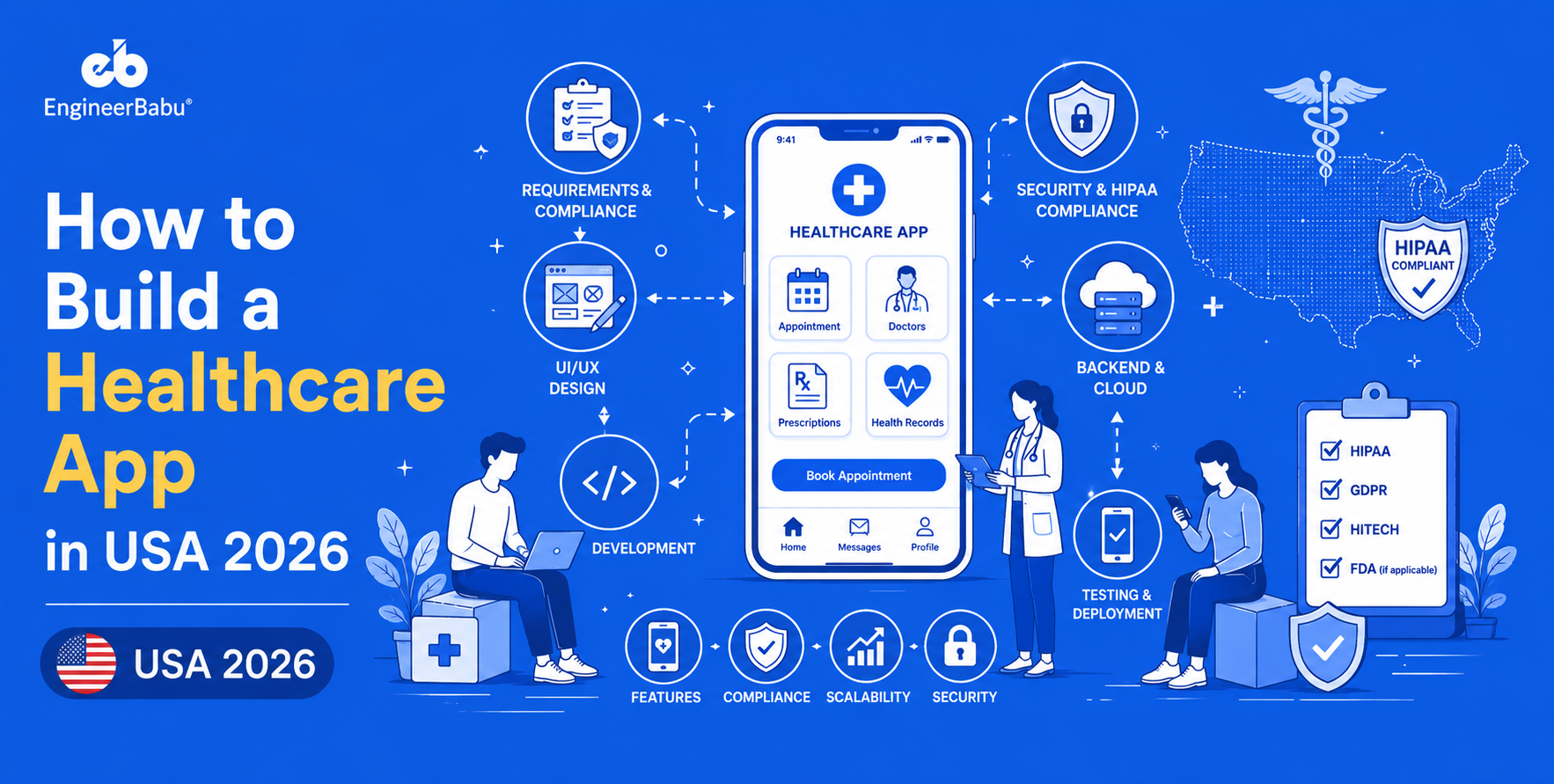
This is the guide I point clients to before our first architecture call.
Not because it answers every question, no single article can but because it sets the right mental model. Building a healthcare app in the USA is not like building any other software product.
The regulatory environment, the EHR integration complexity, the PHI handling requirements, and the patient safety stakes combine to make healthcare one of the most demanding software domains in any industry.
The EngineerBabu team has shipped 100+ healthcare products like telemedicine platforms, remote patient monitoring systems, AI documentation tools, prior authorization platforms, and EHR integrations. This is our complete guide for the US market in 2026.
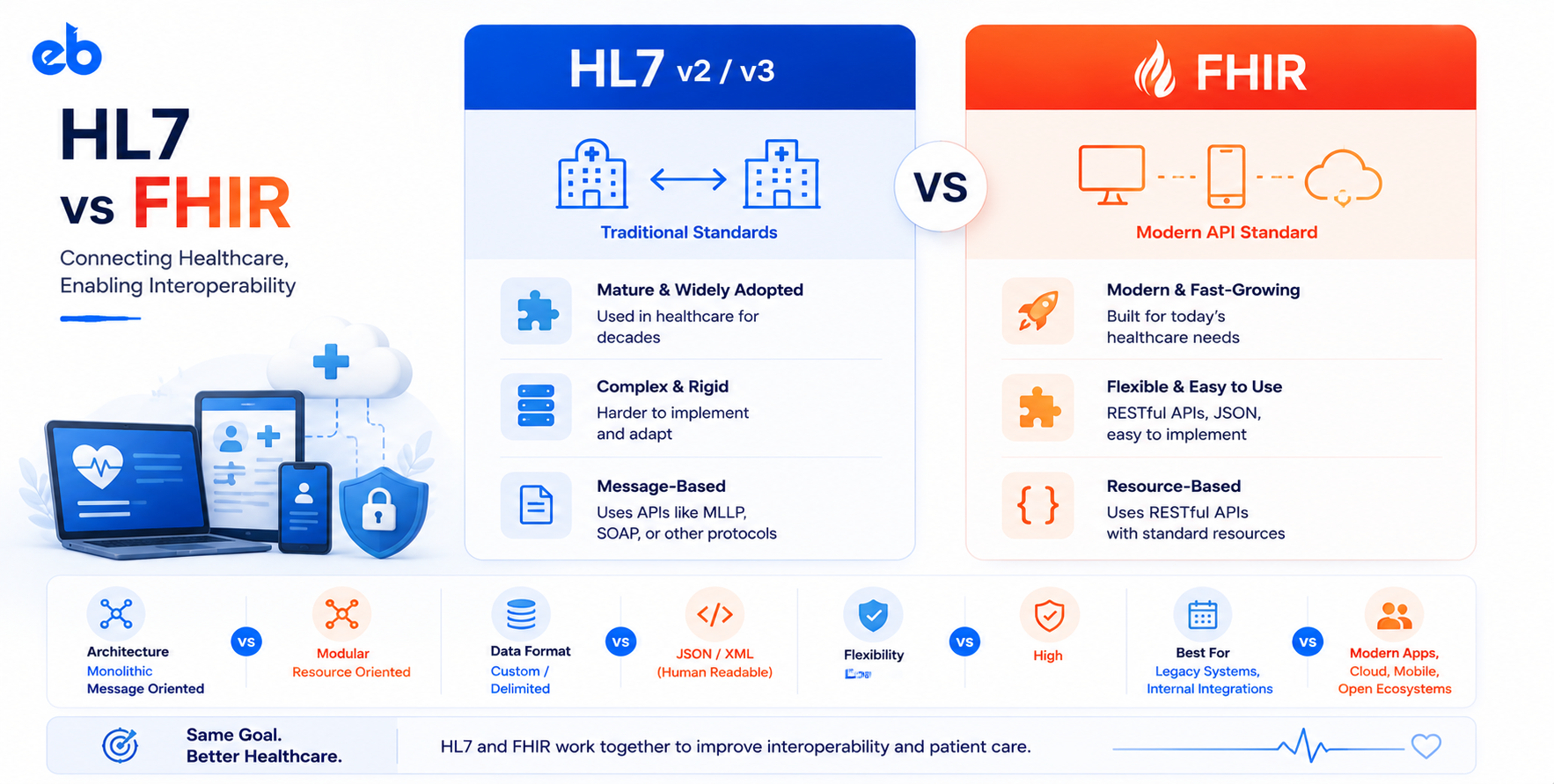
Healthcare app development in the USA requires navigating HIPAA compliance (mandatory for any app handling Protected Health Information), FDA Software as a Medical Device (SaMD) classification (required for apps that diagnose, treat, or prevent disease), and EHR integration complexity (FHIR R4 is the mandated interoperability standard under the 21st Century Cures Act).
The combined effect: healthcare apps cost 20–40% more than equivalent consumer apps, take 30–50% longer to build, and require ongoing compliance maintenance that doesn’t exist for other software categories.
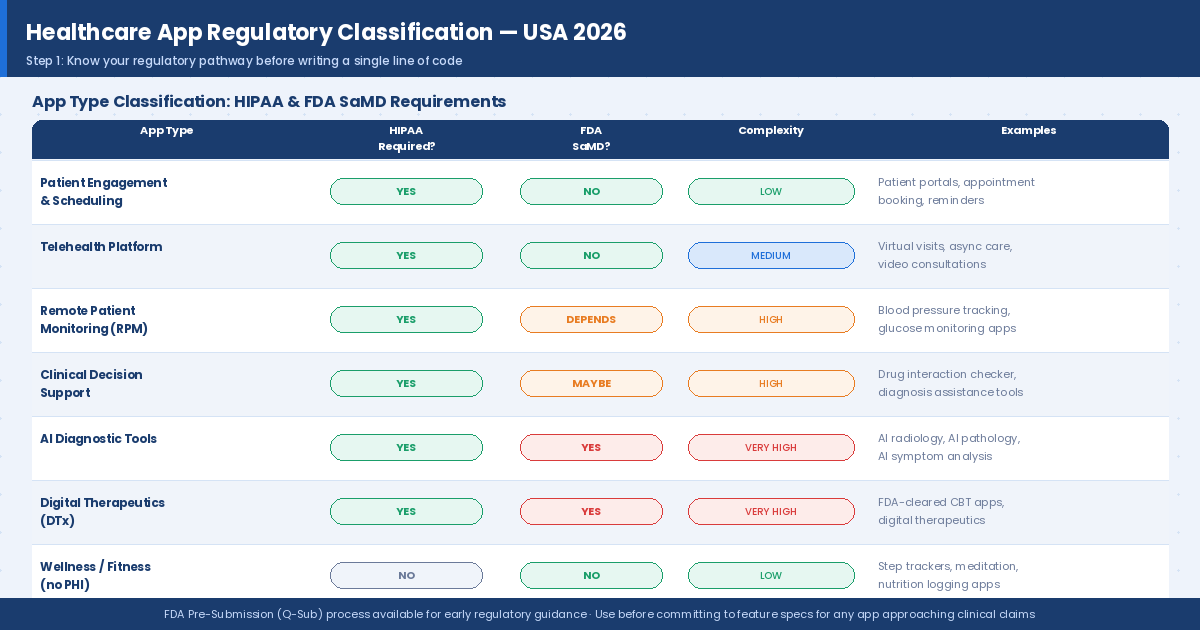
Before writing a single line of code, you need to know which regulatory framework applies. This single decision shapes every subsequent choice.
| App Type | HIPAA Required? | FDA SaMD? | Examples |
| Patient engagement / scheduling | Yes (if PHI) | No | Patient portals, appointment booking |
| Telehealth platform | Yes | No | Virtual visits, async care |
| Remote patient monitoring | Yes | Depends on claims | Blood pressure tracking, glucose monitoring |
| Clinical decision support | Yes | Maybe | Drug interaction checker, diagnosis tools |
| AI diagnostic tools | Yes | Yes (likely) | AI radiology, AI pathology |
| Digital therapeutics | Yes | Yes | FDA-cleared CBT apps, DTx products |
| Wellness/fitness (no PHI) | No | No | Step trackers, meditation apps |
The FDA SaMD question: The FDA regulates Software as a Medical Device, software that is intended to be used for medical purposes. If your app makes diagnostic claims (“this app detects atrial fibrillation”), recommends treatment (“based on your symptoms, consider X”), or monitors for medical conditions in a clinically meaningful way, you likely need FDA clearance (510(k)) or de novo authorization before launch.
Getting FDA wrong means your product cannot be legally marketed in the USA, regardless of how well it works technically. The FDA’s Digital Health Center of Excellence provides the Pre-Submission (Q-Sub) process for early regulatory guidance, use it before you commit to feature specifications for anything approaching clinical claims.
The HIPAA question: If your app creates, receives, maintains, or transmits Protected Health Information on behalf of a covered entity and any app connecting to a physician practice, hospital, or health plan does, HIPAA compliance is mandatory. HIPAA adds $15,000–$40,000 to the initial build cost and $10,000–$30,000 annually for ongoing compliance maintenance.
Healthcare app architecture decisions made at the start are expensive to reverse. Three architectural decisions in particular have outsized downstream impact:
For most healthcare MVP builds ($50K–$150K range), start with a well-structured monolith. Microservices reduce coupling but dramatically increase infrastructure and operational complexity. The “split into services” migration is straightforward when the team has validated what the product actually does. Premature microservices architecture in healthcare apps is one of the most common reasons projects go over budget.
Keep PHI in a dedicated, separately encrypted database from your non-PHI application data. This is both a HIPAA best practice and a performance optimization, you only decrypt when clinically required, reducing exposure surface and improving database query performance on non-PHI operations.
If your app needs to integrate with Epic, Cerner, or Athenahealth, scope this explicitly from day one. Do not assume you will “add EHR integration later.” The data model decisions you make for your internal clinical records directly affect how difficult EHR sync becomes. Build to FHIR R4 data standards internally from sprint one, even before you need the actual integration and the EHR integration phase becomes a mapping exercise rather than a data model redesign.
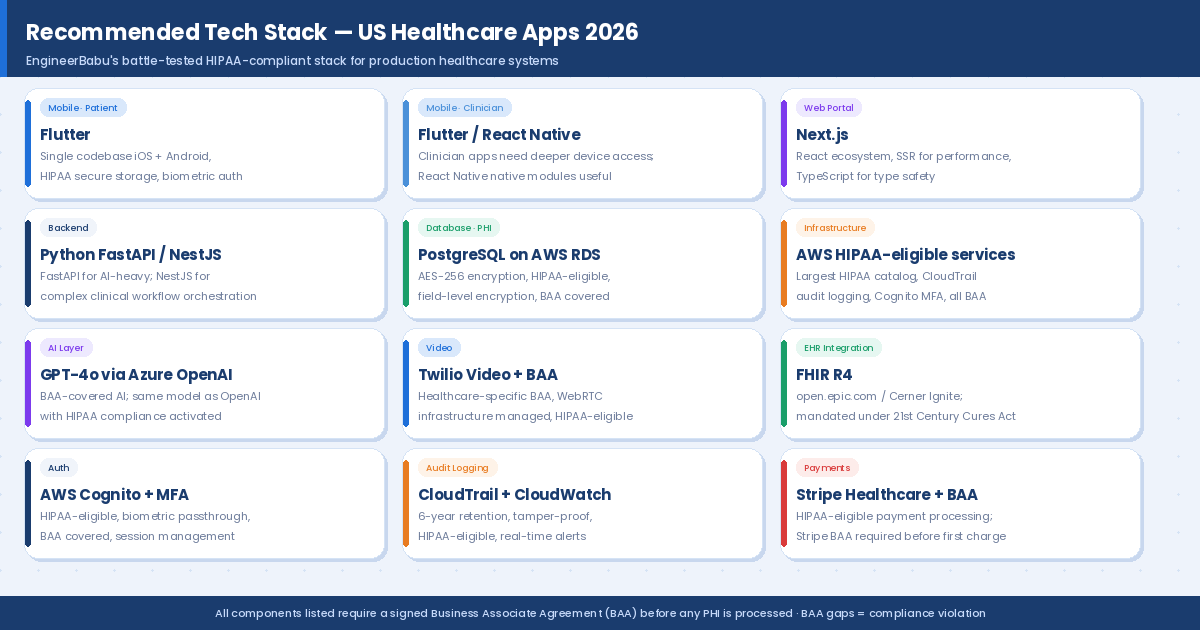
The EngineerBabu recommended stack for US healthcare apps in 2026:
| Layer | Recommendation | Why |
| Mobile (patient-facing) | Flutter | Single codebase iOS + Android, HIPAA-compliant secure storage packages, biometric auth support |
| Mobile (clinician-facing) | Flutter or React Native | Clinician apps often need deeper device access; React Native native modules can be useful |
| Web (provider portal) | Next.js | React ecosystem, SSR for performance, TypeScript for safety |
| Backend | Python FastAPI or Node.js NestJS | FastAPI for AI-heavy backends; NestJS for complex clinical workflow orchestration |
| Database (PHI) | PostgreSQL on AWS RDS | AES-256 encryption, HIPAA-eligible, field-level encryption support, BAA covered |
| Database (non-PHI) | PostgreSQL same cluster or DynamoDB | Separate logical database, same RDS instance |
| Infrastructure | AWS HIPAA-eligible services | Largest HIPAA-eligible service catalog, CloudTrail for audit logging, Cognito for MFA |
| Auth | AWS Cognito with MFA | HIPAA-eligible, supports biometric auth passthrough, BAA covered |
| Video | Twilio Video with BAA | Healthcare-specific BAA, WebRTC infrastructure managed, HIPAA-eligible |
| Payments | Stripe Healthcare with BAA | HIPAA-eligible payment processing |
| AI | GPT-4o via Azure OpenAI (BAA covered) | Same model as standard OpenAI; Azure BAA activates HIPAA compliance |
| Audit logging | AWS CloudTrail + CloudWatch | 6-year retention configurable, tamper-proof, HIPAA-eligible |
| EHR integration | FHIR R4 via open.epic.com / Cerner Ignite | See the Epic FHIR Integration blog for full detail |
The compliance components that must be built before any PHI touches production:
These are not features to be added before launch. They are infrastructure that must exist before clinical data is processed. Retrofitting them into a live system is 3–5× more expensive and 2–4× riskier than building them in from the start.
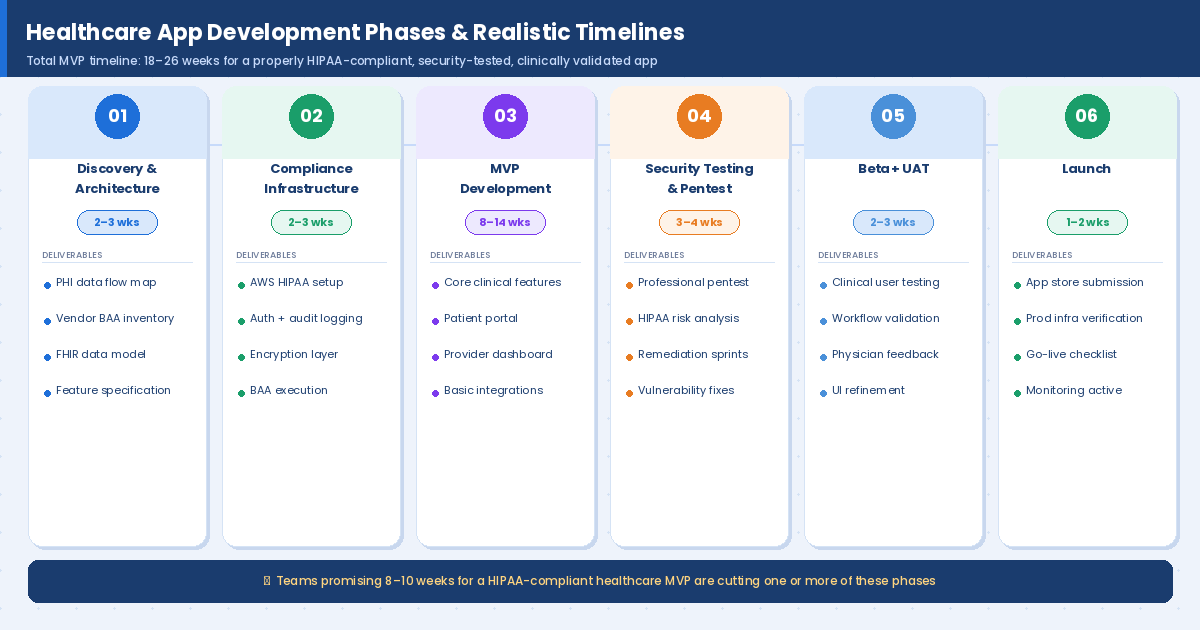
| Phase | Duration | Key Deliverables |
| Discovery + Architecture | 2–3 weeks | PHI data flow map, vendor BAA inventory, FHIR data model, feature spec |
| Compliance Infrastructure | 2–3 weeks | AWS setup, auth, audit logging, encryption, BAA execution |
| MVP Development | 8–14 weeks | Core clinical features, patient portal, provider dashboard, basic integrations |
| Security Testing + Pentest | 3–4 weeks | Professional penetration test, HIPAA risk analysis document, remediation |
| Beta + UAT | 2–3 weeks | Clinical user testing, workflow validation, feedback integration |
| Launch | 1–2 weeks | App store submission, production infrastructure verification, go-live |
Total MVP timeline: 18–26 weeks for a properly HIPAA-compliant, security-tested, clinically validated healthcare app. Teams promising 8–10 weeks for a HIPAA-compliant healthcare MVP are cutting one or more of these phases.
| App Type | MVP Cost Range | Full Platform |
| HIPAA-compliant MVP (no EHR) | $35,000–$65,000 | — |
| Telemedicine platform (video + scheduling) | $50,000–$90,000 | $100,000–$180,000 |
| Remote patient monitoring platform | $60,000–$100,000 | $120,000–$200,000 |
| AI scribe / documentation tool | $80,000–$150,000 | $200,000–$400,000 |
| Patient portal with EHR integration | $80,000–$140,000 | $150,000–$250,000 |
| Custom EHR system | $150,000–$500,000 | $500,000–$2M+ |
| GLP-1 / weight management platform | $80,000–$150,000 | $200,000–$400,000 |
| Prior authorization automation | $100,000–$200,000 | $300,000–$600,000 |
Annual maintenance: 15–20% of initial build cost. Healthcare apps require more maintenance than consumer apps due to HIPAA annual risk assessments, penetration testing, EHR API version updates, and regulatory compliance monitoring.
Epic integration for a single hospital site takes 2–4 months. That’s not a sprint item, it’s its own workstream with its own timeline, dependencies, and per-site approval process. Treating it as equivalent to “adding a payment gateway” is the single most common cause of healthcare app timeline failures.
No BAA means no compliance. Discovering BAA gaps after launch means remediation in a live clinical environment, which is both technically risky and legally exposed.
Healthcare apps are used by people under cognitive load, physicians documenting 30+ patients per day, nurses triaging a patient queue, care coordinators managing 100 chronic disease patients. UI that works in a demo fails in a clinical setting because the developer testing it is not the user. Clinical workflow mapping with actual physician and nurse input before design is non-negotiable for adoption.
Many founders in the AI clinical decision support space have built products for 12–18 months, invested $200K–$500K, and then discovered their product requires FDA clearance before commercial launch. The conversation to have before development: describe your feature set to an FDA regulatory consultant and get their assessment of SaMD risk. A $5,000 regulatory consultation before development is worth more than $500,000 in post-development regulatory rework.
Every hospital, health system, and enterprise payer will ask for your most recent penetration test report in their vendor security questionnaire. If you don’t have one, you’re not being evaluated. Budget $5,000–$15,000 for a professional pentest before your first enterprise sales conversation.
Healthcare app development in the USA costs $35,000–$400,000+ depending on app type, compliance requirements, and EHR integration scope. A basic HIPAA-compliant MVP runs $35,000–$65,000. A telemedicine or RPM platform runs $50,000–$180,000. A custom EHR or AI clinical system starts at $150,000. Annual maintenance is 15–20% of build cost.
A well-scoped, HIPAA-compliant MVP takes 18–26 weeks from discovery to launch. Telemedicine MVPs with no EHR integration: 10–14 weeks. Platforms with Epic integration: add 2–4 months for the EHR integration pathway. AI-powered clinical tools requiring FDA regulatory assessment: add 2–6 months minimum.
If your app is Software as a Medical Device, intended to diagnose, treat, monitor, or prevent disease, likely yes. Consumer wellness apps not making clinical claims, scheduling tools, and communication platforms generally do not. The FDA’s Digital Health Center of Excellence provides Pre-Submission meetings for early regulatory guidance.
Flutter (mobile), Python FastAPI or Node.js NestJS (backend), Next.js (web portal), PostgreSQL (database), AWS (infrastructure). For AI features: GPT-4o via Azure OpenAI (BAA covered). For EHR integration: FHIR R4 APIs. This stack is HIPAA-compliant, battle-tested in healthcare production, and accessible to CMMI-certified Indian teams at 40–60% lower cost than US equivalents.
Yes, with the critical qualification that the team must have genuine HIPAA compliance experience in production, not just familiarity with the concept. EngineerBabu (CMMI Level 5, Google AI Accelerator) builds for the US healthcare market with the same compliance posture as US-based teams at 40–60% lower cost.