How to Reduce Claim Denials with AI USA 2026

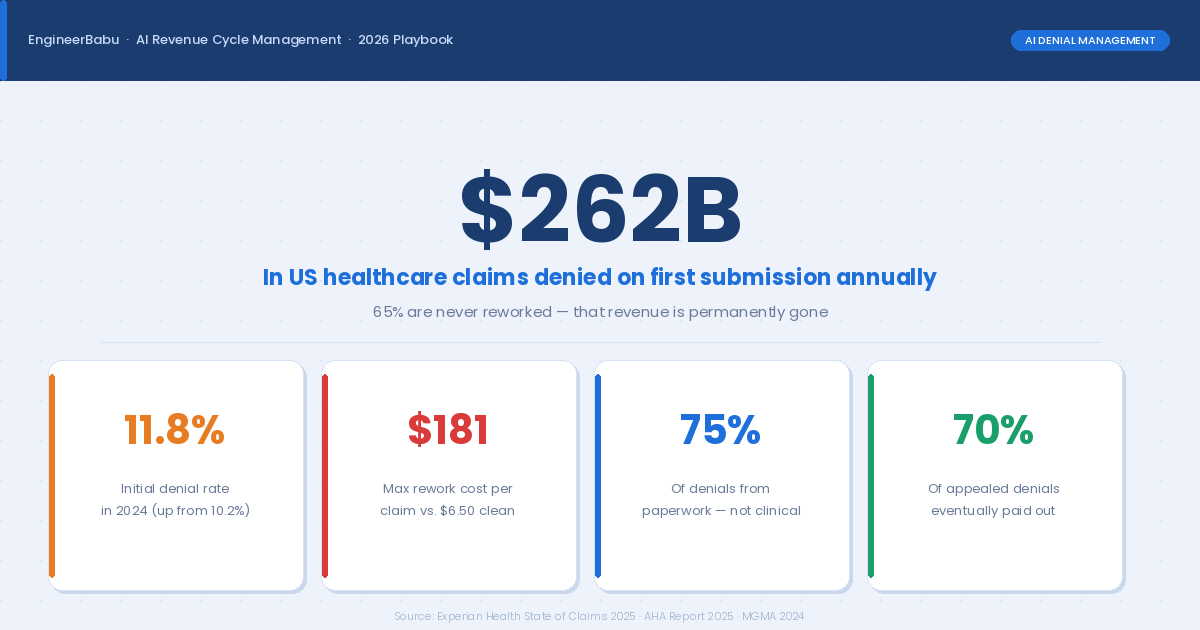
Here is the number that ends every revenue cycle conversation quickly: $262 billion.
That is the estimated value of US healthcare claims denied on first submission annually. Of those, 65% are never reworked, they age out, and that revenue is permanently gone. The cost to process a clean claim on first pass: approximately $6.50.
The cost to rework a denied claim: $25–$181 per claim. The industry median first-submission denial rate in 2024: 11.8%, up from 10.2% the prior year.
Meanwhile, payers have deployed AI systems that reject claims at scales no manual review could match, the same algorithmic infrastructure we documented in the prior authorization blog.
One payer’s system was documented rejecting 300,000 claims in two months. Providers responding to that volume with manual denial management workflows are structurally mismatched.
I’m Mayank Pratap, co-founder of EngineerBabu, a Google AI Accelerator team building AI revenue cycle management systems. This is the denial reduction playbook that actually works in 2026.
AI denial management shifts the revenue cycle posture from reactive (working denials after they happen) to predictive (preventing denials before claims are submitted).
It uses machine learning models trained on historical claims data, NLP to analyze clinical documentation against payer criteria, real-time eligibility verification, and generative AI to draft appeal letters.
Thus, targeting the 60–70% of denials that are preventable with better upstream processes.
Before the playbook, the context:
11.8% initial denial rate (Experian Health 2025 State of Claims), more than 1 in 9 claims denied on first submission.
$262 billion in annual denied claims. Roughly 65% of those are never recovered. The AHA reports hospitals spent $43 billion in 2025 alone trying to collect from insurers for care already delivered.
Rework economics: Clean claim costs $6.50 to process. Denied claim costs $25–$181 to rework. Medicare Advantage denial rework specifically costs $47.77/claim; commercial denial rework averages $63.76.
Appeal success vs. effort: 54–70% of denied claims are eventually paid when actively appealed. But fewer than 0.2% of denied ACA marketplace claims were appealed by patients in 2024, and fewer than 1% by providers. The gap between “could recover” and “actually recovered” is the denial management opportunity.
The top three denial causes (Experian Health survey, 250 RCM leaders): missing or inaccurate data, authorization failures, and inaccurate/incomplete patient information. Three in four denials stem from paperwork or plan design, not clinical judgment. That means 75% of denials are, in principle, preventable with better upstream processes.
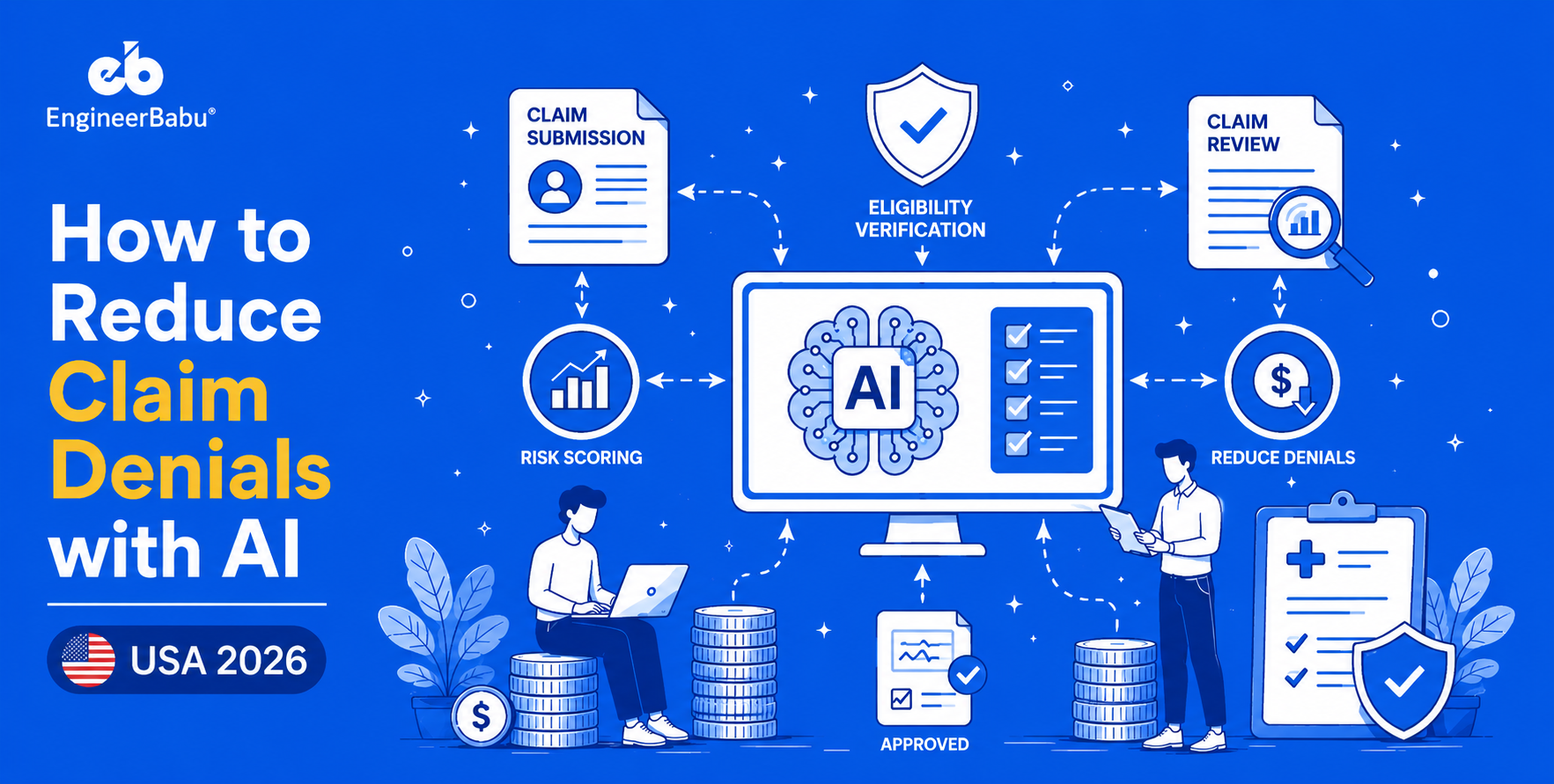
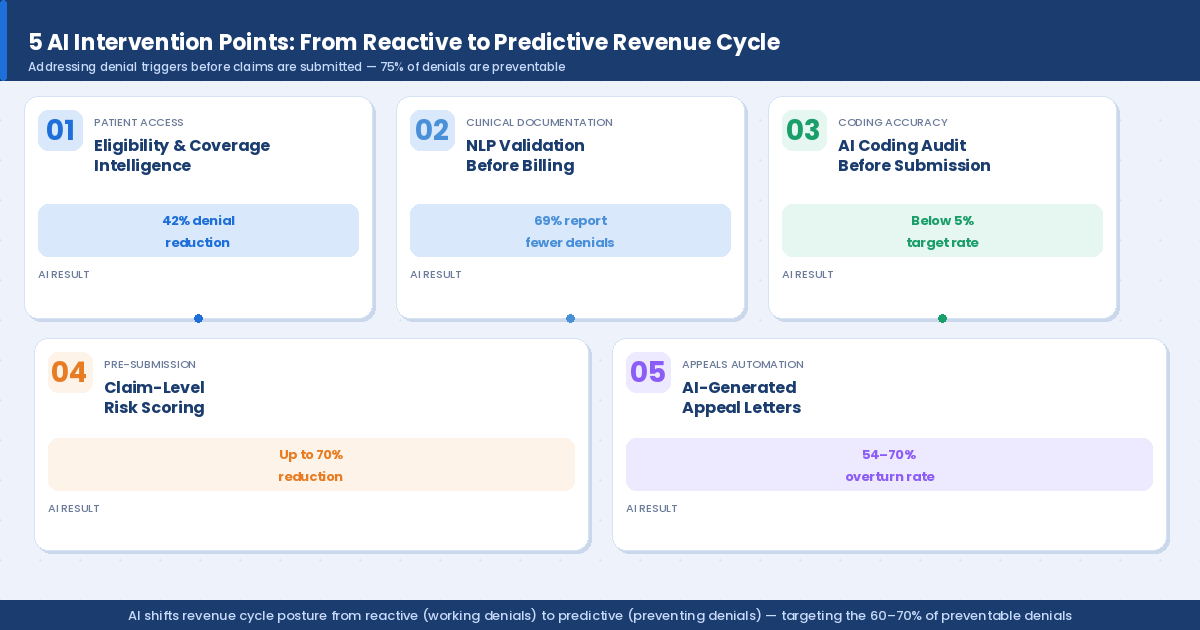
AI reduces denials not by working denials faster, but by addressing denial triggers earlier in the revenue cycle. The five intervention points:
The denial cause: Patient registered with insurance information that was accurate at scheduling but stale at date of service. Post-ACA Medicaid redeterminations and commercial plan churning mean eligibility verified two weeks ago may be wrong today.
The AI intervention: Real-time eligibility verification at every patient touch point, scheduling, pre-registration, day of service with AI-driven risk scoring that flags coverage anomalies before the appointment. OhioHealth reduced registration and eligibility-related denials by 42% using Experian Health’s Patient Access Curator platform.
What to build technically: FHIR-based payer eligibility API connections (most major payers expose eligibility via FHIR R4 Coverage resources or X12 270/271 transactions), AI anomaly detection on coverage data patterns (insurance ID format validation, coverage date logic, plan type consistency), and automated alerts to registration staff when coverage flags arise.
The denial cause: Clinical documentation that satisfied a payer’s medical necessity criteria in 2022 fails their AI-driven review in 2026. Payer policies tighten continuously. Documentation that doesn’t match current criteria generates clinical denials.
The AI intervention: NLP engines that read clinical notes at the point of charge capture and flag documentation gaps against payer-specific medical necessity criteria. Generative AI that suggests specific documentation language to satisfy the criteria, presented to the provider before the note is finalized.
The result: 69% of providers using AI in claims processes report reduced denials (Experian Health 2025 survey). Black Book Research found 83% saw at least 10% denial reduction within six months.
The denial cause: ICD-10, CPT, and HCC coding errors. Wrong code selected, missing modifier, code combination that triggers an edit. Each error is a preventable denial but at high volume with complex coding requirements, human error is inevitable.
The AI intervention: AI coding engines that validate code selection against clinical documentation, identify missing modifiers, flag code combination edits (Correct Coding Initiative edits, medically unlikely edits), and suggest more specific ICD-10 codes where the documentation supports higher specificity. For RCM operations targeting HCC revenue capture, the same $5/visit uplift documented in the AI scribe blog, AI coding audit also surfaces HCC recapture opportunities.
Clean claim rate benchmark: Best-in-class practices hold first-submission denial rates below 5% (MGMA). Median is 8–11.8%. The difference is substantially driven by coding accuracy.
The denial cause: Claims with multiple risk factors that individually might pass review but in combination trigger denial, wrong place of service, procedure code not covered under the patient’s specific plan, missing coordination of benefits information.
The AI intervention: Predictive denial scoring at the claim level before submission. ML models trained on the organization’s historical claims data and payer response patterns assign a denial probability score to each claim. High-risk claims are routed for human review before submission. Low-risk claims pass through automatically.
The 70% preventability threshold: AI denial prevention tools targeting this layer report reducing preventable denials by 30–70%. RapidClaims’ RapidScrub platform reports cutting preventable denials by up to 70%.
The denial cause: Even with strong upstream prevention, some denials are inevitable. The response speed and quality of appeals directly determines recovery rate. Manual appeal letter drafting is slow, inconsistent, and doesn’t scale to denial volume.
The AI intervention: Generative AI that reads the denial reason, pulls relevant clinical documentation from the EHR, maps it against the payer’s specific appeal requirements, and drafts a structured appeal letter with supporting evidence. Human RCM staff review, edit, and submit.
The current reality: 54–70% of actively appealed denials are eventually paid. Organizations with AI-automated appeals workflows process appeals in hours rather than days, dramatically improving both recovery rate and the administrative cost of recovery.
For teams building AI denial management systems rather than buying them, the technical components:
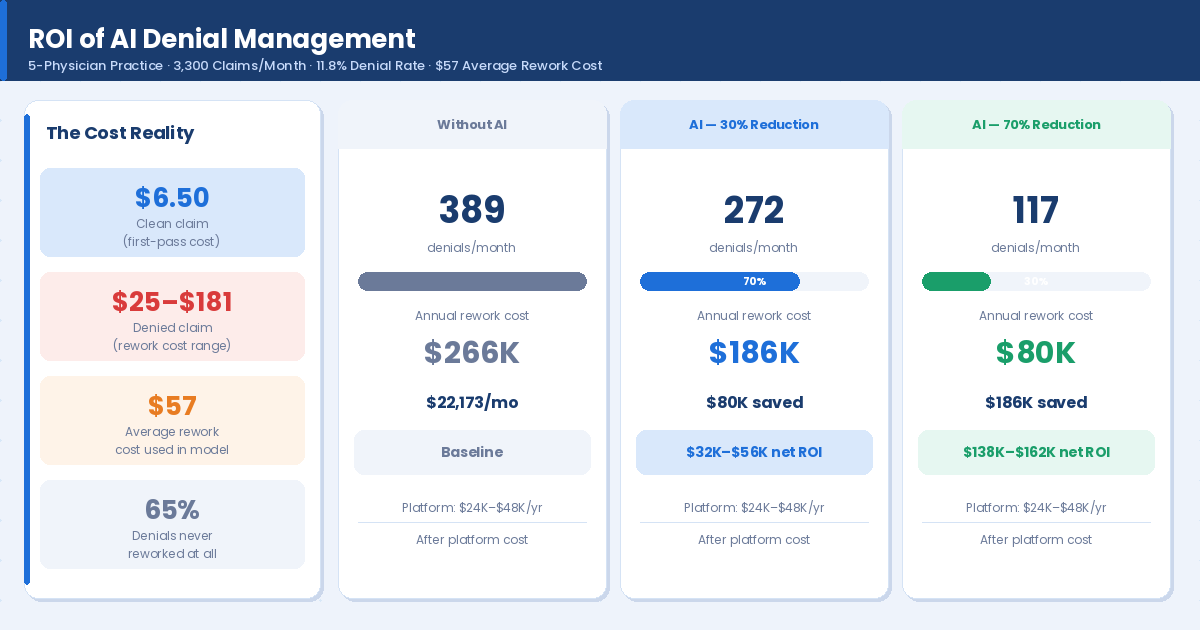
For a 5-physician practice generating 3,300 claims/month at an 11.8% initial denial rate:
| Metric | Without AI | With AI (30% reduction) | With AI (70% reduction) |
| Monthly denials | 389 | 272 | 117 |
| Rework cost ($57/denial avg) | $22,173/month | $15,504/month | $6,669/month |
| Annual rework cost | $266,076 | $186,048 | $80,028 |
| Annual savings vs. baseline | — | $80,028 | $186,048 |
| Platform cost (typical) | — | $24,000–$48,000 | $24,000–$48,000 |
| Net annual ROI | — | $32,000–$56,000 | $138,000–$162,000 |
For a 200-bed hospital processing 50,000 claims/month at 11.8% denial rate: the AI denial prevention math generates millions annually in avoided rework costs plus recovered revenue from the 65% of denials that would otherwise have been written off.
AI addresses most effectively:
AI does not solve:
The distinction matters for implementation. AI prevention tools target the ~75% of denials from administrative and documentation causes. The remaining ~25% from clinical judgment disputes require human escalation.
The 2024 initial claim denial rate reached 11.8% (Experian Health State of Claims 2025), up from 10.2% the prior year. Best-in-class practices hold first-submission denial rates below 5% (MGMA). Medicare Advantage plans denied approximately 17% of initial submissions in recent analysis.
$262 billion in claims are denied annually in the US. Reworking a denied claim costs $25–$181 compared to $6.50 for a clean first-submission claim. Hospitals spent $43 billion in 2025 alone trying to collect from insurers. 65% of denied claims are never reworked.
AI targeting preventable denials, the 75% of denials caused by administrative, documentation, and coding errors rather than clinical judgment can achieve 30–70% reductions. OhioHealth achieved 42% reduction in registration/eligibility denials. Black Book Research found 83% of AI adopters saw 10%+ reduction within six months. Actual results depend on implementation quality and denial mix.
Per Experian Health’s 2025 State of Claims survey: (1) missing or inaccurate data, (2) authorization failures, and (3) inaccurate/incomplete patient information. Three in four denials stem from paperwork or plan design issues not clinical judgment disputes.
Leading platforms include Waystar (processing $1.8T in annual claims), Innovaccer (Black Book #1 AI RCM 2026), RapidClaims, Experian Health AI Advantage, Availity Essentials Pro, and Change Healthcare. For custom AI denial management builds: GPT-4o via Azure OpenAI BAA for documentation NLP, XGBoost/gradient boosting for denial prediction, FHIR R4 for EHR integration, and X12 EDI for payer connectivity.