Custom EHR vs Epic vs Cerner: Which to Choose in the USA (2026)


Create engaging, high-performance mobile applications tailored to your business needs. We craft future-ready apps that offer smooth user experiences on all devices.
Build robust and scalable websites and CMS platforms that help you manage content effortlessly. Our development ensures a seamless digital presence.
Launch secure, feature-rich online stores with intuitive shopping experiences. We build tailored eCommerce platforms designed for growth.
Design captivating games with immersive gameplay and stunning graphics. From concept to launch, we build engaging experiences that players love.
Enhance your customer relationships with customized Salesforce implementations. Drive growth and efficiency with smarter CRM solutions.
Harness artificial intelligence and machine learning to automate workflows and gain actionable insights. Our AI transforms data into smart decisions.
Accelerate your software delivery lifecycle with continuous integration, delivery, and infrastructure automation to boost efficiency.
A hospital CTO called me in January. They had a budget approval for a new clinical documentation system and three options on the table: Epic, Oracle Health (Cerner), and a custom-built EHR tailored to their specialty workflows.
Their Epic sales rep had told them Epic was the obvious choice. Their Oracle rep had told them Epic was overpriced and difficult. Their board had heard horror stories about custom builds going over budget. Nobody was giving them a straight answer.
I’m Mayank Pratap, co-founder of EngineerBabu, a CMMI Level 5 healthcare software team that has built custom EHR modules, integrated with Epic and Cerner production environments, and helped health systems evaluate all three paths. Here’s the framework I gave that CTO.
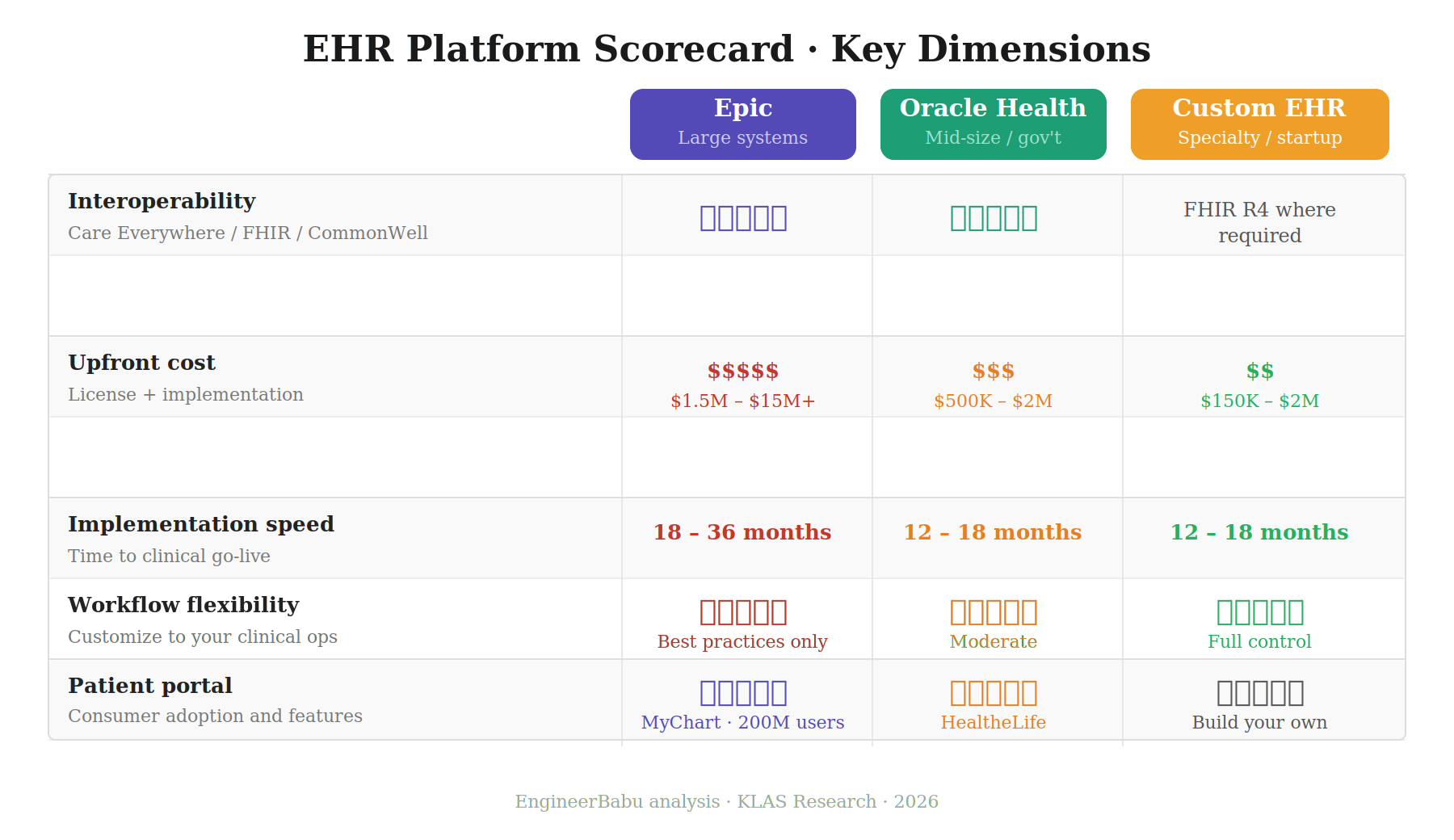
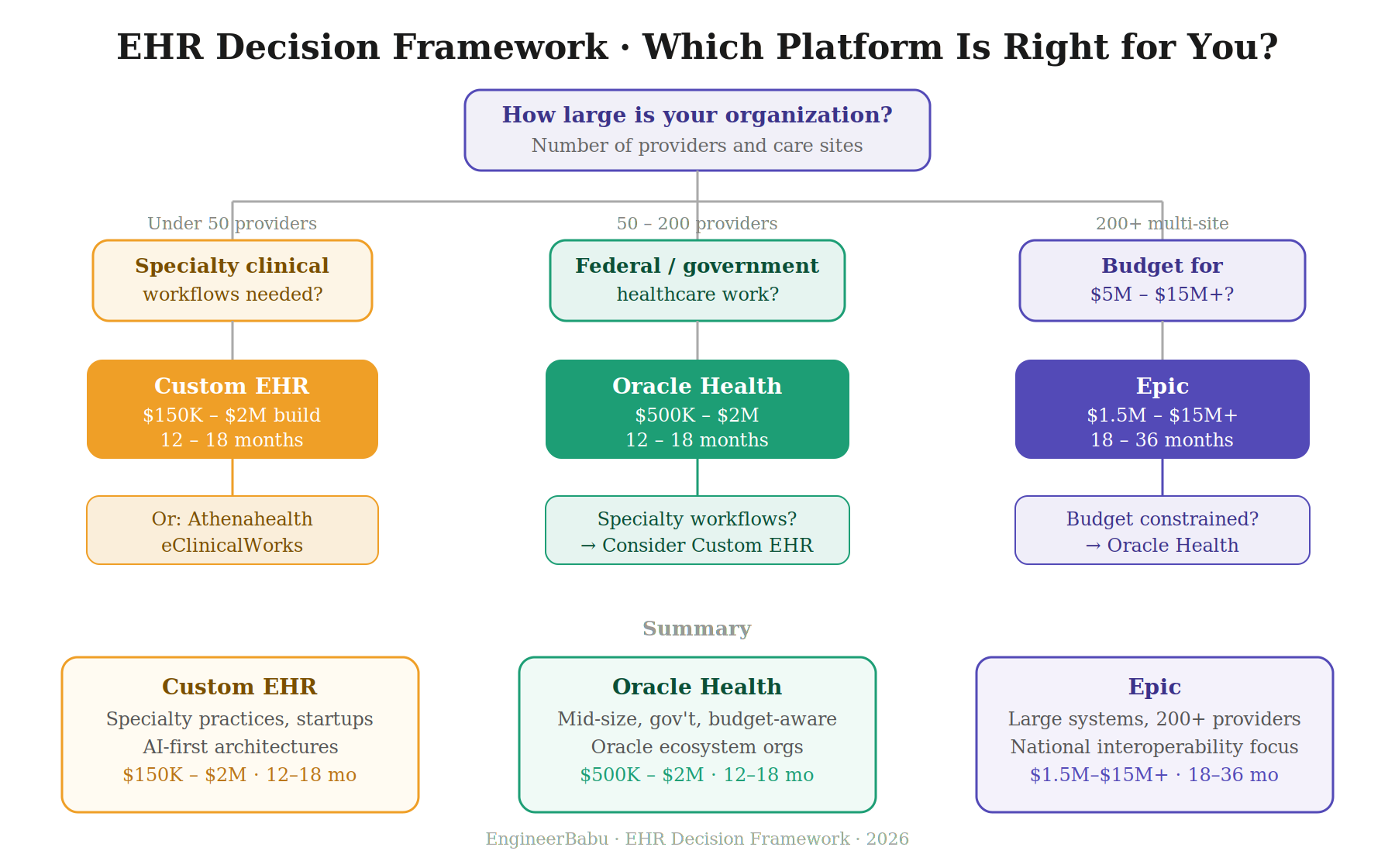
Epic is the right choice for large health systems (200+ beds, complex multi-specialty workflows) that can afford $1M–$15M+ in implementation costs and 18–36 months of organizational disruption, and need national-scale interoperability through Epic’s Care Everywhere network.
Oracle Health (Cerner) is the right choice for mid-size hospitals, government/VA healthcare, and organizations that need faster implementation timelines at lower cost but accept a platform in the middle of a cloud migration.
A custom EHR is the right choice for specialty practices, digital health startups, and organizations with unique clinical workflows that commercial systems can’t accommodate at $150K–$2M build cost with 12–18 months to production, versus $1.5M–$15M+ for Epic or Cerner.
Before diving into the comparison, the market context matters enormously:
Epic now holds 36% hospital market share and covers 48% of US hospital beds. Its customer retention rate exceeds 95%, once a health system implements Epic, switching is extraordinarily rare.
Oracle Health (Cerner), following Oracle’s $28.3 billion acquisition in 2022, holds approximately 21–23% of the acute-care hospital EHR market. Oracle is mid-migration, moving the legacy Cerner Millennium platform to Oracle Cloud Infrastructure (OCI). This migration creates both opportunity (modern cloud architecture) and risk (uncertainty about timelines and feature parity).
Together, Epic and Oracle Health control 61% of the hospital EHR market, per KLAS Research. The remaining market includes Meditech, Altera Digital Health, eClinicalWorks, Athenahealth, and custom builds, primarily serving smaller practices and specialty care settings.
One critical 2026 development: several long-time Cerner customers have cited uncertainty about Oracle’s migration timeline as a factor in evaluating Epic alternatives. For organizations with Cerner Millennium contracts expiring in 2026–2027, the EHR decision is live and the most consequential IT decision they will make this decade.
Epic’s dominance exists for reasons beyond marketing. Its Care Everywhere interoperability network connects 305+ million patient records and handles 220 million record exchanges per month, 50% of those from non-Epic platforms. For a large health system whose patients receive care across multiple organizations, this network effect is genuinely difficult to replicate.
Epic’s patient portal, MyChart, has over 200 million active users, the largest patient engagement platform in US healthcare. For organizations where patient portal adoption is a strategic priority, Epic’s installed user base is a structural advantage.
Epic also integrates clinical, financial, patient engagement, and population health operations in a single platform. At scale, 500+ physicians, multi-site, this integration reduces the operational overhead of managing multiple vendor relationships. Epic’s AI capabilities (ambient documentation via Nuance DAX/Abridge partnerships, Penny for RCM, sepsis prediction models) are deployed across 300+ health systems in production.
The cost is not what the sales deck says it is.
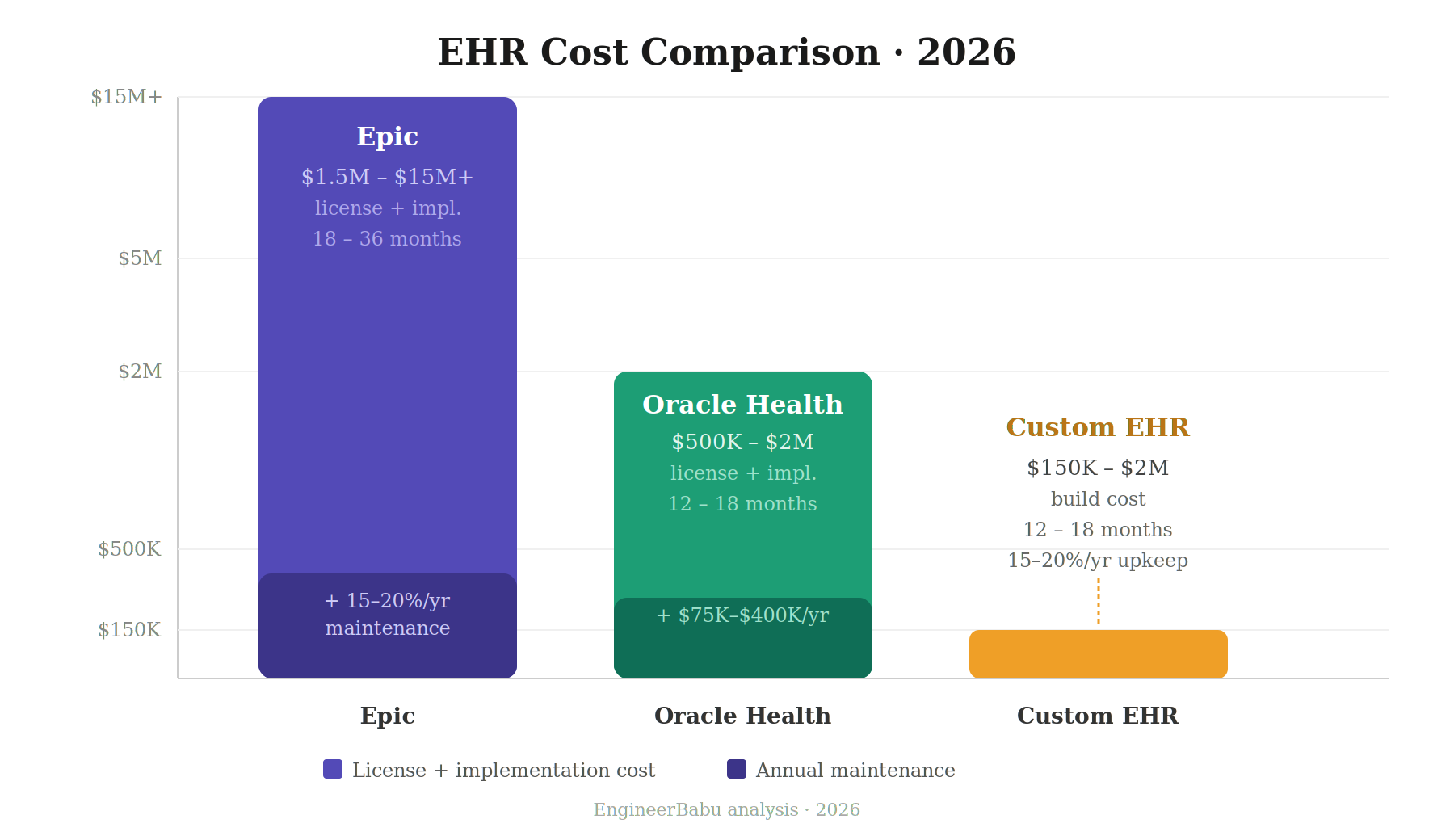
Epic’s published pricing is deliberately opaque, but the real numbers from 2026 implementations:
| Cost Component | Range |
| Licensing (small hospital) | $500K–$1.5M |
| Licensing (large health system) | $5M–$15M+ |
| Implementation services | $500K–$5M+ |
| Data migration | $100K–$500K |
| Training | $500K–$2M+ |
| Annual maintenance (15–20% of license) | $75K–$3M+/year |
| Physician productivity loss (20–30% for 3–6 months) | Up to $2.25M for 50-physician practice |
| Specialty modules (each) | $50K–$200K |
| Per integration (labs, imaging, pharmacy) | $25K–$100K each |
A 500-provider health network full implementation: $80M+ when all costs are included, per benchmarks cited in multiple 2026 guides.
The physician productivity drop is the hidden cost that kills implementation ROI. A 50-physician practice generating $15M annually loses $900K–$2.25M in revenue during the 3–6 month post-go-live adaptation period. This is real, documented, and almost never appears in vendor proposals.
Epic implementations take 18–36 months. For large, multi-site deployments, this is an organizational transformation initiative consuming enormous management attention. Implementation success depends more on change management than on the technology itself.
Epic is famously resistant to customization. Their “best practices” philosophy means Epic prefers you adapt your workflows to their system, not the reverse. Organizations that heavily customize Epic from day one experience 40–50% cost overruns. For specialty practices with genuinely differentiated clinical workflows, this rigidity is a structural problem.
Oracle Health is meaningfully less expensive than Epic for comparable functionality. Cerner implementations are often faster and more modular, making them viable for mid-size hospitals that can’t commit to Epic’s 18–36 month timeline.
Oracle Health’s open architecture philosophy has historically enabled easier third-party integration than Epic, a genuine advantage in organizations running multi-vendor environments. Their CommonWell Health Alliance participation provides cross-platform interoperability where Epic-to-Epic exchange isn’t available.
Oracle’s cloud infrastructure (OCI) backing the platform represents a long-term architectural advantage if the migration executes successfully. Oracle’s scale in enterprise infrastructure could ultimately deliver better performance, scalability, and disaster recovery than Epic’s internally managed hosting.
Oracle Health is the dominant platform in federal healthcare, the Department of Defense MHS GENESIS contract ($4.3 billion) and the VA’s Oracle Health deployment make it essentially mandatory for organizations doing significant federal healthcare work.
The Oracle acquisition uncertainty is real and ongoing. Several high-profile health systems have moved from Cerner to Epic since 2022. KLAS satisfaction scores for Oracle Health have declined. Customers cite uncertainty about the migration timeline from Cerner Millennium to OCI as a source of operational and strategic risk.
Per EHR Source’s 2026 analysis: “For organizations currently on Cerner Millennium, the decision to migrate to Epic versus waiting for Oracle’s cloud platform is the most consequential IT decision they will make this decade.”
Oracle Health’s patient portal (HealtheLife) has significantly lower consumer adoption than Epic’s MyChart. For organizations prioritizing patient engagement metrics, this gap is material.
This is the option the sales reps from Epic and Cerner won’t tell you about honestly and the one that many specialty practices and digital health builders are choosing in 2026.
| Option | Build/License Cost | Timeline | Annual Ongoing |
| Epic (mid-size hospital) | $1.5M–$5M | 18–24 months | $225K–$1M |
| Oracle Health (Cerner) | $500K–$2M | 12–18 months | $75K–$400K |
| Custom EHR (specialty/startup) | $150K–$2M | 12–18 months | 15–20% of build |
Custom EHR builds typically cost $150K–$2M upfront, a fraction of Epic’s licensing plus implementation cost while delivering workflows designed specifically for the practice’s clinical operations.
For context, the EngineerBabu stack for a custom EHR:
Custom EHR is the wrong choice when:
Answer these four questions to reach the right answer for your organization:
Epic implementation costs range from $500K for small hospitals to $15M+ for large multi-site health systems. A 500-provider network full implementation including all hidden costs can reach $80M+. Annual maintenance runs 15–20% of the initial license fee. The physician productivity loss during go-live (20–30% drop for 3–6 months) adds millions more in indirect cost.
Oracle acquired Cerner in 2022 for $28.3 billion and rebranded it as Oracle Health. The underlying platform is still largely Cerner Millennium, being migrated to Oracle Cloud Infrastructure. Oracle Health holds approximately 21–23% of the US acute-care hospital EHR market, with its strongest position in government healthcare.
Custom EHR makes sense when:
(1) your clinical workflows are specialty-specific and commercial systems handle them poorly,
(2) you’re a digital health startup building a product rather than implementing an enterprise system,
(3) you need AI-first architecture that commercial EHR overlay models don’t support, or
(4) Epic’s cost ($1.5M–$15M+) exceeds what your organization can justify. Custom builds at $150K–$2M deliver 12–18 month timelines with full workflow ownership.
For large health systems where national interoperability, integrated financial operations, and MyChart patient engagement are strategic priorities, yes. Epic’s 95%+ retention rate reflects genuine value at scale. For organizations under 200 providers, or those with specialty or startup needs, the cost-benefit rarely works in Epic’s favor.
Epic implementations typically take 18–36 months for mid-size to large health systems. A complex multi-site rollout can take 3+ years. Cerner implementations are generally faster (12–18 months). Custom EHR builds take 12–18 months to a production-ready MVP.
KLAS Research is the independent analyst firm that publishes vendor performance and satisfaction scores for healthcare IT products. KLAS scores are the primary independent reference point for health system CIOs evaluating EHR vendors. Epic consistently leads KLAS satisfaction rankings; Oracle Health’s KLAS scores have declined since the 2022 acquisition.