Ambient AI Scribe vs Human Medical Scribe in the USA: What the 2026 Data Actually Shows


Create engaging, high-performance mobile applications tailored to your business needs. We craft future-ready apps that offer smooth user experiences on all devices.
Build robust and scalable websites and CMS platforms that help you manage content effortlessly. Our development ensures a seamless digital presence.
Launch secure, feature-rich online stores with intuitive shopping experiences. We build tailored eCommerce platforms designed for growth.
Design captivating games with immersive gameplay and stunning graphics. From concept to launch, we build engaging experiences that players love.
Enhance your customer relationships with customized Salesforce implementations. Drive growth and efficiency with smarter CRM solutions.
Harness artificial intelligence and machine learning to automate workflows and gain actionable insights. Our AI transforms data into smart decisions.
Accelerate your software delivery lifecycle with continuous integration, delivery, and infrastructure automation to boost efficiency.
Hire app developers ready to turn your ideas into sleek, high-performing mobile apps for any platform.
Bring in frontend pros who craft smooth, beautiful, and user-friendly interfaces that your visitors will love.
Get backend developers who build fast, secure, and reliable systems to keep everything running behind the scenes.
Hire eCommerce developers who build secure, scalable online stores designed to offer seamless shopping and grow your sales.
Get dedicated developers committed to your projects, delivering consistent quality and speed as an extension of your team.
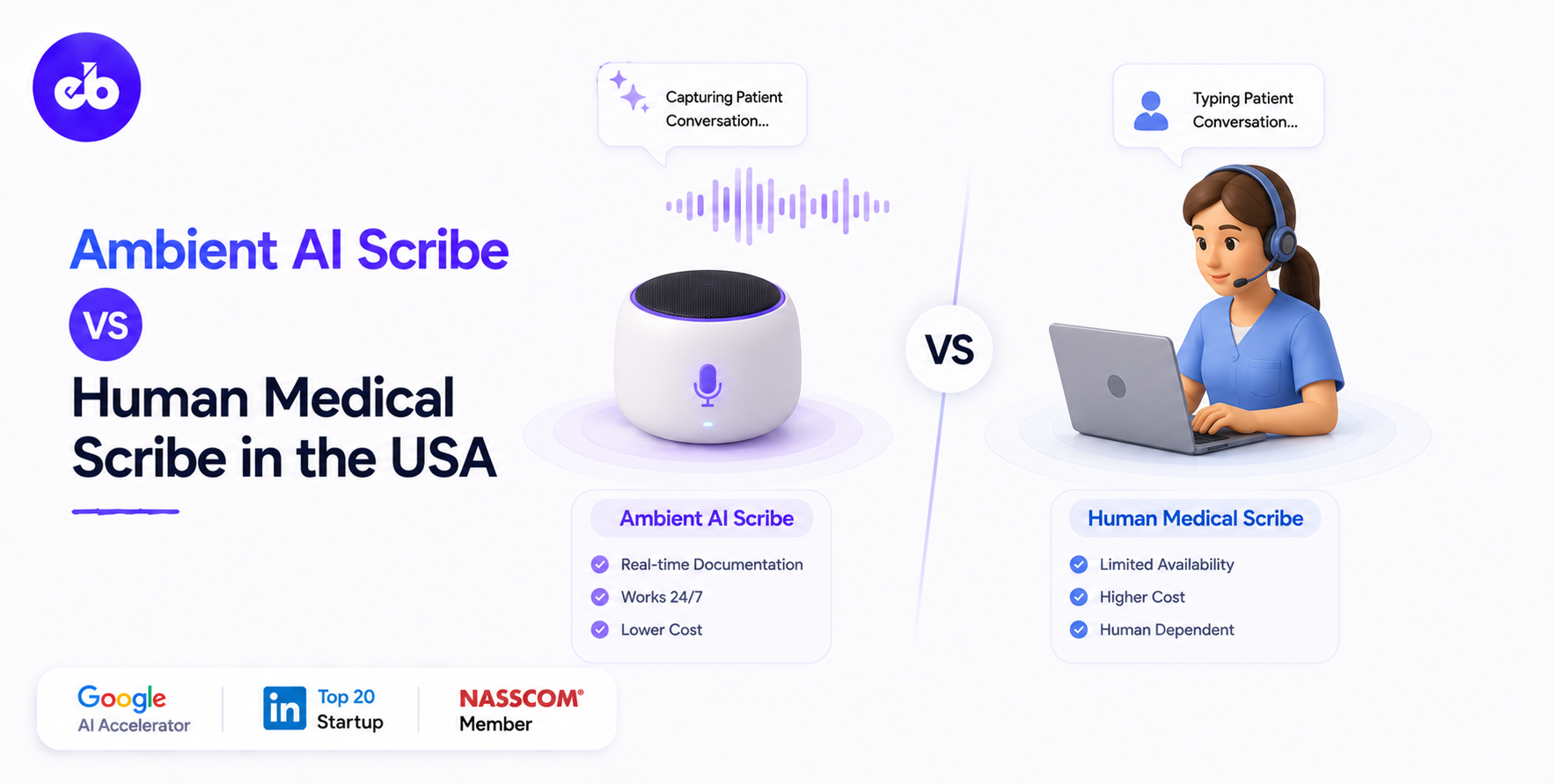
A Chief Medical Information Officer at a regional health system emailed me after I published our AI medical scribe landing page. She’d seen the vendor pitches: Nuance DAX, Abridge, Commure, Freed. She had one question:
“The vendors all show 2-hour documentation savings per day. Our MGB data shows 13 minutes. Who’s lying?”
Nobody was lying. They were measuring different things.
This blog is about the gap between the ambient AI scribe vs human scribe in the USA and what it means for hospital systems evaluating these tools, clinicians deciding whether to adopt them, and health tech teams building products in this space.
I’m Mayank Pratap, co-founder of EngineerBabu, a CMMI Level 5, Google AI Accelerator alumni team that has shipped AI documentation systems for healthcare clients including Apollo Hospitals and ResMed.
We’ve built ambient documentation pipelines, EHR-integrated clinical note generation, and custom scribe infrastructure. This is what the data actually shows when you’re not selling something.
An ambient AI medical scribe is an AI system that listens to a real-time patient-clinician conversation using speech recognition, processes the dialogue and generates a structured clinical note.
This is typically a SOAP note, H&P, or progress note for physician review and EHR integration.
Unlike traditional dictation software requiring explicit commands, ambient scribes work passively in the background during normal conversation. Thus, filtering out small talk and extracting clinically relevant content automatically.
Before comparing anything, one number matters: 88 minutes.
That’s how long the average US clinician spent on administrative tasks daily, according to symplr’s 2025 Compass Survey. Over three years, the industry added nearly 10 minutes of daily administrative burden per clinician. Documentation in the EHR is the largest driver.
A JAMA study found physicians spend approximately 36.2 minutes documenting for every 30-minute office visit. The “pajama time” problem, clinicians finishing notes at home after hours is documented and measurable.
The problem is real. The $4.6 billion annual cost of physician burnout, predominantly driven by documentation, is real. The question is whether ambient AI scribes genuinely solve it, or whether they redistribute the burden in ways the current data doesn’t fully capture yet.
In August 2025, Mass General Brigham published what is now the most-cited study on ambient AI scribes: a JAMA Network Open survey of 1,430 physicians and advanced practice providers across MGB and Emory Healthcare.
What the vendors quote from this study:
All of that is accurate.
What the vendors don’t quote: In April 2026, MGB published a separate study, the first results from the Ambient Clinical Documentation Collaborative (ACDC), which tracked objective EHR metrics on 1,800+ clinicians using AI scribes compared to 6,770 controls.
The actual measured time reduction: 13 minutes per day in EHR usage and 16 minutes in documentation time.
Not 2 hours. Not 90 minutes. Thirteen minutes.
The lead author, Dr. Rebecca Mishuris, Chief Health Information Officer at MGB, stated directly: “The modest reductions in documentation time we observed are unlikely to fully account for changes in burnout, underscoring the need to understand how these tools change how clinicians approach care delivery.”
Additional data worth knowing:
The hybrid finding is significant. The combination of ambient AI with selective human scribe support for complex cases produces substantially better outcomes than either alone.
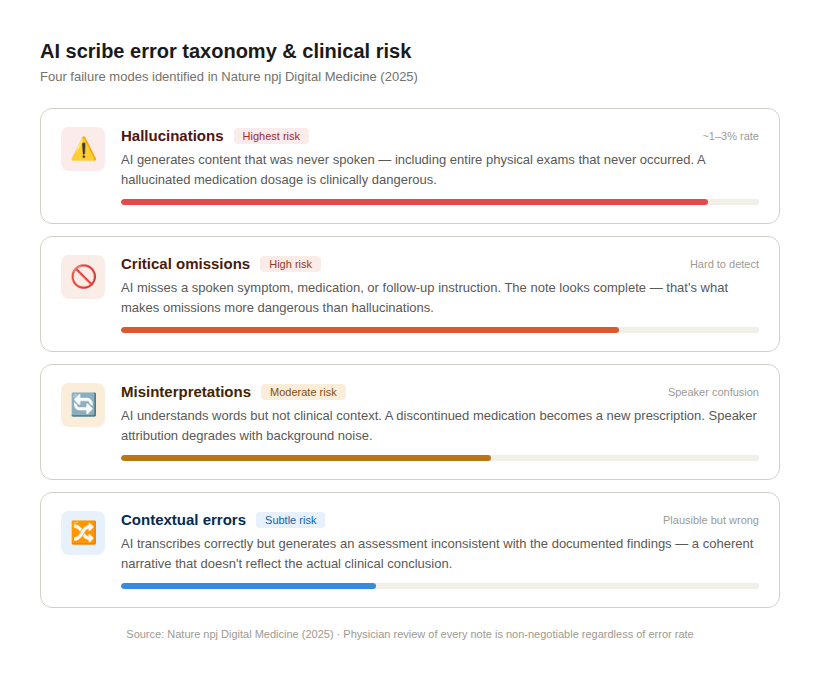
Modern ambient AI scribes report 90–98% accuracy on clinical content, depending on vendor, specialty, and acoustic conditions. That sounds reassuring until you understand the taxonomy of errors.
Published research in Nature npj Digital Medicine (2025) identified four distinct failure modes, each with different clinical risk profiles:
The overall hallucination rate is approximately 1–3% across leading systems. Medical Economics in 2026 noted that hallucination rates sound low until multiplied by millions of encounters.
The clinical risk varies enormously by what gets hallucinated. A hallucinated social history element is annoying. A hallucinated medication dosage or a physical exam finding that never occurred is dangerous.
Physical examination documentation is the highest-risk area. Multiple studies document ambient AI systems recording entire physical examinations that never took place. A normal-appearing examination can mask a serious condition.
The system captures most of the conversation but misses a symptom the patient mentioned, a medication the physician specified, or a follow-up instruction given at the end of the visit.
Omissions are in some ways more dangerous than hallucinations because they’re harder to detect. The note looks complete.
A patient reports discontinuing medication. The AI documents it as a new prescription. Speaker distinction errors, confusing who said what fall in this category. In a multi-provider room or any context with background noise, speaker attribution degrades meaningfully.
The AI correctly transcribes what was said but generates an assessment inconsistent with the documented findings, a coherent narrative that doesn’t reflect the actual clinical conclusion.
No ambient AI scribe is safe without physician review of every generated note before signing. This is not a temporary limitation being engineered away, it is the regulatory and ethical baseline for any AI in clinical documentation.
The physician who signs the note owns the note, legally and clinically, regardless of what generated the first draft.
The positive news: providers consistently report spending 5–10 minutes reviewing and editing AI notes versus 30–45 minutes writing from scratch. That time saving is real, it’s consistent, and it compounds across a full clinic day.
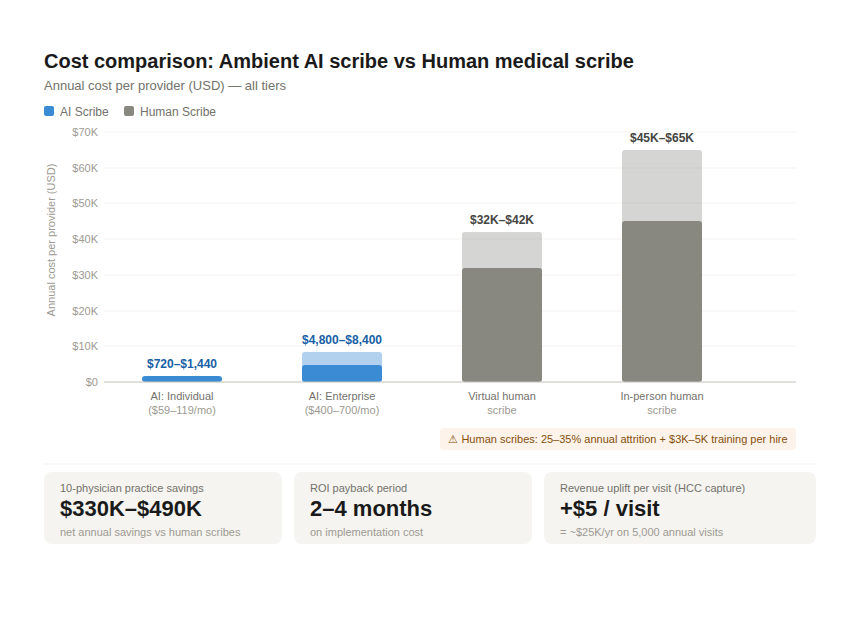
This is where the AI scribe case is unambiguous.
| Type | Annual Cost per Provider |
| In-person scribe (salary + benefits + overhead) | $45,000–$65,000 |
| Virtual human scribe (offshore/onshore remote) | $32,000–$42,000 |
| Training cost per hire | $3,000–$5,000 |
| Annual attrition | 25–35% (requires continuous replacement) |
| Tier | Annual Cost per Provider |
| Individual/small practice (Freed, Twofold, Commure) | $720–$1,440 ($59–$119/month) |
| Enterprise (Nuance DAX, Abridge, Ambience) | $4,800–$8,400 ($400–$700/month) |
| Custom-built ambient scribe (EHR-integrated) | Build once, scale to hundreds of providers |
The ROI math at a specialty group practice: A 10-physician practice replacing human scribes with AI scribes at the enterprise tier saves $380,000–$560,000 annually in scribe costs.
Even at $7,000/provider/year for enterprise AI scribe licensing, the net saving is $330,000–$490,000 per year. ROI on implementation: 2–4 months.
The revenue capture dimension is less discussed but increasingly documented.
A Forbes analysis of Ambience deployments found a measurable revenue uplift of approximately $5 per visit when AI scribes help physicians capture HCC codes, E/M level selection, and ICD-10 specificity they previously undercode for.
On a practice doing 5,000 visits annually, that’s $25,000 in additional annual revenue, essentially additional ROI on top of the cost savings.
The honest answer to the “AI vs human” question is that most large US health systems in 2026 are not choosing between them, they’re deploying a hybrid model.
I said at the start I’d give you the builder’s perspective, not just the clinical one.
The ambient AI scribe market in 2026 has 60+ vendors, according to the Peterson Health Technology Institute. Every EHR vendor is embedding ambient documentation natively, Epic launched its ambient module with deep EHR write-back.
Athenahealth launched its native ambient tool in February 2026, Oracle Health has ambient documentation in its roadmap. The commodity tier of “transcription + basic note generation” is being absorbed into EHR platform pricing.
What that means for the market: the differentiation is moving up the stack.
The teams building in this space that will win are not competing on raw transcription accuracy, that problem is largely solved. They’re competing on:
The EngineerBabu team builds custom ambient documentation systems, using Deepgram for medical-grade speech recognition, GPT-4o or fine-tuned clinical LLMs for note generation, FHIR R4 for EHR integration, and LangSmith for LLMOps monitoring.
If you’re building a healthcare product that needs documentation AI embedded in the workflow rather than bolted on as a third-party vendor, that’s a different product than what Nuance or Abridge is selling and the economics look very different at scale.
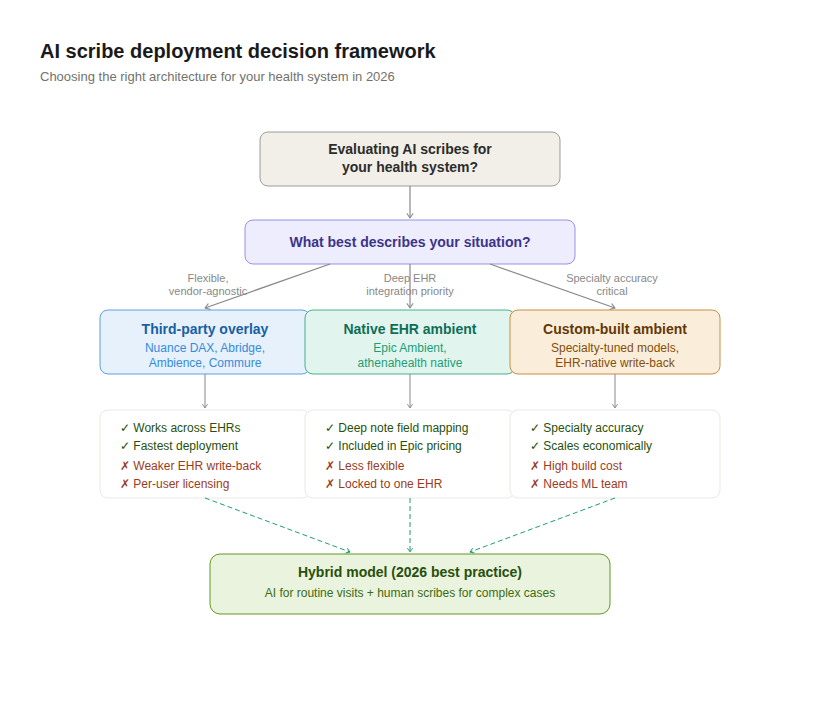
This is no longer an emerging technology evaluation. It is a deployment optimization conversation. The question for most US health systems is not “should we adopt ambient AI scribes” but “which workflow model, which vendor configuration, and which clinical contexts get human scribe support versus AI-only.”
For health system IT and digital health leaders, the practical question is increasingly: do we buy a third-party overlay (Nuance DAX, Abridge, Ambience) that lives outside the EHR, or do we invest in native EHR ambient tools (Epic ambient, athenahealth native) that have deeper write-back integration but less flexibility, or do we build a custom ambient layer for specialty workflows where third-party accuracy is insufficient?
The answer depends on your EHR configuration, specialty mix, and how much of your revenue capture is driven by documentation quality. There’s no universal answer, which is exactly why the CMIO who emailed me was right to push past the vendor marketing to the actual data.
The CMIO was right to be skeptical of the 2-hour headline. The real number is 13 minutes of measurable EHR time reduction. The real benefit is 21.2% burnout reduction, which comes from something harder to measure than documentation time: the experience of being present with patients instead of staring at a screen.
Both things are true. Ambient AI scribes genuinely reduce burnout. They do so less through time savings than through changed engagement during the clinical encounter itself. The financial case is unambiguous at the cost differential. The safety case requires physician review of every note, every time, with particular attention to physical exam documentation.
The health system leaders and health tech builders who understand both sides of that reality, the genuine benefits and the genuine risks are making better decisions than the ones working from vendor marketing decks alone.
If you’re building a healthcare product with ambient documentation requirements, or evaluating whether to embed AI scribe capabilities into an existing clinical platform, I take those scoping conversations seriously.
Reach me at mayank@engineerbabu.com.
Author: Mayank Pratap Co-Founder, EngineerBabu Google AI Accelerator 2024 · CMMI Level 5 · 500+ Products · 20+ Countries LinkedIn
An ambient AI scribe passively listens to a natural patient-clinician conversation and generates a structured clinical note automatically. Traditional dictation requires the physician to speak notes explicitly to the system after or during the visit. Ambient scribes work without breaking the conversational flow of a clinical encounter, the physician talks to the patient, not the software.
MGB’s JAMA Network Open study (August 2025) showed a 21.2% absolute reduction in burnout prevalence in 84 days. Their April 2026 ACDC study showed only 13 minutes of objective daily EHR reduction. Both findings are real, the burnout benefit is driven primarily by reduced cognitive load and more patient presence during encounters, not by the raw minutes of documentation time saved.
Leading systems report hallucination rates of 1–3% on clinical content. Physical examination documentation is the highest-risk area, systems have documented entire examinations that never occurred. The critical point: all hallucination rates assume the physician reads and reviews every AI-generated note before signing. No AI scribe vendor accepts clinical liability for generated notes.
Human scribes cost $32,000–$65,000 per provider annually including training and benefits, with 25–35% annual attrition. Enterprise AI scribes cost $4,800–$8,400/provider/year. Independent practice AI tools cost $720–$1,440/provider/year. A 10-physician practice switching from human to AI scribes saves $330,000–$490,000 annually net of licensing costs.
Yes. Epic has a native ambient documentation module (used by 2/3 of Epic hospitals as of June 2025). Nuance DAX, Abridge, Ambience, and other vendors integrate via FHIR R4 APIs and Epic App Orchard. Integration quality, specifically note write-back into the correct Epic note type and field mapping, varies significantly between vendors and requires validation per health system deployment.