Outsource Software Development to India from UK: A Founder's Honest Guide (2026)


Create engaging, high-performance mobile applications tailored to your business needs. We craft future-ready apps that offer smooth user experiences on all devices.
Build robust and scalable websites and CMS platforms that help you manage content effortlessly. Our development ensures a seamless digital presence.
Launch secure, feature-rich online stores with intuitive shopping experiences. We build tailored eCommerce platforms designed for growth.
Design captivating games with immersive gameplay and stunning graphics. From concept to launch, we build engaging experiences that players love.
Enhance your customer relationships with customized Salesforce implementations. Drive growth and efficiency with smarter CRM solutions.
Harness artificial intelligence and machine learning to automate workflows and gain actionable insights. Our AI transforms data into smart decisions.
Accelerate your software delivery lifecycle with continuous integration, delivery, and infrastructure automation to boost efficiency.
Hire app developers ready to turn your ideas into sleek, high-performing mobile apps for any platform.
Bring in frontend pros who craft smooth, beautiful, and user-friendly interfaces that your visitors will love.
Get backend developers who build fast, secure, and reliable systems to keep everything running behind the scenes.
Hire eCommerce developers who build secure, scalable online stores designed to offer seamless shopping and grow your sales.
Get dedicated developers committed to your projects, delivering consistent quality and speed as an extension of your team.
A UK-based fintech founder called me last year. They’d already spent £180,000 with a London agency on an MVP — 14 months in, still not live. A competitor with a similar product had launched, raised a seed round, and was signing their first enterprise clients.
That call is not unusual. I’ve had versions of it hundreds of times.
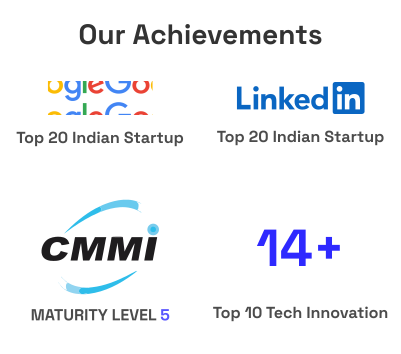
I’m Mayank Pratap. I co-founded EngineerBabu, a CMMI Level 5 product engineering company.
We’ve shipped 500+ products across 20+ countries, built technology for 4 unicorn clients, and delivered 75 YC-selected products. I take on 20 projects a year. Every single client has come through referral. No sales team.
This guide is what I’d tell a UK founder over coffee — before they sign anything.
Outsourcing software development to India from the UK means engaging Indian engineering talent to design, build, and ship software products that your UK-based business owns and operates.
This is not offshoring a call centre. It’s not ticket-based IT support. In 2026, the best Indian product engineering companies are building core infrastructure for fintech, healthtech, and SaaS products that compete in UK and European markets at Series A and Series B scale.
The time zone gap between the UK and India is 4.5 to 5.5 hours, depending on IST vs BST. That gap is actually an asset when managed properly — more on that later.
The honest answer isn’t just cost. If it were only cost, everyone would be doing it successfully. Most aren’t.
IT services make up 72% of all global Staff Outsourcing contract values, consistently ranking among the top outsourced categories. Thus, reflecting how deeply outsourcing is embedded in UK tech operations.
If we talk about the cost, that’s a 10–12x cost difference. But that’s table stakes. The real reasons UK companies choose India:
I’ll give you real numbers, not ranges designed to avoid commitment.
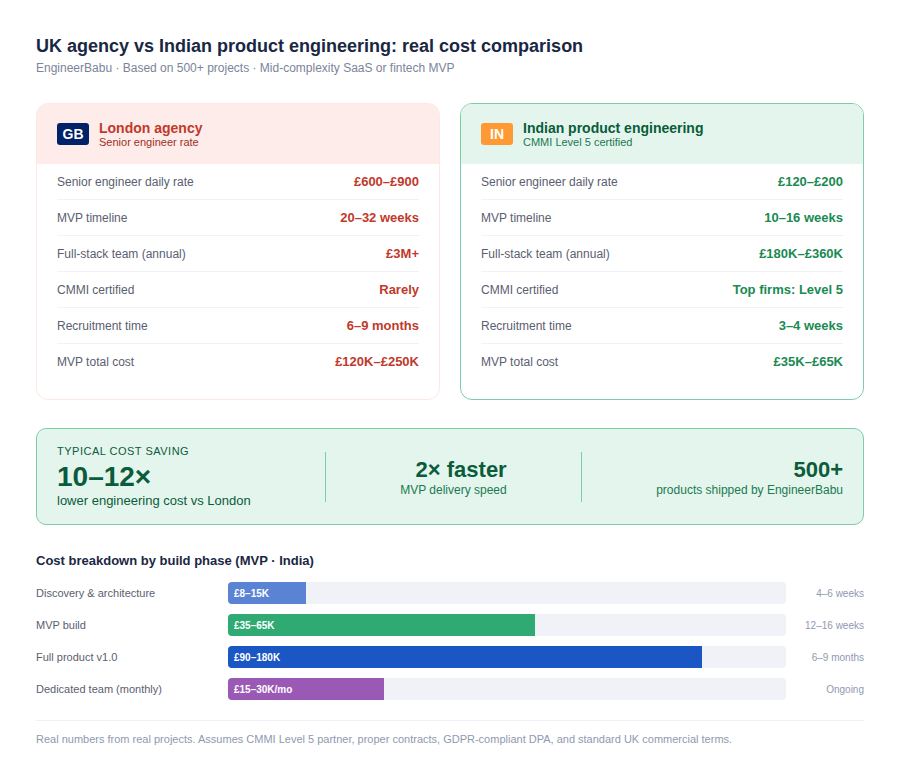
For a mid-complexity SaaS product or a fintech MVP — user authentication, core product logic, third-party integrations, admin dashboard, mobile-responsive frontend — expect:
These numbers assume a legitimate product engineering firm — not a body-shop, not a freelancer platform. CMMI Level 5 certification means the company has documented and optimised its processes to the highest industry standard.
If someone quotes you £12,000 for an MVP and promises 8 weeks, the cut corners will cost you £80,000 to fix later. I’ve seen this pattern more times than I can count.
For comparison, the fintech founder I mentioned above paid £180,000 in London and had nothing.
The EngineerBabu team has built lending platforms that process ₹10,000 crore in disbursements — the full technology stack, compliance architecture, and API integration layer — for a fraction of what UK agencies charge for a basic web application.
This is where most UK companies get it wrong. They evaluate the wrong signals.
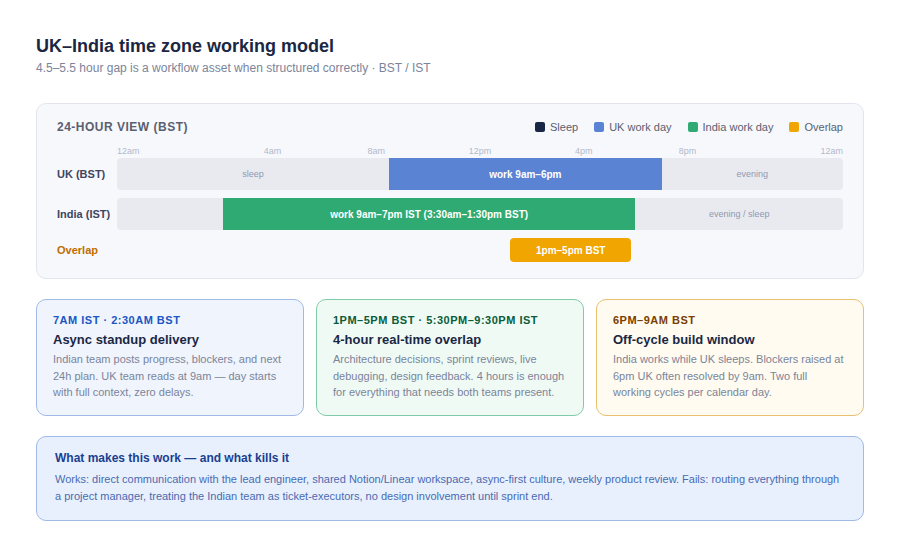
The 4.5–5.5 hour difference between UK (GMT/BST) and India (IST) is manageable with the right working model. It is not a deal-breaker. Here’s how the best teams structure it:
This model works. What doesn’t work is assuming it’ll manage itself. The teams that fail with time zone gaps are the ones that treat the Indian team as ticket-executors rather than product partners. If they’re not in design conversations, they can’t ask the questions that prevent expensive rework later.
Strong fit for outsourcing:
Needs careful handling:
Often gets outsourced badly:
The Simba Beer team, for example, outsourced their AI inventory management and real-time field intelligence system to India. That’s pure engineering execution with well-defined business logic.
The product strategy — what data to capture, which insights matter operationally — stayed with their leadership. That split worked because everyone was honest about where each party adds value.
This section matters more than most guides acknowledge.
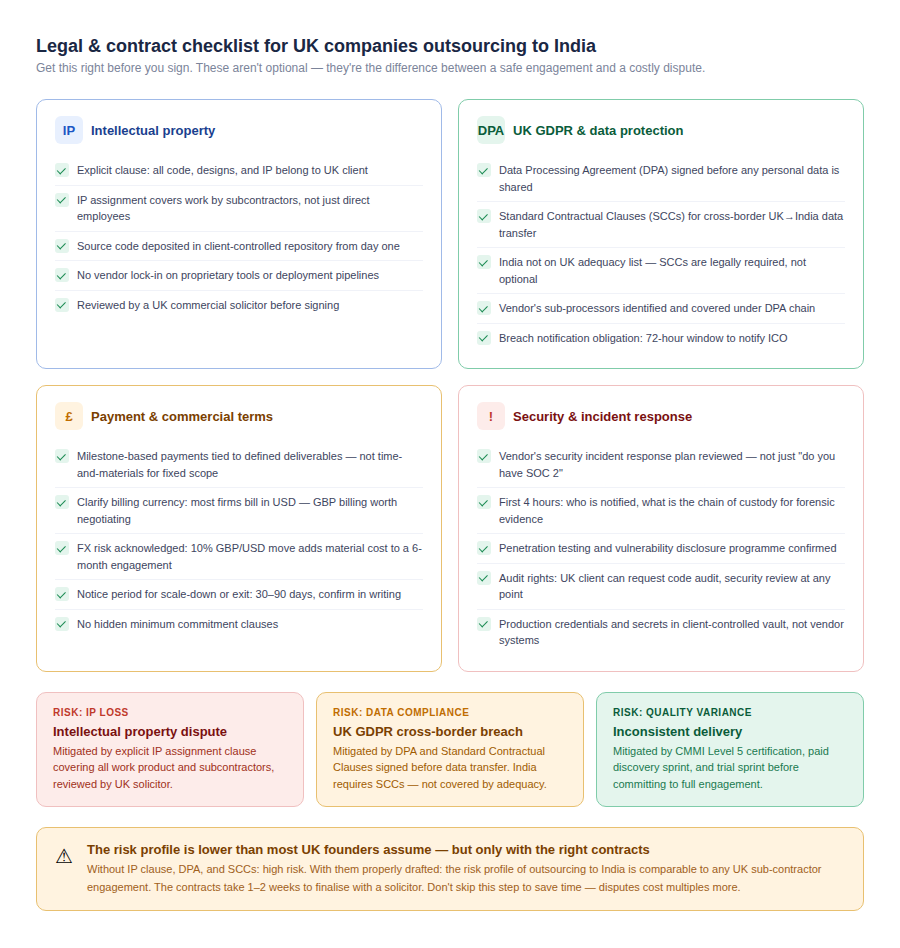
Your contract must explicitly state that all code, designs, and intellectual property created during the engagement is owned entirely by you, the UK client.
This should include work product created by subcontractors, if any. Vague IP clauses have caused serious disputes. Get this reviewed by a UK commercial solicitor.
If your product handles personal data of UK or EU residents, your Indian development partner processes that data on your behalf. You need a Data Processing Agreement (DPA) in place.
Under UK GDPR, cross-border data transfers to India require either Standard Contractual Clauses (SCCs) or an adequacy decision. India is not currently on the UK’s adequacy list — SCCs are required.
Most Indian firms bill in USD. If the pound moves against the dollar, your effective cost changes. A 10% depreciation of GBP against USD adds meaningful cost to a 6-month engagement. Some firms will negotiate GBP billing — worth asking.
Milestone-based payment structures protect you better than time-and-materials billing for fixed-scope work. For longer engagements, a retainer with rolling monthly reviews gives flexibility without losing team continuity.
If you’re building a dedicated team, understand what happens if you need to scale down or exit. Good firms have 30–90 day notice structures. Some lock you into 6-month minimum commitments — read this carefully.
After 500+ projects and 14 years, these are the failure patterns I see repeatedly:
UK founders think they need a 50-page functional specification before approaching an Indian firm. They spend 3 months writing it, then hand it to engineers who’ve never spoken to a customer. The spec is already wrong.
The better model: a 4-week discovery sprint where the engineering team builds the spec with you, asks the questions you didn’t know to ask, and produces an architecture document and phased roadmap that reflects technical reality.
I’ve seen this end badly hundreds of times. A UK startup selects the lowest-cost vendor, gets 6 months of slow delivery and rework, then approaches EngineerBabu or similar to rescue the project.
The rescue project costs 2–3x what the original build would have cost. The total bill — first vendor plus rescue — typically exceeds what a quality firm would have charged originally, with 6–9 months lost.
Daily standups, weekly reports, colourful dashboards — none of these substitute for actual product understanding.
The best engagements I’ve seen have UK stakeholders who can speak with the lead engineer directly, who understand why a particular architectural decision was made, and who treat the Indian team as a genuine product partner.
The worst have UK stakeholders who only talk to a project manager who’s never written code.
“We just need a simple MVP” — I hear this on almost every discovery call.
In practice, “simple” usually means: authentication, user management, core product logic, admin tooling, third-party integrations, mobile responsiveness, performance at reasonable scale, security baseline, and a deployment pipeline. That is not simple.
A realistic discovery conversation with a senior engineer will tell you what the actual scope is. If a firm agrees with your “simple MVP” framing without interrogating it, they’re either inexperienced or they’ll be back to you with change orders in month 2.
Software doesn’t end at launch. Most products require 20–30% of the original build cost annually in ongoing maintenance, security patches, dependency updates, and feature iteration. Budget for this before you start.
| UK Agency | Indian Product Engineering Firm | Freelancer Platform | |
| Senior engineer daily rate | £600–£900 | £120–£200 | £40–£100 |
| MVP timeline | 20–32 weeks | 10–16 weeks | 16–28 weeks (fragmented) |
| Full-stack team availability | Rare without senior premium | Standard | You assemble it yourself |
| Process maturity (CMMI) | Rarely certified | Top firms are Level 5 | None |
| IP risk | Low | Low (with proper contracts) | High |
| GDPR compliance capability | High | Varies — ask for DPA | None |
| Communication overhead | Low | Medium (manageable) | High |
| Best for | Regulated/government work | Product builds, startups, scale-ups | Isolated tasks, augmentation |
If you’re seriously evaluating outsourcing software development to India, here’s how to structure the process:
Not a specification — a brief. What problem are you solving, who’s the user, what does success look like at 6 months, what’s your technical constraint or preference, and what’s your budget range. 2 pages is enough.
Don’t start with Google rankings. Start with founder communities — YC alumni Slack, SaaS founder groups, fintech networks. Referrals surface firms that actually deliver. Ask specifically for references from UK clients.
Any serious firm will offer a structured discovery phase. This produces a technical architecture document, a phased delivery roadmap, and a fixed-price or T&M quote for the build phase. Firms that skip directly to a build quote are skipping the thinking that prevents expensive mid-project corrections.
The quality of the architecture document tells you everything. Is it specific to your product or generic? Does it surface risks you hadn’t considered? Does it show understanding of your market and constraints? Does it reflect real technical depth or surface-level pattern matching?
Before committing to a 6-month engagement, run a sprint. See how the team handles ambiguity, how they communicate blockers, how the code quality holds up. The sprint is your live reference check.
Weekly product review, bi-weekly architecture review, access to version control, deployment pipeline visibility, code quality metrics. Define these upfront. Don’t negotiate governance after problems emerge.
Outsourcing to India is the right decision if:
It’s the wrong decision if:
The fintech founder I opened with eventually got their product live — with a different team. 18 months after the original £180,000 was spent, they had a working product and their first paying customers. They recovered.
But the 18 months mattered. Their competitor had raised a Series A. The window was harder to compete in.
I don’t tell that story to be dramatic. I tell it because I’ve seen it dozens of times, and because it’s entirely preventable. The decision of who builds your product is as important as what you’re building.
If you’re evaluating outsourcing software development to India and want to talk through the architecture decisions, the contract structure, or the team model before you commit — I’m usually the one on those calls.
No sales team. No account manager in between. Just an honest conversation about whether your project is something we’re the right fit for.
Mayank Pratap is the Co-founder of EngineerBabu, a CMMI Level 5 product engineering company recognised in Google AI Accelerator’s Top 20 globally (2024), LinkedIn Top 20 Startups India, and backed by Vijay Shekhar Sharma (Paytm founder).
A properly scoped MVP with a quality Indian product engineering firm costs £35,000–£65,000 over 12–16 weeks. A full product v1.0 runs £90,000–£180,000 over 6–9 months.
Ongoing dedicated team retainers range £15,000–£30,000/month depending on team size and seniority. These are real numbers from real projects — not generic ranges designed to avoid commitment.
With the right contracts in place, yes. Key protections: explicit IP ownership clause covering all work product, Data Processing Agreement for GDPR compliance, Standard Contractual
Clauses for cross-border data transfer, milestone-based payment structure, and audit rights. Get contracts reviewed by a UK commercial solicitor before signing.
The 4.5–5.5 hour time difference enables an effective async-first model. Daily async updates from the Indian team arrive before your UK day begins. A 4-hour real-time overlap window (1pm–5pm BST) covers architecture discussions, reviews, and blockers.
Direct communication with the lead engineer — not routed through a project manager — is non-negotiable for fast-moving products.
CMMI Level 5 is the highest maturity level in the Capability Maturity Model Integration framework, held by less than 1% of software firms globally. It means the company has documented, measured, and continuously improved every process — from requirements management to code review to deployment.
For UK clients, it means predictable delivery, measurable quality, and process rigour that reduces rework risk.
Onboarding a quality partner — brief, shortlist, discovery sprint, sprint review — takes 6–10 weeks before a full build begins. A well-scoped MVP then takes 10–16 weeks. Total from first conversation to live product: 4–6 months.
Firms promising 8-week MVPs without a discovery phase are skipping the thinking that prevents expensive problems at week 14.
Primary risks: IP loss (mitigated by explicit contracts), quality variance (mitigated by CMMI certification and paid discovery sprint), communication breakdown (mitigated by direct engineer access and defined governance), and data compliance gaps (mitigated by DPA and SCCs).
The risk profile of outsourcing to India is substantially lower than most UK founders assume — and substantially higher if they skip the contract and governance steps.