Hospital Management System Development - What Building for 400+ Hospitals Taught Us That No Feature List Can


Create engaging, high-performance mobile applications tailored to your business needs. We craft future-ready apps that offer smooth user experiences on all devices.
Build robust and scalable websites and CMS platforms that help you manage content effortlessly. Our development ensures a seamless digital presence.
Launch secure, feature-rich online stores with intuitive shopping experiences. We build tailored eCommerce platforms designed for growth.
Design captivating games with immersive gameplay and stunning graphics. From concept to launch, we build engaging experiences that players love.
Enhance your customer relationships with customized Salesforce implementations. Drive growth and efficiency with smarter CRM solutions.
Harness artificial intelligence and machine learning to automate workflows and gain actionable insights. Our AI transforms data into smart decisions.
Accelerate your software delivery lifecycle with continuous integration, delivery, and infrastructure automation to boost efficiency.
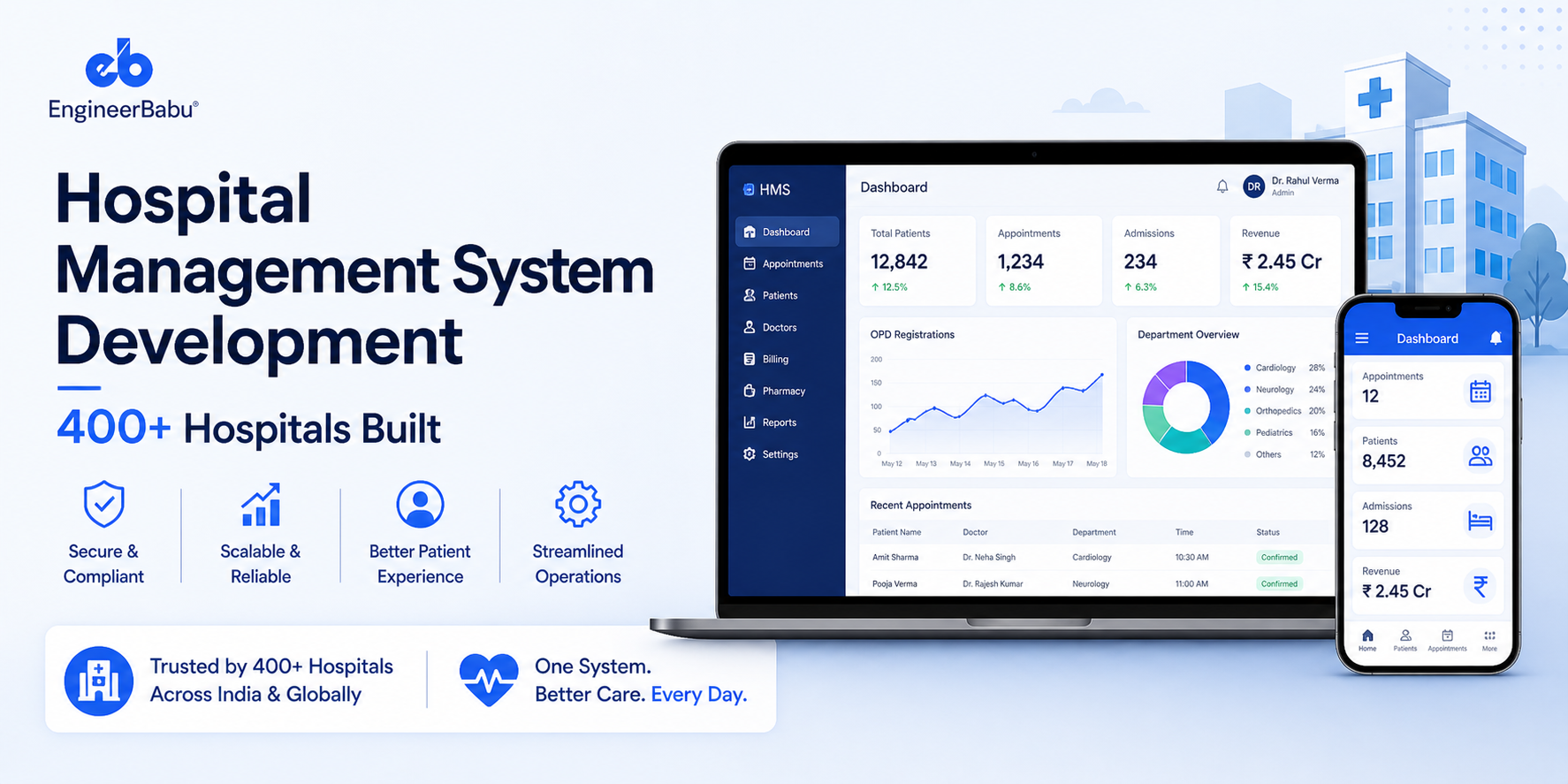
A doctor sees 80 patients in a day.
Not in a luxurious American clinic where each appointment is 30 minutes. In an Indian outpatient department. Eighty patients. Back to back. Six hours. Some with appointments. Many without. Each one needing a different consultation, a different test, a different prescription, a different follow-up.
Now imagine asking that doctor to use a hospital management system designed for a 15-patient-per-day American practice. A system where entering a prescription takes 6 clicks. Where ordering a lab test requires navigating through 3 screens. Where the discharge summary template assumes the doctor has 20 minutes to fill it out.
The doctor doesn’t use it. Or uses it badly. The data is incomplete. The billing is inaccurate. The reports are unreliable. The hospital spent six figures on software that its most important users — the physicians — actively work around.
I’ve seen this pattern at hospitals across India, the UAE, and Africa. Hospitals that bought off-the-shelf HMS software from American or European vendors. Software designed for a different clinical reality. Software that became the most expensive piece of furniture in the building — something everyone walks past but nobody uses.
This is why the EngineerBabu team has built custom hospital management systems for 400+ healthcare clients. Not because custom is always better. Because off-the-shelf fails when clinical workflows don’t match the assumptions baked into the software.
My name is Mayank Pratap. I co-founded EngineerBabu 14 years ago. The team has shipped 500+ products. But healthcare is the vertical where the team’s depth is widest. More healthcare clients than fintech clients. More clinical software deployments than most dedicated health IT companies.
The portfolio includes India’s largest hospital chain. Multi-location hospital groups. Specialty hospital networks. A global Australian medical device company. India’s leading pharmacy and healthcare platform. One of India’s largest diagnostics chains. Telemedicine platforms. Sleep diagnostics systems. Healthcare products across India, the US, the UK, the Middle East, and Africa. 400+ healthcare clients — every one of them a referral.
Google selected EngineerBabu for the AI Accelerator 2024 — and healthcare AI is one of the highest-impact applications of that capability. CMMI certified us at Level 5 — the highest maturity level, directly relevant for healthcare compliance. Vijay Shekhar Sharma backs us personally. 24 clients became unicorns. 75 were Y Combinator-selected.
If you’re a hospital administrator, CIO, or health system leader evaluating whether to build a custom HMS — this is the most honest guide you’ll find. Written by someone who’s built them. Hundreds of times.
The global hospital management system market crossed $35 billion in 2025. Projected to reach $60+ billion by 2030. Every hospital, every clinic, every health system needs software to manage patients, beds, billing, pharmacy, laboratory, and operations.
The problem isn’t availability. Hundreds of HMS products exist. Oracle Health (Cerner). Epic. Meditech. Practo. Healthplix. Insta by Practo. Medixcel. NexGen. The options are endless.
The problem is fit.
A 50-bed community hospital in Indore has different requirements from a 2,000-bed multi-specialty chain in Bangalore. A government district hospital has different workflows from a private super-specialty hospital. A hospital group in the UAE has different compliance requirements from one in India. A hospital in Africa has different infrastructure constraints from one in Singapore.
Off-the-shelf HMS products are designed for the average hospital. The average hospital doesn’t exist. Every hospital has workflows shaped by its history, its specialties, its patient demographics, its regulatory environment, and its operational culture.
When the EngineerBabu team built HMS for India’s largest hospital chain, the system needed to handle 80+ patients per doctor per day in OPD. When the team built for multi-location hospital groups, the system needed unified reporting across 10+ hospitals with different specialty mixes. When the team built for a specialty hospital network, the system needed module-specific workflows for orthopedics, cardiology, and oncology that generic HMS products flatten into one generic template.
These aren’t edge cases. These are the normal reality of hospital operations. And they’re the reason custom hospital management system development exists.
Every HMS blog on the internet gives you the same feature list. Patient registration. Appointment scheduling. Billing. Pharmacy. Lab. Done.
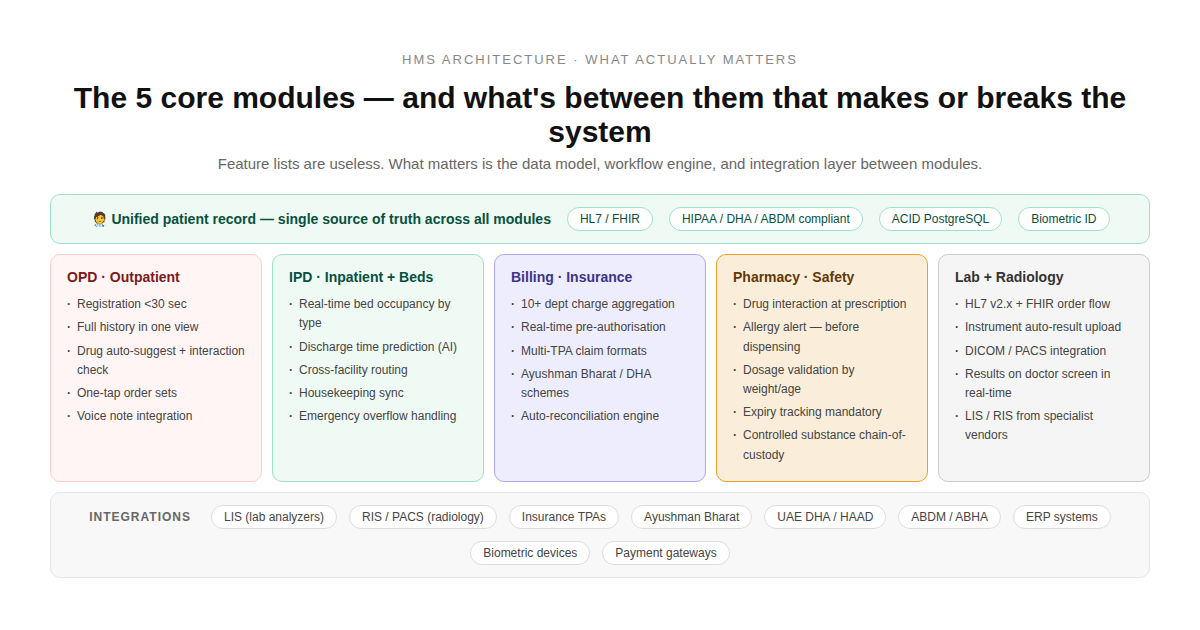
That list is useless. Not because the features are wrong — but because listing features tells you nothing about why most HMS implementations fail. They fail because of what’s between the features. The data model. The workflow engine. The integration layer. The performance under clinical load.
Let me tell you what actually matters.
Outpatient departments in high-volume hospitals process hundreds of patients daily. The HMS must keep pace with the clinical speed, not slow it down.
That means patient registration in under 30 seconds — returning patients identified instantly by phone number, ID, or biometric. Consultation screens that show the patient’s complete history (previous visits, medications, allergies, test results) in one view — no clicking through tabs. Prescription entry with drug auto-suggest, dosage defaults, interaction checking, and one-tap order sets for common protocols. Lab and radiology ordering integrated into the consultation screen — not a separate module that requires the doctor to switch context.
When the team built OPD modules for India’s largest hospital chain — where doctors see 80+ patients per day — every millisecond of the interface was measured. Auto-populated fields based on the patient’s history. Quick-action buttons for the 20 most common prescriptions in each department. Voice note integration for doctors who can’t type between patients. The system was designed to be faster than paper — because if it’s not faster than paper, doctors revert to paper.
The experience with a product that scaled to tens of millions of Indian SMEs taught the team something directly applicable to hospital UX: the user’s environment is the design constraint. A doctor using an HMS between patients in a crowded OPD is the same design challenge as a bookkeeper using an app on a ₹8,000 phone in a noisy shop. Both need software that works in their reality, not software that demands they adapt to its reality.
Inpatient departments have a different challenge. Bed management — tracking which beds are occupied, which are being cleaned, which are reserved for incoming surgeries, which are available by specialty — is an operations research problem disguised as a simple feature.
A 500-bed hospital with 70% occupancy has 150 available beds at any moment. But not all beds are interchangeable. ICU beds are different from general ward beds. Post-surgical beds are different from maternity beds. Isolation beds are different from semi-private rooms. Insurance-covered beds have different allocation rules than cash-paying beds.
The bed management module needs to track real-time occupancy by bed type, specialty, floor, and building. It needs to predict bed availability based on expected discharge times (which come from the treatment plan module). It needs to flag bed-cleaning status so housekeeping and admissions are synchronized. It needs to handle emergency admissions that override reservation priorities.
When the team built IPD modules for multi-location hospital groups, the bed management system needed to work across 10+ hospitals simultaneously — with a central dashboard showing system-wide occupancy and the ability to route patients between facilities when one hospital is full and another has capacity.
This is where 400+ healthcare clients creates an advantage that a first-time hospital developer doesn’t have. The edge cases — emergency overflow, specialty mismatch, insurance bed quota exhaustion, VIP room allocation — have all been encountered and solved. The architecture accounts for them from day one.
Hospital billing is the most complex billing system in any industry. Period.
A single inpatient stay generates charges from 10+ departments: room charges, doctor fees, surgical fees, anesthesia, pharmacy, laboratory, radiology, ICR/ICU, dietary, nursing, procedure charges, consumables. Each department has its own pricing structure. Prices vary by room category, insurance status, and package deals.
Insurance adds another layer. Cashless claims require real-time pre-authorization with the insurer. Different insurers have different package rates for the same procedure. Co-pay calculations vary by policy. Claim submissions have different formats for different Third Party Administrators (TPAs). Denial management — handling claims rejected by insurers — is an entire workflow in itself.
Government schemes (Ayushman Bharat in India, DHA coverage in UAE) have their own pricing, their own submission formats, and their own reconciliation cycles.
The billing module must handle all of this — multiple payers per patient (insurance + cash + government scheme), real-time price calculation as services are added during the stay, automated pre-authorization requests, claim submission in the correct format for each payer, and reconciliation of payments received against claims submitted.
When the team built billing systems for hospital chains, the reconciliation engine was the critical component. Hundreds of thousands of line items per month. Multiple payers. Multiple formats. The engine reconciled automatically — flagging discrepancies for human review instead of requiring manual reconciliation of every transaction. The financial engineering experience from building lending platforms that reconcile thousands of daily transactions — a system that has sustained disbursals of over ₹10,000 crore — directly applied to hospital billing reconciliation. Different domain. Identical engineering pattern.
Hospital pharmacy isn’t retail pharmacy. It’s a clinical safety system.
Drug interaction checking must happen at the point of prescription — before the pharmacy dispenses, not after. Allergy alerts must surface immediately when a doctor prescribes a medication the patient is allergic to. Dosage validation must flag when a prescribed dose exceeds safe limits for the patient’s age, weight, or renal function.
On the inventory side: hospital pharmacy manages hundreds to thousands of drug formulations. Expiry tracking is mandatory — dispensing expired medication is a regulatory violation. Reorder level alerts prevent stockouts of critical medications. Controlled substance tracking requires chain-of-custody documentation.
When the team built pharmacy modules for hospital chains and for India’s leading pharmacy and healthcare platform, the clinical safety layer and the inventory layer had to work as one system. A prescription from the doctor flows to the pharmacy, gets checked for interactions and allergies, gets validated for dosage, gets dispensed from inventory, gets tracked for billing — all in one seamless flow. Not three separate modules bolted together.
The laboratory information system (LIS) and the radiology information system (RIS) are typically standalone systems — often from specialized vendors — that must communicate with the HMS. A doctor orders a test. The order flows to the lab. The lab processes the sample. The result flows back to the doctor’s consultation screen.
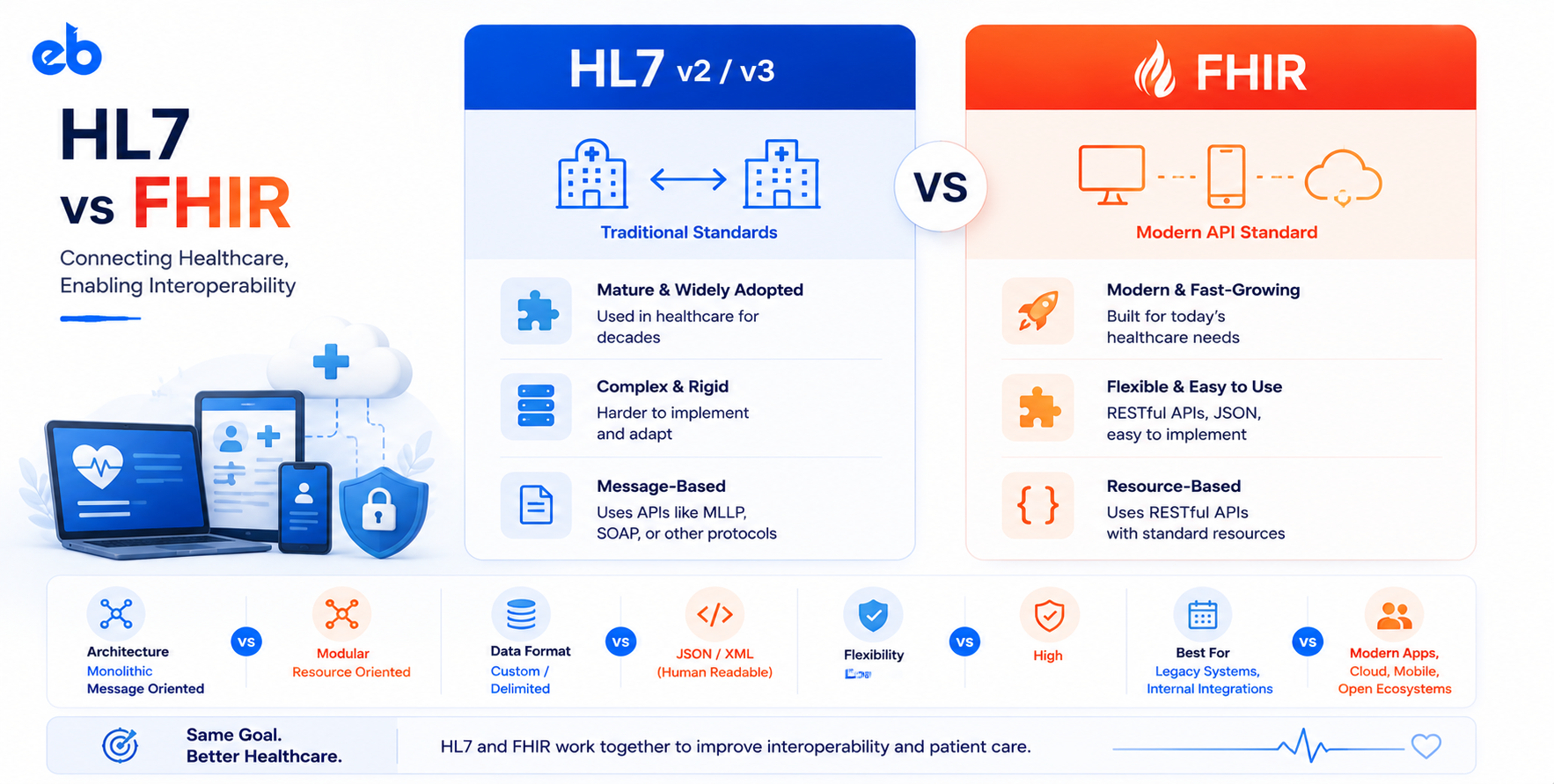
This sounds simple. It’s not. HL7 and FHIR (healthcare interoperability standards) define how these systems communicate. But the reality of hospital IT is that the LIS might use HL7 v2.3, the RIS might use v2.5, and the HMS needs to speak both. Instrument integration — connecting lab analyzers to the LIS so results flow automatically without manual data entry — requires device-specific interfaces.
DICOM integration for radiology — connecting imaging machines (CT, MRI, X-ray, ultrasound) to the PACS (Picture Archiving and Communication System) and from there to the HMS — is another integration layer entirely.
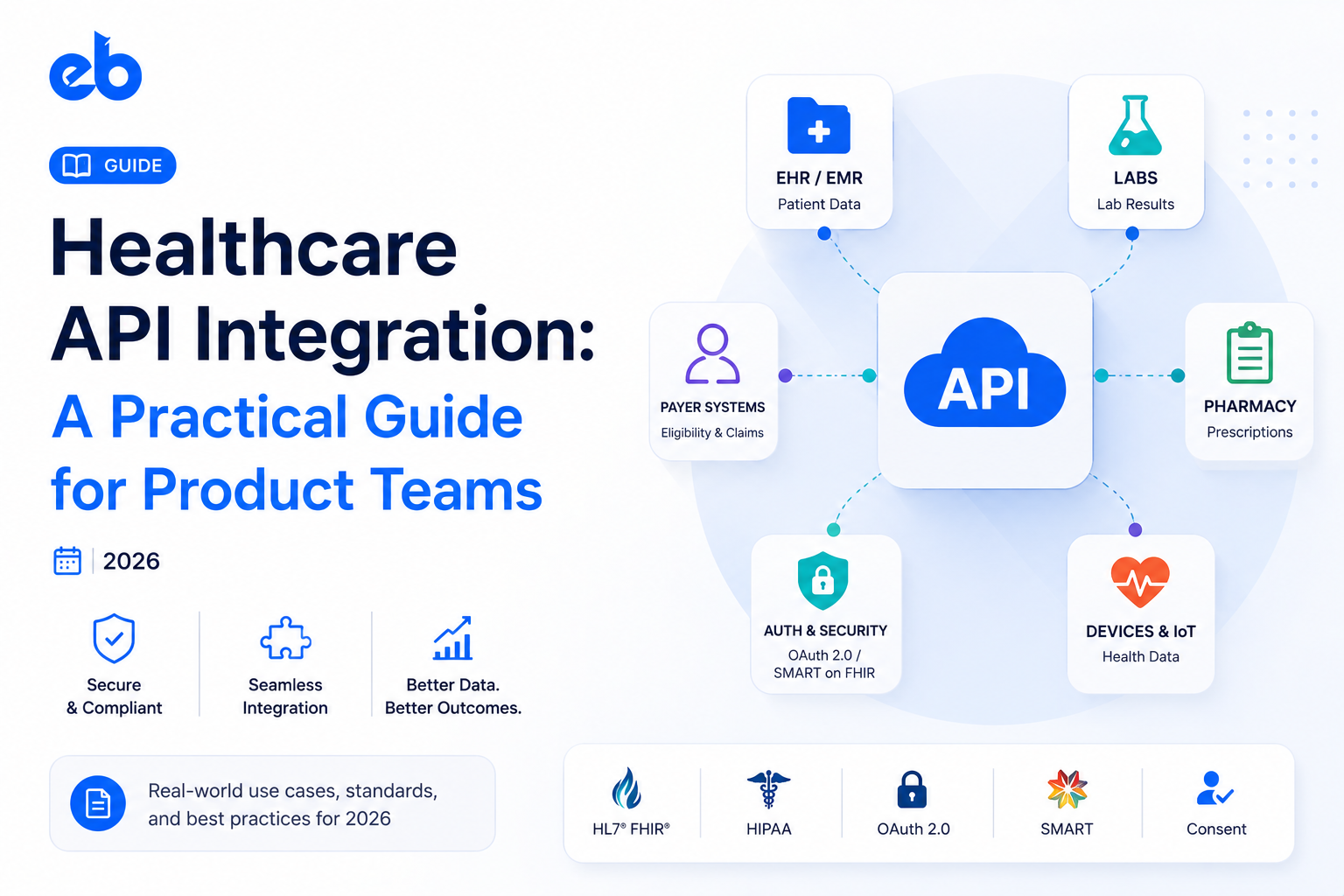
The team has built HL7 and FHIR integrations for hospital systems. The team has built interoperability layers connecting HMS to LIS, RIS, PACS, pharmacy, and insurance systems. When one of India’s largest diagnostics chains needed a platform connecting lab operations to doctor consultations, the integration architecture was the core engineering challenge.
Integration is where most HMS projects fail or succeed. A beautiful HMS that can’t receive lab results from the existing LIS is useless. A technically sound HMS that can’t send claims to the insurance TPA in the correct format creates billing chaos. The team has integrated with enough healthcare systems across enough hospitals to know every integration pattern and every failure mode.
Hospital data is the most sensitive data category in any industry. Patient health information (PHI) requires the highest level of protection.
HIPAA for US hospitals and any system touching US patient data. UAE DHA and HAAD regulations for Gulf hospitals. India’s DISHA (Digital Information Security in Healthcare Act) and ABDM (Ayushman Bharat Digital Mission) for Indian hospitals. UK NHS Digital Standards. Australian Privacy Act and My Health Records Act.
Each regulatory framework mandates specific protections: encryption at rest and in transit, role-based access controls (the billing clerk cannot see clinical notes), audit logging on every data access event, breach notification procedures, and regular security assessments.
CMMI Level 5 certification means these compliance requirements are embedded in the team’s development process. Not added before launch. Built into every sprint, every code review, every deployment. When the team built HIPAA-compliant platforms for a global Australian medical device company and for India’s leading pharmacy platform — and healthcare technology for 400+ clients — the compliance architecture was the first decision, not the last.
Google selected EngineerBabu for the AI Accelerator 2024. Healthcare AI is one of the most impactful applications — and one of the most overhyped.
Let me separate what works from what doesn’t.
Appointment no-show prediction. ML models that predict which patients will miss appointments based on historical patterns, appointment type, weather, day of week, and patient behavior. Hospitals with no-show rates of 15-25% can reduce them to 8-12% with predictive scheduling — recovering significant revenue from slots that would otherwise go empty.
Clinical documentation assistance. AI that auto-generates clinical notes from structured inputs or voice. Directly addresses physician burnout — the #1 problem in healthcare globally. When doctors spend less time typing notes, they spend more time with patients.
Insurance claims optimization. AI that reviews claims before submission, identifies missing documentation, predicts rejection probability, and suggests corrections. Healthcare systems deploying claims AI have recovered significant revenue and reduced processing time by 60%+.
Inventory demand forecasting. Predicting pharmacy and consumable demand based on admission patterns, seasonal trends, and procedure schedules. Reduces both stockouts and overstock.
Bed availability prediction. Forecasting discharge times based on treatment plans, historical length-of-stay data, and patient recovery patterns. Improves bed management and reduces admission wait times.
Fully autonomous clinical diagnosis. AI can assist — flag potential findings, suggest differentials, prioritize review. AI cannot replace physician judgment. Selling AI as “the system will diagnose patients” is irresponsible and regulatory suicide.
Replacing radiologists with AI. AI can augment radiologists — catching findings they might miss during high-volume reading. AI cannot replace the clinical judgment, contextual reasoning, and liability that a qualified radiologist provides.
The CTO’s 17 years building AI-driven scoring and prediction systems — credit models that make thousands of real-time decisions daily — provides the engineering foundation for healthcare AI. The techniques are similar: data pipeline engineering, model training on historical outcomes, real-time inference, monitoring for accuracy drift. The domain data is different. The engineering patterns are identical.
The technology stack for a hospital management system must balance reliability, performance, compliance, and long-term maintainability.
When the team built neobank architecture for a company that became a unicorn — multiple financial services running independently but communicating seamlessly — the microservices pattern was identical to what a hospital needs. OPD, IPD, pharmacy, lab, radiology, billing — each a separate service, each independently scalable, united by API contracts and a shared patient data model. The neobank became a unicorn. The architecture scaled. The same pattern powers hospital systems.
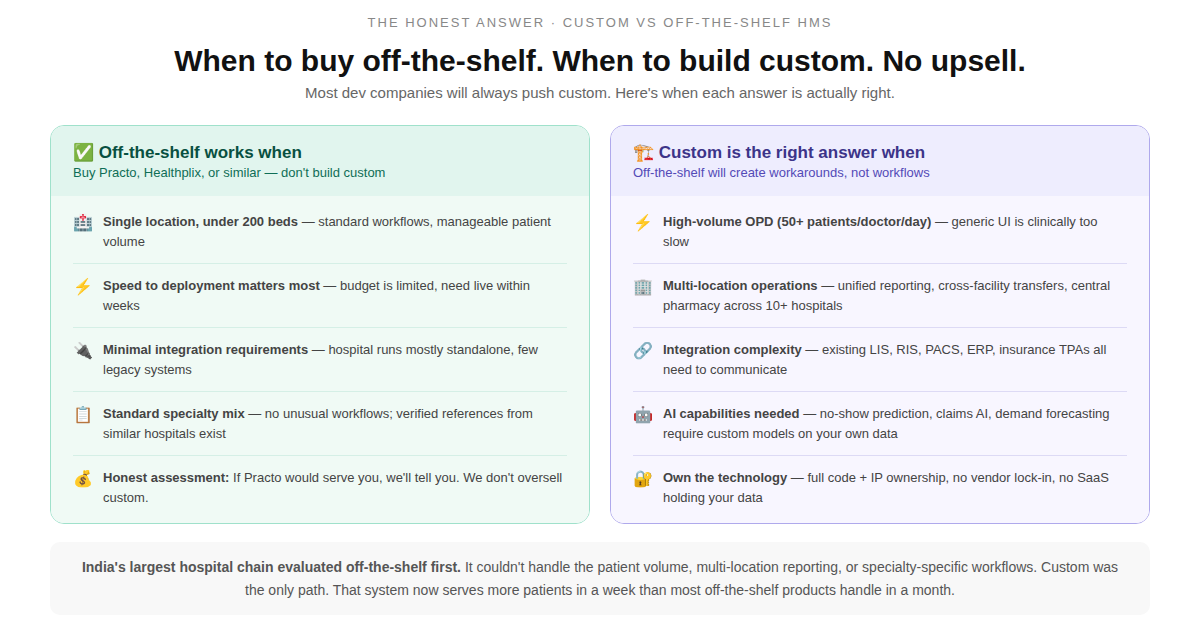
Most hospital management system development companies will tell you custom is always better. It’s not. Let me give you the honest answer.
The hospital is single-location, under 200 beds. Workflows are standard — no unusual specialty mix or operational model. The budget is limited and speed to deployment matters more than perfect fit. Integration requirements are minimal — the hospital runs mostly standalone. The off-the-shelf product has been deployed at similar hospitals and has references you can verify.
In these cases, buying off-the-shelf is faster, cheaper, and lower risk than custom development. The team will tell you this honestly — because building a custom HMS for a hospital that would be perfectly served by Practo or Healthplix wastes the client’s money and the team’s time.
Clinical workflows are unique — high-volume OPD, complex surgical scheduling, multi-specialty coordination, unique triage protocols. No off-the-shelf product accommodates them without painful workarounds.
Multi-location operations — the hospital group needs unified reporting, cross-facility patient transfers, centralized pharmacy management, and system-wide bed visibility. Most off-the-shelf products are designed for single-location deployment.
Integration complexity — the hospital has existing LIS, RIS, PACS, ERP, and insurance systems that must communicate with the HMS. Off-the-shelf products often have limited integration capability beyond basic HL7.
Compliance requirements demand dedicated infrastructure — data residency, custom access controls, institution-specific audit requirements that multi-tenant SaaS products can’t accommodate.
AI capabilities — no-show prediction, clinical documentation AI, claims optimization, demand forecasting. These require custom model training on the hospital’s own data. Off-the-shelf products with “AI features” typically offer generic models that underperform on institution-specific data.
The hospital wants to own the technology — the code, the data model, the deployment, the roadmap. Off-the-shelf products lock the hospital into the vendor’s feature timeline. Custom healthcare development means the hospital controls its own technology destiny.
When the team built for India’s largest hospital chain, off-the-shelf was evaluated first. It couldn’t handle the patient volume, the multi-location reporting requirements, or the specialty-specific workflow customizations. Custom was the only path. The system now serves a hospital chain that sees more patients in a week than most off-the-shelf products are designed to handle in a month.
Not a methodology diagram. What actually happens.
The first two weeks are clinical observation, not coding. The team visits the hospital — OPD, IPD, pharmacy, lab, billing, admissions. They watch doctors work. They watch nurses handoff shifts. They watch billing clerks process insurance claims. They observe where the current process breaks, where people create workarounds, where paper forms fill gaps that software should handle.
This clinical observation phase is where most health IT companies fail — because they send developers who’ve never been inside a hospital. The EngineerBabu team has been inside 400+ hospitals over 14 years. The observation is informed by pattern recognition: “this workflow problem is similar to what we saw at 30 other hospitals, and here’s what worked.”
Architecture comes next. The data model — patient records, clinical encounters, medications, orders, results, billing — is designed with clinical accuracy in mind, not just database efficiency. The module structure is defined based on which departments go live first (typically registration, OPD, and billing) and which come in subsequent phases (pharmacy, lab, radiology, IPD).
Development follows the same sprint cadence as every EngineerBabu project — two-week sprints, demo every two weeks. But with a crucial addition: clinical validation at every sprint. A doctor or clinical administrator reviews the working software every two weeks. Not just the CIO. A physician who will actually use the system. Their feedback shapes the next sprint.
CMMI Level 5 processes mean every sprint includes security review, compliance validation, and quality gates. Code that handles PHI gets additional review. Audit logging is verified at every deployment. Penetration testing happens before go-live.
Go-live is phased, not big-bang. Registration and OPD first — the highest-volume, most visible departments. Then billing and insurance. Then pharmacy. Then lab and radiology. Each phase runs for 2-4 weeks before the next department goes live. Issues are caught and resolved with manageable impact — not across the entire hospital simultaneously.
Post-go-live support is included — because the first month of a live HMS surfaces edge cases that no amount of testing predicts. A doctor discovers a workflow that wasn’t anticipated. An insurance TPA changes their claim format. A lab analyzer sends results in an unexpected format. The team is present — onsite or remote — for the critical first weeks.
The team ships focused HMS modules in 8-12 weeks. Full multi-department HMS in 4-8 months. Enterprise HMS for multi-location chains in 8-14 months.
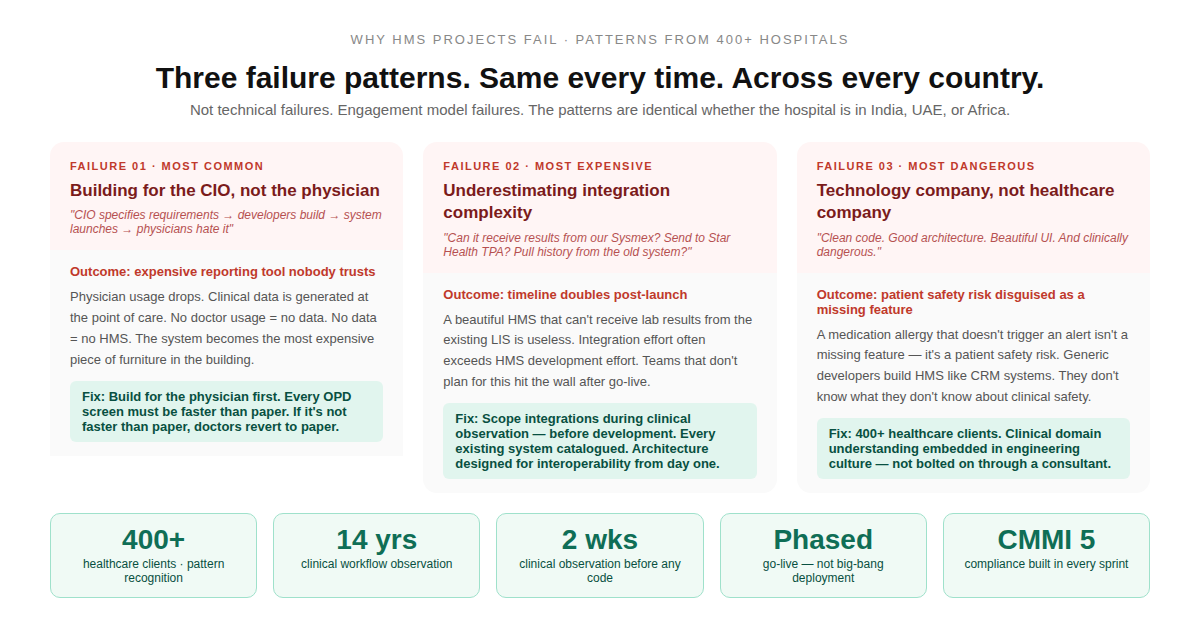
The CIO specifies requirements. The developers build to those specifications. The system launches. The physicians hate it. Usage drops. Data quality collapses. The system becomes an expensive reporting tool that nobody trusts.
The team builds for the physician first. Every OPD screen, every prescription flow, every order entry is designed to be faster than paper for the doctor. If the doctor doesn’t use it, nothing else matters — because clinical data is generated at the point of care. No doctor usage, no data. No data, no HMS.
The HMS works beautifully in isolation. Then the hospital asks: “Can it receive results from our Sysmex analyzer? Can it send claims to Star Health’s TPA portal? Can it pull patient history from our old system?” Each integration is a mini-project. The total integration effort often exceeds the HMS development effort. Teams that don’t plan for this discover their timeline doubling post-launch.
The team scopes integrations during the clinical observation phase — before development begins. Every existing system is catalogued. Every integration requirement is identified. The architecture is designed for interoperability from day one. 400+ hospitals means the team has integrated with practically every major LIS, RIS, PACS, insurance TPA, and government health scheme in India and the UAE.
A generic software company can build a hospital management system. They’ll build it the way they build e-commerce platforms and CRM systems. Clean code. Good architecture. Beautiful UI. And clinically dangerous — because they don’t understand the difference between a medical record and a database entry. A medication allergy that doesn’t trigger an alert during prescription entry isn’t a missing feature. It’s a patient safety risk.
The EngineerBabu team has 400+ healthcare clients. The clinical domain understanding is embedded in the engineering culture — not bolted on through a healthcare consultant hired for the project. When the team builds a prescription module, they build drug interaction checking because they know hospitals need it — not because a requirements document specified it.
Mayank Pratap leads every engagement personally. The hospital CIO, the medical director, the health system CEO — they talk to the founder from discovery through go-live.
400+ healthcare clients. India’s largest hospital chain. Multi-location hospital groups. Specialty networks. A global Australian medical device company. India’s leading pharmacy platform. One of India’s largest diagnostics chains. Telemedicine platforms across multiple continents. The breadth is unmatched by any Indian development company of comparable size.
The CTO’s 17 years building production systems — financial infrastructure that processes thousands of daily decisions — provides the architectural foundation. The same engineering discipline that makes a lending platform reliable at ₹10,000 crore scale makes a hospital system reliable at 80-patients-per-hour OPD scale.
Google AI Accelerator 2024 for healthcare AI — no-show prediction, clinical documentation, claims optimization, demand forecasting. Not demo AI. Production AI validated by Google.
CMMI Level 5 for the compliance discipline that healthcare regulators demand. HIPAA. DHA. ABDM. Every regulatory framework the team has built for — across 400+ hospitals in India, the US, the UK, the Middle East, and Africa.
Custom builds. Full code and IP ownership. The hospital’s system. The hospital’s data. The hospital’s property. No vendor lock-in. No multi-tenant SaaS that holds the hospital’s data hostage.
Starting from $15K for focused modules. Full HMS scoped and priced after understanding the hospital’s clinical context — because a 50-bed community hospital and a 2,000-bed multi-specialty chain are fundamentally different projects.
If you’re running a hospital, a health system, or a hospital group — and your current HMS is creating more workarounds than workflows — email me. mayank@engineerbabu.com. The founder. Not a sales team.
Tell me about the hospital. The bed count. The specialty mix. The daily OPD volume. The existing systems. The compliance requirements. I’ll spend 30 minutes understanding the clinical context and giving an honest assessment — does custom HMS make sense for your situation? What modules should you build first? What should you defer?
If off-the-shelf would genuinely serve you better, I’ll tell you that too. 400+ healthcare clients didn’t come from overselling. They came from being honest — and delivering systems that physicians actually use.
Mayank Pratap Co-founder, EngineerBabu mayank@engineerbabu.com | engineerbabu.com
Google AI Accelerator 2024 · CMMI Level 5 · 400+ Healthcare Clients · 4 Unicorn Clients · 75 YC Selections · Backed by Vijay Shekhar Sharma · LinkedIn Top Startup India (Twice) · NASSCOM Member