Outsourcing Software Development to India - Everything a US Company Needs to Know


Create engaging, high-performance mobile applications tailored to your business needs. We craft future-ready apps that offer smooth user experiences on all devices.
Build robust and scalable websites and CMS platforms that help you manage content effortlessly. Our development ensures a seamless digital presence.
Launch secure, feature-rich online stores with intuitive shopping experiences. We build tailored eCommerce platforms designed for growth.
Design captivating games with immersive gameplay and stunning graphics. From concept to launch, we build engaging experiences that players love.
Enhance your customer relationships with customized Salesforce implementations. Drive growth and efficiency with smarter CRM solutions.
Harness artificial intelligence and machine learning to automate workflows and gain actionable insights. Our AI transforms data into smart decisions.
Accelerate your software delivery lifecycle with continuous integration, delivery, and infrastructure automation to boost efficiency.
Hire app developers ready to turn your ideas into sleek, high-performing mobile apps for any platform.
Bring in frontend pros who craft smooth, beautiful, and user-friendly interfaces that your visitors will love.
Get backend developers who build fast, secure, and reliable systems to keep everything running behind the scenes.
Hire eCommerce developers who build secure, scalable online stores designed to offer seamless shopping and grow your sales.
Get dedicated developers committed to your projects, delivering consistent quality and speed as an extension of your team.
Let me start with the uncomfortable truth.
You’ve probably already had a bad experience outsourcing to India. Or you know someone who has. The missed deadlines. The code that looked finished but broke in production. The communication gaps that turned a three-month project into a nine-month nightmare. The feeling of paying for something you never actually received.
I know these stories because I’ve spent 14 years cleaning up the mess.
My name is Mayank Pratap. I co-founded EngineerBabu in Indore, India. The team has shipped 500+ products. More than half of them for US-based companies. 75 for Y Combinator-selected startups — the most rigorous startup filter in America. 24 clients that became unicorns. Bank Open went from a startup to a billion-dollar neobank with core banking integrations built by the EngineerBabu team. BURQ — a US logistics platform — was built by the team. TaptapSend — a multi-continent remittance platform operating under US compliance requirements among five other jurisdictions — was built by the team.
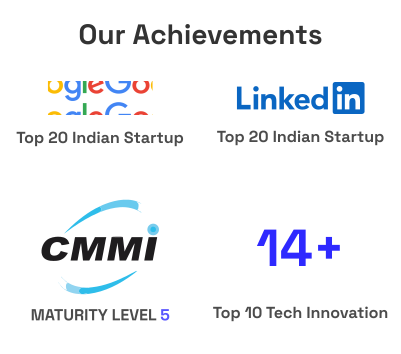
Google selected EngineerBabu for the AI Accelerator 2024. CMMI certified us at Level 5. Vijay Shekhar Sharma – the man who built Paytm into India’s largest digital payments ecosystem — backs us personally.
I’m writing this blog because the conversation about outsourcing to India is broken. It’s either “India is cheap, save 80%” or “India is risky, don’t do it.” Both are wrong. The truth is more nuanced, more useful, and worth 15 minutes of your time if you’re a US CTO, CEO, or VP Engineering making this decision.
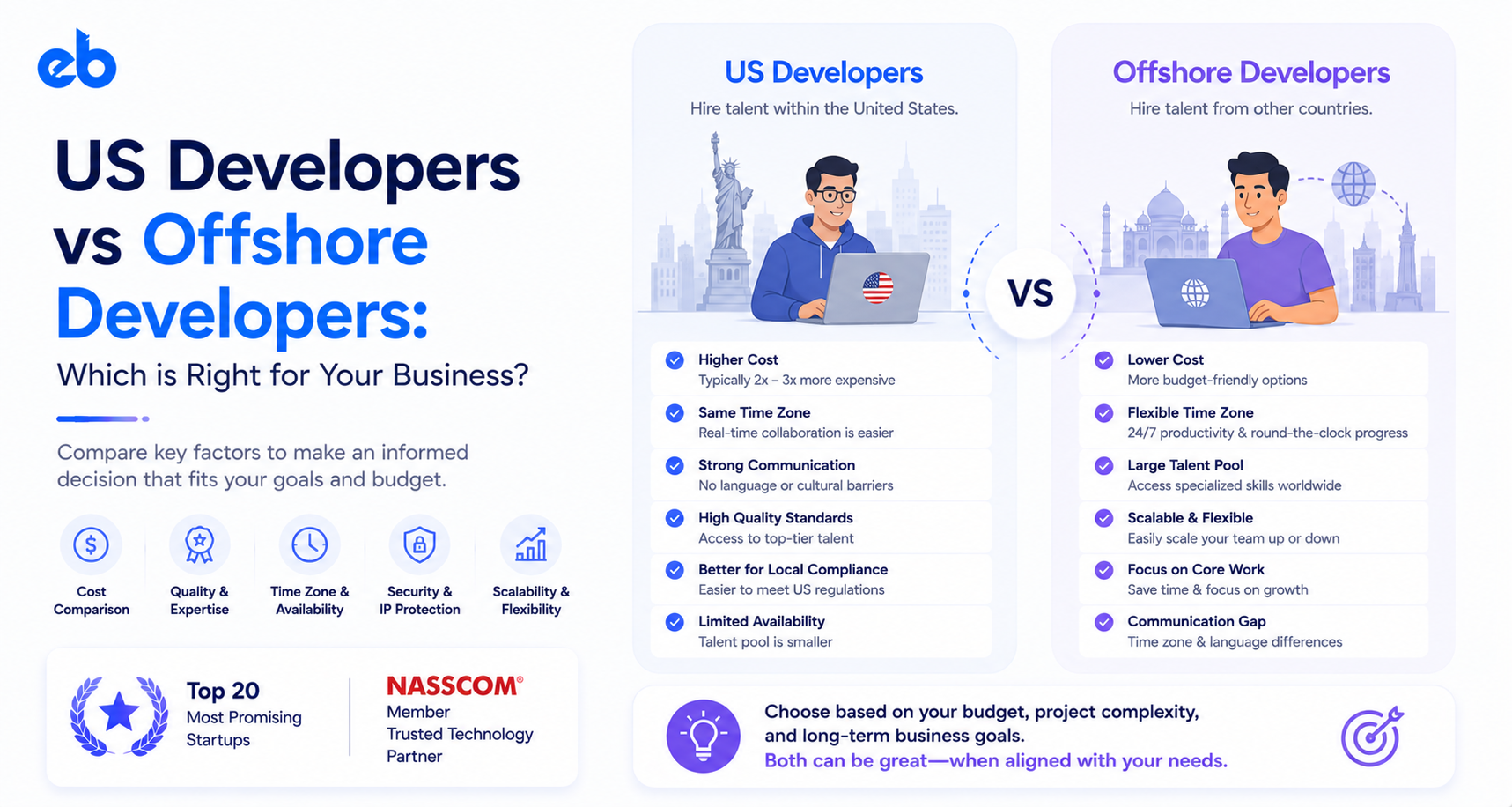
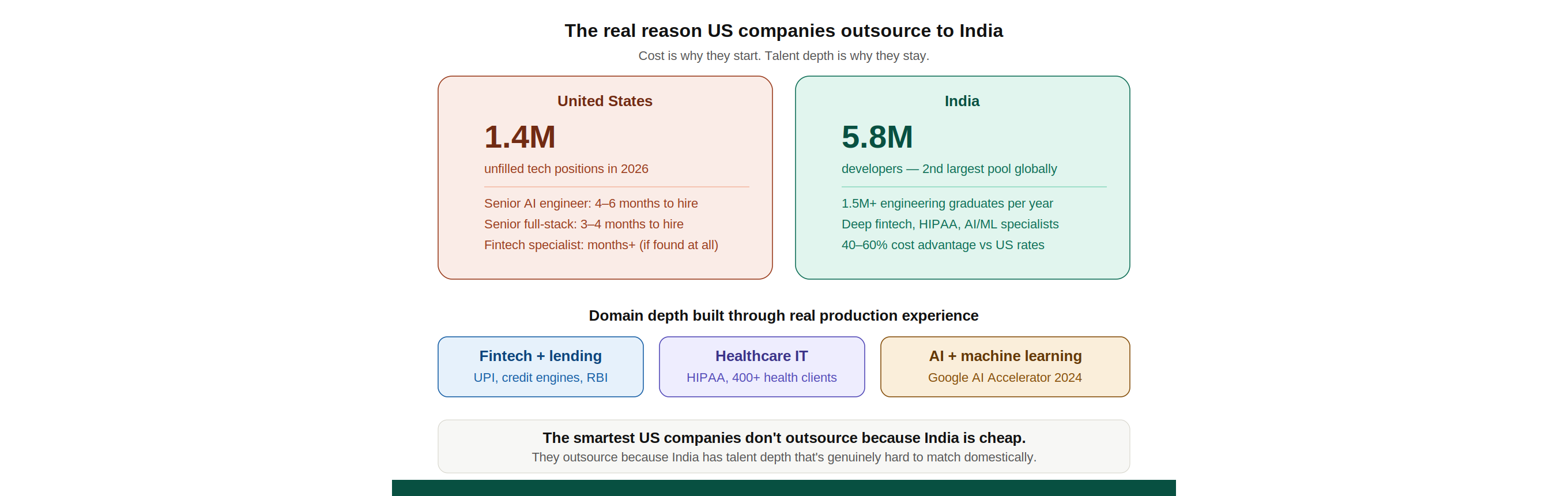
The cost narrative is overplayed. Yes, India is 40-60% cheaper than US development. But cost isn’t why the smartest US companies outsource to India. Cost is why they start considering it. They stay because of something else entirely.
The US has a developer shortage. There are 1.4 million unfilled tech positions in America in 2026. Finding a senior AI engineer in San Francisco takes 4-6 months. Finding a senior full-stack developer in Austin takes 3-4 months. Finding a specialized fintech engineer with credit bureau integration experience takes even longer — if you can find one at all.
India has 5.8 million developers. Over 1.5 million engineering graduates per year. Specialization depth that most US hiring managers don’t realize exists — until they start looking.
When EarlySalary needed a credit decisioning engine that processes thousands of real-time decisions daily against multiple bureau data sources, the EngineerBabu CTO had already spent 17 years at Wishfin building exactly that kind of infrastructure. Finding equivalent expertise in the US would have taken months and cost five times as much — assuming you could find it.
When TaptapSend needed compliance engineering across five regulatory jurisdictions — including US financial regulations — the team had multi-country compliance architecture patterns already proven in production. Replicating that experience with a US-only team would have meant hiring specialists from each jurisdiction individually.
The smartest US companies don’t outsource to India because India is cheap. They outsource because India has talent depth in specific domains — fintech, healthcare, AI, enterprise — that’s genuinely hard to match domestically. The cost advantage is a bonus. The talent advantage is the reason.
That said, most US companies outsource to India and get burned. Not because India doesn’t have the talent. Because they chose the wrong company. Let me tell you exactly how to avoid that.
I’ve sat across the table from hundreds of US decision-makers. I know the fears. They’re legitimate. And pretending they don’t exist would be dishonest. So let me address each one directly.
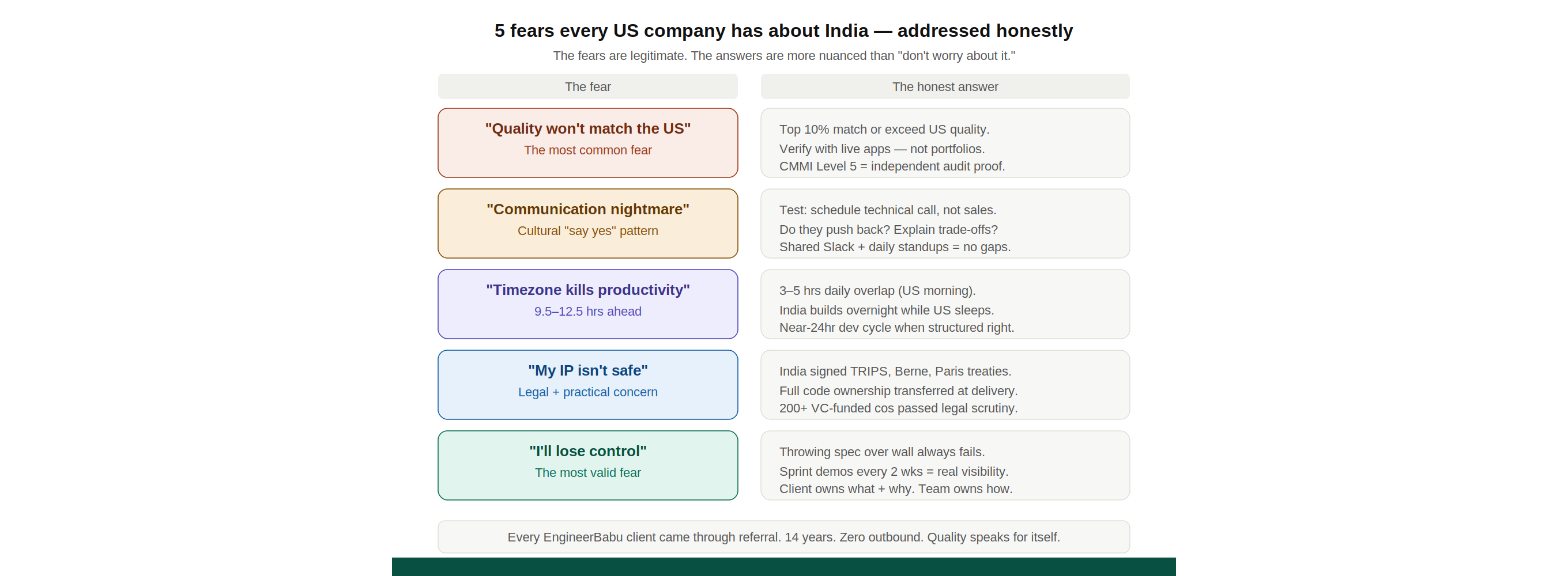
This is the most common fear. And it’s partially justified — because most Indian software companies deliver mediocre quality. There are 30,000+ software companies in India. The bottom 90% reinforce every negative stereotype about Indian outsourcing.
The top 10% deliver quality that matches or exceeds what you’d get from a US team. The difference is selection, not geography.
How to verify quality: Don’t look at portfolios. Look at products. When the EngineerBabu team says they built EarlySalary’s lending platform, you can download the app and see it operating. When they say Bank Open became a unicorn with their core banking integrations, you can Google the valuation. When they say Khatabook scaled to tens of millions of users, you can verify the numbers.
Ask any Indian company: “Name three products you built that I can download, use, and verify right now.” If they can’t answer, the portfolio is decoration.
CMMI Level 5 certification is the most objective quality signal available. It’s an independent, multi-month audit of engineering processes, security, quality assurance, and delivery management. Fewer than 1% of Indian companies achieve Level 5. The EngineerBabu team holds it. When your board or your investors ask “how do you know the Indian team is good?” — CMMI Level 5 is the answer that ends the conversation.
Bad communication kills more outsourcing relationships than bad code.
The failure pattern is predictable. The Indian team says “yes” to everything during the call. Then builds something different from what was discussed. Asks no questions. Raises no concerns. Delivers something technically complete but functionally wrong. The US team is frustrated. The Indian team is confused about why.
This is a cultural pattern, not a quality problem. Many Indian companies have a “say yes, figure it out later” culture. Strong Indian companies have unlearned this pattern.
At EngineerBabu, I personally lead client communications. When a requirement doesn’t make sense, the team pushes back. When a feature will take longer than the client expects, they say so before starting — not after missing the deadline. When the architecture needs to change, the CTO (17 years at Wishfin, who has presented technical architectures to CTOs at companies worth billions) explains why and proposes alternatives.
The team operates with US clients daily. Sprint demos every two weeks. Daily standups during overlapping hours. Shared Slack channels for real-time communication. Documentation in English that a US product manager can read and understand without translation.
One practical test before hiring any Indian company: schedule a technical call with their senior engineer — not their sales team. Have your CTO ask hard questions. Evaluate how they respond. Do they push back when appropriate? Do they explain trade-offs? Do they ask clarifying questions? Or do they just say “yes, we can do that” to everything?
The first response tells you nothing about technical skill. It tells you everything about communication culture.
India is 9.5-12.5 hours ahead of the US, depending on which US timezone. At first glance, that sounds unworkable.
In practice, it creates a unique advantage — if structured correctly.
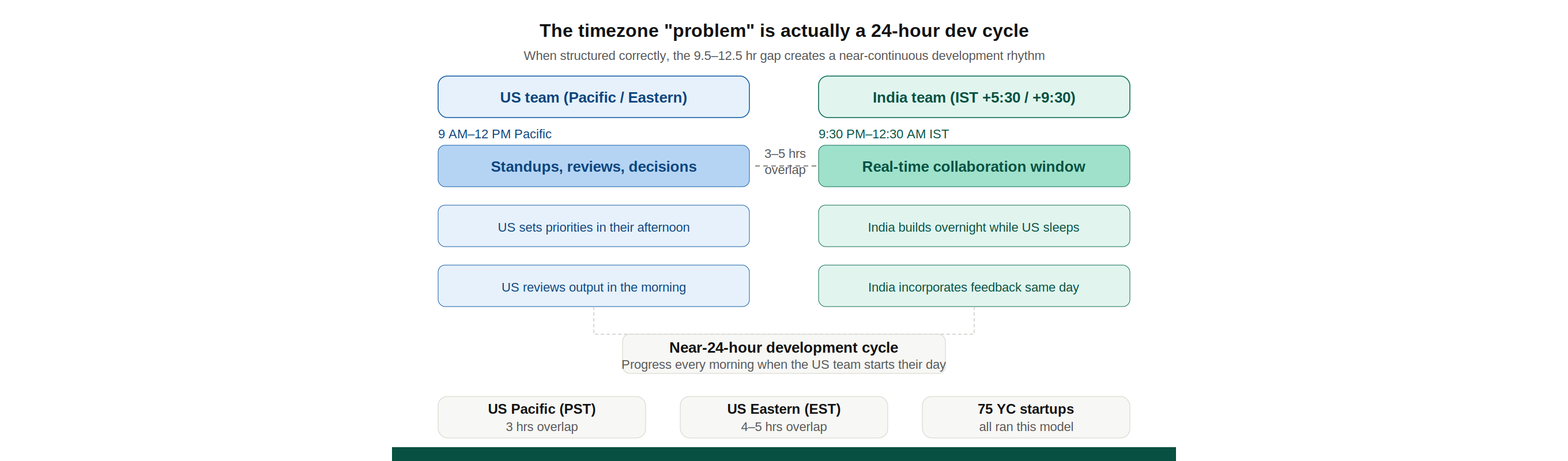
India Standard Time is 12.5 hours ahead of US Pacific. The EngineerBabu team’s work day starts at 9:30 AM IST. That’s 9 PM Pacific the previous evening. The team works their full day. By the time the US client’s morning starts at 9 AM Pacific (9:30 PM IST), the Indian team has already completed a full day of development.
The overlap window: 9 AM – 12 PM Pacific (9:30 PM – 12:30 AM IST). That’s 3 hours of real-time collaboration daily. It’s enough for standups, code reviews, architectural discussions, and sprint demos.
The magic of this structure: the US team defines priorities in their afternoon. The Indian team builds overnight. The US team reviews in their morning. The Indian team incorporates feedback in their afternoon. It’s almost like having a 24-hour development cycle.
For US East Coast (EST): the overlap is 4-5 hours (12 PM – 5 PM EST / 9:30 PM – 2:30 AM IST). Even more collaborative time.
The EngineerBabu team has delivered 500+ products to US clients with this timezone model. It works. Not because the timezone is convenient — it isn’t. But because the team has built structured communication rhythms that make the overlap hours productive and the non-overlap hours autonomous.
75 Y Combinator-selected startups. Most of them US-based. They all operated on this model. If it didn’t work, the second YC project wouldn’t have happened — let alone the 75th.
This fear has two dimensions: legal protection and practical security.
Legal protection: India has strong IT intellectual property laws — the Indian IT Act, Copyright
Act, and Patent Act all protect foreign IP. India is a signatory to major international IP treaties (TRIPS, Berne Convention, Paris Convention). Indian courts have consistently upheld IP rights in technology disputes. The legal framework is robust.
Beyond national law, every serious engagement starts with an NDA and a Master Services Agreement that specifies complete IP ownership transfer, code escrow provisions, and confidentiality obligations.
Practical security: This is where company-level practices matter more than country-level laws.
EngineerBabu transfers complete code and IP ownership. Every line of code, every architecture document, every deployment script belongs to the client. No white-label. No shared codebases. No proprietary frameworks. No vendor lock-in. The client can take the code to another vendor, bring development in-house, or do anything they want with it — because it’s theirs.
CMMI Level 5 processes include specific security controls: access management (developers only access the repositories they work on), audit logging, code review requirements, secure development practices, and data handling procedures.
200+ VC-funded companies and 4 unicorns have trusted the team with their core technology. These aren’t companies with casual attitudes about IP. Their investors, their legal teams, and their boards vetted the IP protection before allowing outsourced development. The fact that the engagements proceeded — and that every client came through referral — tells you the IP protection holds up to institutional scrutiny.
This fear is the most valid — and the most preventable.
Loss of control happens when the outsourcing model is “throw the spec over the wall and wait six months.” That model fails every time. Not because of India. Because that model fails everywhere.
The model that works: collaborative product development with structured visibility.
The EngineerBabu engagement model gives US clients visibility into every decision. Sprint planning includes the client. Daily standups (during overlap hours) keep the client informed. Sprint demos every two weeks let the client see, use, and approve working software — not slide decks. Architecture decisions are reviewed jointly. Scope changes are discussed, documented, and priced transparently.
The client doesn’t lose control because control is built into the process. Not as a favor — as a system.
When the team built Bank Open’s neobank platform, the Bank Open founders were in every architecture review. When TaptapSend’s compliance framework was designed, the TaptapSend team made the regulatory decisions — the EngineerBabu team executed them with technical expertise. The product belongs to the client. The engineering expertise belongs to the team. Both contribute.
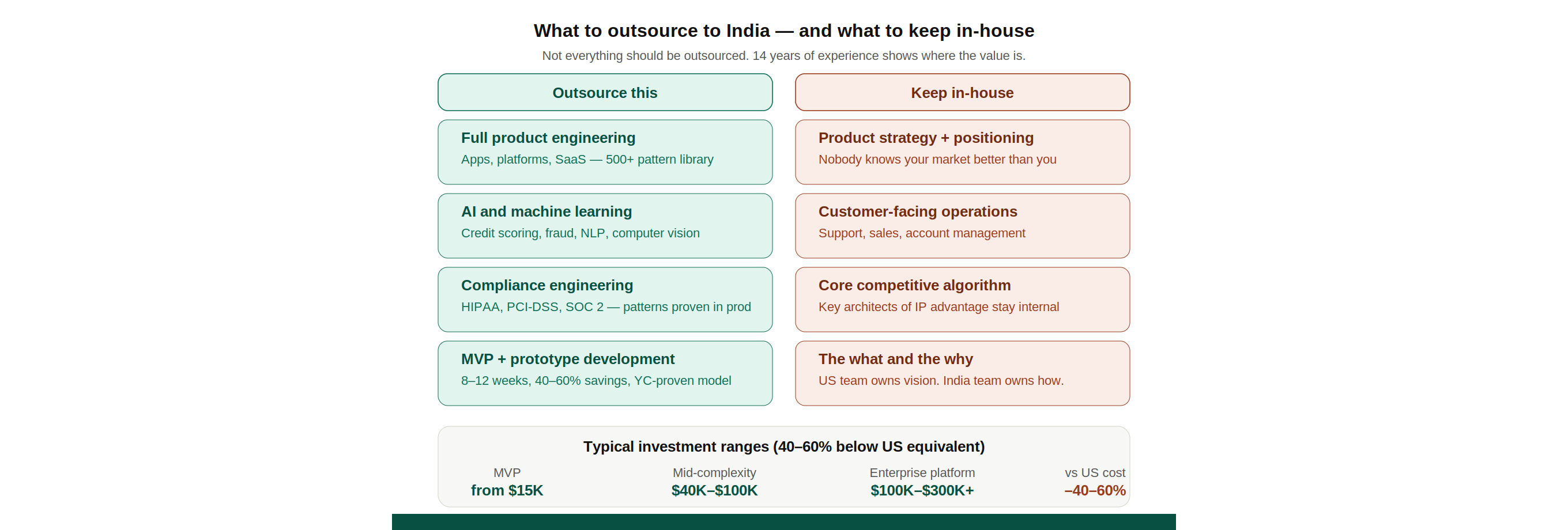
Not everything should be outsourced. 14 years of experience has taught me where outsourcing creates the most value and where it creates problems.
Product engineering — full applications, platforms, and systems. This is where India’s talent depth creates the most value. Building a complete product — from architecture to deployment — leverages the team’s pattern recognition across 500+ products. The credit engine architecture that worked for EarlySalary informs the next fintech product. The microservices pattern that scaled Bank Open informs the next platform. Every new product benefits from the accumulated knowledge of every product that came before.
AI and machine learning development. India’s AI talent pool is among the deepest globally.
Google validated EngineerBabu’s AI capabilities through the AI Accelerator 2024 selection. For US companies that need AI features — credit scoring, fraud detection, recommendation engines, natural language processing, computer vision — India provides specialized talent that’s genuinely hard to find domestically at any price.
Compliance engineering for regulated industries. HIPAA for US healthcare. PCI-DSS for payments. SOC 2 for enterprise SaaS. The EngineerBabu team has built compliant systems across all these frameworks. When the team built HIPAA-compliant platforms for Apollo Hospitals, Manipal, and ResMed — and healthcare platforms for 400+ clients globally — they developed compliance architecture patterns that apply directly to US healthcare products. Compliance expertise is expensive to hire in the US. India has it in depth.
MVP and prototype development. Speed + cost efficiency = the sweet spot for outsourcing. The team ships MVPs in 8-12 weeks. 75 YC-selected startups started this way — build the MVP in India, validate in the market, raise funding, scale. The 40-60% cost savings on MVP development means longer runway for the startup. More iterations before the money runs out.
Product strategy and market positioning. Nobody knows your market, your users, and your competitive landscape better than you. Strategy should live inside the company.
Customer-facing operations. Support, sales, account management — functions that require deep understanding of your specific customers.
Core competitive differentiation. If your competitive advantage IS a proprietary algorithm or approach, the key architects of that approach should be in-house — even if the implementation is outsourced.
The best outsourcing relationships look like this: the US team owns the what and the why. The Indian team owns the how. Both teams collaborate on execution. Nobody throws specs over a wall. Nobody disappears after signing a contract.
I could describe a process. But I’d rather tell you what actually happens month by month.
Before contract: Mayank (that’s me) gets on a call with the US CTO or CEO. Not a sales team. The founder. The conversation is about the business — the market, the users, the competitive landscape, the technical requirements. If the project is outside the team’s expertise, I say so. If the timeline isn’t realistic, I say that too. The call ends with either a preliminary architecture proposal or an honest explanation of why the project isn’t a fit.
This honesty is how every client for 14 years has come through referral. Not marketing. Not outbound. Referral.
Week 1-2: Discovery and scoping. Daily calls during overlap hours. The team understands the business model, maps user journeys, identifies technical risks, and defines the architecture. The output is a detailed scope document and a realistic timeline. CMMI Level 5 processes mean this scoping is rigorous — no ambiguity about what’s included and what isn’t.
Week 3-4: Design and prototyping. Figma prototypes. User flows. The US team reviews and approves before development begins. This phase saves enormous time and money by catching UX problems before they become engineering problems.
Week 5 onwards: Development in two-week sprints. Each sprint ends with a demo that the US client sees and uses. Not a PowerPoint. Working software deployed to a staging environment. The client clicks, tests, provides feedback. The team incorporates it in the next sprint.
Throughout: Daily standups during overlap hours. Shared Slack channel with real-time communication. The CTO (17 years at Wishfin) reviews architecture decisions. Mayank is available for scope discussions, priority calls, and strategic decisions.
At delivery: Complete code and IP transfer. Deployment to the client’s infrastructure. Documentation. Training for the client’s team if they’re taking over maintenance. Two months of post-launch support to handle production issues.
The team has done this hundreds of times for US companies. The 75 YC projects. The unicorn clients. BURQ. TaptapSend. The process works because it’s been refined across 500+ deliveries. The failure modes have been identified and eliminated. The communication rhythms have been optimized. The quality gates have been tested under real conditions.
For certain industries, India doesn’t just match US development — it exceeds it. Not on cost. On capability.
Fintech and lending. India’s fintech ecosystem is among the world’s most advanced. UPI processes more digital transactions than Visa and Mastercard combined in India. The regulatory complexity of operating in India’s financial system has created engineers who understand compliance at a depth that most US engineers never encounter. The EngineerBabu CTO’s 17 years at Wishfin. EarlySalary’s ₹10,000 crore platform. Bank Open’s unicorn neobank. OpenMoney’s multi-product financial architecture. Razorpay ecosystem integration. LoanOS processing ₹1,000 crore annually through a DSA. This fintech depth doesn’t exist at this concentration anywhere else.
Healthcare IT. India serves as a development hub for US healthcare companies because HIPAA compliance expertise is deep and the cost advantage on compliance engineering is significant. The EngineerBabu team has built for Apollo Hospitals, Manipal, Shalby, CHL, ResMed, 1MG, Fortis, Practo, Thyrocare, and Tata Health — 400+ healthcare clients total. Finding this depth of healthcare engineering in a US-based agency of similar size is effectively impossible.
AI and machine learning. Google selected an Indian company — EngineerBabu — for the AI Accelerator 2024. India’s IITs produce some of the world’s best AI researchers. The practical AI engineering talent pool — people who can take ML models from research to production — is deeper in India than in any country except the US itself.
Enterprise and SaaS platforms. India built the backend systems that run most Fortune 500 companies (through Infosys, TCS, Wipro). The product engineering layer — companies like EngineerBabu that build products, not IT services — inherited that enterprise-grade engineering discipline. CMMI Level 5 is an enterprise credibility signal. Adani Group, Paytm ecosystem, and Bank Open are enterprise-scale references.
Fourteen years. Hundreds of client relationships. These three things kill outsourcing engagements consistently.
Choosing on price alone. The $15/hour bid wins the contract. The $15/hour team delivers code that needs to be rewritten. The rewrite costs more than the $50/hour team would have charged originally. I’ve personally taken over more projects from failed cheap vendors than I can count. The pattern is identical every time. The client saved money upfront and spent double overall.
The EngineerBabu team isn’t the cheapest in India. They’re the most experienced in their category. 500+ products create pattern recognition that eliminates wrong turns. 4 unicorn clients prove the outcomes. The cost difference between the cheapest team and the right team is a rounding error compared to the cost of rebuilding a failed product.
No senior technical involvement from the vendor. The sales call featured the CTO. The project features a 2-year-experience developer. The architecture decisions are made by someone who’s never built a system at scale. The product ships with fundamental architectural flaws that become apparent only when real users arrive.
The EngineerBabu CTO (17 years, Wishfin) and Mayank (14 years, founder) are involved in architecture and key technical decisions on every project. Not as approvers who sign off on documents. As participants who shape the technical direction. That involvement doesn’t scale infinitely — which is why the company takes 20 projects a year, not 200.
Treating outsourcing as a transaction instead of a partnership. “Here’s the spec. Build it.
Deliver it in six months.” This model fails because software development isn’t manufacturing. Requirements evolve. Markets shift. Technical discoveries change the optimal approach. A vendor treated as a transaction partner delivers exactly what was specified — even when what was specified is no longer what’s needed.
The model that works: the Indian team and the US team function as one unit. Shared goals.
Shared context. Shared accountability. That’s how EarlySalary built a ₹10,000 crore platform. That’s how Bank Open built a unicorn. Not procurement. Partnership.
Mayank Pratap — the founder, the person writing this blog — leads every engagement personally. The US client talks to the same person from the first call through launch and beyond. No handoff to a project manager. No disappearing after the contract is signed.
Custom builds from scratch. Every line of code belongs to the client. Full IP ownership transferred. No white-label. No shared infrastructure. No vendor lock-in. The client walks away owning everything.
CTO with 17 years of financial infrastructure experience at Wishfin. Google AI Accelerator 2024 for validated AI capabilities. CMMI Level 5 for audited engineering processes. 4 unicorn clients. 75 Y Combinator selections. 200+ VC-funded products. 500+ total products shipped to clients across 15+ countries.
EarlySalary. Khatabook. OpenMoney. Bank Open. Razorpay. TaptapSend. BURQ. Kulu Fintech. Simba Beer. Adani Group. Apollo Hospitals. Manipal. ResMed. 1MG.
Every client came through referral. No marketing. No outbound sales. Fourteen years of delivering quality that speaks for itself.
Starting from $15K depending on scope and complexity. The exact number comes after understanding the specific project.
If you’re a US company considering outsourcing to India — or if you’ve tried before and it didn’t work — email me. mayank@engineerbabu.com. Not a form. Not a chatbot. Me.
I’ll spend 30 minutes understanding your project and telling you honestly: is outsourcing to India the right move? Is EngineerBabu the right partner? If not — if your project needs something different — I’ll tell you that too.
The worst that happens: you spend 30 minutes and learn something useful about the outsourcing landscape. The best that happens: you find the partner that builds your product the way it should be built.
That’s how every one of our US client relationships started. A conversation. An honest assessment. A decision to move forward based on capability, not promises.
Mayank Pratap Co-founder, EngineerBabu mayank@engineerbabu.com | engineerbabu.com Google AI Accelerator 2024 · CMMI Level 5 · Backed by Vijay Shekhar Sharma · 4 Unicorn Clients · 75 YC Selections · 200+ VC-funded Products · LinkedIn Top 20 Startups India · NASSCOM Member
Yes — when you choose the right partner. India offers 40-60% cost savings, 5.8 million developers with deep domain specialization, strong English proficiency at top-tier firms, and established compliance expertise across HIPAA, PCI-DSS, SOC 2, and other US-relevant frameworks. EngineerBabu has shipped 75 YC-selected projects and built products for 4 unicorn clients — the vast majority US-based. The key is selecting a CMMI-certified, founder-led company with verifiable product track records, not the cheapest bid.
India is 9.5-12.5 hours ahead of the US depending on timezone. The productive model uses 3-5 hours of daily overlap (mornings US / evenings India) for standups, reviews, and decisions, while the Indian team works autonomously during non-overlap hours. This creates a near-24-hour development cycle. EngineerBabu has used this model for 500+ products delivered to US clients, including 75 YC startups. Structured sprint cadences and shared Slack channels ensure no communication gaps.
With the right partner, yes. India has strong IP law, is a signatory to major international IP treaties, and Indian courts consistently uphold foreign IP rights. EngineerBabu transfers complete code and IP ownership to every client — no white-label, no shared codebases, no vendor lock-in. CMMI Level 5 security processes include access management, audit logging, and secure development practices. 200+ VC-funded companies and 4 unicorns have trusted the team with their core technology under institutional-grade legal scrutiny.
Projects with quality Indian teams start from $15K for MVPs, $40K-$100K for mid-complexity products, and $100K-$300K+ for enterprise platforms. This represents 40-60% savings versus equivalent US development. EngineerBabu provides exact estimates after a detailed scoping phase — not ranges that are too wide to be useful. The cost advantage comes from India’s lower cost of living and operations, not lower talent quality.
Full product engineering (mobile apps development usa, web platforms, SaaS), AI/ML development, compliance-heavy products (fintech, healthcare), and MVP development are the strongest fits. India excels when projects require domain specialization, regulatory expertise, or AI capabilities. EngineerBabu’s strongest verticals are fintech (EarlySalary, Bank Open, Razorpay), healthcare (Apollo, Manipal, ResMed — 400+ clients, HIPAA-compliant), and AI (Google AI Accelerator 2024). Keep product strategy, customer operations, and core competitive algorithm design in-house.