MVP Development Company in India - What 75 Y Combinator Projects Taught Us About Building Fast


Create engaging, high-performance mobile applications tailored to your business needs. We craft future-ready apps that offer smooth user experiences on all devices.
Build robust and scalable websites and CMS platforms that help you manage content effortlessly. Our development ensures a seamless digital presence.
Launch secure, feature-rich online stores with intuitive shopping experiences. We build tailored eCommerce platforms designed for growth.
Design captivating games with immersive gameplay and stunning graphics. From concept to launch, we build engaging experiences that players love.
Enhance your customer relationships with customized Salesforce implementations. Drive growth and efficiency with smarter CRM solutions.
Harness artificial intelligence and machine learning to automate workflows and gain actionable insights. Our AI transforms data into smart decisions.
Accelerate your software delivery lifecycle with continuous integration, delivery, and infrastructure automation to boost efficiency.
Hire app developers ready to turn your ideas into sleek, high-performing mobile apps for any platform.
Bring in frontend pros who craft smooth, beautiful, and user-friendly interfaces that your visitors will love.
Get backend developers who build fast, secure, and reliable systems to keep everything running behind the scenes.
Hire eCommerce developers who build secure, scalable online stores designed to offer seamless shopping and grow your sales.
Get dedicated developers committed to your projects, delivering consistent quality and speed as an extension of your team.
Seventy-five.
That’s the number of Y Combinator-selected startups the EngineerBabu team has built products for. Not pitched to. Not consulted for. Built the actual product that YC accepted, that users used, that investors funded.
Y Combinator is the most selective startup accelerator on Earth. Acceptance rate under 1%. Every company that enters YC needs a working product — not a slide deck, not a prototype, not a Figma mockup. A product that real users use.
Seventy-five times, a founder selected the EngineerBabu team to build that product. Seventy-five times, the product was good enough that YC said yes. Seventy-five times, the product shipped fast enough to meet YC’s timeline — because YC doesn’t wait.
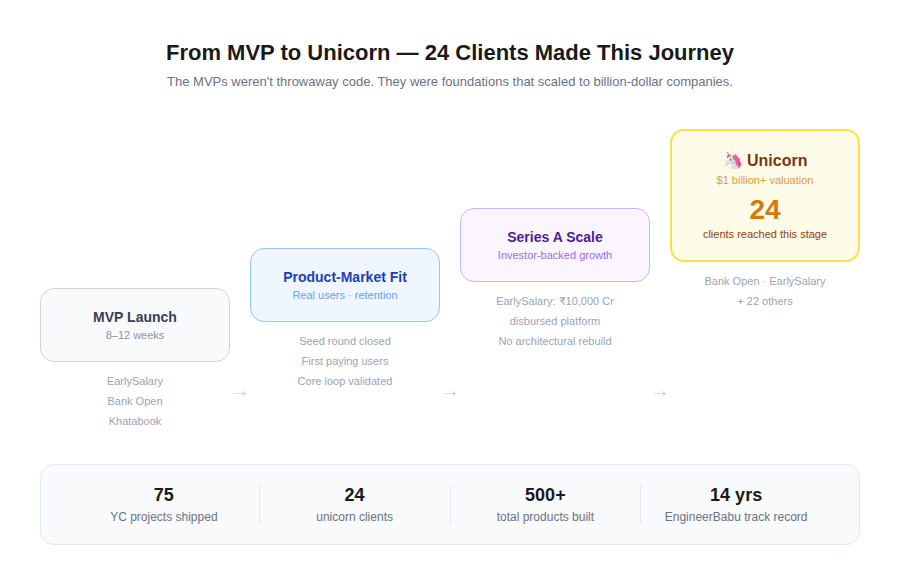
One of those projects won the Harvard Innovation Lab. Twenty-four of the team’s clients — across YC and non-YC projects — became unicorns.
I’m starting with this number because MVP development is the most crowded, most commoditized, most misleading segment of the Indian software development market. Every company claims to build MVPs. Every company promises “fast delivery.” Every company has a “startup-friendly” landing page.
The difference is in the outcomes. Seventy-five YC selections. Twenty-four unicorns. Those outcomes don’t happen with mediocre engineering.
My name is Mayank Pratap. I co-founded EngineerBabu 14 years ago. I also co-founded Supersourcing — so I’ve been a startup founder twice. I haven’t just built MVPs for other people’s startups. I’ve built MVPs for my own.
That dual perspective — builder and founder — shapes how the team approaches every MVP engagement. We don’t just ask “what features should the MVP have?” We ask “what’s your runway, what’s your funding timeline, what metrics will your investors evaluate, and what’s the minimum product that gets you to the next milestone?”
Because an MVP isn’t a small version of a big product. It’s a hypothesis expressed as software. And the only thing that matters is whether that hypothesis gets validated before the money runs out.
The term “Minimum Viable Product” has been tortured into meaninglessness. Let me restore it.
An MVP is not a crappy version of your product. “Minimum” doesn’t mean low quality. It means minimum scope — the smallest set of features that tests your core hypothesis. The code quality, the architecture, the security, the performance — all of these must be production-grade. Because if the MVP works, you’re going to scale it. And you can’t scale a codebase that was built to be thrown away.
When the team built Bank Open’s initial product — the one that eventually became a unicorn neobank — it was an MVP. Minimum features. Maximum architectural quality. The core banking integrations were designed to scale from day one. When Bank Open grew from zero to a billion-dollar company, they didn’t need to rebuild the foundation. It was already built for scale.
An MVP is not a prototype. A prototype proves that something is technically possible. An MVP proves that someone will use it and pay for it. Prototypes live in demo environments. MVPs live in production with real users making real decisions.
An MVP is not a feature list minus half the features. It’s a ruthless prioritisation exercise. What is the one thing this product must do better than any alternative? Build that one thing. Ship it. Measure it. Everything else is phase two.
The 75 YC projects the team built forced this discipline. YC founders don’t have the luxury of building everything. They have weeks, not months. Limited funding. A demo day with the world’s most demanding investors watching. The MVP must be focused, functional, and compelling — in 8-12 weeks.
That pressure — build fast, build right, build only what matters — is the operating mindset the team brings to every MVP engagement. Not just YC projects. Every startup that walks through the door.
Let me do the math that every funded startup founder should do before deciding where to build.
Scenario A: Build locally in the US. Senior developer: $180,000/year ($15,000/month). You need at least two developers plus a designer. Monthly engineering cost: $35,000-$45,000. Time to hire: 2-4 months. Time to build MVP after hiring: 3-4 months. Total time from decision to MVP in users’ hands: 5-8 months. Total cost: $175,000-$360,000.
Your seed funding: $1M-$2M. Engineering just consumed 20-35% of your runway before you have a single user.
Scenario B: Build with EngineerBabu in India. MVP development starting from $15K. 8-12 weeks from kickoff to launch. No hiring delay — the team exists, is experienced, and starts immediately. Total cost: $15,000-$60,000 depending on complexity.
Engineering consumed 1.5-6% of your runway. The remaining 94-98.5% funds customer acquisition, regulatory compliance, market validation, hiring commercial roles, and — critically — runway.
Runway is survival. The startup that has 18 months of runway iterates more, experiments more, pivots more, and finds product-market fit more often than the startup that has 8 months of runway and is already talking to bridge round investors.
This isn’t abstract math. 75 YC-selected startups made this exact calculation. They chose the EngineerBabu team because the math made their startups more likely to survive.
But what about quality?
4 of those clients became unicorns. The products the team built weren’t “good enough for now.” They were foundations that scaled to billion-dollar companies. EarlySalary’s lending platform — built as an initial product, now at ₹10,000 crore disbursed. Bank Open — built as an MVP, now a unicorn. Khatabook — built for an initial market, now serving tens of millions of users.
The cost savings didn’t come at the expense of quality. They came from India’s structural cost advantage — lower cost of living, lower operational costs — applied to engineering talent that’s equivalent to what you’d find in San Francisco.
India has thousands of companies that build MVPs. Many of them charge $5,000-$10,000 and deliver something that looks finished on the surface but is architecturally unsound underneath.
Here’s what separates the team.
The most valuable thing the team brings to an MVP engagement isn’t coding speed. It’s pattern recognition.
After 500+ products, the team has seen every category of startup. Lending platforms. Payment systems. Marketplace apps. Healthcare platforms. SaaS products. E-commerce systems. EdTech platforms. Logistics apps. Social products. Enterprise tools.
For each category, the team knows: what features users actually use (versus what founders think users want), what architecture decisions will become bottlenecks at scale, what third-party integrations are reliable (versus which ones have terrible documentation and worse support), what the common failure modes are and how to avoid them.
When a fintech founder comes to the team wanting to build a lending MVP, the CTO (17 years, Wishfin) doesn’t need a research phase to understand lending architecture. The team has built EarlySalary, LoanOS, and multiple other lending platforms. The architecture decisions are informed by what worked and what broke across all of them.
When a healthcare founder comes wanting to build a telemedicine MVP, the team has 400+ healthcare clients worth of context. They know what HIPAA compliance requires architecturally, what video consultation edge cases exist, what EHR integration challenges to anticipate.
This pattern recognition is the difference between an MVP that takes 8 weeks and an MVP that takes 20 weeks. Not because the team codes faster. Because the team makes fewer wrong decisions.
The biggest mistake in MVP development: building throwaway code.
“We’ll rebuild it properly after we raise the Series A.” No, you won’t. You’ll be too busy growing. Too busy hiring. Too busy servicing customers. The MVP codebase becomes the production codebase. And if the MVP was built as throwaway — monolithic, no separation of concerns, hardcoded values, no test coverage — you’ll spend the next 18 months fighting technical debt instead of building features.
The team builds MVPs with production-grade architecture from day one. Microservices where appropriate. Clean API design. Database schemas that accommodate growth without migration nightmares. Infrastructure-as-code for reproducible deployments. CI/CD pipelines. Automated testing for core business logic.
This isn’t over-engineering. It’s informed architecture. The team knows which components need to scale first (usually the database and the API layer) and which can be simple initially (usually the admin panel and reporting). They invest architectural rigour where it matters and keep things simple where it doesn’t.
Bank Open’s neobank started as an MVP. The architecture scaled to a unicorn without a rebuild. That’s not luck. That’s architectural decisions made by a team that knew what unicorn-scale architecture looks like — because they’d built it before.
Most Indian MVP shops operate as assembly lines. The founder pitches. The sales team closes. A project manager assigns. Junior developers build. The founder never appears again.
At EngineerBabu, I lead every engagement. When a startup founder calls, they talk to me — a fellow founder who’s built two companies (EngineerBabu and Supersourcing). I understand the anxiety of runway pressure. I understand the board dynamics. I understand what it feels like when your product launch is two months late and your investors are asking questions.
The CTO — 17 years at Wishfin — reviews every architecture. Not as a rubber stamp. As a participant who shapes the technical direction based on deep domain experience.
Google AI Accelerator 2024 and CMMI Level 5 aren’t credentials you’d associate with MVP development. Most MVP shops are young, scrappy agencies. The team is a mature engineering company with startup DNA — the scrappiness of a startup builder (75 YC projects) combined with the process discipline of a CMMI Level 5 organisation (500+ products).
That combination is rare. And for funded startups where the MVP isn’t just an experiment but the foundation of a company — it’s exactly what’s needed.
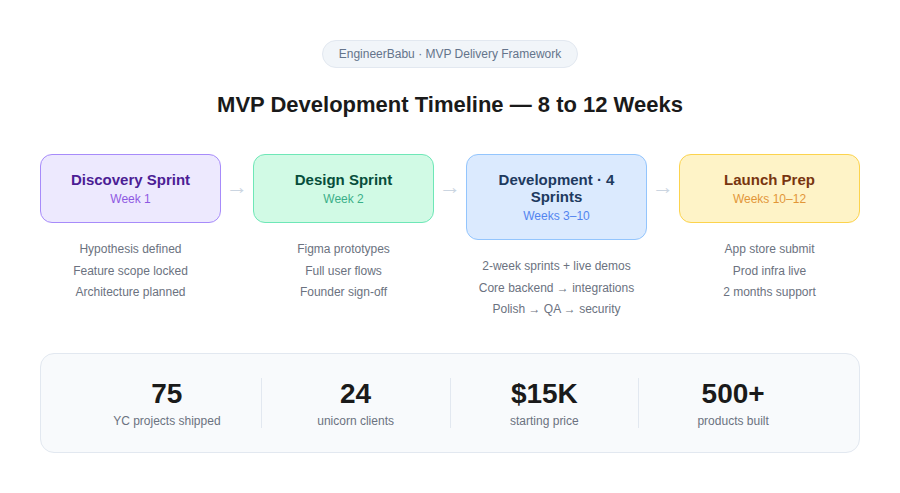
Let me walk through exactly what happens week by week.
No code is written in week one. This sounds counterintuitive for a team that promises 8-12 week delivery. It’s actually the reason the team delivers in 8-12 weeks.
The discovery sprint answers three questions. What is the core hypothesis this MVP tests? What is the minimum feature set that tests it? What architectural decisions must be made now versus deferred to phase two?
When EarlySalary’s initial product was being designed, the discovery sprint identified that the core hypothesis wasn’t “will people use a salary advance app?” It was “can we make credit decisions fast enough and accurate enough to sustain profitable lending at scale?” That insight shaped every architectural decision — the credit engine became the first thing built, not the user interface.
The team does this with the founder directly. Not a junior business analyst taking notes. The CTO and Mayank in the room, asking the hard questions. What’s your burn rate? When do you need to raise? What metrics will your investors evaluate? What does your competitive landscape look like? What happens if this hypothesis is wrong — what’s the pivot?
These questions feel uncomfortable. They’re supposed to. They prevent the team from building a beautiful product that tests the wrong hypothesis.
Figma prototypes. Complete user flows. Every screen the user will see, every interaction they’ll have. Reviewed and approved by the founder before a single line of code is written.
The design sprint catches 80% of UX problems at a stage where fixing them costs hours, not weeks. A screen that’s confusing in Figma would have been confusing in code — but discovering it in code means rewriting backend logic, not moving boxes in a design tool.
The team’s design approach for MVPs is informed by Khatabook’s scale. When a product needs to work for millions of users on low-end devices and spotty connections — which is the eventual reality for most consumer products — the UX discipline starts at the MVP stage. Clean. Fast. Obvious. No animations that don’t serve a purpose. No screens that could be eliminated.
Development runs in two-week sprints. Each sprint ends with a working, deployed feature set that the founder can test.
Sprint 1 (Weeks 3-4): Core backend + authentication + primary user flow. The product’s backbone. The single most important user journey — working end to end.
Sprint 2 (Weeks 5-6): Secondary features + integrations. Payment gateway, third-party APIs, admin panel basics.
Sprint 3 (Weeks 7-8): Polish + remaining features + testing. Edge cases handled. Error states designed. Performance optimised.
Sprint 4 (Weeks 9-10): QA + security testing + deployment preparation. For regulated products (fintech, healthcare), compliance validation happens here.
The founder sees working software every two weeks. Not slide decks. Not progress reports. The actual product, deployed to a staging environment, clickable and testable.
If something is wrong — if a feature doesn’t match the vision, if the UX feels off, if a priority needs to change — it’s caught within two weeks. Not at the end of a six-month waterfall cycle.
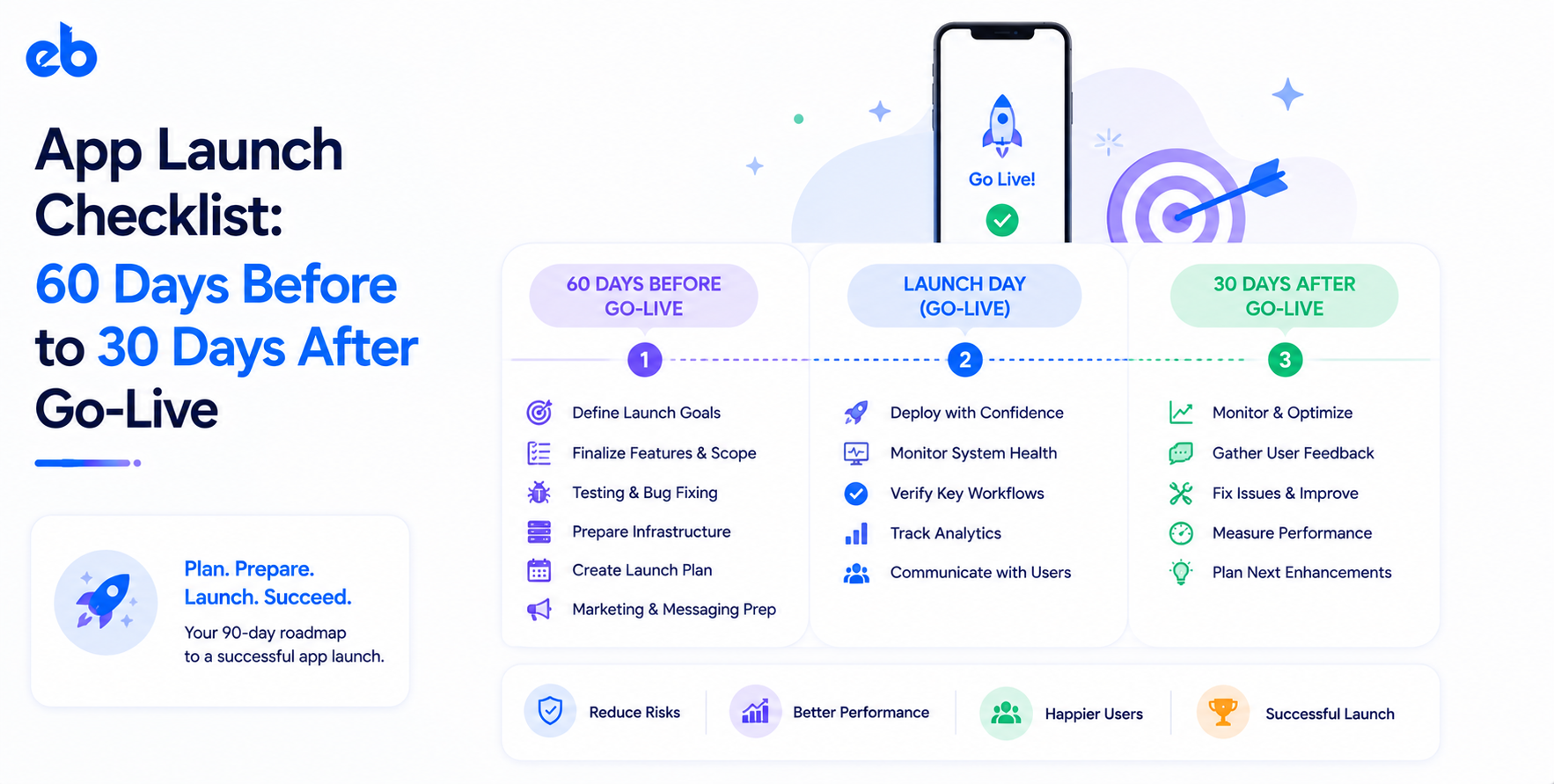
App store submissions (for mobile apps). Production environment setup. Monitoring and alerting configuration. Analytics integration. Launch checklist verification. Go-live.
Post-launch: two months of support included. Bug fixes. Performance optimisation. User feedback incorporation. The team doesn’t disappear after deployment. They stay through the critical first weeks when real users discover real edge cases.
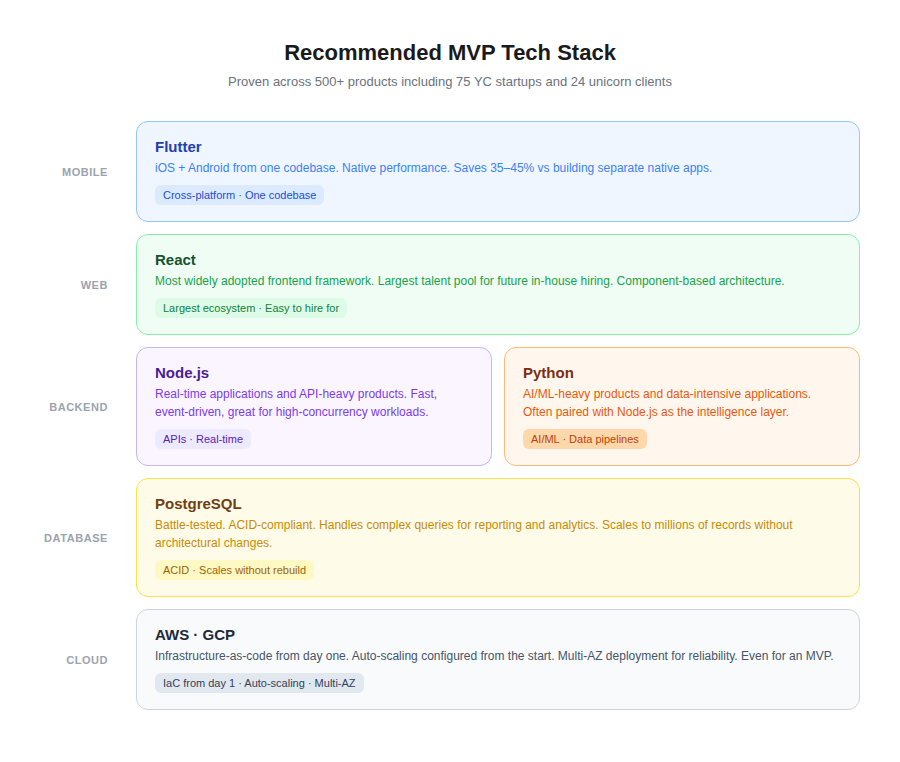
The tech stack for an MVP should optimise for three things: speed of development, ability to scale, and availability of developers for future hiring.
Mobile: Flutter. Cross-platform. One codebase for iOS and Android app development. Native performance. The team has shipped multiple Flutter-based fintech, healthcare, and consumer apps. Flutter saves 35-45% versus building separate native apps — and for an MVP where speed-to-market is everything, that saving is decisive.
Web frontend: React. Most widely adopted frontend framework. Largest talent pool for future in-house hiring. Component-based architecture that accelerates development.
Backend: Node.js for real-time applications and API-heavy products. Python for AI/ML-heavy products or data-intensive applications. Sometimes both — Node.js for the API layer, Python for the intelligence layer.
Database: PostgreSQL. Battle-tested. ACID-compliant. Handles complex queries for reporting and analytics. Scales to millions of records without architectural changes.
Cloud: AWS or GCP. Infrastructure-as-code from day one. Even for an MVP. Because when the product takes off, the infrastructure must scale without a rebuild. Auto-scaling configured from the start. Multi-AZ deployment for reliability.
Payment integration: Stripe (global), Razorpay (India), Adyen (multi-currency). The team has integrated all of them — multiple times. Integration that takes a first-timer two weeks takes the team two days.
This stack isn’t a recommendation designed to sound impressive. It’s the stack the team actually uses for MVPs — proven across 500+ products including the 75 YC projects and the products that became unicorns.
The core MVP process is the same. The domain-specific nuances are different.
A fintech MVP must handle real money from day one. There’s no “we’ll add payment integration later.” If it’s a lending product, the credit engine must work in the MVP — that’s the core hypothesis. If it’s a payment product, the payment flow must be production-grade.
The team’s fintech MVP capability: EarlySalary started as an MVP. Bank Open started as an MVP. Both became unicorns. The CTO’s 17 years at Wishfin means fintech MVPs get architecture informed by decades of financial infrastructure experience.
Compliance can’t be deferred either. RBI, CBUAE, MAS, ASIC — regulated market products need compliance architecture from sprint one. The team builds it in. Not as overhead. As architecture.
HIPAA compliance from day one if the product touches US patient data. PHI encryption, access controls, audit logging — these aren’t phase two features. They’re MVP features.
The team’s 400+ healthcare clients mean healthcare MVPs get clinical workflow understanding built in. The team knows what physicians need, what patients expect, and what regulators require — without a learning curve.
Multi-tenancy architecture from day one. User role management. Subscription billing integration (Stripe Billing). Onboarding flows optimised for conversion. Analytics embedded for tracking activation metrics.
Supersourcing — the B2B SaaS platform Mayank co-founded — was built with this architecture. It’s not theoretical SaaS knowledge. It’s operational.
Two-sided marketplace dynamics. Seller onboarding. Buyer experience. Trust mechanisms. Search and discovery. Transaction processing. Commission management.
Supersourcing is a marketplace. The team has built and operated the marketplace model. The cold-start problem, the chicken-and-egg dynamics, the quality curation challenge — the team has lived through all of them.
An MVP that launches and stays the same is a dead product. The real work begins after launch.
The team offers three post-MVP paths:
Path 1: Continued development with the EngineerBabu team. The dedicated team model. The same engineers who built the MVP continue building phase two, three, and beyond. The accumulated knowledge from the MVP phase compounds. No context loss. No knowledge transfer overhead. This is how Bank Open went from MVP to unicorn and EarlySalary went from MVP to ₹10,000 crore.
Path 2: Transition to in-house team. The code is the client’s. The documentation is complete. The architecture is clean. The client hires their own engineers. The team does a structured knowledge transfer — codebase walkthrough, architecture documentation, deployment guide, monitoring setup. Clean handoff. No vendor lock-in.
Path 3: Hybrid. In-house team for core product development. EngineerBabu team for specific capabilities — AI features, compliance engineering, performance optimisation. The two teams collaborate. The client scales in-house gradually while maintaining access to the team’s depth.
All three paths start the same way: an MVP built with production-grade architecture, clean code, comprehensive documentation, and complete IP ownership. The client’s options are open from day one.
Mayank Pratap — a fellow founder who’s built two companies. Not a services salesman. A founder who understands runway anxiety, investor dynamics, and the pressure of demo day. Every engagement is founder-to-founder.
Email me. mayank@engineerbabu.com. One founder to another.
Tell me about the idea, the market, the hypothesis you want to test, and the runway you have. I’ll tell you honestly what the MVP should include, what it should exclude, what it will cost, and how fast the team can ship it.
No pitch deck required. No commitment to hear the assessment. Just a conversation between two founders about building something that matters.
Seventy-five YC startups started with a conversation like this. Twenty-four of them became unicorns. Let’s see what yours becomes.
Mayank Pratap Co-founder, EngineerBabu & Supersourcing mayank@engineerbabu.com | engineerbabu.com
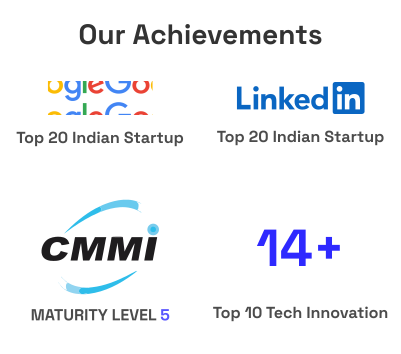
Google AI Accelerator 2024 · CMMI Level 5 · 75 YC Projects · 4 Unicorn Clients · Backed by Vijay Shekhar Sharma · 200+ VC-funded Products · LinkedIn Top 20 Startups India · NASSCOM Member
MVP development from India starts from $15K with a quality Tier 1 team. Simple consumer apps: $15K-$25K. Mid-complexity products with payment integration and compliance: $25K-$50K. Complex MVPs with AI, multi-role systems, or regulatory requirements: $50K-$80K. These represent 60-70% savings versus US development. EngineerBabu has shipped 75 YC-selected MVPs and provides exact estimates after a discovery sprint.
EngineerBabu ships MVPs in 8-12 weeks — from discovery sprint through production deployment. Week 1 is discovery (no code — defining the hypothesis and minimum feature set). Week 2 is design (Figma prototypes). Weeks 3-10 are development in two-week sprints with demos every two weeks. Weeks 10-12 are QA, security testing, and launch. The timeline is achievable because 500+ shipped products create pattern recognition that eliminates wasted effort.
India is the optimal MVP development destination for US startups. 75 YC-selected startups built their products with EngineerBabu — YC’s most rigorous evaluation validated the quality. 4-5 hours of daily timezone overlap enables real-time collaboration. Cost savings of 60-70% mean longer runway — the startup has more iterations to find product-market fit before funding runs out. 4 clients became unicorns, proving the MVPs the team builds aren’t throwaway prototypes but scalable foundations.
EngineerBabu builds MVPs with production-grade architecture from day one. Microservices where appropriate, clean API design, automated testing, CI/CD pipelines, infrastructure-as-code. Bank Open’s MVP became a unicorn neobank without an architectural rebuild. EarlySalary’s MVP became a ₹10,000 Cr platform. The team builds for scale from the first sprint because they know from 500+ products that “we’ll rebuild later” never actually happens.
Yes. Complete code and IP ownership is transferred. The code lives in the client’s repository from day one. No white-label. No shared codebases. No proprietary frameworks. No vendor lock-in. The founder can take the code to another vendor, hire in-house engineers, or continue with EngineerBabu — because the product is the founder’s property. This is non-negotiable for every engagement.
EngineerBabu | 75 YC MVPs Shipped. 4 Became Unicorns. Yours Could Be Next.