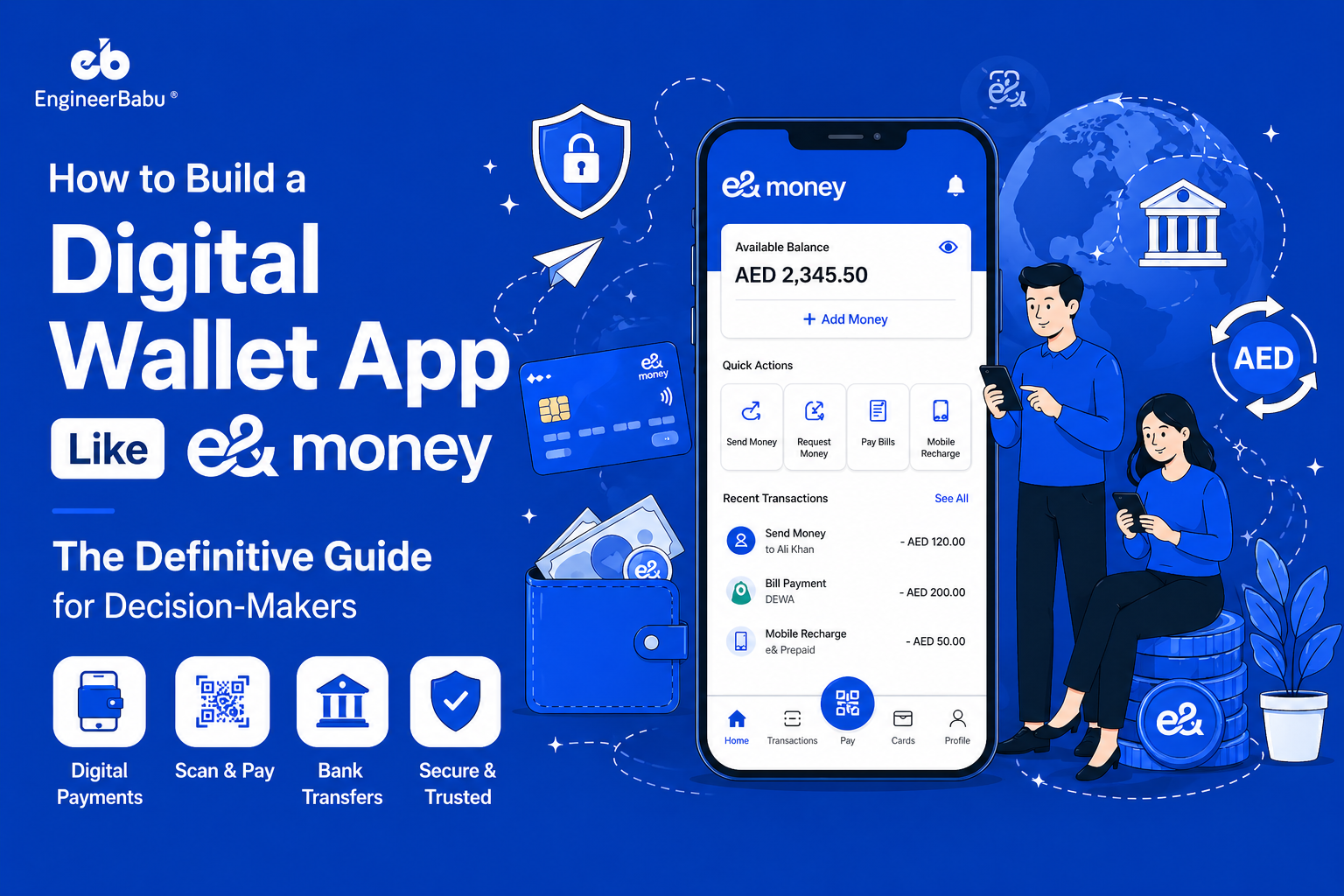
How to Build a Digital Wallet App Like e& money — The Definitive Guide for Decision-Makers


Create engaging, high-performance mobile applications tailored to your business needs. We craft future-ready apps that offer smooth user experiences on all devices.
Build robust and scalable websites and CMS platforms that help you manage content effortlessly. Our development ensures a seamless digital presence.
Launch secure, feature-rich online stores with intuitive shopping experiences. We build tailored eCommerce platforms designed for growth.
Design captivating games with immersive gameplay and stunning graphics. From concept to launch, we build engaging experiences that players love.
Enhance your customer relationships with customized Salesforce implementations. Drive growth and efficiency with smarter CRM solutions.
Harness artificial intelligence and machine learning to automate workflows and gain actionable insights. Our AI transforms data into smart decisions.
Accelerate your software delivery lifecycle with continuous integration, delivery, and infrastructure automation to boost efficiency.
Hire app developers ready to turn your ideas into sleek, high-performing mobile apps for any platform.
Bring in frontend pros who craft smooth, beautiful, and user-friendly interfaces that your visitors will love.
Get backend developers who build fast, secure, and reliable systems to keep everything running behind the scenes.
Hire eCommerce developers who build secure, scalable online stores designed to offer seamless shopping and grow your sales.
Get dedicated developers committed to your projects, delivering consistent quality and speed as an extension of your team.
Here’s what most people get wrong about digital wallets.
They think it’s a payments app. A screen with a balance and a send button. Something you can build in a few months with a decent development team and a Stripe integration.
It’s not.
A digital wallet like e& money is a full financial services platform compressed into a phone screen. Stored value. Peer-to-peer transfers. International remittances. Bill payments. QR merchant payments. Salary disbursement. KYC verification. Multi-currency support. Loyalty systems. Every one of those is a separate engineering challenge. Together, they form one of the most complex consumer fintech products you can build.
I know this because my team has built the systems that power products like these.
My name is Mayank Pratap. I co-founded EngineerBabu 14 years ago. Since then, the company has shipped over 500 products. 200+ for VC-funded companies. 75 for Y Combinator-selected startups. 24 clients that became unicorns.
EarlySalary — one of India’s first salary advance platforms. EngineerBabu built the lending infrastructure. That platform has disbursed over ₹10,000 crore. Khatabook — the bookkeeping app that scaled to tens of millions of Indian SMEs and became a full financial services platform. OpenMoney — a full-stack financial platform where payments, investments, and credit flow through one unified architecture. Bank Open (now Open Financial) — a neobank that went on to become a unicorn, with core banking integrations built by the EngineerBabu team.
TaptapSend — a multi-continent remittance platform operating across five regulatory jurisdictions. The team built compliance and money movement across borders, currencies, and regulatory regimes simultaneously. Kulu Fintech — GCC-focused financial infrastructure. Simba Beer — where custom technology recovered millions in blocked capital.
Payment orchestration work within the Razorpay ecosystem. Products built for Paytm’s ecosystem. Enterprise technology for Adani Group. HIPAA-compliant healthcare platforms for Apollo Hospitals, Manipal, Shalby, CHL Hospitals, ResMed, and 1MG.
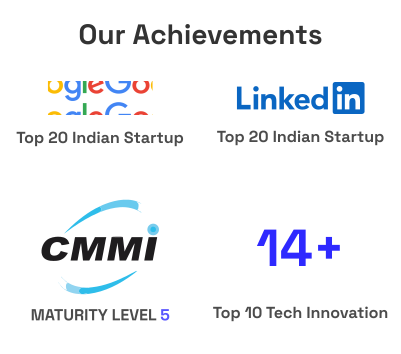
Google selected EngineerBabu for the AI Accelerator 2024. CMMI certified us at Level 5 — the highest maturity level. Vijay Shekhar Sharma — the founder of Paytm — backs the company personally. LinkedIn named us a Top 20 Startup in India. NASSCOM lists us as a member.
When I explain what it takes to build a digital wallet app like e& money, it comes from the other side of having built these systems. Not once. Hundreds of times.
e& money sits at #2 in UAE’s fintech app rankings. Backed by e& (formerly Etisalat) — one of the largest telecom groups in the Middle East. Frequently in the top 3 on both Google Play and App Store charts.
Most people look at it and see a simple payment app. Tap, pay, done.
Behind that simplicity is a staggering amount of infrastructure.
Digital wallet with stored value. Peer-to-peer transfers — domestic and international. Bill payments across dozens of utility providers. QR-based merchant payments. Salary disbursement integrations for corporates. Remittance corridors to South Asia, Southeast Asia, and Africa. KYC verification tied to Emirates ID. Multi-currency support. Loyalty and cashback systems.
The global digital wallet market crossed $9 trillion in transaction volume in 2024. In the
Middle East, mobile wallet adoption is accelerating faster than anywhere outside Southeast Asia. UAE’s cashless transaction share exceeded 70% in 2025. Saudi Vision 2030 is pushing digital payments aggressively. The UAE Central Bank’s digital dirham initiative is creating new infrastructure rails.
The opportunity is enormous. But building a wallet that actually handles real money, across real payment rails, under real regulatory oversight — that’s a fundamentally different challenge than building an app that looks like it handles money.
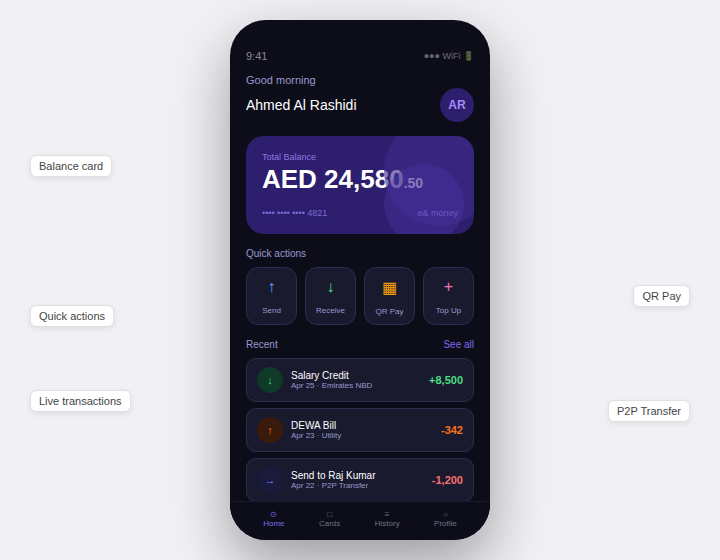
Every blog will hand you a feature list. Features are easy to list. The hard part is knowing which ones break under real transaction load and which architectural decisions are irreversible once you’ve launched.
Everything visible in a digital wallet app — the balance, the transaction history, the send button — is a display layer sitting on top of money movement infrastructure. That infrastructure determines whether the wallet works or fails catastrophically.
Money in: bank transfers, card top-ups, agent deposits, salary credits, merchant refunds. Money out: peer-to-peer transfers, bill payments, merchant payments, bank withdrawals, international remittances. Every inflow and outflow must reconcile perfectly. Every day. Across every currency. Across every payment rail.
When the EngineerBabu team built OpenMoney’s financial platform, the core challenge was identical — payments, investments, and credit flowing through a single architecture. Multiple money inflows, multiple outflows, one reconciliation engine that makes it all balance. That discipline — making every dirham, rupee, and dollar accountable across every transaction — is what separates a real digital wallet from a demo.
The team has built payment orchestration within the Razorpay ecosystem. They’ve built the complete financial backbone for products that process millions of transactions. The pattern is always the same: money movement is the product. Everything else is presentation.
For a wallet targeting the UAE market, you have the luxury of existing payment rails — Stripe, Adyen, Checkout.com, local card networks, Apple Pay, Samsung Pay. The challenge isn’t building rails. It’s orchestrating them. Multiple payment methods. Multiple settlement cycles. Multiple currencies. One engine that reconciles all of it without losing a fils.
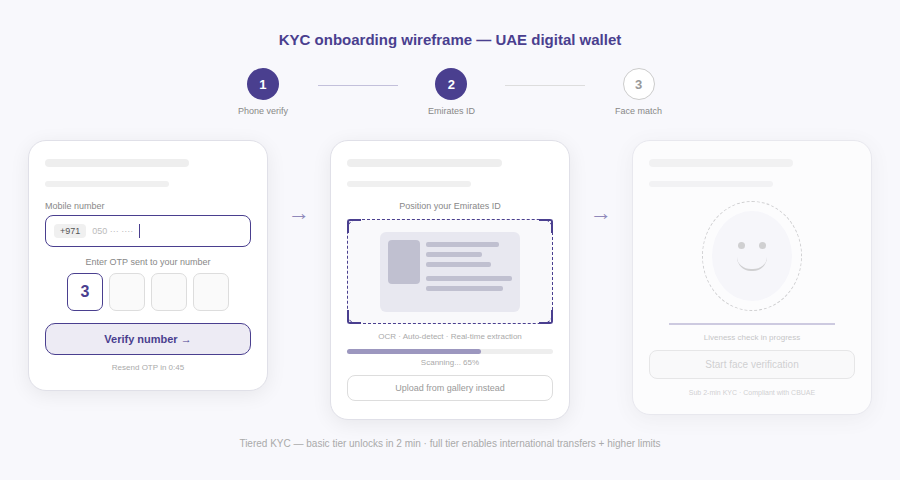
In the UAE, digital wallet KYC ties directly to Emirates ID. In Saudi Arabia, the National ID system. The KYC flow is the first experience every user has — and it directly determines the conversion rate.
Too much friction and users drop off before they ever load money. Too little verification and regulators shut the app down.
The answer is tiered KYC. A basic tier — phone number plus Emirates ID scan — gives limited functionality: small balances, domestic transfers only. A full tier — document verification, facial recognition, liveness detection, credit bureau checks — unlocks everything: international transfers, higher limits, merchant payments.
When the team built EarlySalary’s lending platform, the onboarding flow was the critical bottleneck. A salary advance product lives or dies on how fast a user goes from download to first disbursement. The team engineered sub-2-minute KYC — document scanning with OCR, real-time identity verification against government databases, instant credit decisioning. That same onboarding engineering applies directly to digital wallet KYC. Speed without compromising verification. Compliance without creating friction.
Khatabook scaling to tens of millions of users taught the team something equally important about identity at scale. Not every user has a smartphone from 2024. Not every user has a stable internet connection. KYC flows must complete even when the user loses connectivity midway and comes back. They must work on a ₹8,000 Android phone on a 3G connection. That discipline is invisible to users. It’s the difference between a 40% onboarding completion rate and a 90% one.
P2P transfers are how wallets grow. A user sends money to a friend. The friend downloads the wallet to receive it. Now there are two users. This is the viral loop that drives wallet adoption.
For domestic P2P, the engineering challenge is real-time settlement and notification. The sender taps “send,” the receiver’s balance updates instantly. Sounds simple. It requires a real-time messaging layer, atomic transaction processing (the debit and credit must happen as one operation — never one without the other), and push notification delivery within seconds.
International remittance is an order of magnitude harder. Cross-border compliance. FX rate management. Correspondent banking relationships. Anti-money laundering screening on every transaction. Settlement timing that varies by corridor — same day for some routes, 2-3 days for others.
TaptapSend’s multi-continent remittance platform was built by the EngineerBabu team. Five regulatory jurisdictions. Multiple corridors. Different KYC requirements per country. Different data residency rules. Different AML screening standards. One architecture that satisfied all of them. That’s not a feature you add to a wallet later — it’s a structural decision that shapes the entire system from day one.
If the wallet targets the UAE’s massive expatriate population — and it should, because that’s where the remittance volume lives — the cross-border capability isn’t an add-on. It’s a primary use case.
Consumer-to-consumer transfers create adoption. Merchant payments create revenue.
QR-based payments at physical stores. Online checkout integration for e-commerce. In-app payments for services. Bill payments to utility providers, telecom operators, government services. Each one requires a different integration, a different settlement flow, and a different reconciliation cycle.
The merchant layer needs an SDK for merchant app integration, a merchant dashboard for transaction monitoring and settlement tracking, API documentation for custom integrations, and a settlement engine that handles daily payouts with proper commission deduction.
The EngineerBabu team has built merchant integration systems across multiple fintech products. They’ve built payment layers within the Razorpay ecosystem. They’ve done it for markets where infrastructure was established and markets where they had to build every layer. The edge cases are where these systems break — partial refunds, split settlements, multi-currency merchant payouts, tip handling, void transactions after settlement. The team has found them all. Repeatedly.
A digital wallet is a target. From the moment it launches, bad actors will attempt account takeovers, synthetic identity fraud, money laundering through rapid P2P cycling, and merchant collusion schemes.
The security layer includes multi-factor authentication (biometric + PIN + device binding), transaction velocity monitoring, device fingerprinting, anomaly detection, geo-fencing for high-risk transactions, and real-time fraud scoring on every money movement.
Google’s selection of EngineerBabu for the AI Accelerator 2024 was built around AI-driven intelligence for financial services. Fraud detection is one of the highest-value applications of AI in fintech — patterns that would take human analysts hours to identify can be flagged in milliseconds by properly trained models. The team builds these models with the kind of data-first approach that comes from having built AI-driven risk systems for lending platforms processing thousands of decisions daily.
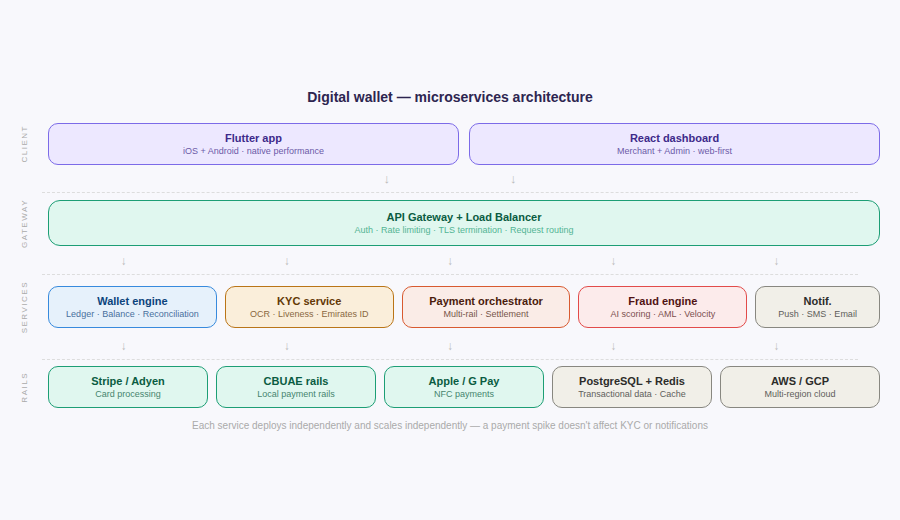
The technology choices for digital wallet app development aren’t about picking trendy frameworks. They’re about reliability under financial load, regulatory compliance, and the ability to scale without rebuilding.
Flutter for the consumer app. One codebase for iOS and Android, native performance. The EngineerBabu team has shipped multiple Flutter-based fintech applications. The framework is proven for production financial products.
React for the merchant dashboard and admin panel. Web-first, because merchants and operations teams work in browsers.
Node.js for the real-time transaction API layer — event-driven architecture handles the concurrent connection load that a wallet generates. Python for the fraud detection and risk scoring engine, where the machine learning ecosystem is unmatched.
PostgreSQL for transactional data — battle-tested in financial systems, supports the complex queries needed for reconciliation and regulatory reporting. Redis for session management and caching — because wallet balance lookups need to be instant.
AWS or GCP with multi-region deployment. Microservices architecture — the payment processing service, the KYC service, the notification service, the fraud detection service, and the reconciliation service all run independently. When the notification service gets overloaded during a promotional campaign, the payment processing service keeps running without interruption.
When the team built Bank Open’s neobank platform, the architecture followed exactly this pattern — multiple financial services running independently but communicating seamlessly. Bank Open became a unicorn. The architecture scaled with them. That same microservices discipline applies to digital wallet development. The wallet will grow in ways nobody can predict at launch. The architecture must accommodate that growth without requiring a rebuild.
Every development company has a methodology diagram. Discovery → Design → Develop → Deploy. They all look identical. They reveal nothing about how the work actually gets done.
Here’s what actually happens when the EngineerBabu team builds a digital wallet.
The starting point isn’t features. It’s money flow. Before any design work, the team maps every money movement pathway — every inflow, every outflow, every edge case, every reconciliation cycle. When OpenMoney’s platform was built, this money flow mapping happened before a single screen was designed. The result was an architecture that didn’t need to be rearchitected when new financial products were added later.
Compliance comes next — not later. Not “before launch.” During architecture. When TaptapSend needed compliance across five countries, the team didn’t build five separate compliance modules. They built one compliance abstraction layer configurable per jurisdiction. The same pattern applies to a UAE wallet that might expand to Saudi, Bahrain, or Egypt. Build the abstraction once. Configure the specifics per market.
The team ships MVPs in 8-12 weeks. That’s not a rushed timeline. It’s what happens when a team has shipped 500+ products and knows exactly what to build first, what to defer to phase two, and what to skip entirely. Pattern recognition is the most valuable thing an engineering team brings to a fintech project. It can’t be bought without volume.
CMMI Level 5 processes mean every sprint has built-in security review, compliance validation, and quality gates. This isn’t overhead — it’s insurance against the kind of regulatory findings that shut wallets down months after launch.
Three killers. Consistent across every failed wallet project the team has encountered.
Underestimating reconciliation complexity. The wallet works beautifully in testing. Then it launches. A thousand transactions happen on day one. By day two, the settlement report is off by a few hundred dirhams. Nobody knows why. The problem isn’t a bug — it’s an architecture that didn’t account for partial failures, timeout retries, and concurrent transactions hitting the same balance. Fixing reconciliation after launch means rebuilding the ledger system while users are actively transacting. It’s surgery on a moving patient.
The team has built reconciliation engines for platforms processing millions of transactions. For EarlySalary’s ₹10,000 crore in disbursals. For OpenMoney’s multi-product financial platform. Reconciliation isn’t a feature — it’s the foundation the team lays before building anything visible.
Treating compliance as a phase instead of architecture. When the team built HIPAA-compliant healthcare platforms for Apollo Hospitals, Manipal, and ResMed, they learned something that applies directly to fintech: regulated software designed for compliance from day one costs the same. Regulated software retrofitted with compliance costs 3-5x more and delays launch by months. CBUAE, SAMA, PCI-DSS, AML/KYC — these requirements must shape the database schema, the API design, the data residency decisions. Not decorate them afterward.
Building features instead of unit economics. A wallet with every feature e& money has — but with no path to profitability — is an expensive way to move other people’s money for free. Merchant commission structures. Transaction fee models. Premium tier pricing. Float income calculations. These economics must be modeled before the first screen is designed, because they shape product decisions in ways that are prohibitively expensive to change post-launch.
Mayank Pratap leads the company personally. When a client starts a digital wallet development project with EngineerBabu, they’re talking to the founder — not a sales team, not an account manager. Fourteen years of product meetings, architecture reviews, and difficult trade-off conversations. That involvement doesn’t change based on project size.
EngineerBabu builds custom platforms from scratch. The client’s product, the client’s brand, the client’s IP. Complete code ownership transferred at delivery. No white-label. No shared infrastructure. A product built specifically for the client’s market and business model. Everything — every line of code, every architecture document, every deployment script — belongs to the client.
The CTO brings 17 years of credit and financial infrastructure experience from Wishfin — one of India’s largest credit marketplaces. The engineering leadership has built money movement systems at a depth and scale that most development teams never encounter.
Google AI Accelerator 2024 validates the AI capability — fraud detection, risk scoring, transaction intelligence. CMMI Level 5 means internationally audited engineering processes. 24 unicorn clients, 75 YC selections, 200+ VC-funded products means the team has seen every failure mode and knows how to avoid them.
EarlySalary. Khatabook. OpenMoney. Bank Open. Razorpay. TaptapSend. Kulu Fintech. Simba Beer. Adani Group. Apollo Hospitals. Manipal. ResMed. 1MG. These aren’t logos on a website — they’re products the team built, shipped, and scaled.
Digital wallet app development starting from $15K depending on scope, market complexity, and feature depth. Exact numbers come after understanding the specific business — not before.
Email Mayank directly. mayank@engineerbabu.com. Not a form. Not a chatbot. The founder.
Share the market, the users, the regulatory environment, and the business model. Mayank will spend 30 minutes understanding the business and giving an honest assessment — does building a digital wallet make sense? What should be built first? What can wait?
No pitch deck. No pressure. Just a conversation between people who care about building great fintech products.
Mayank Pratap Co-founder, EngineerBabu mayank@engineerbabu.com | engineerbabu.com
Google AI Accelerator 2024 · CMMI Level 5 · Backed by Vijay Shekhar Sharma · 24 Unicorn Clients · 75 YC Selections · 200+ VC-funded Products · LinkedIn Top 20 Startups India · NASSCOM Member
How much does digital wallet app development cost?
Digital wallet app development starts from $15K depending on scope, market complexity, compliance requirements, and feature depth. A focused MVP with wallet, P2P transfers, and basic merchant payments sits at the lower end. Multi-currency platforms with international remittance and advanced fraud detection scale from there. EngineerBabu provides exact numbers after understanding the specific business model.
How long does it take to build a digital wallet app like e money?
EngineerBabu ships wallet MVPs in 8-12 weeks — core wallet functionality, P2P transfers, bill payments, KYC, and compliance for the primary market. Full platforms with international remittance, multi-currency support, and advanced features take longer depending on scope.
What tech stack is best for digital wallet app development?
Flutter for cross-platform mobile apps. React for merchant and admin dashboards. Node.js for real-time transaction processing. Python for fraud detection and AI models. PostgreSQL for transactional data. AWS
or GCP for cloud infrastructure. Payment gateway integration with Stripe, Adyen, or Checkout.com depending on market.
What compliance does a digital wallet need in the UAE?
UAE digital wallets require CBUAE licensing or partnership with a licensed entity, PCI-DSS for card data security, Emirates ID integration for KYC, AML/KYC frameworks, and data protection compliance. Saudi Arabia requires SAMA compliance. EngineerBabu architects compliance into the product from day one — never as a post-launch retrofit.
Can EngineerBabu build a custom digital wallet for my business?
Yes. EngineerBabu builds custom digital wallet platforms from scratch — tailored to the client’s market, users, compliance requirements, and business model. Full stack: wallet engine, P2P transfers, merchant payments, bill pay, KYC, fraud detection, admin dashboard. Complete code and IP ownership transferred. No white-label. Experience with EarlySalary, OpenMoney, Bank Open, TaptapSend, and Razorpay’s ecosystem means the team understands both the technology and the economics of building financial products that work.
EngineerBabu | Product Engineering for Fintech That Moves Real Money