What is the Cost to Build an App Like Duolingo


Create engaging, high-performance mobile applications tailored to your business needs. We craft future-ready apps that offer smooth user experiences on all devices.
Build robust and scalable websites and CMS platforms that help you manage content effortlessly. Our development ensures a seamless digital presence.
Launch secure, feature-rich online stores with intuitive shopping experiences. We build tailored eCommerce platforms designed for growth.
Design captivating games with immersive gameplay and stunning graphics. From concept to launch, we build engaging experiences that players love.
Enhance your customer relationships with customized Salesforce implementations. Drive growth and efficiency with smarter CRM solutions.
Harness artificial intelligence and machine learning to automate workflows and gain actionable insights. Our AI transforms data into smart decisions.
Accelerate your software delivery lifecycle with continuous integration, delivery, and infrastructure automation to boost efficiency.
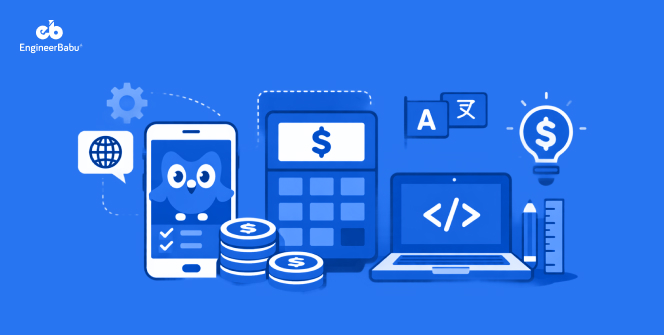
A few years ago, learning a new language meant carrying bulky books or sitting through long classes. Today, you can pick up your phone, spend just 10 minutes a day, and start speaking a new language almost effortlessly. That shift is exactly why apps like Duolingo have become part of daily routines for millions of people.
The demand is only growing. As per PR Newswire, the global language learning market is expected to cross $100 billion in the coming years, driven largely by mobile-first platforms and AI-powered personalization.
This surge has pushed many founders and businesses to explore one key question: what is the cost to build an app like Duolingo?
If you are thinking about entering the EdTech space, understanding the real investment behind such an app is crucial. It is not just about building lessons. It involves smart design, engaging user experiences, and technologies like AI and speech recognition working seamlessly in the background.
In this guide, we will break down everything you need to know, from development factors to realistic cost estimates, so you can plan your app with clarity and confidence.
Duolingo is a gamified language-learning platform that makes education feel more like a game than a task. Instead of long lessons, it uses short, interactive exercises that keep users engaged daily.
Its success comes from a few simple but powerful ideas. Gamification elements like streaks, rewards, and levels create habit-forming behavior. AI-driven personalization adapts lessons based on user performance, making learning efficient.
The freemium model also plays a big role by offering free access while monetizing advanced features.
For anyone analyzing the cost to build an app like Duolingo, it is important to understand that its success is not just about features, but how thoughtfully those features are designed to keep users coming back consistently.
When you start planning the cost to build an app like Duolingo, features are where everything begins. The more refined and engaging your feature set is, the more impact it has on both user experience and overall development cost.
This is where users spend most of their time, so it needs to feel smooth and intuitive. Basic features like registration, profiles, and language selection set the foundation. Interactive lessons keep users engaged, while gamification elements like streaks and badges make learning addictive. Progress tracking and push notifications help users stay consistent, which is key for long-term retention.
This is where things start getting interesting and more complex. Features like speech recognition and AI-powered personalization make the app feel smart and responsive. Chatbots allow users to practice real conversations, while offline mode adds flexibility. Social sharing also plays a subtle role in growth by encouraging users to invite others and stay engaged.
Behind every smooth app is a powerful admin panel. It allows you to manage users, update learning content, and monitor performance through analytics. Monetization controls help you manage subscriptions and in-app purchases. When estimating the cost to build an app like Duolingo, this backend system is just as important as the user-facing experience.
Choosing the right tech stack plays a huge role in shaping both performance and the cost to build an app like Duolingo. It is not just about picking popular tools, but selecting technologies that can scale, handle real-time interactions, and support personalized learning experiences smoothly.
The frontend is what users interact with daily, so it needs to be fast and responsive. Cross-platform frameworks like React Native and Flutter help you in both iOS development and Android efficiently. If you are planning a native route, understanding native languages can help ensure smoother performance and better user experience on Apple devices.
The backend handles everything from user data to lesson logic and real-time updates. Technologies like Node.js and Django are commonly used for their scalability and speed. Many teams prefer Node.js Development for handling concurrent users and real-time features, which is essential for apps with high engagement like Duolingo.
A strong database setup is critical since you are managing user progress, learning paths, and content. MongoDB works well for flexible, unstructured data, while PostgreSQL is great for structured and relational data. Choosing the right database directly impacts how efficiently your app performs as it scales.
AI is what makes apps like Duolingo feel personalized. From adaptive learning paths to speech recognition, AI and ML models play a key role. AI development services are also one of the major contributors to the cost to build an app like Duolingo, since building and training these systems requires both expertise and resources.
Cloud platforms like AWS and Google Cloud help you scale your app without worrying about infrastructure limits. They support storage, computing power, and real-time data processing. A reliable cloud setup ensures your app stays fast and available, even as your user base grows rapidly.
Before jumping into numbers, it helps to understand how the app actually comes together. The development journey directly influences the cost to build an app like Duolingo, since each phase requires time, expertise, and iteration to get things right.
Everything starts with clarity. You need to understand your target users, their learning behavior, and what gaps exist in the market. This stage also includes defining features, business goals, and monetization approach. A well-planned roadmap saves time later and avoids unnecessary costs during development.
This is where your app starts taking shape visually. A clean, engaging ui/ux design is crucial for retention, especially in learning apps. Designers focus on creating intuitive navigation and interactive elements that make learning feel effortless. Good design is not just about looks, it directly impacts how often users come back.
This is the most resource-intensive phase. Developers build the frontend, backend, and integrate features like gamification and AI. The complexity here significantly affects the cost to build an app like Duolingo, especially if you are aiming for real-time interactions and personalized learning experiences.
No app should go live without proper testing. This phase ensures everything works smoothly across devices and scenarios. From fixing bugs to improving performance, QA helps deliver a reliable experience. Skipping or rushing this step often leads to bigger issues after launch.
Once the app is ready, it is launched on app stores. But the work does not stop there. Regular updates, performance monitoring, and feature improvements are essential to keep users engaged. Ongoing maintenance is a continuous cost factor you should always plan for.
If you are trying to estimate the cost to build an app like Duolingo, it is important to know that there is no fixed number. The final cost depends on multiple variables, and even small changes in scope or features can significantly impact your budget.
The overall complexity of your app is one of the biggest cost drivers. A basic learning app with limited functionality will cost far less than a fully interactive platform with AI, gamification, and real-time feedback. The more sophisticated your app logic is, the more development time and expertise it requires.
Every feature you add increases both time and cost. Simple features like user login are quick to build, but advanced ones like speech recognition or adaptive learning take much more effort. When calculating the cost to build an app like Duolingo, prioritizing essential features for the first version can help manage your budget better.
Choosing where your app will run also affects cost. Building for a single platform is cheaper, while supporting iOS, web and Android development together increases development time. Cross-platform approaches can help reduce cost, but sometimes native apps offer better performance depending on your goals.
A clean and simple design costs less than a highly interactive, animation-rich interface. Apps like Duolingo rely heavily on engaging visuals and smooth transitions, which require extra design effort. Investing in good UI/UX is important, but it should be balanced with your budget constraints.
Where your development team is based can significantly impact pricing. Developers in regions like the US or Western Europe typically charge more than teams in India or Eastern Europe. This difference can greatly influence the overall cost to build an app like Duolingo without necessarily affecting quality if you choose the right team.
Integrating third-party services like payment gateways, analytics tools, or APIs can speed up development but also add to the cost. Some services come with subscription fees, while others require custom integration. These integrations are often essential, but they should be chosen carefully to avoid unnecessary expenses.
Launching the app is just the beginning. Regular updates, bug fixes, and performance improvements are ongoing costs. As your user base grows, maintaining the app becomes more resource-intensive. Planning for long-term maintenance is crucial if you want your app to stay competitive and reliable.
Now let’s talk numbers, because this is where most decisions actually happen. The cost to build an app like Duolingo can vary widely depending on how ambitious you want your product to be. From a simple MVP to a fully-featured platform, your investment can scale significantly.
If you are just starting out, building an MVP is the smartest move. It includes core features like basic lessons, user profiles, and progress tracking. On average, an MVP can cost anywhere between $25,000 to $60,000. This approach helps you test the idea in the market without committing to a huge upfront investment.
A full-scale app with AI, gamification, speech recognition, and advanced analytics requires a much larger budget. The cost to build an app like Duolingo at this level typically ranges from $80,000 to $250,000 or more. The final number depends on how refined and scalable you want the product to be.
Development costs also vary depending on where your team is located. In the US, hourly rates are significantly higher, making projects more expensive. In contrast, countries like India or regions like Eastern Europe offer more cost-effective options. This difference can greatly influence the overall cost to build an app like Duolingo without changing the core scope.
Understanding the timeline is just as important as the cost when planning your app. The cost to build an app like Duolingo is closely tied to how long development takes, since longer projects require more resources and management. Timelines can vary based on features, complexity, and team size.
Building a minimal viable product usually takes around 3 to 5 months. This includes core features like lessons, user registration, progress tracking, and basic gamification. Keeping the scope lean helps you launch quickly, gather feedback, and refine the app without spending too much upfront.
A complete app with AI-powered personalization, speech recognition, and advanced analytics can take anywhere from 8 to 12 months. Additional time is spent on testing, optimizations, and fine-tuning the learning experience. Factoring in these timelines is essential when planning the overall cost to build an app like Duolingo.
Building an app like Duolingo doesn’t always have to break the bank. With smart planning, you can manage your budget while still creating a high-quality product. The cost to build an app like Duolingo can be optimized by focusing on essentials first, leveraging existing tools, and making strategic decisions about design, development, and deployment.
Starting with a minimal viable product allows you to launch the core learning features and basic gamification quickly. This helps gather user feedback early, validate the idea, and prioritize features for future updates.
By limiting the initial scope, you avoid unnecessary development costs and reduce time spent building non-essential components. Focusing on an MVP is a proven way to test the market while keeping the cost to build an app like Duolingo under control.
Building separate apps for iOS and Android can be expensive and time-consuming. Using frameworks like Flutter or React Native allows you to write a single codebase for both platforms.
This not only reduces development time but also minimizes maintenance costs. Cross-platform development can significantly lower the cost to build an app like Duolingo, especially for startups looking to reach a wider audience quickly without compromising performance.
Integrating ready-made APIs instead of building every feature from scratch is a smart cost-saving move. APIs for speech recognition, analytics, or payment processing reduce development time and ensure reliable performance.
This approach also allows your team to focus on unique features that differentiate your app. Leveraging APIs strategically helps optimize the cost to build an app like Duolingo while maintaining high-quality user experience and faster time to market.
Outsourcing to a skilled team can save both money and headaches. An experienced education app development company can guide you in selecting the right tech stack, designing scalable architecture, and prioritizing features efficiently.
With professional guidance, you avoid costly mistakes, speed up development, and ensure your budget is spent wisely. Thus, reducing the overall cost to build an app like Duolingo without compromising quality.
Building an app like Duolingo is an exciting venture, but it comes with its fair share of challenges and costs. From selecting the right features to choosing the ideal tech stack and development approach, every decision impacts the cost to build an app like Duolingo.
Starting with an MVP, leveraging cross-platform frameworks, and partnering with experienced developers can help you balance quality and budget. With careful planning, you can create a language-learning app that engages users and grows steadily over time.
The cost depends on app complexity, features, and platform. An MVP can range from $25,000 to $60,000, while a full-featured app may go up to $250,000 or more.
An MVP usually takes 3–5 months, while a full-scale app can take 8–12 months, depending on features, testing, and optimizations.
Frontend frameworks like Flutter or React Native, backend options like Node.js or Django, databases like MongoDB or PostgreSQL, and AI/ML integration are commonly used.
Yes. Strategies include building an MVP first, using cross-platform frameworks, integrating ready-made APIs, and partnering with experienced developers or an education app development company.
Its gamification, AI-powered personalization, bite-sized lessons, and habit-forming design keep users engaged daily while offering scalable monetization options.