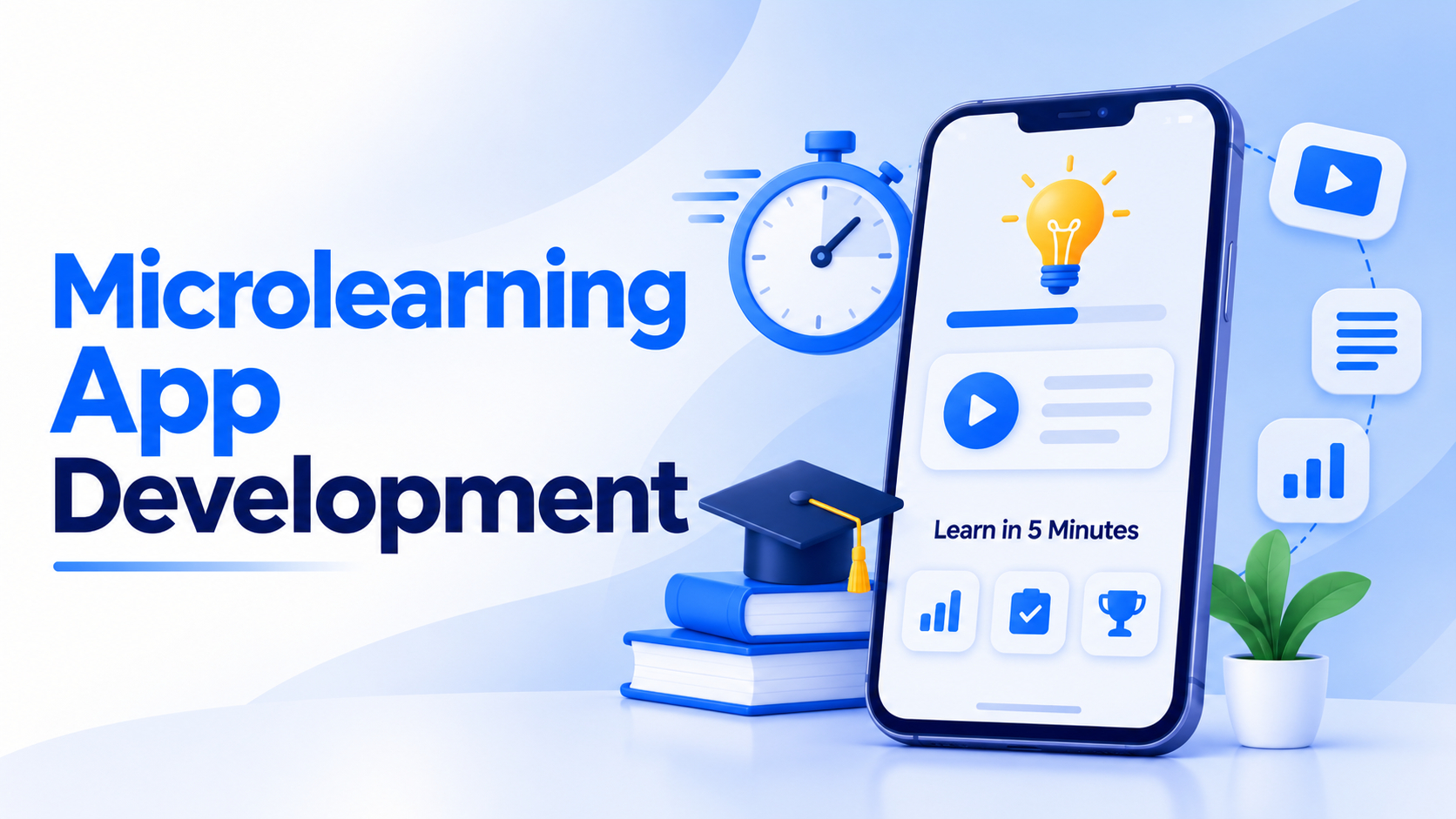
Microlearning App Development: Features, Cost & Stack


Create engaging, high-performance mobile applications tailored to your business needs. We craft future-ready apps that offer smooth user experiences on all devices.
Build robust and scalable websites and CMS platforms that help you manage content effortlessly. Our development ensures a seamless digital presence.
Launch secure, feature-rich online stores with intuitive shopping experiences. We build tailored eCommerce platforms designed for growth.
Design captivating games with immersive gameplay and stunning graphics. From concept to launch, we build engaging experiences that players love.
Enhance your customer relationships with customized Salesforce implementations. Drive growth and efficiency with smarter CRM solutions.
Harness artificial intelligence and machine learning to automate workflows and gain actionable insights. Our AI transforms data into smart decisions.
Accelerate your software delivery lifecycle with continuous integration, delivery, and infrastructure automation to boost efficiency.
TL;DR
Microlearning App Development is the practice of building a learning product where every lesson carries one objective and ends in a few minutes. It is not a shrunk-down LMS.
The unit of design is a single skill moment, delivered on a phone, reinforced on a schedule, measured by behavior rather than seat time.
Corporate L&D teams, edtech founders and compliance-heavy industries are shifting toward Microlearning App Development because hour-long courses stall early and rarely finish. This guide covers what to build, how to build it, what it costs, and where most teams quietly go wrong.
Microlearning App Development means designing a mobile learning product where each lesson has one objective, one takeaway, and a two to seven minute runtime.
The structure is the opposite of a traditional course. Instead of modules that assume a free hour, you ship cards, clips, drills and checks that fit a coffee break.
Three things separate Microlearning App Development from regular education app development. Content is atomic and independently useful, so lesson 14 still works without lesson 13. Delivery is scheduled by an algorithm instead of a syllabus. Success is measured by recall and on-the-job application, not completion certificates.
That shift changes your data model, your content pipeline and your notification logic. Microlearning App Development is a product decision long before it becomes a design decision.
This section covers the commercial and behavioral forces pushing budgets toward Microlearning App Development. It looks at where the spending is heading over the next five years. It also explains why frontline and deskless teams drive most of the demand.
The microlearning market is projected to reach $3.32 billion in 2026 and $5.81 billion by 2031, an 11.83% CAGR (Mordor Intelligence). That growth is not coming from new course catalogs. It comes from short, repeatable skill drops layered onto systems companies already run.
Teams midway through corporate LMS development projects now fund Microlearning App Development instead of ripping out what works.
Frontline staff, field agents, nurses and retail teams almost never get a quiet hour. They get four minutes between shifts, in a parking lot, on a phone with one bar.
Microlearning App Development is winning because it matches that reality instead of fighting it. A polished online learning platform still fails here if its smallest unit of value takes 40 minutes to reach.
This section breaks down the features separating a real microlearning product from a video library. Each one affects retention, not the interface. Skip any of them and completion flattens within weeks.
The engine decides what a learner sees next, based on their last answer, their streak and their role. Without it, you have built course management software with shorter videos. The engine is the product.
Lessons should resurface at widening intervals, with the gap shortening whenever a learner gets something wrong. This is the highest-leverage feature in Microlearning App Development. It converts exposure into retention.
Gamification in Microlearning App Development works when the stakes feel professional rather than childish. Tie rewards to skill badges that carry internal weight. Avoid confetti on compliance modules.
Managers need to see which skills are weak across a team, not who logged in. Strong reporting works at the question level, so L&D can fix content that keeps failing. That feedback loop is where the ROI story lives.
This section walks through the Microlearning App Development sequence we follow on real projects. The order matters, because content decisions constrain engineering decisions later. Each step assumes you are shipping a pilot before a full rollout.
Start by naming the behavior you want changed on the job. Write it as an observable action, such as handling a chargeback dispute without escalation. Then work backward into the three or four micro-skills that behavior depends on.
Most teams skip this, which is why their content library ends up as a pile of clips with no spine. A tight skill map keeps Microlearning App Development focused and gives your analytics something meaningful to measure.
Decide the exact shape of one lesson before writing fifty. Fix the runtime, the format mix, the number of checks and the single takeaway line. Most teams land on a 90-second explainer, two recall questions and one application prompt.
Lock that template, because inconsistent atoms break both authoring speed and spaced repetition math. Standardized atoms also make AI-assisted generation reliable, since the model fills a fixed structure instead of a blank page.
Now build the logic layer that queues lessons, tracks mastery per skill and reschedules misses. This covers repetition intervals, streak rules, nudge timing and offline sync. Teams that build an LMS first and bolt scheduling on afterward almost always rewrite it.
Keep the engine independent of content so formats can change without touching the algorithm. Budget real engineering time here, because this layer separates Microlearning App Development from a video player with a login.
AI earns its place in two spots during Microlearning App Development. First, authoring: turn existing SOPs, call recordings and PDFs into draft lessons a human reviews. Second, personalization: adjust difficulty, sequencing and lesson order from live performance data.
A lightweight assistant built through AI chatbot development can answer learner questions inside the lesson flow. Keep humans approving every published lesson, because a confidently wrong compliance card is worse than no card.
Connect HRIS, SSO, your existing LMS and reporting tools before the pilot, not after. Run the pilot with one team for four to six weeks and watch three numbers: day-seven retention, lesson completion and recall accuracy. Fix the content that fails, not the interface.
Treating the first release as MVP development keeps scope sane and produces proof before a company-wide rollout. Launch once the engine holds its numbers with a real audience.
Your stack should follow two needs: fast content delivery and reliable offline behavior. Flutter development services suit teams wanting one codebase with tight animation control for card-based lessons. React Native works equally well when JavaScript talent already sits in-house.
Most Microlearning App Development backends run on Node.js or Python, with PostgreSQL for progress data and Redis for streaks and queues. Keep lesson payloads under 2 MB so a weak connection still works, and serve media from a CDN.
For AI features, a vector database plus an LLM API covers authoring and in-app answers. Comparing cross-platform app frameworks early in Microlearning App Development saves costly rewrites once content volume grows.
Pricing in Microlearning App Development depends far more on engine complexity than on screen count. A pilot with fixed content and basic scheduling is a different product from a multi-tenant platform with AI authoring and manager dashboards.
| Build scope | Typical cost | Timeline |
| Pilot app, fixed lesson sets, basic scheduling | $35,000 to $55,000 | 12 to 14 weeks |
| Full product, spaced repetition, analytics, SSO | $60,000 to $90,000 | 16 to 20 weeks |
| Multi-tenant platform with AI authoring | $95,000 to $120,000+ | 20 to 22 weeks |
Online education app development cost varies by features as well. AI development features nowadays cost more than even the most complex backend features.
Two line items catch founders off guard. Authoring tooling is often half the backend effort, and HRIS or LMS integrations can add three weeks alone.
Fixed-scope pilots remain the safest entry point into Microlearning App Development before committing to a full platform.
That is where, an experienced e-learning app development company usually trims discovery, since the skill-mapping and engine patterns are already proven.
These are the failure patterns that show up most often in post-launch audits.
Microlearning App Development rewards teams that respect the format instead of borrowing from long-form learning. Get the skill map, the content atom and the delivery engine right, and the interface almost designs itself.
Get them wrong, and no amount of polish rescues your completion rate. If a broader rollout is on the table, it helps to first understand how to build an e-learning platform before narrowing scope.
Ready to scope your build? Talk to the EngineerBabu team about Microlearning App Development for your workforce or your edtech product.
Two to seven minutes suits most audiences. The real rule is one objective per lesson. If a learner cannot state the takeaway afterward, that lesson is carrying too much weight.
Usually not, and it should not try. Most companies keep the LMS for records and compliance, then run Microlearning App Development alongside it for reinforcement, faster onboarding and daily skill practice.
Yes, with human review on every published lesson before release. Regulated teams use it for refreshers, policy updates and procedure checks, while formal certification stays inside their audited system of record.
Track recall accuracy over time, day-seven retention and on-the-job behavior change. Completion rate alone misleads badly here, because learners can finish every lesson in sequence without retaining anything they actually apply.
No, AI is optional at launch. It speeds authoring and personalization, but Microlearning App Development built on a strong spaced repetition engine with human-written lessons already beats most long-form corporate training.