How AI Prior Authorization Works in the USA: What's Actually Happening in 2026


Create engaging, high-performance mobile applications tailored to your business needs. We craft future-ready apps that offer smooth user experiences on all devices.
Build robust and scalable websites and CMS platforms that help you manage content effortlessly. Our development ensures a seamless digital presence.
Launch secure, feature-rich online stores with intuitive shopping experiences. We build tailored eCommerce platforms designed for growth.
Design captivating games with immersive gameplay and stunning graphics. From concept to launch, we build engaging experiences that players love.
Enhance your customer relationships with customized Salesforce implementations. Drive growth and efficiency with smarter CRM solutions.
Harness artificial intelligence and machine learning to automate workflows and gain actionable insights. Our AI transforms data into smart decisions.
Accelerate your software delivery lifecycle with continuous integration, delivery, and infrastructure automation to boost efficiency.
Hire app developers ready to turn your ideas into sleek, high-performing mobile apps for any platform.
Bring in frontend pros who craft smooth, beautiful, and user-friendly interfaces that your visitors will love.
Get backend developers who build fast, secure, and reliable systems to keep everything running behind the scenes.
Hire eCommerce developers who build secure, scalable online stores designed to offer seamless shopping and grow your sales.
Get dedicated developers committed to your projects, delivering consistent quality and speed as an extension of your team.
The American Medical Association published a survey two days ago. One number stopped me mid-scroll.
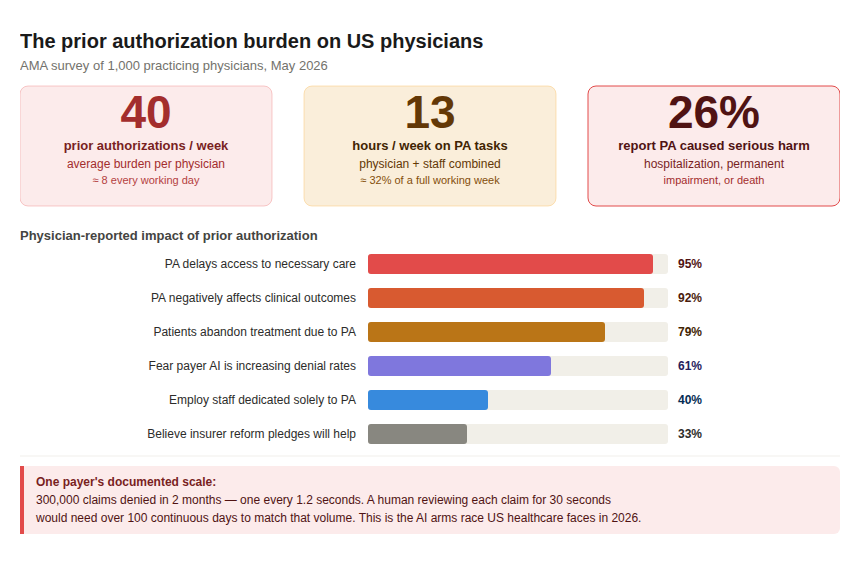
26% of US physicians report that prior authorization has led to a serious adverse event for a patient, including hospitalization, permanent impairment, or death.
No delays. Not an inconvenience. Permanent impairment and death.
Meanwhile, investigative reporting uncovered that one large US payer’s AI algorithm rejected 300,000 claims over two months, one every 1.2 seconds. A human reviewing each claim for 30 seconds would need more than 100 days of continuous work to match that volume.
This is the collision point US healthcare is navigating in 2026: AI being deployed by payers to deny faster, AI being deployed by providers to approve faster and a regulatory structure still trying to determine who is liable when an algorithm makes the wrong call.
I’m Mayank Pratap, co-founder of EngineerBabu, a CMMI Level 5, Google AI Accelerator team that has built healthcare AI products for clients including Apollo Hospitals, ResMed, and US-based digital health startups.
We’ve built prior authorization automation platforms, AI clinical documentation systems, and EHR-integrated workflows. This is what AI prior authorization actually looks like in production in 2026, from both the policy and the engineering perspective.
AI prior authorization is the use of artificial intelligence, natural language processing, machine learning, and large language models to automate the process of requesting and reviewing insurance coverage approval before a medical service, procedure, or medication is delivered.
On the provider side, AI reads the patient’s EHR, extracts relevant clinical documentation, maps it against payer-specific criteria, and submits the request electronically without manual staff intervention.
On the payer side, AI screens incoming requests against clinical guidelines and coverage policies to approve or flag for human review. Both sides are now operating in the same regulatory environment: CMS’s Interoperability and Prior Authorization Final Rule (CMS-0057), effective 2026–2027.
Prior authorization was designed as a cost-control mechanism. What it became is a documented source of patient harm and physician burnout.
The AMA’s May 2026 survey of 1,000 practicing physicians published this week shows how little has changed despite years of insurer pledges:
In June 2025, more than 60 health insurers pledged to reform their prior authorization programs, with staggered implementation deadlines through 2027. The AMA’s 2026 survey response to that pledge: only one in three physicians (33%) believe it will make a meaningful difference.
Physician skepticism is grounded in evidence. Only 24% of physicians report that denied requests are consistently reviewed by appropriately qualified clinicians, despite insurers committing to exactly that.
Only 16% of physicians participating in peer-to-peer reviews say the health plan representative often or always has appropriate qualifications.
This is the environment into which AI prior authorization technology is deploying, a system with 13 hours of weekly administrative waste per physician, 40 requests per week, and documented patient deaths from delays. The ROI case for automation is not debatable.
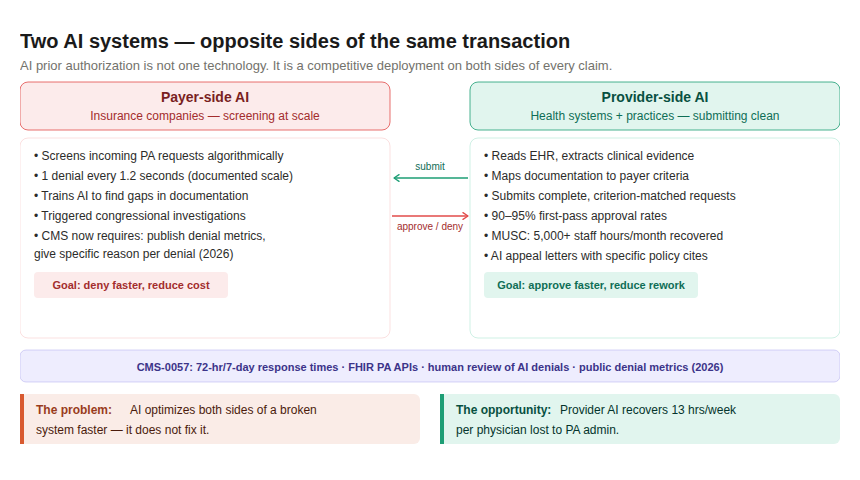
The most important framing for AI prior authorization in 2026 is that it is not one technology. It is two competing deployments on opposite sides of the same transaction.
The Medical University of South Carolina reports reclaiming more than 5,000 staff hours per month with AI prior authorization automation. Early adopters of AI-assisted PA submission report first-pass approval rates exceeding 95%.
The result is an arms race. Payers train AI to find gaps in documentation. Providers train AI to ensure documentation is complete. CMS is attempting to regulate the rules of engagement through the Interoperability and Prior Authorization Final Rule.
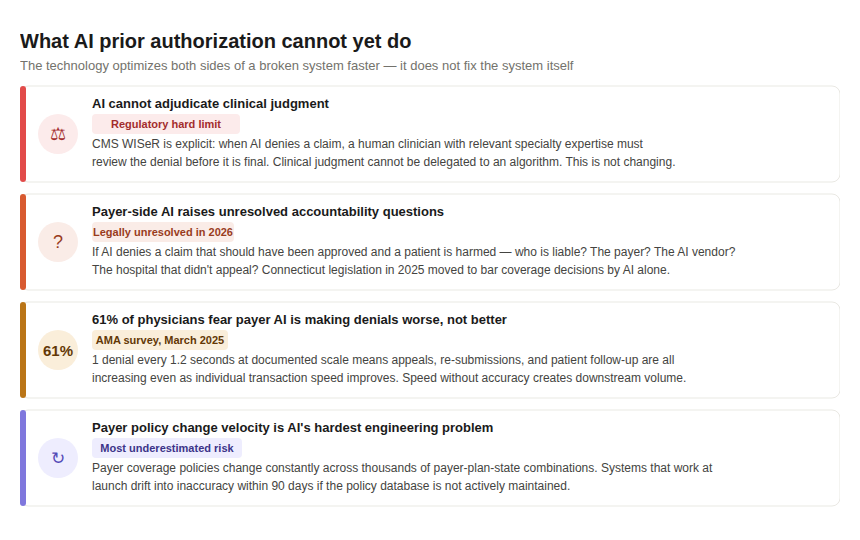
Sixty-one percent of physicians fear the payer-side AI is increasing denials and worsening patient harm, per AMA’s March 2025 survey. That concern is the regulatory driver behind the transparency requirements now in effect.
Understanding AI prior authorization in the USA requires understanding the two concurrent regulatory actions reshaping the space.
The CMS-0057 rule, finalized January 2024 and taking effect through 2026–2027, mandates that Medicare Advantage plans, Medicaid programs, and Affordable Care Act exchange plans implement FHIR-based APIs for prior authorization. The key requirements:
Effective January 1, 2026:
Effective January 1, 2027:
These mandates are why AI prior authorization is not a speculative technology in 2026 — it is a compliance response. Both payers and providers need automation infrastructure to meet the response time requirements at scale.
On January 1, 2026, CMS launched the Wasteful and Inappropriate Services Reduction (WISeR) program — the first direct federal deployment of AI-assisted prior authorization review for Original Medicare.
WISeR currently operates in six states across four Medicare Administrative Contractor jurisdictions:
Services targeted include procedures commonly scrutinized for necessity: nerve stimulators, cervical fusions, and incontinence treatments. AI screens incoming prior authorization requests; when coverage is denied, a human clinician with relevant specialty expertise must review the case before the denial is finalized.
By mid-2026, CMMI plans to pilot a “gold carding” feature, exempting clinicians with consistent approval histories from future prior authorization requirements for specific service types.
This is potentially the most meaningful structural reform in the space: if a physician has a 24-month record of approved PA requests for a procedure, they skip the queue.
For builders and health system IT leaders, this is the layer that matters most. The technical implementation of AI prior authorization has standardized around three interoperating FHIR-based services from the Da Vinci Project, an HL7 initiative bringing together US payers, providers, and health IT vendors.
At the moment a clinician places an order in the EHR, a medication, a procedure, a referral, a CDS Hooks call fires to the payer’s CRD service. The payer returns a real-time response telling the EHR whether prior authorization is required for that specific service under that patient’s specific coverage.
This happens within the clinical workflow, before the order is finalized. The clinician sees a card in their EHR interface: “Prior authorization required, click here to initiate.” Or: “No prior authorization needed, order approved.”
The elimination of “we didn’t know PA was required until the claim was denied”, a scenario that generates massive administrative rework, is the primary value of CRD.
What CRD needs technically: The EHR must support CDS Hooks (Epic, Cerner, and Athenahealth all do). The payer must expose a CRD-compliant service endpoint. Patient coverage data must be retrievable in real time, typically via FHIR Coverage resources.
When CRD confirms that prior authorization is required, DTR takes over. The payer’s DTR service sends a structured FHIR Questionnaire, a dynamic form generated from the payer’s codified clinical policy for that specific procedure. The form is tailored to the patient: based on the patient’s diagnoses, medications, and clinical history already in the EHR, many questions are pre-populated automatically via CQL (Clinical Quality Language) expressions.
A prior authorization for a GLP-1 medication like semaglutide might require: BMI documentation, HbA1c levels, documentation of previous treatment attempts with other medications, and provider attestation of medical necessity. DTR pulls BMI from Observation resources, HbA1c from lab Observation resources, current medications from MedicationRequest resources and pre-fills the questionnaire. The physician reviews, corrects where needed, and approves.
The reduction in staff labor here is dramatic. A manual PA submission requires a staff member to pull the chart, read the payer’s criteria PDF, identify the relevant documentation, copy it into the submission form, and submit. DTR automates the first three steps entirely.
The AI layer in DTR: For complex payer policies that are written in narrative language rather than codified rules, LLM-based systems extract the clinical criteria from policy documents, map them to FHIR resources, and generate the questionnaire dynamically. This is where GPT-4o or specialized clinical LLMs are being deployed, reading medical policy text and converting it into structured FHIR Questionnaire logic.
The completed PA request, patient demographics, coverage details, diagnosis codes, procedure codes, clinical evidence as FHIR resources is submitted electronically to the payer via the PAS API.
The output is a Da Vinci PAS Bundle (a structured FHIR resource bundle) sent to payers who have implemented FHIR-native PA APIs. For payers still operating on legacy systems, the same content is converted to an X12 278 transaction, the EDI format required under HIPAA for electronic PA submission.
PAS also handles the response lifecycle: approved, denied, pended for more information, partially approved. Status polling runs automatically; staff are alerted only when human intervention is required.
First-pass approval rates with AI-assisted PAS: Early adopters report 90–95% first-pass approval, compared with 65–75% industry average for manual PA submissions. The improvement comes from submitting complete, criterion-matched documentation on the first attempt rather than submitting incomplete requests that bounce back for additional information.
For a practice or health system deploying AI prior authorization on the provider side, the workflow looks like this:
The MUSC case: The Medical University of South Carolina, implementing provider-side AI prior authorization, recovered more than 5,000 staff hours per month. The operational math: if a manual PA takes 30 minutes of staff time, automating 10,000 PAs per month saves 5,000 hours. At $35/hour for PA staff, that’s $175,000/month in recovered labor costs $2.1 million annually.
Honest framing matters here. The technology is not solving the prior authorization problem, it is optimizing both sides of a broken system faster.
For health systems evaluating AI prior authorization, the build-vs-buy decision has become substantially clearer in 2026.
Buy (SaaS PA automation platforms): Vendors including Cohere Health, Rhyme (formerly Infinitus), Waystar, Availity, and Olive (acquired by various health IT companies) offer turnkey AI PA platforms. Best for practices and mid-size health systems that want to reduce PA burden without building technical infrastructure. ROI typically 6–12 months.
Build (custom AI PA workflows embedded in specific clinical workflows): For health systems or health IT companies with specific specialty workflows, payer mix, or EHR configurations where commercial platforms don’t provide sufficient accuracy or integration depth, custom builds using the Da Vinci standards (CRD, DTR, PAS) with an AI layer produce meaningfully better results. The FHIR standards are published and open, the engineering challenge is the payer policy database and the LLM orchestration layer for policy-to-FHIR mapping.
The EngineerBabu approach for custom PA platforms:
Prior authorization costs US physicians 13 hours per week. It has contributed to patient deaths. One payer’s algorithm denied 300,000 claims in two months, one every 1.2 seconds.
AI is solving the speed problem on both sides of that transaction simultaneously. Provider-side AI is making clean, complete submissions that achieve 95% first-pass approval rates. Payer-side AI is screening submissions at a volume no human workforce could match. CMS is mandating transparency, response time standards, and human review of AI-generated denials.
The underlying problem that US healthcare requires permission slips for treatments physicians already determined are medically necessary is not one that AI solves. But the technology genuinely reduces the 13 hours per week that physicians currently spend on fax machines, phone hold queues, and peer-to-peer reviews.
The MUSC data shows what that recovery looks like in practice: 5,000 staff hours per month returned to patient care.
If you’re building a prior authorization platform, evaluating AI PA vendors, or integrating PA automation into an existing healthcare product, the specific decisions around EHR integration, payer coverage database architecture, and LLM orchestration are where most projects succeed or fail. Reach me at mayank@engineerbabu.com.
Author: Mayank Pratap Co-Founder, EngineerBabu Google AI Accelerator 2024 · CMMI Level 5 · 500+ Products · 20+ Countries, LinkedIn
AI prior authorization uses machine learning, NLP, and LLMs to automate the process of requesting insurance coverage approval before delivering medical services. On the provider side, AI reads the EHR, extracts clinical evidence, and submits structured requests to payers via FHIR-based APIs. On the payer side, AI screens requests against clinical criteria and coverage policies. Both sides operate under CMS-0057, which mandates FHIR-based PA APIs and 72-hour/7-day response times.
WISeR (Wasteful and Inappropriate Services Reduction) launched January 1, 2026 in six US states. CMS partners with payers as model participants to test AI-assisted prior authorization review for select Medicare fee-for-service procedures including nerve stimulators, cervical fusions, and incontinence treatments. AI screens requests; human clinicians with specialty expertise review all denials. CMS plans to add a gold-carding feature by mid-2026, exempting physicians with consistent approval histories.
These are the three Da Vinci FHIR implementation guides for electronic prior authorization. CRD (Coverage Requirements Discovery) answers “does this order need PA?” in real time at order entry via CDS Hooks. DTR (Documentation Templates and Rules) delivers a pre-populated questionnaire pulling clinical evidence directly from the EHR. PAS (Prior Authorization Support) handles electronic submission of the complete PA request and tracking of the payer’s response lifecycle.
The Medical University of South Carolina recovered 5,000+ staff hours per month with AI PA automation. At 13 hours of weekly PA burden per physician, a 10-physician practice spends 130 hours per week on PA work at $35/hour that’s $4,550/week, $236,600/year. AI automation targeting 70% reduction produces approximately $165,000/year in recovered labor costs for a 10-physician practice, before counting revenue from reduced claim denials.
Payers can use AI to screen prior authorization requests, but CMS now requires that all AI-assisted denials include a specific reason and that denials are reviewed by a human clinician with appropriate specialty expertise before being finalized. Beginning 2026, payers must publish aggregate approval and denial metrics. Connecticut and other states are considering legislation that would bar coverage decisions made by AI alone.
X12 278 is the EDI (Electronic Data Interchange) transaction format mandated under HIPAA for electronic prior authorization submission. It remains the standard for payers operating on legacy systems. Da Vinci PAS provides the modern FHIR-based alternative for payers implementing CMS-0057 compliant PA APIs. Most production AI PA systems include an X12 278 adapter alongside FHIR-native submission to handle the full range of US payers.