How EngineerBabu Built AI Inventory Management for Simba Beer | Case Study


Create engaging, high-performance mobile applications tailored to your business needs. We craft future-ready apps that offer smooth user experiences on all devices.
Build robust and scalable websites and CMS platforms that help you manage content effortlessly. Our development ensures a seamless digital presence.
Launch secure, feature-rich online stores with intuitive shopping experiences. We build tailored eCommerce platforms designed for growth.
Design captivating games with immersive gameplay and stunning graphics. From concept to launch, we build engaging experiences that players love.
Enhance your customer relationships with customized Salesforce implementations. Drive growth and efficiency with smarter CRM solutions.
Harness artificial intelligence and machine learning to automate workflows and gain actionable insights. Our AI transforms data into smart decisions.
Accelerate your software delivery lifecycle with continuous integration, delivery, and infrastructure automation to boost efficiency.
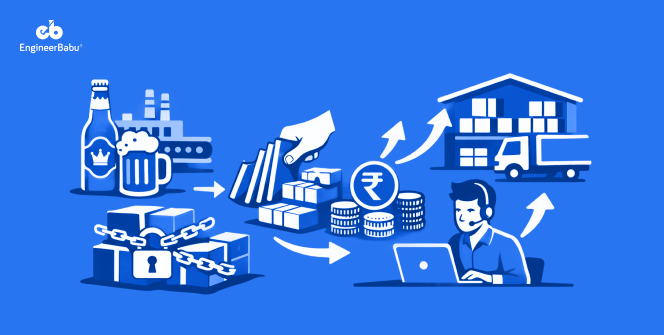
The Silent Killer of Beverage Businesses: Inventory You Can’t See
There’s a problem hiding in plain sight across India’s beverage and FMCG industry. It’s not a production problem. It’s not a quality problem. It’s an information problem and it’s silently bleeding companies of millions of dollars every single year.
Here’s what it looks like: A premium beer brand has hundreds of retail touchpoints from tiny neighbourhood wine shops to large format retail stores and high-end restaurants. Every single day, bottles are sold, bottles are broken, bottles expire, and new stock arrives. But the company headquarters? They’re making decisions based on data that’s anywhere from two weeks to two months old.
The result is a phenomenon that operations teams know all too well but rarely quantify: inventory blockage. Capital sitting on shelves in the wrong stores, in the wrong quantities, in the wrong product mix. Real cash not theoretical losses, but actual money locked up in glass bottles gathering dust in a shop that didn’t need them, while another shop ten kilometres away has empty shelves and lost sales.
This is the story of how we solved this exact problem for Simba Beer, India’s No. 1 premium craft beer brand. But more importantly, this is a playbook that applies to virtually any brand dealing with distributed retail, perishable inventory, and a field sales force that’s supposed to be selling, not filling out spreadsheets.
Meet Simba: A Premium Brand With a Not-So-Premium Supply Chain Problem
Simba has earned its position as India’s leading premium beer brand through exceptional product quality, smart branding, and relentless distribution. But like many fast-growing consumer brands, the backend operations hadn’t kept pace with the front-end success.
Simba’s products are available across hundreds of retail outlets, and that’s where the complexity begins. These outlets are not homogeneous. They vary dramatically in size, footfall, customer profile, product preference, and storage capacity.
A small neighbourhood liquor shop in a residential area might sell 20 bottles a week, primarily of one or two popular SKUs. A premium lounge bar in a metro city might move 200 bottles a week across the full product range. A large-format retail store sits somewhere in between, with seasonal demand swings and promotional cycles layered on top.
Each of these outlets represents a micro-economy with its own demand pattern. And Simba, like most brands operating through traditional retail channels, had limited visibility into what was actually happening at the shelf level.
Before we stepped in, Simba’s inventory management process looked something like this:
Step 1: Field Sales Visits.
Every day, Simba’s field sales representatives would physically visit their assigned stores. At each store, they’d conduct a manual stock check, counting bottles on shelves, asking shopkeepers what had been sold, noting down breakage and returns. All of this was recorded on paper or in basic spreadsheets on their phones.
Step 2: Daily Reporting.
Each sales representative would compile their notes into a daily report and send it back to their area manager. The format wasn’t standardized. Some sent WhatsApp messages. Some sent emails. Some filled out Excel sheets. The data quality was inconsistent, and the effort was enormous.
Step 3: Area-Level MIS Compilation.
Area managers would then aggregate reports from all their field reps into an area-level Management Information System (MIS) report. This typically happened weekly, sometimes bi-weekly. By this point, the data was already several days old.
Step 4: Regional and National Rollup.
Area-level reports would then be consolidated into regional reports, which would eventually make their way to the national operations and supply chain team. The CEO and leadership team would receive a consolidated view, but by the time it reached their desk, the data was often a month old.
Step 5: Decision-Making.
Based on this stale data, the leadership team would make decisions about inventory allocation, production planning, and capital deployment. Decisions that should have been made in real time were being made with a 30-to-45-day lag.
The financial impact of this broken process was staggering, and it manifested in several interconnected ways.
Capital blockage in slow-moving inventory.
When you don’t know which products are selling where, you end up pushing inventory based on assumptions rather than data. The result? Thousands of bottles sitting in stores that don’t need them. Each bottle represents real capital, production cost, packaging, logistics, distributor margins, all locked up with no return.
Lost sales from stockouts.
The flip side of overstocking in one location is understocking in another. High-demand stores would frequently run out of popular SKUs while neighbouring stores had excess. Every stockout is a lost sale and in the premium beer segment, a lost sale often means a customer switching to a competitor brand. That’s not just a one-time loss; it’s a potential lifetime customer gone.
Credit cycle strain.
In India’s traditional retail ecosystem, brands typically operate on a credit model. You supply inventory to retailers on credit (udhar) and collect payment later, often 30 to 60 days after delivery. When your inventory allocation is misaligned with actual demand, your receivables cycle stretches even further. You’ve deployed capital, you’ve extended credit, and the product isn’t moving. That’s a cash flow problem that compounds quickly.
Field force inefficiency.
Simba’s sales representatives were spending a disproportionate amount of their time on data collection rather than actual selling. A rep visiting 10 to 15 stores a day was spending 15 to 20 minutes at each store just on inventory counting and reporting. That’s two to three hours a day, roughly 30 to 40 percent of their productive time lost to administrative work.
Decision latency.
Perhaps the most damaging cost of all was the inability to respond to market signals in real time. A new competitor launching in a specific geography, a sudden spike in demand due to a local event, a supply disruption affecting a particular product variant by the time these signals reached the decision-makers, the window of opportunity (or damage control) had passed.
The Solution: Real-Time Inventory Intelligence, Built for the Ground Reality
When Simba approached us, they didn’t need a theoretical supply chain overhaul. They needed something practical, a solution that their existing field sales team could adopt immediately, without weeks of training, and that would deliver real-time visibility from the shop shelf all the way to the CEO’s dashboard.
A lot of enterprise supply chain solutions are designed top-down. They start with the ERP, the data warehouse, the analytics platform and then try to push data collection down to the field level as an afterthought. We took the opposite approach.
We started with the person standing in the shop. The field sales representative. What does their day look like? What’s their comfort level with technology? What phone are they carrying? How much time can they realistically spend on data entry at each store?
This ground-up design philosophy shaped every decision we made.
We built a mobile application specifically designed for Simba’s field sales workflow. Here’s what it does:
Store check-in with location verification.
When a sales rep arrives at a store, they check in through the app. GPS verification confirms they’re physically at the location. This solves a perennial problem in field force management, ensuring that reported visits are actual visits.
Product-level inventory update.
The rep walks through a simple, intuitive interface to record the current status at that store. For each SKU: how many units were sold since the last visit, how many are currently on the shelf and how many were damaged or broken. The interface is designed to minimize typing, dropdowns, quick-select buttons, and smart defaults based on the store’s historical pattern.
Photo capture for verification.
For breakage and damage reporting, the app allows photo documentation. This creates an auditable trail and reduces disputes between the brand, distributors, and retailers.
Instant sync.
The moment a rep submits their update, the data is available across the entire system. No compilation. No waiting for weekly reports. No MIS aggregation delays. The store-level data flows directly into the central platform.
While the mobile app handles data collection, the central dashboard transforms that data into actionable intelligence.
Real-time inventory heatmap.
A visual representation of inventory levels across all stores, colour-coded by status, green for healthy stock levels, amber for approaching reorder point, red for stockout or critical low. Leadership can see the entire retail landscape at a glance.
Store-level drill-down.
Click on any store and you get the complete picture, current inventory by SKU, sales velocity over different time periods, breakage rate, days of inventory on hand, and reorder recommendations.
Area and regional aggregation.
For area managers and regional heads, the dashboard aggregates store-level data into geographic views. Which areas are performing? Where are the problem spots? Which stores need immediate attention?
Product performance analytics.
Beyond store-level views, the platform provides product-level analytics. Which SKUs are fast-moving across the board? Which are slow movers? Where are there geographic preferences, a particular variant selling well in one city but not another?
Automated alerts and triggers.
The system generates automatic alerts when inventory at any store drops below a defined threshold, when breakage rates exceed normal ranges, when a store hasn’t been visited by a rep in the expected cycle, or when sales velocity shows an unusual spike or drop.
The real-time data collection and dashboarding would have been transformative on their own. But we didn’t stop there.
Once you have clean, granular, real-time data flowing from hundreds of retail outlets, you’ve created the foundation for something much more powerful: AI-driven demand forecasting and inventory optimization.
Store-level demand prediction.
Using historical sales data, seasonal patterns, local events, and even weather data, the AI model predicts demand for each SKU at each store for the upcoming week. This isn’t a broad, category-level forecast, it’s granular enough to tell you that Store #247 in Indiranagar will likely need 12 bottles of Simba Wit and 8 bottles of Simba Stout next week.
Dynamic reorder recommendations.
Based on predicted demand, current inventory levels, lead times, and minimum order quantities, the system generates optimized reorder recommendations. These are specific, actionable, and tailored to each store’s unique demand pattern.
Inventory mix optimization.
One of the most valuable capabilities is product mix recommendation. Instead of sending a standard assortment to every store, the system recommends the optimal product mix for each outlet based on its specific sales pattern. A store that overwhelmingly sells one variant shouldn’t be stocked with equal quantities of all variants.
Anomaly detection.
The AI also flags unusual patterns that might indicate underlying issues, a sudden drop in sales at a store that’s been performing well (potential competitor activity or relationship issue), abnormally high breakage rates (potential handling or storage problem), or demand patterns that don’t match seasonal expectations.
The transformation wasn’t gradual, it was dramatic. Within the first few weeks of deployment, the impact was visible across multiple dimensions.
The most immediate and visceral change was in decision-making speed. The CEO and leadership team went from receiving month-old aggregated MIS reports to having real-time dashboards updated continuously throughout the day. A decision that used to take a month to even get the data for could now be made the same day.
With real-time visibility and AI-driven allocation, Simba was able to systematically identify and reduce inventory blockage. Overstocked stores were identified within days instead of months. Product that wasn’t moving in one location could be redirected to locations with demand.
The capital freed up from dead inventory was substantial, millions of rupees that were previously trapped on shelves were returned to productive circulation.
With predictive reordering, stockouts dropped dramatically. High-performing stores were proactively replenished before they ran dry, instead of reactively restocked after days of lost sales. This translated directly into revenue recovery.
With the mobile app streamlining the reporting process, sales reps reclaimed hours of productive time each week. Time previously spent on manual counting, note-taking, and report compilation was redirected toward actual selling, building relationships with retailers, introducing new products, and expanding distribution.
Better inventory-demand alignment meant that products were selling through faster, which meant retailer payments came in sooner. The cash-to-cash cycle tightened, improving overall working capital health.
Photo-documented breakage reports and real-time tracking created unprecedented transparency in a traditionally opaque area. Breakage patterns became visible, specific stores, specific routes, specific logistics partners with higher-than-normal breakage rates could be identified and addressed.
Simba’s story is compelling, but it’s far from unique. The challenges they faced are endemic across the FMCG, beverage, and consumer goods industry, particularly in markets with fragmented retail landscapes like India, Southeast Asia, Africa, and Latin America.
Most consumer brands have invested in some form of technology, ERPs, warehouse management systems, distributor management systems. But there’s a persistent blind spot: the last mile. The data trail typically goes dark somewhere between the distributor and the retail shelf.
Distributors know what they shipped. Brands know what they produced. But nobody has real-time visibility into what’s actually sitting on shelves and what’s actually being sold at the point of consumption. This last-mile blind spot is where the real money gets stuck.
Distributor data is not retail data. Knowing that a distributor dispatched 1,000 cases to a region tells you nothing about which stores have excess and which have shortfalls. The distribution within a region can be wildly uneven.
Periodic audits are too slow.
Many brands conduct periodic retail audits, monthly or quarterly. through third-party agencies like Nielsen or internal audit teams. While valuable for trend analysis, these are far too slow for operational decisions.
Manual field reporting doesn’t scale.
The model Simba was using, field reps manually collecting and reporting data, is the most common approach in the industry. And it universally fails for the same reasons: inconsistent formats, reporting delays, data quality issues, and the enormous time tax on the field force.
Retailer cooperation is limited.
Many brands try to get retailers to share POS (point of sale) data. In modern trade (organized retail chains), this sometimes works, though often with significant delays and data-sharing restrictions. In traditional trade (independent stores, which still account for the majority of FMCG sales in India), POS data is virtually non-existent.
For most brands, inventory inefficiency isn’t a line item on any report. It’s an invisible tax that manifests across the P&L: excess working capital tied up in inventory, write-offs from expired or damaged goods, lost sales from stockouts, inflated logistics costs from emergency replenishments, and diminished retailer relationships from inconsistent supply.
A brand doing ₹500 crore in annual revenue could easily have ₹30 to 50 crore blocked in misallocated inventory at any given time. That’s not a rounding error, that’s the difference between raising debt and funding growth from internal accruals.
That’s where FMCG brands needs a professional inventory software management company to solve this issues.
The solution we built for Simba wasn’t a one-off custom project. It was an implementation of a repeatable framework that can be adapted for any brand with distributed retail operations. Here’s the playbook.
Before building anything, you need a comprehensive understanding of your retail footprint. How many outlets? What types (small, medium, large, on-premise, off-premise)? What geographies? What’s the visit frequency of your field force? What’s the current data collection process?
This mapping exercise typically reveals surprises. Most brands overestimate their visibility and underestimate the variation across their retail base.
The most common failure in supply chain digitization is building from the top down. Sophisticated analytics platforms are useless if the data feeding them is garbage. Start with the data collection layer. Make it dead simple for field teams. Minimize manual entry. Use smart defaults and visual interfaces.
The target should be no more than 2 to 3 minutes of data entry per store visit. Anything more, and adoption will collapse within weeks.
Eliminate every batch process in your data pipeline. Store-level data should be visible at every level of the organization within minutes of capture, not days or weeks. This requires a lightweight cloud infrastructure, not a massive ERP overhaul, but a purpose-built data pipeline that can ingest, process, and present field data in near-real-time.
Don’t try to deploy a full AI-powered demand forecasting system from day one. Start with visibility, just being able to see real-time inventory across all stores is transformative. Then add basic analytics, sales velocity, breakage rates, reorder alerts. Then, once you have a few months of clean data, layer on predictive models.
This incremental approach is critical because AI models are only as good as the data they’re trained on. Poor data in the early stages will produce misleading predictions. Better to build the data foundation first and add intelligence progressively.
Dashboards and analytics are valuable, but the ultimate goal is automated action. Reorder recommendations that flow directly to distributors. Inventory rebalancing suggestions that route to logistics teams. Alerts that trigger immediate intervention when anomalies are detected.
The goal is a system where the default path is the optimal path, where doing nothing (just following the system’s recommendations) produces better outcomes than the best manual planning.
While our work with Simba was in the premium beer segment, the underlying problem, last-mile inventory blindness, transcends industry boundaries. Here’s where the same framework delivers transformative results.
The dynamics are nearly identical to beer, with the added complexity of higher SKU counts (vintages, blends, limited editions) and more pronounced geographic taste preferences. Premium spirits brands frequently have millions locked in misallocated inventory across traditional retail channels.
Soft drinks, juices, energy drinks, and water brands face the same distribution complexity with the added pressure of shorter shelf life and higher price sensitivity. Seasonal demand swings are more extreme, making real-time visibility even more critical.
FMCG food brands operating through traditional retail face identical challenges, fragmented retail, manual field reporting, and limited shelf-level visibility. The perishability factor adds urgency to inventory optimization.
With extremely short shelf life and complex cold chain requirements, dairy brands have an even higher cost of inventory misallocation. A misplaced case of beer loses capital value slowly; a misplaced crate of milk loses everything in days.
Pharmaceutical distribution in India and similar markets involves multi-tier distribution, fragmented retail (chemist shops), and critical availability requirements. Stockouts in pharma don’t just mean lost revenue, they can mean patients without medication.
Lower-value, high-volume consumer electronics accessories (phone cases, chargers, earphones) distributed through traditional retail face surprisingly similar challenges: too many SKUs, too many outlets, and virtually no real-time sell-through data.
Seed companies, fertilizer brands, and crop protection product manufacturers distribute through networks of rural dealers with highly seasonal demand. Pre-season inventory allocation is essentially a bet and without real-time field data, it’s often a poorly informed one.
If you’re a brand recognizing your own challenges in Simba’s story, the natural next question is: how do you find the right partner to build this? Not all technology providers are created equal, and this space is full of off-the-shelf solutions that look impressive in demos but fail in real-world deployment.
Look for a partner who understands the ground reality of FMCG distribution in your market. The challenges of managing field sales teams, working with traditional trade retailers, and operating in areas with patchy internet connectivity require specific design sensibilities that generic enterprise software vendors often lack.
Ask to see the mobile interface, not the dashboard. The dashboard will always look good. The real test is whether the field-facing app is intuitive enough for a sales representative with moderate tech comfort to use accurately, quickly, and consistently over months and years.
The solution should handle 50 stores or 5,000 stores without requiring a different architecture. But it should also be deployable without a 6-month implementation project. The best solutions can be piloted in a specific geography within weeks, proven in the field, and then scaled.
Demand forecasting models should be trained on your data, not generic industry averages. Look for partners who build adaptive models that improve over time as they ingest more of your specific data, factoring in your seasonal patterns, your product portfolio, your geographic nuances, and your promotional calendar.
The solution should integrate with your existing systems, your ERP, your distributor management system, your accounting software, rather than requiring you to rip and replace. Most brands have significant investment in existing infrastructure; the right solution adds a layer of intelligence on top.
In the consumer goods industry, the traditional competitive advantages, product quality, brand building, distribution reach are increasingly table stakes. Every serious brand has decent products, significant marketing budgets, and wide distribution.
The next frontier of competitive advantage is operational intelligence, the ability to see, understand, and respond to market signals faster than your competition.
A brand that knows, in real time, what’s selling where, can do things that a brand operating on month-old data simply cannot. It can reallocate inventory before a stockout becomes a lost sale. It can identify and respond to competitive threats in days, not months.
It can optimize its field force deployment based on actual need rather than fixed routes. It can manage its working capital with surgical precision rather than broad estimates.
This isn’t a future vision. This is what Simba is doing today. And it’s available to any brand willing to acknowledge the blind spot and invest in closing it.
If your brand is facing challenges similar to what Simba experienced, inventory sitting in the wrong places, decisions based on stale data, field teams spending more time reporting than selling, or capital blocked in slow-moving stock, we’d love to talk.
We’ve built real-time inventory intelligence systems for brands across the FMCG spectrum, and we bring a combination of deep technical capability and ground-level understanding of Indian and emerging-market distribution realities.
Whether you’re a premium beverage brand, a packaged food company, a pharmaceutical manufacturer, or any business with distributed retail operations, the playbook is proven and the technology is ready.
The question isn’t whether you have this problem. The question is how much it’s costing you not to solve it.
———————————————————————————————————————————————————————-
This case study is based on our work with Simba, India’s No. 1 premium beer brand, through our product development and technology consulting practice. For more on how we help brands build intelligent supply chains, get in touch with our team.