Healthcare CRM Software Development: Features, Benefits & Cost


Create engaging, high-performance mobile applications tailored to your business needs. We craft future-ready apps that offer smooth user experiences on all devices.
Build robust and scalable websites and CMS platforms that help you manage content effortlessly. Our development ensures a seamless digital presence.
Launch secure, feature-rich online stores with intuitive shopping experiences. We build tailored eCommerce platforms designed for growth.
Design captivating games with immersive gameplay and stunning graphics. From concept to launch, we build engaging experiences that players love.
Enhance your customer relationships with customized Salesforce implementations. Drive growth and efficiency with smarter CRM solutions.
Harness artificial intelligence and machine learning to automate workflows and gain actionable insights. Our AI transforms data into smart decisions.
Accelerate your software delivery lifecycle with continuous integration, delivery, and infrastructure automation to boost efficiency.
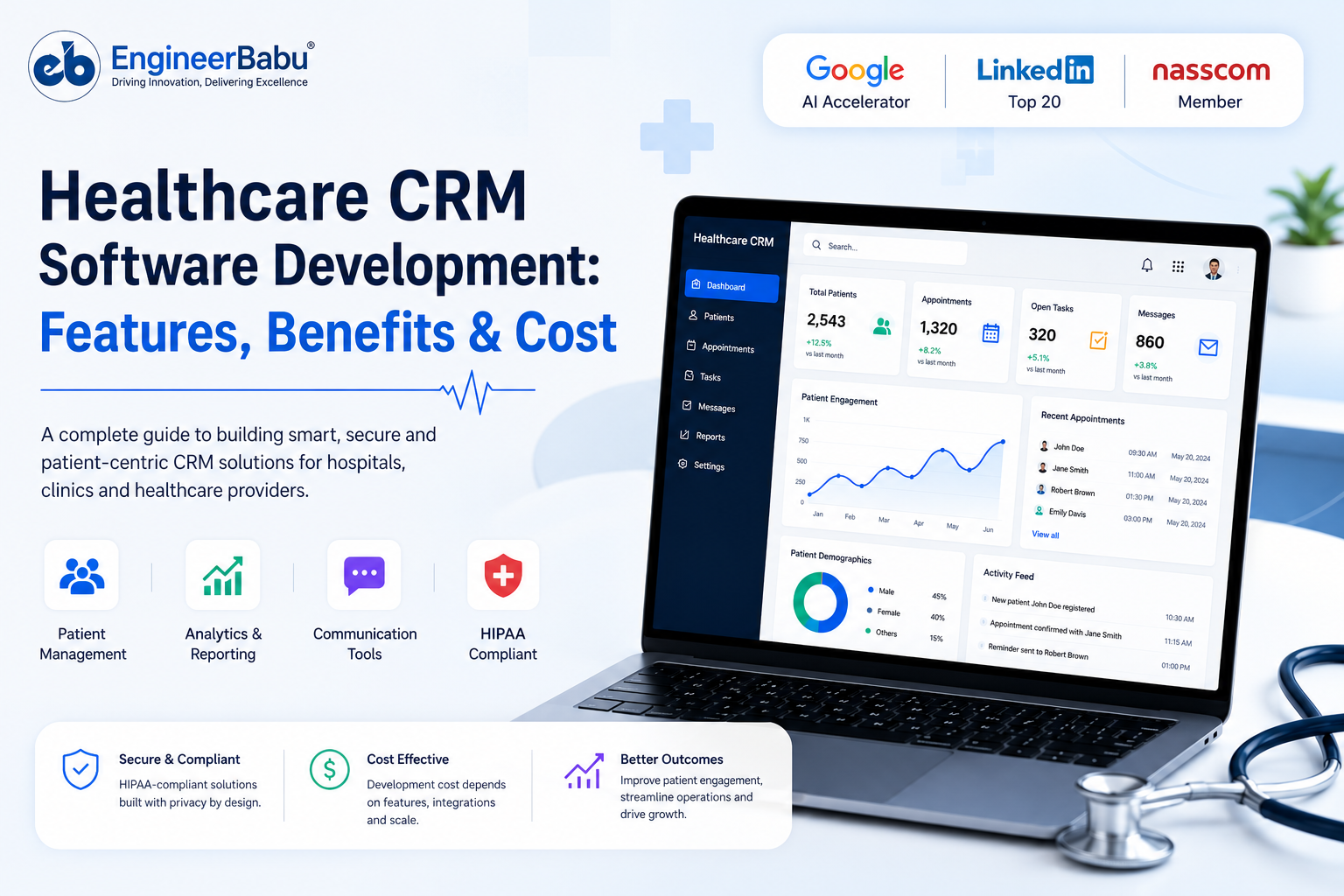
Healthcare providers today manage more patient interactions than ever, from appointment scheduling and follow ups to care coordination and long term engagement. Relying on spreadsheets or generic CRM tools often leads to fragmented data and missed opportunities for better care delivery.
This is where Healthcare CRM Software development plays a critical role.
How?
By enabling healthcare organizations to centralize patient information and streamline communication across touchpoints.
According to a report by Grand View Research, the global healthcare CRM market is expected to grow USD 30.65 billion by 2030. All driven by the need for improved patient engagement and seamless integration with clinical systems.
When built as part of a broader healthcare software development strategy, a well designed healthcare CRM helps hospitals, clinics, and healthtech startups build stronger patient relationships. Let’s learn more.
Healthcare CRM software is a specialized system designed to manage patient relationships, communication, and engagement throughout the care journey. Unlike traditional CRM tools built for sales teams, healthcare CRMs are tailored to handle sensitive patient data and regulatory requirements.
At its core, Healthcare CRM Software development focuses on creating platforms that unify patient profiles, interaction history, appointment data, and communication preferences. This enables healthcare organizations to deliver consistent and timely experiences across digital and offline channels.
Also, a healthcare CRM typically works alongside electronic health records, billing systems, and patient portals. The best part?
With custom software development for healthcare, these systems can be adapted to specific operational needs, whether it is managing referrals, automating reminders, or improving post treatment follow ups.
Healthcare organizations are dealing with growing patient volumes, rising expectations, and complex regulatory requirements. Therefore, as digital health models mature, Healthcare CRM Software development becomes essential for delivering consistent patient experiences while maintaining operational control.
Patient retention depends heavily on timely communication and continuity of care. Missed follow ups, inconsistent outreach, and lack of personalization often result in patient drop off.
With Healthcare CRM Software development, healthcare providers can track patient interactions, automate engagement, and ensure consistent communication throughout the care journey. This leads to stronger long term relationships.
Patients interact through calls, emails, apps, and messaging platforms, but these conversations often remain scattered across systems. This fragmentation limits visibility and context for care teams.
CRM platforms consolidate communication history into a single view, allowing staff to respond accurately and maintain consistent messaging across all patient touchpoints.
Healthcare communication involves sensitive patient information that must meet strict regulatory standards. Managing this data across disconnected tools increases compliance risk.
CRM systems designed for healthcare support controlled access, data traceability, and secure storage. Thus, helping organizations maintain regulatory alignment while managing non clinical patient interactions effectively.
Manual coordination between departments creates delays and increases administrative workload. Staff often spend time switching between systems to retrieve patient information.
CRM software reduces inefficiencies by centralizing data, automating routine processes, and improving collaboration between administrative, care coordination, and support teams.
Effective CRM platforms are built around features that support patient engagement, operational efficiency, and system interoperability. Strategic Healthcare CRM Software development focuses on delivering capabilities that align with real healthcare workflows rather than generic sales processes.
Centralized patient profiles store demographic information, interaction history, preferences, and engagement data in one secure system. Through Healthcare CRM Software development, organizations gain a comprehensive view of patient relationships beyond clinical records. This enables more personalized communication while maintaining structured and compliant data management.
Analytics dashboards provide insights into patient engagement, response times, and operational performance. These reports help healthcare leaders identify trends, measure efficiency, and make informed decisions to improve patient communication and internal workflows.
Automated scheduling, reminders, and follow ups reduce no shows and administrative effort. Healthcare CRM Software development allows workflows to trigger messages based on appointments, treatments, or care plans, ensuring patients stay informed while staff focus on higher value responsibilities.
Seamless integration ensures non clinical data aligns with clinical and financial systems. CRM platforms connect with EHR software, HIS, and billing tools to maintain data consistency, reduce duplication, and support smoother information flow across the healthcare technology ecosystem.
Healthcare CRM platforms support communication through SMS, email, in app notifications, and messaging tools. Built through Healthcare CRM Software development, these systems ensure all patient interactions are logged centrally. Thus, giving teams full context and improving responsiveness across multiple channels.
CRM systems help manage referrals, interdepartmental handoffs, and care coordination activities. By using Healthcare CRM Software development, organizations can track patient movement across departments, reduce information gaps, and improve collaboration between physicians, specialists, and administrative teams.
Healthcare CRM platforms handle sensitive patient communication and personal data, making healthcare compliance and security foundational requirements rather than optional features.
Effective Healthcare CRM Software development must align with regulatory standards while ensuring data protection across every interaction, system integration, and user role.
Healthcare CRM systems must be GDPR and HIPAA compliant. Plus, it should also follow local healthcare data protection laws depending on the region of operation. These regulations govern how patient data is collected, stored, accessed, and shared.
CRM platforms must enforce compliance across communication workflows without disrupting daily operations.
Patient data should only be accessible to authorized users based on defined roles and responsibilities. Role based access control ensures that clinicians, administrative staff, and support teams can view only the information relevant to their function.
This minimizes exposure risks and strengthens accountability within CRM environments.
Encryption protects patient data both in transit and at rest, reducing the risk of breaches during communication or storage. Secure databases, encrypted healthcare APIs, and protected backups are essential components of Healthcare CRM Software development. Thus, ensuring sensitive information remains safeguarded throughout the system lifecycle.
CRM platforms often integrate with EHR and EMR, HIS, and billing systems, increasing the attack surface if not handled correctly. Secure APIs, authentication protocols, and controlled data exchange ensure integrations maintain compliance standards while enabling seamless information flow across healthcare systems.
Building a healthcare CRM requires a structured approach that balances usability, compliance, and scalability. A well planned Healthcare CRM Software development process ensures the platform supports real world healthcare workflows while remaining secure and adaptable as organizational needs evolve.
The process begins with understanding operational goals, patient engagement needs, and regulatory constraints. Inputs from clinicians, administrative staff, and compliance teams help define functional priorities. Clear requirement mapping reduces rework and ensures the CRM supports both patient communication and internal coordination effectively.
Healthcare CRM interfaces must be intuitive for users with varying technical proficiency. Designing role specific workflows ensures clinicians, support staff, and administrators can access relevant information quickly. Thoughtful UI/UX design improves adoption rates and minimizes training effort across teams.
A scalable backend supports secure data handling and seamless integrations. CRM platforms are designed to connect with EHR, HIS, billing, and communication systems. Proper architecture planning ensures consistent data flow, performance stability, and future readiness as usage and data volume grow.
Before deployment, CRM systems undergo extensive testing to validate security controls, data accuracy, and compliance requirements. Quality assurance ensures workflows function as expected without exposing sensitive data. This phase is critical for minimizing operational risk post launch.
Deployment strategies focus on system stability, user onboarding, and monitoring. Scalability planning ensures the CRM can handle increased users, data, and feature expansion over time without compromising performance or security.
The cost of developing a healthcare CRM depends on multiple factors, including feature complexity, compliance requirements, and system integrations.
Basic CRM solutions focused on patient communication and scheduling typically require lower investment, while advanced platforms with analytics, automation, and integrations with clinical systems increase development effort.
Customization level also plays a significant role. Tailored workflows, role based access controls, and scalability planning add to overall cost but provide long term operational value.
Ongoing maintenance, security updates, and compliance support should also be considered when evaluating total cost of ownership.
Selecting the right development partner directly impacts the success of a healthcare CRM initiative. Domain expertise, regulatory understanding, and long term support capabilities are essential when building systems that manage sensitive patient interactions.
A partner with experience in healthcare software understands compliance requirements, integration complexities, and real world operational challenges. This ensures CRM solutions are designed with security, usability, and scalability in mind from the start.
As a healthcare software development company, EngineerBabu works closely with healthcare providers and healthtech startups to build CRM platforms. These align with patient engagement goals while meeting strict regulatory standards.
The focus remains on creating reliable, adaptable systems that support sustainable healthcare operations.
Healthcare CRM platforms have become essential for organizations looking to improve patient engagement, streamline communication, and maintain compliance in an increasingly digital healthcare environment.
A well designed CRM supports better coordination, operational efficiency, and long term patient relationships when aligned with real healthcare workflows.
Investing in thoughtful Healthcare CRM Software development ensures these systems are secure, scalable, and adaptable to evolving healthcare needs.
For healthtech startups, working with an experienced partner like EngineerBabu helps translate complex requirements into systems that deliver measurable value and sustainable growth.
Healthcare CRM software is used to manage patient communication, engagement, and non clinical interactions. It helps healthcare organizations centralize patient information, automate follow ups, track interactions, and improve coordination between administrative and care teams while supporting compliance requirements.
Traditional CRM systems are designed for sales and marketing use cases, while healthcare CRM platforms are built around patient engagement, data privacy, and regulatory compliance. Healthcare CRMs integrate with clinical and administrative systems and are designed to handle sensitive patient information securely.
Yes, when developed correctly, healthcare CRM software supports compliance with regulations such as HIPAA and GDPR. This includes role based access control, audit logs, data encryption, and secure integrations. Compliance readiness depends heavily on how the CRM is designed and implemented.
Development timelines vary based on feature scope, integrations, and compliance requirements. A basic healthcare CRM may take a few months, while more advanced platforms with automation, analytics, and system integrations typically require longer development and testing cycles.
Custom development is often preferred when organizations require tailored workflows, specific integrations, or scalability. Off the shelf solutions may work for basic needs, but custom healthcare CRM platforms offer greater flexibility, compliance control, and long term alignment with operational goals.
Read more : Healthcare Software DevelopmentCompany in USA