AI in Medical Diagnosis Apps: Features, Benefits & Challenges


Create engaging, high-performance mobile applications tailored to your business needs. We craft future-ready apps that offer smooth user experiences on all devices.
Build robust and scalable websites and CMS platforms that help you manage content effortlessly. Our development ensures a seamless digital presence.
Launch secure, feature-rich online stores with intuitive shopping experiences. We build tailored eCommerce platforms designed for growth.
Design captivating games with immersive gameplay and stunning graphics. From concept to launch, we build engaging experiences that players love.
Enhance your customer relationships with customized Salesforce implementations. Drive growth and efficiency with smarter CRM solutions.
Harness artificial intelligence and machine learning to automate workflows and gain actionable insights. Our AI transforms data into smart decisions.
Accelerate your software delivery lifecycle with continuous integration, delivery, and infrastructure automation to boost efficiency.
Hire app developers ready to turn your ideas into sleek, high-performing mobile apps for any platform.
Bring in frontend pros who craft smooth, beautiful, and user-friendly interfaces that your visitors will love.
Get backend developers who build fast, secure, and reliable systems to keep everything running behind the scenes.
Hire eCommerce developers who build secure, scalable online stores designed to offer seamless shopping and grow your sales.
Get dedicated developers committed to your projects, delivering consistent quality and speed as an extension of your team.
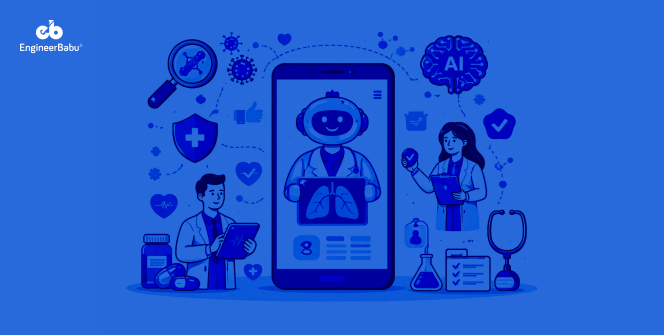
AI in Medical Diagnosis Apps is quickly becoming a core part of how modern healthcare delivers faster and more accurate clinical decisions. Instead of relying only on manual interpretation, doctors and care teams now use AI-driven apps to analyze symptoms, medical images, and patient history in real time.
This shift is helping healthcare systems handle rising patient volumes while improving diagnostic consistency.
The impact is already measurable. According to a National Institute of Health (NIH), AI models have matched or exceeded physician-level accuracy in several diagnostic tasks.
Separately, McKinsey reports that AI could create up to $100 billion annually in value across the healthcare sector, with diagnostics being one of the highest-impact areas.
As healthcare moves toward data-driven decision making, AI in medical diagnosis apps are no longer experimental tools. They are becoming essential infrastructure for scalable, accessible, and outcome-focused care.
AI-powered medical diagnosis apps use artificial intelligence to help identify diseases, assess health risks, and support clinical decision-making using patient data. AI in Medical Diagnosis Apps goes beyond basic symptom checking by analyzing inputs such as:
These apps are widely used by hospitals, diagnostic labs, doctors, and healthtech platforms to improve accuracy and enable early detection. Instead of relying on fixed rules, AI models learn from large healthcare datasets and continuously refine their predictions as new data is introduced.
A key difference lies in adaptability. Traditional symptom checker tools offer static, generic outputs. In comparison, AI-based medical diagnosis solutions apply machine learning and deep learning to detect patterns that may not be immediately visible to clinicians.
AI in Medical Diagnosis Apps offers a range of features that make healthcare faster, smarter, and more precise. Here’s a closer look at the key features that define AI-driven diagnosis solutions:
AI in Medical Diagnosis Apps can quickly analyze patient symptoms and suggest possible conditions. Using advanced algorithms, these apps prioritize cases based on urgency, helping clinicians focus on critical patients first and improving overall workflow efficiency.
AI in Medical Diagnosis Apps can also examine X-rays, MRIs, CT scans, and other imaging data with high accuracy. Deep learning models detect subtle anomalies that might be missed by human eyes, supporting faster and more precise diagnostics.
AI-powered diagnosis tools use historical and real-time data to predict potential health risks. AI in Medical Diagnosis Apps can identify patients at high risk for chronic diseases or complications, enabling early intervention and personalized care plans.
AI for clinical diagnosis provides actionable insights to clinicians, assisting with treatment decisions, medication suggestions, and follow-up strategies. This support reduces diagnostic errors and enhances patient outcomes.
Seamless integration allows AI in Medical Diagnosis Apps to pull and push data from electronic health records. This ensures that patient history, lab results, and treatment records are readily available for accurate and efficient decision-making.
AI in Medical Diagnosis apps are actively shaping how healthcare is delivered across multiple domains. From imaging to preventive care, these apps empower clinicians and patients alike with actionable insights. Here are the top use cases where AI-driven diagnosis is making a real difference:
AI in Radiology can analyze X-rays, MRIs, and CT scans to detect anomalies with high precision. These apps assist radiologists by highlighting potential issues, reducing interpretation time, and improving diagnostic accuracy.
AI in Modern lab diagnostics apps evaluates lab results and pathology reports, spotting patterns and irregularities that might be overlooked. This accelerates disease detection and supports faster clinical decision-making.
Patients with diabetes, heart disease, or other chronic conditions benefit from AI in Medical Diagnosis apps that track health trends over time. The apps alert both patients and doctors to early warning signs, enabling timely interventions.
AI is also useful in mental health and it can analyze speech patterns, mood inputs, and behavioral data to detect mental health conditions early. These insights support psychologists and psychiatrists in monitoring treatment progress and predicting risks.
AI in Medical Diagnosis apps also identifies potential health risks before they become serious. By combining lifestyle, genetic, and clinical data, these apps provide personalized recommendations for preventive care and healthy living.
While AI in Medical Diagnosis apps is transforming healthcare, several challenges remain. These hurdles must be addressed for the technology to achieve its full potential and maintain trust among clinicians and patients.
Creating AI-powered medical diagnosis apps is not just about coding an algorithm, it requires a careful blend of technical expertise, healthcare knowledge, and regulatory awareness. These apps must deliver accurate insights while maintaining patient safety, privacy, and clinical reliability.
Developing AI in Medical Diagnosis apps demands proficiency in machine learning development, deep learning, and data analytics. Expertise in medical imaging, natural language processing for clinical notes, and predictive modeling is also essential.
On the domain side, understanding medical workflows, disease patterns, and patient care protocols ensures that the AI outputs are clinically relevant and actionable.
Regulatory compliance is a cornerstone of any healthcare app. AI in Medical Diagnosis Apps must adhere to standards such as HIPAA compliance process, GDPR, or local medical device regulations.
Beyond compliance, clinical validation through rigorous testing, peer review, and pilot studies is critical to ensure the app’s recommendations are reliable and safe for patients.
Partnering with experienced AI development teams can significantly reduce risks and accelerate time-to-market. Top companies like EngineerBabu combine deep technical expertise with healthcare domain knowledge, helping startups and enterprises build scalable, compliant, and effective AI diagnosis solutions.
From initial prototyping to full-scale deployment, a skilled partner ensures that your app not only works but truly improves patient outcomes.
Building AI in Medical Diagnosis apps is a multidisciplinary challenge, but with the right expertise, regulatory diligence, and development partner, it becomes a transformative tool
AI in Medical Diagnosis Apps is reshaping the way healthcare is delivered, making diagnosis faster, more accurate, and accessible to patients everywhere. From symptom analysis to predictive risk assessment, these apps empower clinicians and patients with actionable insights.
However, developing such apps requires not just AI expertise but also clinical understanding, regulatory compliance, and validated workflows. Partnering with an experienced development team ensures that your solution is both effective and trustworthy.
EngineerBabu’s healthcare software development services specialize in building AI-powered medical apps that combine technical innovation with healthcare domain knowledge.
AI in Medical Diagnosis Apps uses machine learning and data analytics to support doctors in detecting diseases, assessing risks, and making informed clinical decisions.
Yes, when properly validated and compliant with healthcare regulations, AI in Medical Diagnosis Apps enhances accuracy while maintaining patient safety and privacy.
No. AI in Medical Diagnosis Apps is designed to assist, not replace, clinicians. It provides insights to improve diagnostic accuracy and efficiency.
Faster diagnosis, improved accuracy, predictive risk assessment, and better patient outcomes are the key advantages of AI in Medical Diagnosis Apps.
Partnering with experienced teams like EngineerBabu, using their health app development services, ensures your app is AI-powered, compliant, and clinically reliable.